Roman Vatican
castle
AD 37
Caligula Marks the Hill
Caligula began building a circus in the gardens of Agrippina on the right bank of the Tiber, in a district Romans called the ager Vaticanus. The place still lay outside Rome's old core, more roadside necropolis than sacred center, with damp ground underfoot and burial plots lining the approaches.
church
AD 64
Peter's Martyrdom Takes Root
According to Christian tradition, Peter was executed here during Nero's persecution after the Great Fire of Rome. His grave turned a marginal patch of earth into a destination for prayer, and that single tomb would end up ordering every wall, altar, and dome built above it.
Christian Rome
church
c. 324
Constantine Builds Over the Dead
After Christianity gained legal status, Constantine ordered the first St. Peter's Basilica raised directly above Peter's shrine. Engineers had to cut into the slope, bury part of the necropolis, and force level ground where none existed. You can still feel the audacity of it: a cemetery turned into one of Latin Christendom's great pilgrimage magnets.
gavel
756
The Papal States Begin
Pippin's grant gave the pope territorial power, and the bishop of Rome became a ruler with land, revenue, and soldiers as well as relics. That matters here because Vatican sovereignty did not appear from nowhere in 1929; its roots reach back to this bargain between altar and crown.
Leonine and Medieval Vatican
swords
846
Raiders Sack St. Peter's
Muslim raiders struck the undefended district around St. Peter's and carried off treasure from the basilica precinct. The attack exposed a hard truth: holiness without walls is just loot waiting for a boat.
castle
c. 848
Leo IV Raises the Leonine Walls
Pope Leo IV answered the raid by fortifying the Vatican quarter, creating the Leonine City around St. Peter's. Stone changed everything. The shrine was no longer an exposed suburb but a defended enclave with a political future.
gavel
1309
The Papacy Leaves for Avignon
When the papal court moved to Avignon, the Vatican hill lost its daily pulse of power and slipped into neglect. Pilgrims still came, but the district itself sagged. Empty ceremonial rooms have a smell of dust and damp cloth; the medieval Vatican knew that smell for decades.
church
1377
Rome Gets the Popes Back
Gregory XI returned the papacy to Rome, ending the Avignon exile. The comeback was real, though hardly elegant: the Vatican needed repair, money, and a new sense of purpose after more than a century of drift.
Renaissance Vatican
person
1447
Nicholas V Imagines a Renaissance Court
Nicholas V treated the Vatican as a project rather than an inheritance. He backed rebuilding at St. Peter's, expanded the papal library, and pushed the hill toward its new role as a humanist capital where manuscripts mattered almost as much as relics.
church
1477
Sixtus IV Rebuilds the Sistine
Sixtus IV began rebuilding the old Cappella Magna into what became the Sistine Chapel, a severe rectangular box that later generations would cover in genius. By its consecration in 1483, the chapel had become a ceremonial engine for the papal court, built for liturgy, politics, and carefully staged awe.
person
1506
Julius II Starts a New Vatican
In one startling year, Julius II founded the Swiss Guard, laid the first stone of the new St. Peter's on 18 April, and began shaping the sculpture collection that grew into the Vatican Museums. Few rulers have ever hammered their will into masonry so directly. The old basilica was no longer enough for him.
person
1508
Michelangelo Climbs the Scaffold
Michelangelo began painting the Sistine ceiling in 1508, working above a chapel that smelled of wax, damp lime plaster, and human impatience. Four years later he had turned overhead space into drama: prophets, sibyls, and Genesis scenes stretched across the vault like a theological argument delivered in muscle.
swords
1527
The Sack Breaks Rome
Imperial troops stormed Rome on 6 May 1527, and 147 Swiss Guards died defending Clement VII as he fled toward Castel Sant'Angelo. The shock reached every corridor of the Vatican. One artistic age ended in blood, smoke, and smashed confidence.
Baroque and Papal Court
science
1582
A Calendar Leaves the Tower
Gregorian reform, prepared with astronomical work linked to the Tower of the Winds, gave the Catholic world a new calendar under Gregory XIII. This is one of the Vatican's quieter talents: behind the incense and marble, clerics and mathematicians were arguing about the length of the year.
church
1626
New St. Peter's Is Consecrated
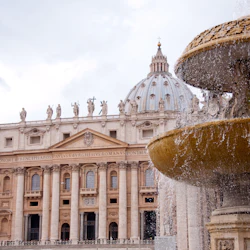
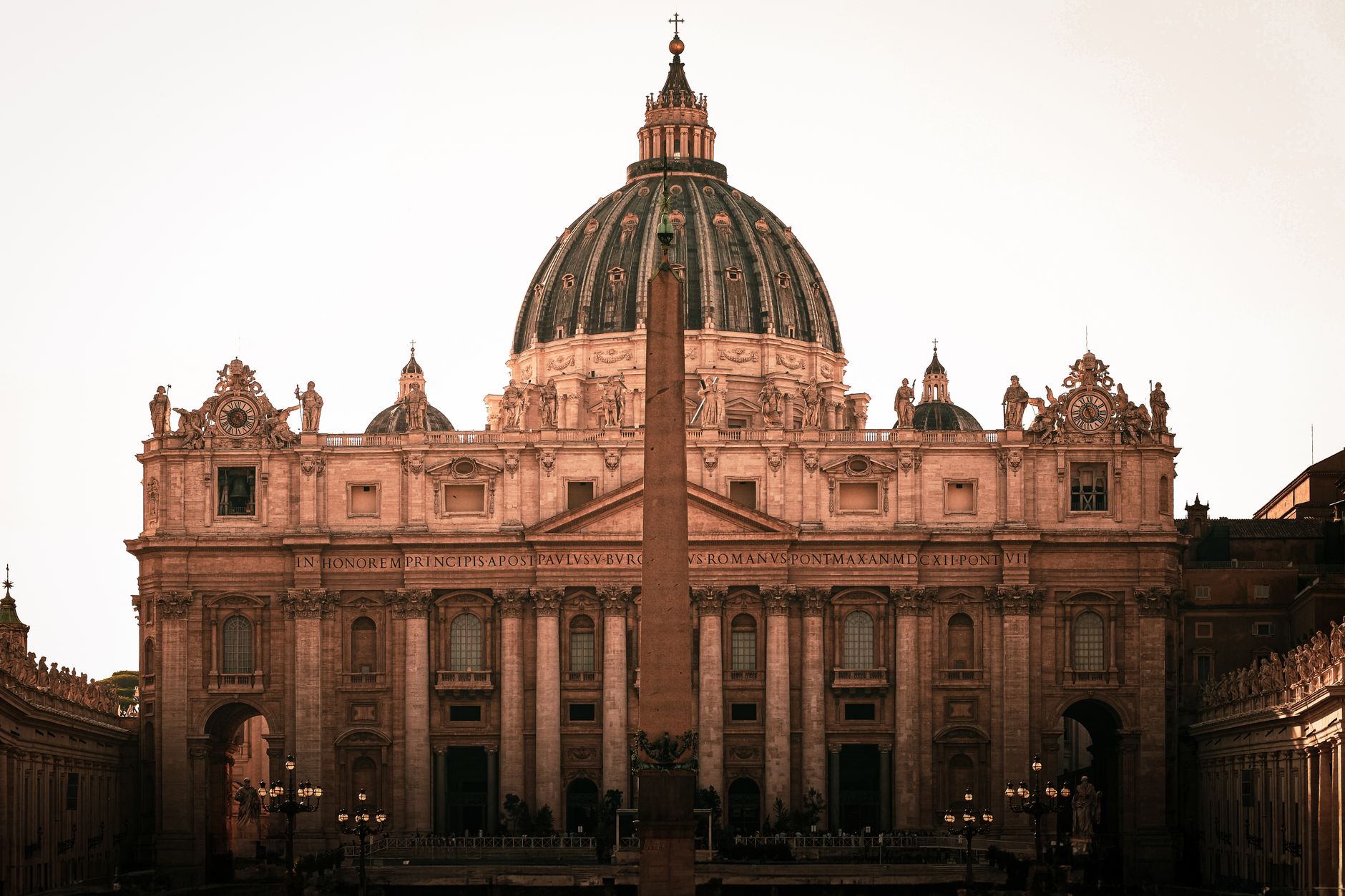
After more than a century of design changes, rival egos, and colossal expense, the new St. Peter's Basilica was solemnly dedicated on 18 November 1626. Bramante, Michelangelo, Maderno, and Bernini all left fingerprints on it. The result covers about 2.3 hectares, less a church than a stone empire gathered under one dome.
person
1656
Bernini Embraces the Square
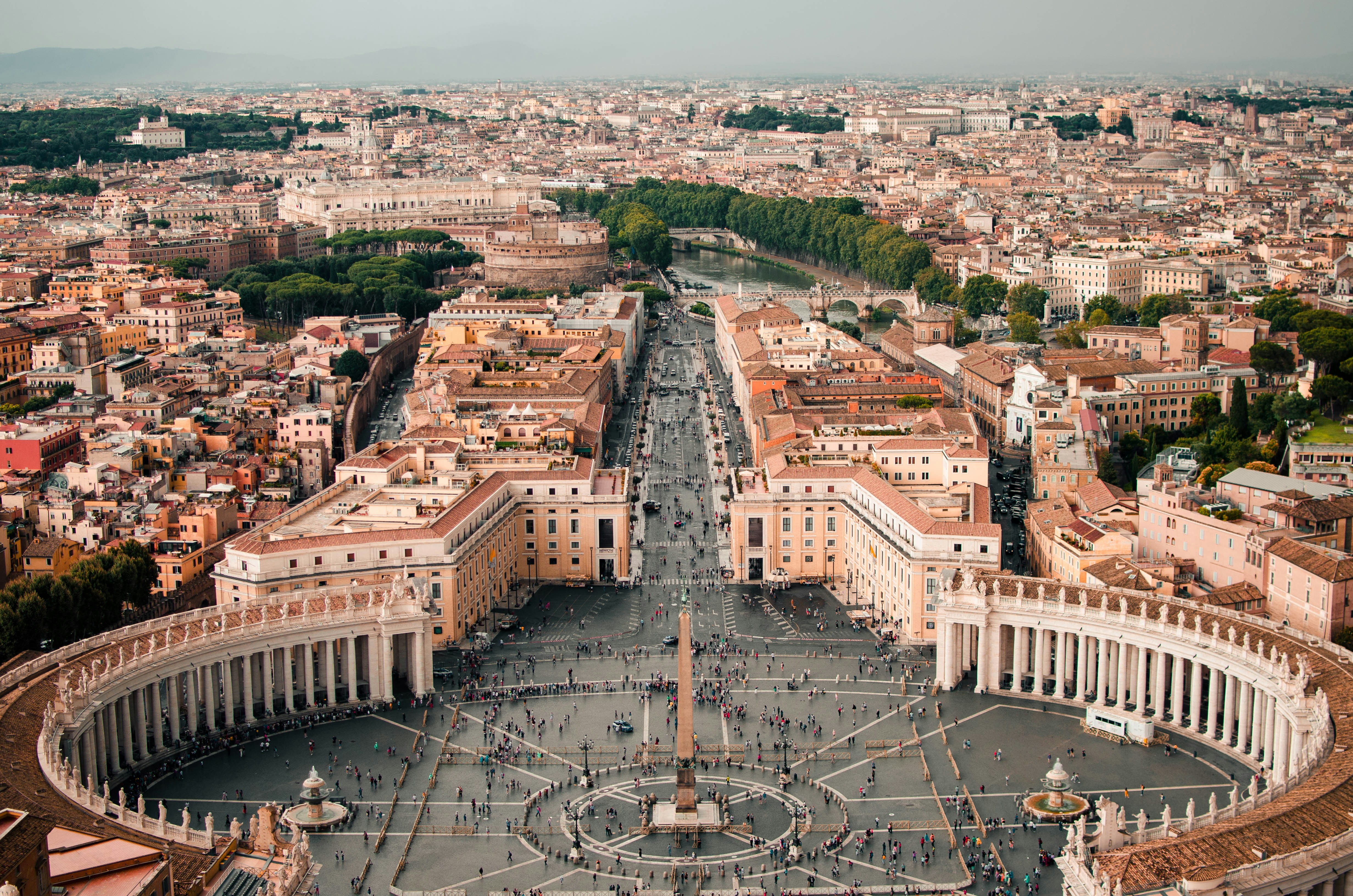
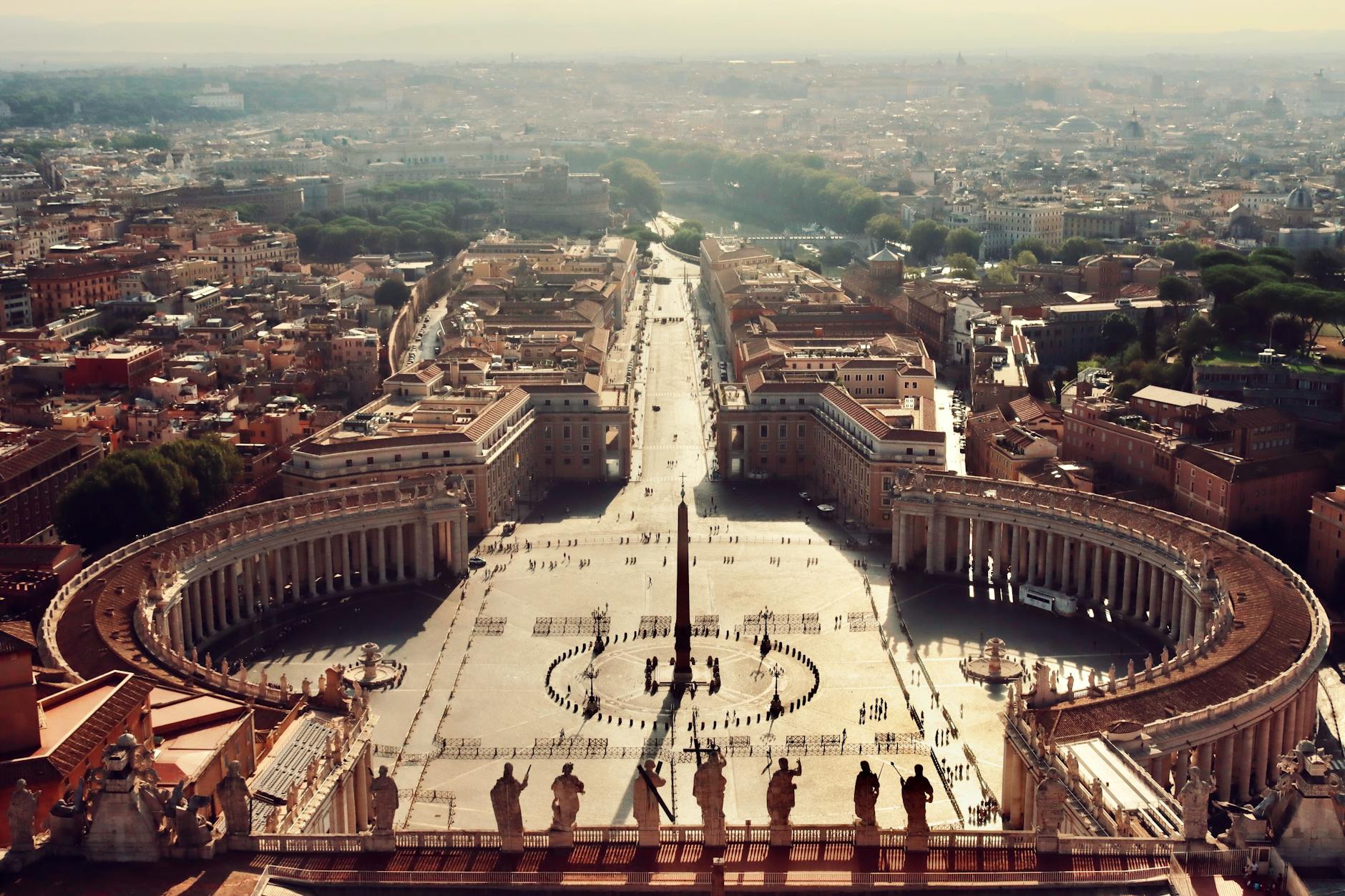
Bernini began shaping St. Peter's Square and its colonnades in 1656, building an oval forecourt of 284 columns and 88 pilasters around the basilica. He liked to describe the arms of the Church embracing the faithful. Stand there when the bells start and the metaphor feels less rhetorical than he probably intended.
Revolution and Roman Question
palette
1797
Napoleon Strips the Collections
The Treaty of Tolentino forced the papal government to surrender works of art to France, and then occupation turned political humiliation into physical removal. Crates left for Paris; galleries were thinned; the Vatican learned how modern states steal with paperwork first and soldiers second.
gavel
1870
The Popes Become Prisoners
Italian troops entered Rome on 20 September 1870, ending the Papal States after more than a millennium. From then until 1929, popes described themselves as prisoners in the Vatican, sovereign in claim yet hemmed in by a new Italian capital pressing up outside the walls.
Vatican City State
gavel
1929
A State the Size of a Palace
The Lateran Treaty, signed on 11 February and in force from 7 June, created Vatican City State as a sovereign territory of 44 hectares. Tiny, yes. But the point was never size; it was independence, visible and legal, for the pope in the middle of Rome.
person
1931
Marconi Gives the Vatican a Voice
Vatican Radio was inaugurated on 12 February 1931 with Guglielmo Marconi's help, sending papal words beyond the Leonine walls without a horse, courier, or diplomatic pouch. The city of frescoes and files had entered the age of signal and static.
local_fire_department
1943
Bombs Fall on Neutral Ground
On 5 November 1943, bombs struck Vatican City despite its wartime neutrality, damaging parts of the gardens and nearby buildings. No one was killed. Even so, the attack tore a brief, ugly hole in the idea that these walls could keep modern war at a polite distance.
public
1962
The Council Opens the Windows
The Second Vatican Council began in 1962 and brought bishops from across the globe into the Vatican's ceremonial heart. Latin gave way to many voices, and the old courtly center had to listen. Few gatherings inside these walls have altered Catholic life more deeply.
public
1984
UNESCO Seals the Legacy
UNESCO inscribed Vatican City on the World Heritage List in 1984, recognizing not one monument but an entire state built as a dense archive of faith, art, and power. The designation confirmed what the stones already argue: this place is a historical document you can walk through.
gavel
2023
The State Rewrites Its Rules
A new Fundamental Law issued by Pope Francis entered into force on 7 June 2023, updating how Vatican City State is governed. Even the smallest sovereign state needs fresh wiring from time to time. Behind the frescoes, the bureaucracy keeps moving.
person
2025
Francis Dies at Santa Marta
Pope Francis died in the Vatican on 21 April 2025 at 7:35 a.m., in Casa Santa Marta rather than the grander papal apartments. That detail suits his papacy: less velvet, more guesthouse corridor. The mourning turned the city inward, and every familiar window suddenly looked historical.
church
2025
Leo XIV Takes the Chair
On 8 May 2025, the conclave elected Pope Leo XIV, giving Vatican City a new sovereign and the Catholic Church a new voice from the same old balcony over St. Peter's Square. White smoke still works. Five centuries of painted walls, ritual silence, and watched chimneys remain a very effective electoral machine.