mosque
Silk Road Cities
Samarkand, Bukhara, and Khiva hold one of the strongest urban heritage routes anywhere in Asia. You move from Timurid spectacle to trading domes to intact city walls without losing the historical thread.
Uzbekistan is where Silk Road history stops feeling like a slogan and turns back into streets, brick, trade, and empire. Few countries give you this much architectural weight with such little friction between one great city and the next.
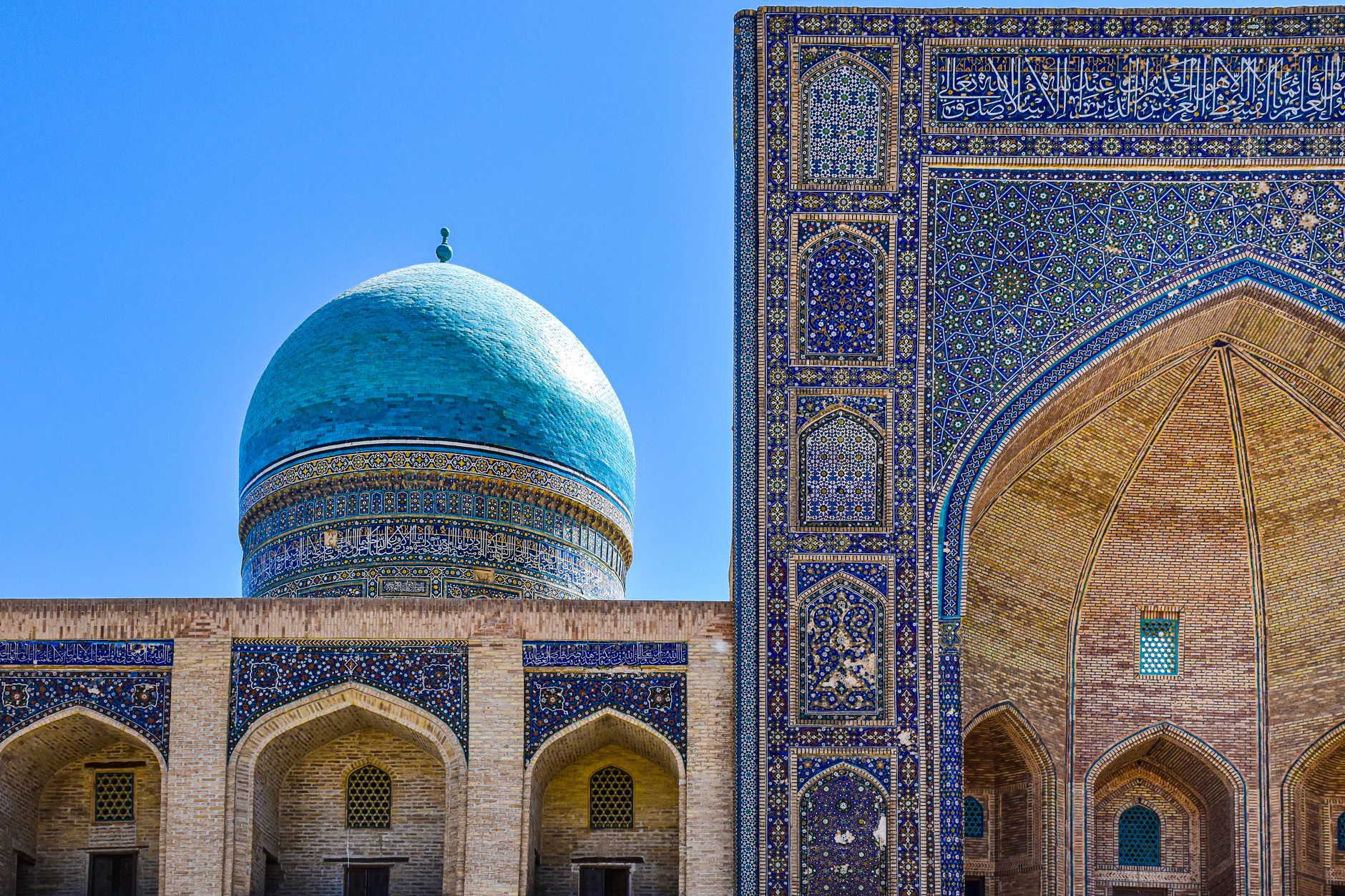 Uzbekistan
Entry30-day visa-free for many passports, including EU, UK, Canada, Australia, and US citizens
UUzbekistan travel guide starts with a surprise: some of the world's grandest Islamic architecture stands in cities many travelers still skip.
Uzbekistan rewards travelers who care about history, but it doesn't feel embalmed. In Samarkand, three madrassas face each other across the Registan with the kind of confidence states usually reserve for capitals; in Bukhara, 10th-century brickwork survives because a mausoleum spent centuries buried in sand. Then Khiva compresses a whole walled city into mud-brick lanes and turquoise domes you can cross on foot before lunch. The scale changes from stop to stop, yet the through-line stays clear: this was not a remote edge of anywhere. It was the middle of the route between China, Persia, and the Mediterranean.
The country also works better on the ground than many first-time visitors expect. Fast Afrosiyob trains make the classic Tashkent, Samarkand, and Bukhara route easy, while Khiva, Termez, Moynaq, and Nurata pull the story in stranger directions: Buddhist ruins near the Afghan border, a ship graveyard in the former Aral Sea, desert forts, market towns, and old pilgrimage sites. In the Fergana Valley, Margilan and Kokand still make the Silk Road feel like a commercial system rather than a museum label. You see it in atlas silk, bread stamped for the tandoor, and bazaars where trade still runs on tea, trust, and exact prices.
Sogdian and Hellenistic Uzbekistan, c. 600 BCE-300 BCE
A painted wall in Afrasiab, the ancient heart of Samarkand, still sets the scene better than any chronicle. On it, ambassadors from China, Korea, and lands farther west file into one court in bright robes, bearing gifts for a Sogdian ruler who sat at the center of routes rather than the center of an empire. Ce que l'on ignore souvent, c'est que the first masters of this land were not conquerors in the usual sense. They were brokers, interpreters, and merchants who made themselves necessary to everyone else.
The Sogdians built their fortune on movement. From Samarkand to Bukhara, from oasis to oasis, they carried silk, musk, silver, paper, and news. They also carried religions with the same ease. Zoroastrian rites, Buddhist images, Nestorian Christianity, and local cults lived side by side in a way that later centuries would find almost indecently tolerant.
Then came Alexander in 329 BCE, young, brilliant, and already dangerous to those who loved him. He took Marakanda, as the Greeks called Samarkand, and somewhere in this Central Asian campaign he met Roxane, the daughter of a local nobleman. Ancient writers insist it was love at first sight. One can almost see the political advisors blanching. A Macedonian king was expected to marry for strategy, not for a woman from the eastern edge of his new world.
The romance did not end like a fairy tale. Roxane became queen, then widow, then a pawn in the dynastic butchery that followed Alexander's death. She and her young son were murdered around 310 BCE. That, too, is part of Uzbekistan's early history: courts where tenderness and calculation sat at the same table, and where a marriage in a mountain fortress could alter the future of Asia.
Roxane survives in legend as a beauty, but the harder truth is that she spent her short life negotiating the ambitions of men who kept conquering long after the wedding feast ended.
One of the oldest surviving private letters from the wider region is a Sogdian complaint about debt, betrayal, and relatives who never wrote back; the Silk Road could sound remarkably modern.
The Persianate Islamic Golden Age, 819-999
Imagine Bukhara on a winter evening under the Samanids: mud-brick walls holding the cold at bay, lamps burning low, scholars bent over manuscripts while outside the alleys smell of wool, horses, and bread from the tandoor. This was not a provincial court. It was one of the great capitals of the 9th and 10th centuries, a place where power expressed itself not only through armies, but through paper, ink, and argument.
Ismail Samani gave the dynasty its dignity and, in a sense, its conscience. His mausoleum in Bukhara still stands, modest in scale and dazzling in effect, each baked brick set with such precision that the walls seem woven rather than built. Ce que l'on ignore souvent, c'est que this small cube survived because it was buried for centuries under silt and neglect. Oblivion saved it better than admiration might have done.
The city's library became the stuff of intellectual legend. The young Ibn Sina, whom Europe later called Avicenna, entered those rooms as a prodigy and emerged with a mind capable of swallowing Aristotle, medicine, logic, and metaphysics in one breath. He treated a ruler before he was fully a man. He also drank, argued, fled, and wrote at a pace that suggests either genius or a complete refusal to sleep.
And Bukhara was not alone. In Khwarezm, on the edge of today's Uzbekistan, Al-Biruni measured the earth with an elegance that still startles mathematicians. While western Europe was struggling to preserve fragments, this region was comparing texts, correcting observations, and asking better questions. The consequence was immense. Uzbekistan's oasis cities became not just stops on the Silk Road, but workshops where the medieval world learned how to think.
Ibn Sina was no marble sage in a textbook; he was a restless physician who cured princes, wrote in bursts, and left behind the feeling of a man forever racing his own intellect.
The Ismail Samani Mausoleum was once so deeply buried that locals forgot what it was, which is why one of Central Asia's masterpieces escaped the usual cycle of pious renovation and clumsy repair.
Mongol Ruin and Timurid Splendor, 1218-1507
The catastrophe began, absurdly enough, with a commercial dispute. In 1218, merchants sent by Genghis Khan were seized at Otrar, accused of espionage, and killed with the approval of the Khwarezm Shah. An envoy was then humiliated. The reply was apocalyptic. By 1220, Samarkand had fallen, and the polished world of Transoxiana learned what happens when imperial vanity meets Mongol memory.
Cities burned, populations were scattered, irrigation works failed, and whole learned traditions went dark. One should never romanticize this. The chronicles are full of numbers that may be exaggerated, but the silence that followed was real. Bukhara, Samarkand, and the towns around them ceased to be what they had been. A civilization can die noisily. It can also die by emptying its libraries and workshops.
Then, in 1336, near Shahrisabz, a child was born into the Barlas clan: Timur, whom Europe would call Tamerlane. He was lame, ambitious, theatrical, and pitiless. He loved genealogies almost as much as conquest and understood perfectly that magnificence is a political instrument. When he made Samarkand his capital, he treated the city like a jeweler treats a crown. He deported artisans from conquered lands, built mosques, gardens, madrassas, and tombs, and wrapped power in turquoise tiles so dazzling that defeat itself seemed almost decorative.
But one must look beyond the domes. Timur's empire rested on forced movement, fear, and endless campaigning. His wife Saray Mulk Khanum lent the court its Chinggisid legitimacy. His descendants, especially Ulugh Beg, gave the dynasty its intellectual afterlife. In Samarkand, Ulugh Beg built an observatory and measured the stars with a precision Europe would not surpass for generations. That is the Timurid paradox in one glance: a warlord's grandson staring calmly into the heavens while the memory of conquest still smoked beneath the foundations.
Timur wanted posterity to see him as a lawgiver and heir to world empire, yet the man behind the legend was obsessed with ceremony, bloodline, and the stagecraft of fear.
Ulugh Beg's star catalogue listed more than a thousand stars with such accuracy that later astronomers were forced to admit the prince had done science at a level many kings could barely spell.
Khanates, Courts, and the Long Russian Advance, 1507-1924
After the Timurids, power fractured into the khanates of Bukhara, Khiva, and Kokand. Each court had its own etiquette, its own rivalries, its own small humiliations performed in embroidered robes. In Khiva, caravans arrived through desert light and slave markets exposed the harsh truth beneath the elegance. In Bukhara, emirs cultivated piety and suspicion in equal measure. In Kokand, in the Fergana Valley, the palace world glittered while factions sharpened their knives behind carved doors.
One of the most moving figures of this age is a woman: Nodira, poet, patron, and queen of Kokand. She wrote verses under a pen name, sponsored madrasas and gardens, and understood that culture is also a form of rule. Then politics turned. In 1842, after the fall of Kokand to the Emir of Bukhara, Nodira was executed. Courts often preserve poems better than they preserve the women who wrote them.
The Russians arrived first as traders, then as mapmakers, then as masters. Tashkent fell in 1865 after a determined campaign led by General Cherniaev. Samarkand was taken in 1868. Khiva submitted in 1873. Kokand disappeared into the Russian Empire in 1876. Ce que l'on ignore souvent, c'est que conquest did not erase local elites overnight; it rearranged them, pensioned some, exiled others, and taught a new generation to survive between imperial offices and old loyalties.
By the early 20th century, reformers known as the Jadids tried to remake society through schools, print, and language rather than sabers. They sensed the old order was finished. They were right. The tragedy is that many would later be destroyed by the Soviet system that first seemed to offer them a stage.
Nodira of Kokand was not simply a royal consort; she was a cultured political actor who turned poetry into prestige and paid for dynastic collapse with her life.
When Russian officers first described Central Asian courts, they wrote as if they had entered an operetta, yet their reports often missed the fact that women like Nodira were shaping policy through patronage, family alliances, and literary salons.
Soviet Rule, the Aral Disaster, and Independence, 1924-present
The Soviet period began with borders drawn not by old loyalties, but by committees, census logic, and political convenience. In 1924, the Uzbek Soviet Socialist Republic took shape. Tashkent grew into a grand Soviet capital of avenues, ministries, and apartment blocks, then had to reinvent itself after the earthquake of 1966. A city can be rebuilt in concrete. Memory is slower.
Moscow demanded cotton, and Uzbekistan delivered at a terrible price. Rivers that had fed the Aral basin for centuries were diverted to irrigate monoculture on a colossal scale. The figures are dry; the result is not. Moynaq, once a fishing port, found itself stranded far from the retreating sea, its rusting boats left on sand salted with pesticides and dust. This is one of the great environmental tragedies of the 20th century, and it happened not in abstraction, but in households where livelihoods vanished within a generation.
Soviet rule also produced its own social contract: education, industry, ballet, engineering, and a secular public life built alongside censorship, surveillance, and periodic purges. Many Jadid intellectuals who had dreamed of reform were shot or silenced in the 1930s. The state taught millions to read while deciding, with chilling calm, what they should be allowed to read.
Independence came in 1991, not with a storming of palaces, but through the collapse of the Soviet center. Since 2016, under Shavkat Mirziyoyev, Uzbekistan has opened more visibly to the world, eased visas, restored some regional ties, and encouraged a fresh look at places like Samarkand, Bukhara, Khiva, Termez, and Margilan. Yet the modern story is not only one of reopened hotels and faster trains. It is also about what kind of nation emerges after empire, planned economy, environmental loss, and the long habit of caution. That question still hangs in the air.
Islam Karimov shaped the first quarter-century of independence with the instincts of a Soviet manager and the anxieties of a ruler determined that disorder would never threaten his state.
Moynaq's ship graveyard exists because the sea retreated faster than the town could move, leaving trawlers beached in what had once been open water and turning memory itself into a landscape.
Uzbek does not rush toward its object. It circles, offers a cushion, asks after your mother, then arrives at the request as if the request had only just occurred to it. In Tashkent, you hear Uzbek and Russian braided in the same breath, vowels changing shoes mid-step, and the effect is less confusion than abundance.
A language reveals its ethics in the way it handles refusal. Here, the blunt no has bad manners. Silence does part of the work. So does a soft promise, a sidelong future tense, a smile that means the universe has understood your wish and declined it on everyone's behalf.
Then come the honorifics, those tiny crowns placed on ordinary speech. Aka, opa, bobo, buvi. You do not merely address a person; you place them in a moral geometry. A country is a table set for strangers, and Uzbek begins laying that table before the samovar even breathes.
Uzbek cuisine has no interest in restraint. It believes in rice, fat, flame, patience, carrots cut into long gold strips, and the grave authority of a black kazan large enough to suggest military ambitions. Plov is not a dish in the solitary sense. It is a gathering with ingredients.
In Bukhara, the rice carries history like a spice. In Samarkand, the grains often keep their posture, separate yet loyal, with lamb, chickpeas, garlic heads, and the yellow carrots that matter so much here they feel theological. Someone will pour tea before the first bite. Someone else will insist you eat more, which is not advice but a civic principle.
Bread changes the mood of a room. Non is torn, never insulted with a knife, and treated with a degree of respect many nations reserve for flags. Then the smoke of shashlik arrives, and with it the onion, vinegar-sharp, and the entire philosophy becomes clear: appetite is not greed. Appetite is gratitude with better timing.
Uzbekistan trusts poets with a seriousness other countries reserve for bankers. Alisher Navoi is not a decorative ancestor in a textbook; he is a founding force, a man who wrote in Chagatai Turkic when Persian held the prestige, which is to say he committed the elegant crime of proving his own language capable of splendor. In Tashkent, his name appears on institutions with the calm inevitability of weather.
This matters because literature here has long been an argument about dignity. Who gets to speak beautifully. Who gets remembered in their own tongue. The answer, repeated across centuries from Herat to Kokand, is that language is not merely a tool of expression. It is rank, memory, permission.
And then there is the older Silk Road habit of borrowing everything except inferiority. Persian metaphors, Turkic cadence, Arabic scholarship, Russian syntax drifting through the twentieth century like cigarette smoke in a corridor. Uzbek literature learned early that purity is a dull ambition. Mixture has better sentences.
The guest in Uzbekistan occupies a dangerous position: adored, watched, fed, and morally expensive. Mehmon does not mean a person who has arrived. It means a person whose comfort now measures the honor of the host. You will be urged toward the best seat, the deepest bowl, the last apricot, and resistance will be interpreted as charming but unserious.
Respect moves through the room by choreography. Younger people rise when elders enter. Tea is poured, often not full, because a half-filled cup invites return and attention. Shoes matter. Bread matters. How you receive what is offered matters more than the object itself.
This can feel ceremonial until you notice the tenderness beneath the protocol. The codes are strict because care here prefers form. A slapdash kindness is no kindness at all. In many places, good manners conceal indifference. In Uzbekistan, they often conceal feeling too large for direct display.
The first lesson of Uzbek architecture is that geometry can produce ecstasy. In Samarkand, the Registan does not persuade by ornament alone, though the ornament would be enough for lesser civilizations. It persuades by scale, by proportion, by the insolent calm of three madrassahs facing a square as if symmetry were a political doctrine.
Then Bukhara changes the conversation. Brick replaces glaze as the chief seducer. The Ismail Samani Mausoleum performs miracles with fired clay and shadow, proving that a cube can contain more mystery than many cathedrals. Khiva, enclosed within the walls of Itchan Kala, feels like a city distilled to its verbs: enclose, rise, call, watch.
What these places understand is that decoration is not decoration. It is theology, mathematics, climate control, vanity, empire, and seduction working the same shift. A turquoise dome against desert light is never only pretty. It is a rebuttal to dust.
Uzbek art rarely begins in a frame. It begins in thread, glaze, wood, hammered copper, a loom that sounds like patient percussion. In Margilan, silk still carries the old authority of labor that cannot be hurried, and ikat refuses the neat obedience of printed pattern: the blur at the edge of each motif is the record of dye moving through tied threads, accident promoted to style.
Suzani embroidery makes domestic life look imperial. A dowry cloth can contain suns, pomegranates, vines, knives of red, impossible flowers, all stitched with the confidence of women who knew walls remember nothing and fabric remembers everything. In workshops from Bukhara to Shahrisabz, ornament behaves less like embellishment than possession.
Ceramics do something similar. Rishtan blue is not the same blue as Samarkand tile, and your eye learns this with surprising speed. One blue cools the pulse. The other commands it. Art here does not ask whether beauty is useful. It assumes beauty is one of the oldest tools ever made.
Samarkand, Bukhara, and Khiva hold one of the strongest urban heritage routes anywhere in Asia. You move from Timurid spectacle to trading domes to intact city walls without losing the historical thread.
Afrosiyob trains link Tashkent, Samarkand, and Bukhara in hours, not days. That turns a history-heavy trip into something remarkably practical for first-time visitors.
Uzbek cuisine is generous, blunt, and deeply social. Expect shared platters of plov, tandoor-baked samsa, hand-pulled noodles, and tea houses where lingering is part of the meal.
In Margilan and across the Fergana Valley, silk weaving, embroidery, ceramics, and market craft are still part of daily economic life. These aren't demonstration pieces made only for tourists.
Termez, Nurata, and Moynaq show a different Uzbekistan: Buddhist archaeology, desert fortresses, Soviet environmental ruin, and places that unsettle the neat Silk Road narrative.
Uzbekistan delivers major architecture, strong food, and efficient transport at costs that remain moderate by European standards. For many travelers, that means more time on the ground and fewer compromises.
12 cities — start with the ones we'd send you to first.
The Registan's three madrasas frame a square so geometrically audacious that when Tamerlane's architects finished it in the 15th century, the rest of the Islamic world simply stopped trying to compete.
A city where 140 protected monuments are not museum pieces but working fabric — the Kalon minaret has stood since 1127, and the teahouse in its shadow has been serving green tea, more or less continuously, ever since.
Itchan Kala is the only Central Asian walled city that survives almost entirely intact, a 50-monument labyrinth of turquoise tiles and carved wooden columns where the 18th century simply forgot to leave.
Central Asia's largest city wears its Soviet-era metro stations — marble halls with chandeliers, mosaics of cotton workers and cosmonauts — like a secret art museum buried 30 metres underground.
Tamerlane was born here in 1336, and he thanked the city by building Ak-Saray palace, whose ruined entrance portal was once so tall that Samarkand's Registan would have fit inside the doorway.
The valley's de facto capital sits at the centre of Uzbekistan's most densely populated and politically charged region, where silk workshops still stretch threads by hand across wooden frames and the bazaar sells Atlas s
The Yodgorlik Silk Factory is one of the last places on earth where raw cocoons are boiled, reeled, and woven into ikat fabric in a single building, all by workers who learned the process from their grandmothers.
The 19th-century Khudoyar Khan palace — 113 rooms, seven courtyards, tilework in seven colours — was the last great monument built by an Uzbek khanate before the Russian Empire arrived and decided the question of who was
Uzbekistan's southernmost city sits on the Amu Darya facing Afghanistan, and its archaeological museum holds Buddhist relics, Hellenistic coins, and Zoroastrian ossuaries within a single room — the physical residue of ev
Tashkent is not the country's prettiest city, which is part of the point. It is where Soviet planning, new-money glass, old mahalla neighborhoods, and one of Central Asia's strongest transport hubs all rub against each other. Give it time and it stops feeling like a transit stop and starts reading as the place that explains modern Uzbekistan to the rest of the trip.
Samarkand carries the grand imperial version of the country: ruler's mausoleums, tiled facades scaled for astonishment, and a name that arrived in many languages before most Europeans knew where it sat on a map. Nearby Shakhrisabz sharpens that story by bringing it back to Timur's birthplace, where ambition looks less polished and more personal.
Bukhara feels tighter, older, and more inward than Samarkand. The scale is human, the lanes still hold shade, and the city's power comes from how much of its trading and religious fabric survived in place. Beyond it, Nurata and the Kyzylkum edge show the hard geography that always sat behind Silk Road wealth.
Khiva is the country at its most theatrical, though the setting is grounded in hard desert fact. Inside Itchan Kala, minarets and courtyards compress centuries into a small walled grid; farther north, Moynaq strips romance away and replaces it with one of the starkest environmental stories in the region.
The Fergana Valley is where craft, agriculture, and daily life come to the front. Margilan still matters for silk, Kokand keeps the memory of a khanate that once balanced larger powers, and Fergana works better as a lived-in base than as a monument collection. This region rewards travelers who like markets, workshops, and the mechanics of ordinary life.
Termez sits far from the classic tourist loop and that distance is exactly why it matters. Buddhism, Islam, frontier trade, and military geography all left marks here, and the city's closeness to Afghanistan gives the place a seriousness you do not get in the polished Silk Road circuit. If the north is about domes, the south is about layers.
Uzbekistan's history is a sequence of oasis courts, imperial shocks, and reinventions written in brick, cotton, and dust.
Alexander the Great captures ancient Samarkand during his Central Asian campaign. The conquest ties the region to the Hellenistic world and opens the door to the story of Roxane, the local noblewoman who becomes his wife.
Alexander marries Roxane, a Bactrian princess from the wider region of present-day Uzbekistan. Ancient authors present the match as passion; his officers saw a political shock.
The wall paintings of Afrasiab in Samarkand depict ambassadors from multiple civilizations arriving at one court. They preserve the Sogdian vision of Central Asia as a place of exchange rather than isolation.
Qutayba ibn Muslim's campaigns bring the region more firmly into the Islamic world. Conversion is gradual, uneven, and layered over older religious traditions that do not vanish overnight.
The Samanid dynasty begins consolidating power in Transoxiana and Khurasan. Their rule will turn Bukhara into one of the great cultural capitals of the 9th and 10th centuries.
Ismail Samani dies after establishing Bukhara as the center of a polished Persianate court. His mausoleum remains one of the oldest and most elegant Islamic monuments in Central Asia.
Ibn Sina is born into the intellectual orbit of Samanid Uzbekistan. The libraries and debates of Bukhara shape the young prodigy who will later become Avicenna.
Al-Biruni is born in the Khwarezmian world of today's Uzbekistan. His work on astronomy, geography, and comparative culture will carry the region's scholarly prestige far beyond Central Asia.
The armies of Genghis Khan devastate the great oasis cities after a diplomatic breakdown with the Khwarezm Shah. Libraries, workshops, and irrigation networks suffer a blow from which the region takes generations to recover.
Timur is born near Shahrisabz into the Barlas clan. He will go on to build an empire through conquest and transform Samarkand into a theater of imperial magnificence.
Timur makes Samarkand the seat of his empire. Artisans are brought from conquered lands, and the city begins its transformation into a showcase of blue domes, vast courtyards, and dynastic ambition.
Ulugh Beg, Timur's grandson, is born into a conquering dynasty but develops the mind of a scholar-prince. His name will become inseparable from the scientific prestige of Samarkand.
In Samarkand, Ulugh Beg sponsors one of the great observatories of the premodern world. The measurements made here will astonish later astronomers with their precision.
Muhammad Shaybani Khan and the Uzbeks displace the last Timurid structures in Transoxiana. Power shifts toward new khanates, and the political map begins to resemble the early modern order.
Dynastic change reshapes the khanate of Bukhara, which continues as a major courtly and religious center. The city remains influential even as power fragments across Central Asia.
Nodira is born into the world she will later adorn and challenge through poetry, patronage, and court politics. Her life captures both the brilliance and the danger of the Kokand court.
After a violent turn in regional politics, Nodira is executed following the fall of Kokand to the Emir of Bukhara. Her death marks the vulnerability of even the most cultivated women at Central Asian courts.
General Cherniaev's troops take Tashkent, giving the Russian Empire a decisive foothold in Central Asia. The city will soon become the administrative center of Russian Turkestan.
Russian control extends to Samarkand, one of the great symbolic prizes of the region. The conquest brings new administration, archaeology, military presence, and imperial mythmaking.
The Khanate of Khiva falls under Russian control while retaining a degree of nominal autonomy. Court life continues, but the balance of power has shifted irreversibly.
The Khanate of Kokand is abolished and absorbed into the Russian Empire. In the Fergana Valley, imperial administration replaces one of the last independent Central Asian thrones.
Soviet national delimitation creates the Uzbek Soviet Socialist Republic. Borders are redrawn to fit ideology and administration rather than older loyalties alone.
A devastating earthquake damages large parts of Tashkent. The rebuilding that follows gives the capital much of its present Soviet urban character, with wide avenues and planned districts.
Uzbekistan becomes independent as the Soviet Union collapses. The new state inherits Soviet institutions, deep historical memory, and a pressing need to define its own national story.
After the death of Islam Karimov, Mirziyoyev becomes president and begins a period of cautious but visible opening. Uzbekistan starts presenting itself less as a sealed state and more as a regional crossroads again.
The Zarafshan-Karakum Corridor is inscribed on the UNESCO World Heritage List. The designation acknowledges that Uzbekistan's history was never confined to one city; it lived in routes, water systems, caravanserais, and shared landscapes.
Sogdian and Hellenistic Uzbekistan
Roxane survives in legend as a beauty, but the harder truth is that she spent her short life negotiating the ambitions of men who kept conquering long after the wedding feast ended.
A painted wall in Afrasiab, the ancient heart of Samarkand, still sets the scene better than any chronicle. On it, ambassadors from China, Korea, and lands farther west file into one court in bright robes, bearing gifts for a Sogdian ruler who sat at the center of routes rather than the center of an empire. Ce que l'on ignore souvent, c'est que the first masters of this land were not conquerors in the usual sense. They were brokers, interpreters, and merchants who made themselves necessary to everyone else.
The Sogdians built their fortune on movement. From Samarkand to Bukhara, from oasis to oasis, they carried silk, musk, silver, paper, and news. They also carried religions with the same ease. Zoroastrian rites, Buddhist images, Nestorian Christianity, and local cults lived side by side in a way that later centuries would find almost indecently tolerant.
Then came Alexander in 329 BCE, young, brilliant, and already dangerous to those who loved him. He took Marakanda, as the Greeks called Samarkand, and somewhere in this Central Asian campaign he met Roxane, the daughter of a local nobleman. Ancient writers insist it was love at first sight. One can almost see the political advisors blanching. A Macedonian king was expected to marry for strategy, not for a woman from the eastern edge of his new world.
The romance did not end like a fairy tale. Roxane became queen, then widow, then a pawn in the dynastic butchery that followed Alexander's death. She and her young son were murdered around 310 BCE. That, too, is part of Uzbekistan's early history: courts where tenderness and calculation sat at the same table, and where a marriage in a mountain fortress could alter the future of Asia.
One of the oldest surviving private letters from the wider region is a Sogdian complaint about debt, betrayal, and relatives who never wrote back; the Silk Road could sound remarkably modern.
The Persianate Islamic Golden Age
Ibn Sina was no marble sage in a textbook; he was a restless physician who cured princes, wrote in bursts, and left behind the feeling of a man forever racing his own intellect.
Imagine Bukhara on a winter evening under the Samanids: mud-brick walls holding the cold at bay, lamps burning low, scholars bent over manuscripts while outside the alleys smell of wool, horses, and bread from the tandoor. This was not a provincial court. It was one of the great capitals of the 9th and 10th centuries, a place where power expressed itself not only through armies, but through paper, ink, and argument.
Ismail Samani gave the dynasty its dignity and, in a sense, its conscience. His mausoleum in Bukhara still stands, modest in scale and dazzling in effect, each baked brick set with such precision that the walls seem woven rather than built. Ce que l'on ignore souvent, c'est que this small cube survived because it was buried for centuries under silt and neglect. Oblivion saved it better than admiration might have done.
The city's library became the stuff of intellectual legend. The young Ibn Sina, whom Europe later called Avicenna, entered those rooms as a prodigy and emerged with a mind capable of swallowing Aristotle, medicine, logic, and metaphysics in one breath. He treated a ruler before he was fully a man. He also drank, argued, fled, and wrote at a pace that suggests either genius or a complete refusal to sleep.
And Bukhara was not alone. In Khwarezm, on the edge of today's Uzbekistan, Al-Biruni measured the earth with an elegance that still startles mathematicians. While western Europe was struggling to preserve fragments, this region was comparing texts, correcting observations, and asking better questions. The consequence was immense. Uzbekistan's oasis cities became not just stops on the Silk Road, but workshops where the medieval world learned how to think.
The Ismail Samani Mausoleum was once so deeply buried that locals forgot what it was, which is why one of Central Asia's masterpieces escaped the usual cycle of pious renovation and clumsy repair.
Mongol Ruin and Timurid Splendor
Timur wanted posterity to see him as a lawgiver and heir to world empire, yet the man behind the legend was obsessed with ceremony, bloodline, and the stagecraft of fear.
The catastrophe began, absurdly enough, with a commercial dispute. In 1218, merchants sent by Genghis Khan were seized at Otrar, accused of espionage, and killed with the approval of the Khwarezm Shah. An envoy was then humiliated. The reply was apocalyptic. By 1220, Samarkand had fallen, and the polished world of Transoxiana learned what happens when imperial vanity meets Mongol memory.
Cities burned, populations were scattered, irrigation works failed, and whole learned traditions went dark. One should never romanticize this. The chronicles are full of numbers that may be exaggerated, but the silence that followed was real. Bukhara, Samarkand, and the towns around them ceased to be what they had been. A civilization can die noisily. It can also die by emptying its libraries and workshops.
Then, in 1336, near Shahrisabz, a child was born into the Barlas clan: Timur, whom Europe would call Tamerlane. He was lame, ambitious, theatrical, and pitiless. He loved genealogies almost as much as conquest and understood perfectly that magnificence is a political instrument. When he made Samarkand his capital, he treated the city like a jeweler treats a crown. He deported artisans from conquered lands, built mosques, gardens, madrassas, and tombs, and wrapped power in turquoise tiles so dazzling that defeat itself seemed almost decorative.
But one must look beyond the domes. Timur's empire rested on forced movement, fear, and endless campaigning. His wife Saray Mulk Khanum lent the court its Chinggisid legitimacy. His descendants, especially Ulugh Beg, gave the dynasty its intellectual afterlife. In Samarkand, Ulugh Beg built an observatory and measured the stars with a precision Europe would not surpass for generations. That is the Timurid paradox in one glance: a warlord's grandson staring calmly into the heavens while the memory of conquest still smoked beneath the foundations.
Ulugh Beg's star catalogue listed more than a thousand stars with such accuracy that later astronomers were forced to admit the prince had done science at a level many kings could barely spell.
Khanates, Courts, and the Long Russian Advance
Nodira of Kokand was not simply a royal consort; she was a cultured political actor who turned poetry into prestige and paid for dynastic collapse with her life.
After the Timurids, power fractured into the khanates of Bukhara, Khiva, and Kokand. Each court had its own etiquette, its own rivalries, its own small humiliations performed in embroidered robes. In Khiva, caravans arrived through desert light and slave markets exposed the harsh truth beneath the elegance. In Bukhara, emirs cultivated piety and suspicion in equal measure. In Kokand, in the Fergana Valley, the palace world glittered while factions sharpened their knives behind carved doors.
One of the most moving figures of this age is a woman: Nodira, poet, patron, and queen of Kokand. She wrote verses under a pen name, sponsored madrasas and gardens, and understood that culture is also a form of rule. Then politics turned. In 1842, after the fall of Kokand to the Emir of Bukhara, Nodira was executed. Courts often preserve poems better than they preserve the women who wrote them.
The Russians arrived first as traders, then as mapmakers, then as masters. Tashkent fell in 1865 after a determined campaign led by General Cherniaev. Samarkand was taken in 1868. Khiva submitted in 1873. Kokand disappeared into the Russian Empire in 1876. Ce que l'on ignore souvent, c'est que conquest did not erase local elites overnight; it rearranged them, pensioned some, exiled others, and taught a new generation to survive between imperial offices and old loyalties.
By the early 20th century, reformers known as the Jadids tried to remake society through schools, print, and language rather than sabers. They sensed the old order was finished. They were right. The tragedy is that many would later be destroyed by the Soviet system that first seemed to offer them a stage.
When Russian officers first described Central Asian courts, they wrote as if they had entered an operetta, yet their reports often missed the fact that women like Nodira were shaping policy through patronage, family alliances, and literary salons.
Soviet Rule, the Aral Disaster, and Independence
Islam Karimov shaped the first quarter-century of independence with the instincts of a Soviet manager and the anxieties of a ruler determined that disorder would never threaten his state.
The Soviet period began with borders drawn not by old loyalties, but by committees, census logic, and political convenience. In 1924, the Uzbek Soviet Socialist Republic took shape. Tashkent grew into a grand Soviet capital of avenues, ministries, and apartment blocks, then had to reinvent itself after the earthquake of 1966. A city can be rebuilt in concrete. Memory is slower.
Moscow demanded cotton, and Uzbekistan delivered at a terrible price. Rivers that had fed the Aral basin for centuries were diverted to irrigate monoculture on a colossal scale. The figures are dry; the result is not. Moynaq, once a fishing port, found itself stranded far from the retreating sea, its rusting boats left on sand salted with pesticides and dust. This is one of the great environmental tragedies of the 20th century, and it happened not in abstraction, but in households where livelihoods vanished within a generation.
Soviet rule also produced its own social contract: education, industry, ballet, engineering, and a secular public life built alongside censorship, surveillance, and periodic purges. Many Jadid intellectuals who had dreamed of reform were shot or silenced in the 1930s. The state taught millions to read while deciding, with chilling calm, what they should be allowed to read.
Independence came in 1991, not with a storming of palaces, but through the collapse of the Soviet center. Since 2016, under Shavkat Mirziyoyev, Uzbekistan has opened more visibly to the world, eased visas, restored some regional ties, and encouraged a fresh look at places like Samarkand, Bukhara, Khiva, Termez, and Margilan. Yet the modern story is not only one of reopened hotels and faster trains. It is also about what kind of nation emerges after empire, planned economy, environmental loss, and the long habit of caution. That question still hangs in the air.
Moynaq's ship graveyard exists because the sea retreated faster than the town could move, leaving trawlers beached in what had once been open water and turning memory itself into a landscape.
Uzbek does not rush toward its object. It circles, offers a cushion, asks after your mother, then arrives at the request as if the request had only just occurred to it. In Tashkent, you hear Uzbek and Russian braided in the same breath, vowels changing shoes mid-step, and the effect is less confusion than abundance.
A language reveals its ethics in the way it handles refusal. Here, the blunt no has bad manners. Silence does part of the work. So does a soft promise, a sidelong future tense, a smile that means the universe has understood your wish and declined it on everyone's behalf.
Then come the honorifics, those tiny crowns placed on ordinary speech. Aka, opa, bobo, buvi. You do not merely address a person; you place them in a moral geometry. A country is a table set for strangers, and Uzbek begins laying that table before the samovar even breathes.
Uzbek cuisine has no interest in restraint. It believes in rice, fat, flame, patience, carrots cut into long gold strips, and the grave authority of a black kazan large enough to suggest military ambitions. Plov is not a dish in the solitary sense. It is a gathering with ingredients.
In Bukhara, the rice carries history like a spice. In Samarkand, the grains often keep their posture, separate yet loyal, with lamb, chickpeas, garlic heads, and the yellow carrots that matter so much here they feel theological. Someone will pour tea before the first bite. Someone else will insist you eat more, which is not advice but a civic principle.
Bread changes the mood of a room. Non is torn, never insulted with a knife, and treated with a degree of respect many nations reserve for flags. Then the smoke of shashlik arrives, and with it the onion, vinegar-sharp, and the entire philosophy becomes clear: appetite is not greed. Appetite is gratitude with better timing.
Uzbekistan trusts poets with a seriousness other countries reserve for bankers. Alisher Navoi is not a decorative ancestor in a textbook; he is a founding force, a man who wrote in Chagatai Turkic when Persian held the prestige, which is to say he committed the elegant crime of proving his own language capable of splendor. In Tashkent, his name appears on institutions with the calm inevitability of weather.
This matters because literature here has long been an argument about dignity. Who gets to speak beautifully. Who gets remembered in their own tongue. The answer, repeated across centuries from Herat to Kokand, is that language is not merely a tool of expression. It is rank, memory, permission.
And then there is the older Silk Road habit of borrowing everything except inferiority. Persian metaphors, Turkic cadence, Arabic scholarship, Russian syntax drifting through the twentieth century like cigarette smoke in a corridor. Uzbek literature learned early that purity is a dull ambition. Mixture has better sentences.
The guest in Uzbekistan occupies a dangerous position: adored, watched, fed, and morally expensive. Mehmon does not mean a person who has arrived. It means a person whose comfort now measures the honor of the host. You will be urged toward the best seat, the deepest bowl, the last apricot, and resistance will be interpreted as charming but unserious.
Respect moves through the room by choreography. Younger people rise when elders enter. Tea is poured, often not full, because a half-filled cup invites return and attention. Shoes matter. Bread matters. How you receive what is offered matters more than the object itself.
This can feel ceremonial until you notice the tenderness beneath the protocol. The codes are strict because care here prefers form. A slapdash kindness is no kindness at all. In many places, good manners conceal indifference. In Uzbekistan, they often conceal feeling too large for direct display.
The first lesson of Uzbek architecture is that geometry can produce ecstasy. In Samarkand, the Registan does not persuade by ornament alone, though the ornament would be enough for lesser civilizations. It persuades by scale, by proportion, by the insolent calm of three madrassahs facing a square as if symmetry were a political doctrine.
Then Bukhara changes the conversation. Brick replaces glaze as the chief seducer. The Ismail Samani Mausoleum performs miracles with fired clay and shadow, proving that a cube can contain more mystery than many cathedrals. Khiva, enclosed within the walls of Itchan Kala, feels like a city distilled to its verbs: enclose, rise, call, watch.
What these places understand is that decoration is not decoration. It is theology, mathematics, climate control, vanity, empire, and seduction working the same shift. A turquoise dome against desert light is never only pretty. It is a rebuttal to dust.
Uzbek art rarely begins in a frame. It begins in thread, glaze, wood, hammered copper, a loom that sounds like patient percussion. In Margilan, silk still carries the old authority of labor that cannot be hurried, and ikat refuses the neat obedience of printed pattern: the blur at the edge of each motif is the record of dye moving through tied threads, accident promoted to style.
Suzani embroidery makes domestic life look imperial. A dowry cloth can contain suns, pomegranates, vines, knives of red, impossible flowers, all stitched with the confidence of women who knew walls remember nothing and fabric remembers everything. In workshops from Bukhara to Shahrisabz, ornament behaves less like embellishment than possession.
Ceramics do something similar. Rishtan blue is not the same blue as Samarkand tile, and your eye learns this with surprising speed. One blue cools the pulse. The other commands it. Art here does not ask whether beauty is useful. It assumes beauty is one of the oldest tools ever made.
Roxane entered history through the eastern campaigns around Samarkand, but she was no decorative bride from the margins. Her marriage to Alexander made Central Asia part of the dynastic story of the Hellenistic world, and her murder after his death shows how quickly romance becomes state business.
In Bukhara, Ismail Samani turned authority into something more durable than military success: orderly government, patronage, and a court that rewarded learning. His mausoleum still feels like a manifesto in brick, modest in scale and royal in confidence.
Ibn Sina's link to Uzbekistan is not ceremonial. It is formative. The libraries and intellectual world of Bukhara gave him the stage on which a prodigy could become one of the great medical minds of the medieval world, brilliant, overworked, and entirely convinced he could think his way through anything.
Al-Biruni belonged to the Khwarezmian world of northwestern Uzbekistan, where exact observation mattered more than rhetorical flourish. He measured the earth, studied India without sneering at it, and left behind the rare impression of a scholar genuinely curious about how other people lived.
Timur still stares down Uzbekistan from statues, squares, and schoolbooks, yet the man was far more unsettling than the bronze suggests. He raised Samarkand into one of the most dazzling cities on earth, then financed that splendor through campaigns so brutal that whole regions remembered his name as a disaster.
Ulugh Beg is the sort of figure Stéphane Bern would adore: a grandson of Timur who preferred star tables to battlefield glory. In Samarkand he gathered mathematicians, measured the heavens, and proved that a Timurid court could produce science of astonishing precision as well as pageantry.
Nodira gave Kokand a literary sheen that pure politics never could. She sponsored learning, wrote poetry under a pen name, and moved through court life with intelligence that frightened rivals; when power shifted, she was executed, which tells you exactly how seriously they took her.
Al-Fergani carried the scientific reputation of the Fergana Valley far beyond Central Asia. His works on astronomy traveled west into Latin translation and east into later Islamic scholarship, a reminder that this region exported thinkers as readily as silk and fruit.
Karimov presided over the birth of modern Uzbekistan with a style shaped by Soviet habits and post-Soviet fear. He gave the state continuity and severe control in the same movement, leaving behind a country that was stable, tightly managed, and often afraid to speak too loudly.
Mirziyoyev's importance lies in tempo rather than myth. Under him, Uzbekistan has reopened to neighbors and visitors, eased some restrictions, and recast cities like Tashkent and Samarkand as outward-looking symbols of a country trying to revise itself without renouncing the strong state.
This is the cleanest first bite of Uzbekistan: one modern capital, one great Silk Road city, one easy high-speed rail link between them. Start in Tashkent for markets, metro stations, and logistics, then move to Samarkand for the Registan, Shah-i-Zinda, and the sort of blue tile work that ruins weaker architecture for a while.
This western route trades speed for atmosphere. Bukhara gives you madrassahs and trading domes still stitched into the old street plan, Nurata breaks the journey with a desert-edge pause, and Khiva ends the week inside walls that still make sense as a city rather than a museum set.
This route shifts east and stays close to living craft traditions. Tashkent handles arrival and departure, then Kokand, Margilan, and Fergana show a denser, more domestic Uzbekistan where palaces, silk workshops, and market towns matter as much as headline monuments.
This is the long southern arc, built for people who want Uzbekistan beyond the obvious trio. Termez brings Buddhist ruins and an Afghan-border atmosphere, Shakhrisabz adds Timur's hometown, Samarkand delivers imperial scale, and Bukhara closes with a slower, older rhythm that suits the end of a two-week trip.
Friday noon. Shared platter, right hand, tea after tea. Families gather, men gather, arguments stop, rice speaks.
Street corner, hot oven, standing up. Bite, burn tongue, laugh, continue. Lamb fat runs, onion follows.
Evening smoke, metal skewers, raw onion rings, vinegar. Friends talk, drivers wait, hands work faster than words.
Bread torn, never cut. Table first, conversation second. Every visit begins here.
Steam basket, family table, cold weather. Small hole, broth first, then the dumpling. Patience and fingers.
Lunch, noodle pull, broth, fork, spoon. Uyghur inheritance, market appetite, serious slurping.
Nowruz night, women stir the pot for hours. Wheat, sweetness, songs, dawn. Spring enters by ladle.

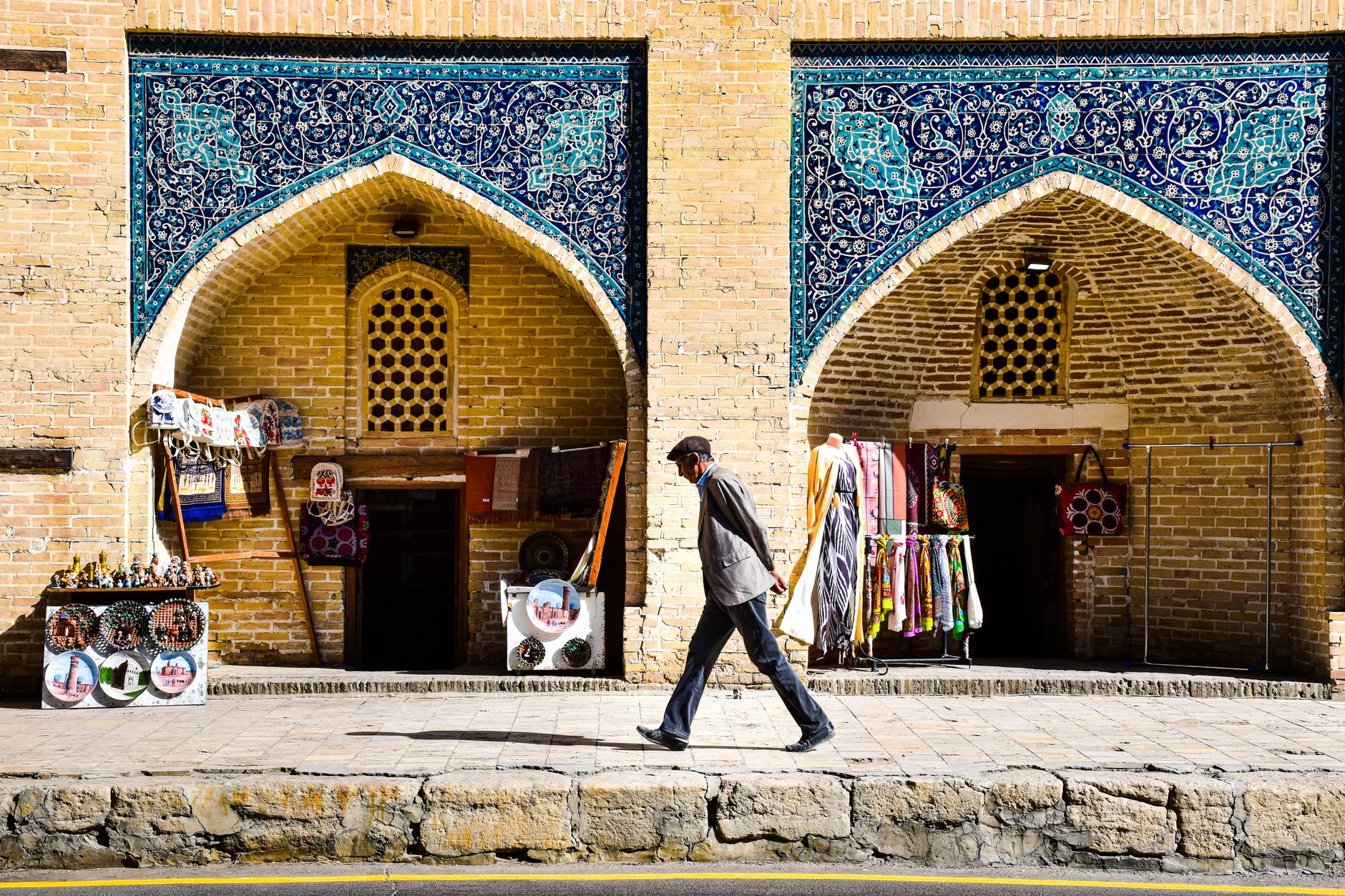


Uzbekistan has separate entry rules from Schengen. EU, UK, Canada, Australia, and, from January 1, 2026, US passport holders can enter visa-free for up to 30 days; for longer stays, use the official e-visa or consular route. Travel with at least 6 months of passport validity and confirm that your hotel in Tashkent, Samarkand, Bukhara, or elsewhere is handling the required registration within 3 working days.
The local currency is the Uzbek so'm, or UZS. Cards work well in Tashkent and increasingly in Samarkand and Bukhara, but bazaars, shared taxis, and small guesthouses still lean on cash, so carry ATM cash and avoid damaged foreign notes if you plan to exchange money. In restaurants, 5 to 10 percent is a normal thank-you when service is good, and some bills already include a service charge.
Most travelers arrive by air, usually through Tashkent International Airport, which has the best onward rail and domestic flight connections. Samarkand is the strongest second gateway, while Bukhara, Urgench for Khiva, Fergana, and Nukus make sense if your route is regional rather than national.
For first trips, trains are the smart choice. The Afrosiyob high-speed line links Tashkent, Samarkand, and Bukhara in comfort and usually beats the road on both time and sanity, while flights make sense for the long jump to Khiva via Urgench or for western and southern edges such as Moynaq and Termez. Book premium train departures early in spring and autumn, because the best times sell out first.
Spring and autumn are the sweet spots: March to mid-June and September to October usually bring the easiest temperatures for long days outside. July and August can push Bukhara and Khiva well past 40C, while winter is cold but usable, with thinner crowds and a very different look in Samarkand when the domes sit under snow.
Mobile data is easy to sort on arrival, and local SIMs are simple to buy with passport details at airports and city shops. 4G is reliable in Tashkent, Samarkand, Bukhara, Fergana, Margilan, and Kokand, then weakens on desert roads toward Khiva, Nurata, Moynaq, and some remote stretches in the south.
Uzbekistan is one of the easier countries in the region for independent travel, with low violent crime and a tourism infrastructure that has improved fast since 2016. The practical risks are smaller and more ordinary: careless driving after dark, heat exhaustion in summer, and overpaying for unofficial taxis if you do not settle the fare before the car moves.
Use cards for hotels and better restaurants, but keep cash for bazaars, station snacks, shared taxis, and smaller guesthouses. Outside Tashkent, Samarkand, and Bukhara, cash still ends arguments faster than any app.
The fast trains on the Tashkent, Samarkand, and Bukhara corridor are the best seats in the country and everyone knows it. Lock those tickets in as soon as your dates are fixed, especially for April to June and September to October.
Hotels usually register foreign guests automatically, but do not assume. If you are staying in an apartment, small guesthouse, or with friends, ask who is filing the registration before the first night ends.
Plov is strongest at midday, when the big cauldrons are fresh and the serious local crowd appears. Late-evening plov exists, but it is often the leftovers of a dish built for noon.
In summer, start monuments early, hide from 1 pm to 4 pm, then go back out when the stone cools and the light improves. Bukhara and Khiva punish stubborn people.
For unofficial street taxis, agree the price before the door shuts. In larger cities, app-based rides can save both money and the small theater of bargaining.
Hospitality comes first in Uzbekistan, and conversation often arrives before the practical question you thought you were asking. Slow down, accept the tea, and the useful answer usually appears two minutes later.
If you plan to buy silk, ceramics, or embroidery, keep the receipts and ask about VAT-refund eligibility. Since April 1, 2026, airport refunds are available on qualifying purchases above 300,000 UZS, though the operator keeps a service fee.
Explore Uzbekistan with a personal guide in your pocket
Audio guides for 1,100+ cities across 96 countries. History, stories, and local insight — offline ready.
No, not for stays up to 30 days. US citizens became visa-free from January 1, 2026, though older guides still say a visa is required, so check the official Uzbek MFA page rather than recycled blog posts.
No, by European or North American standards it is still good value. A careful independent traveler can manage on about $30 to $50 a day, while a comfortable mid-range trip with decent hotels and fast trains often lands around $70 to $120 a day.
Seven to ten days is the useful minimum for a first trip. That gives you enough time for Tashkent, Samarkand, and either Bukhara or the Fergana Valley without turning the whole country into a luggage relay.
Yes, it is the best way to do the route. The train is fast, comfortable, and city-center to city-center, which means it usually beats flying once you count airport transfers and waiting time.
Yes, but not everywhere. Cards are common in Tashkent and increasingly normal in Samarkand and Bukhara, while cash still matters in markets, smaller cafes, and for many taxis or regional services.
April, May, late September, and October are usually the safest bets. You get manageable temperatures, better walking weather, and fewer heat-related compromises than in July or August, when the cities can feel like open brick ovens.
Usually, yes, proper hotels do. The problem starts with apartments, informal rentals, or small places that assume someone else is handling it, so ask directly and keep proof if the property gives it to you.
Yes, generally it is considered one of the safer destinations in the region for solo travel. Usual precautions still apply, and the more common issues are unwanted attention from taxi drivers or basic travel friction rather than serious street crime.
Take the train for the classic central route and fly for the long western or southern jumps. Tashkent to Samarkand and Bukhara belongs to rail; Khiva, Moynaq, and sometimes Termez are where flights start to make sense.
Last reviewed