Yosemite National Park
Yosemite ValleyUnited States 37° N · 119° W Updated Apr 2026
Protected for scenery before Yellowstone became a national park, Yosemite Valley pairs granite spectacle with an older name: Ahwahnee.
 Photo: Thomas Wolf, www.foto-tw.de · CC BY-SA 3.0
One of America's grandest wilderness icons was protected only after the people who shaped it were driven out. Yosemite National Park in Yosemite Valley, United States, rewards a visit because almost nowhere else puts so much stone, water, and national myth in one frame: El Capitan rises 914 meters, nearly three Eiffel Towers stacked nose to tail, while the Merced River slides through meadows that look serene until you learn how contested they have been. Come for the shock of scale, stay for the uneasy, moving fact that this valley can change your idea of what "nature" means.
Morning in Yosemite Valley feels engineered by a dramatist with a weakness for granite. Light hits Half Dome in hard silver, pine resin warms in the sun, and every footstep near the river seems to echo off cliffs that were scraped and polished by ice between about 2.5 million years ago and 15,000 years ago, according to geologists cited by the National Park Service.
Most visitors arrive expecting pure wilderness. Ahwahnee, the valley's older name, corrects that story. Records and oral histories show this was a peopled homeland, tended with fire, trade, ceremony, and black-oak food systems long before tourists pointed cameras at Tunnel View.
Yosemite also matters because the United States used this place to test a radical idea. On June 30, 1864, during the Civil War, Abraham Lincoln signed the Yosemite Grant to protect Yosemite Valley and the Mariposa Grove for public use; the view was magnificent, yes, but the legal experiment was just as daring.
What to see
-
Tunnel View
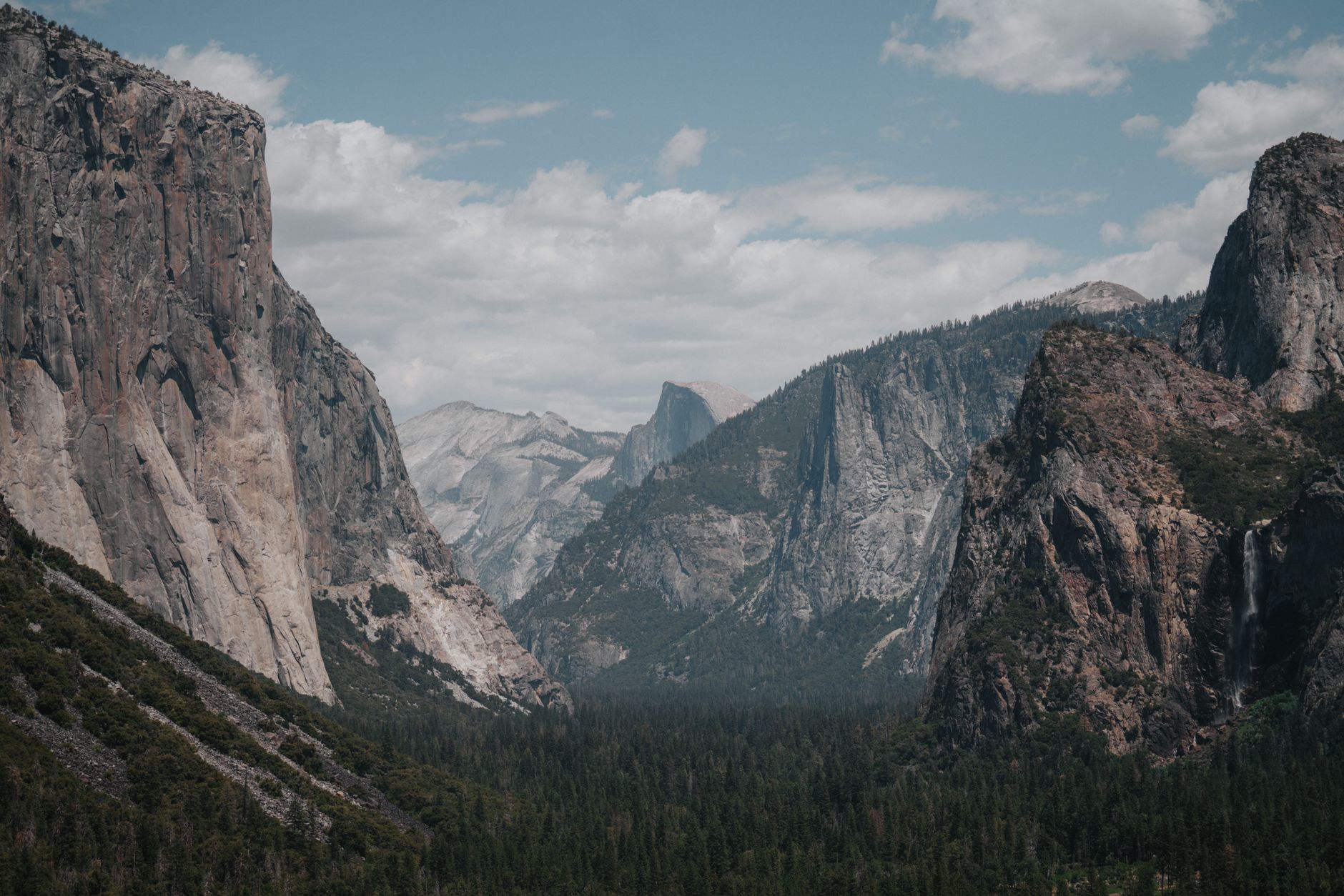
The first shock of Yosemite still happens at a roadside pullout blasted from the Wawona Tunnel approach and opened in 1933: El Capitan on the left, Bridalveil Fall on the right, Half Dome held far back like a final clause the valley saves for last. Come late in the day or just after a storm, when the granite brightens, the Merced air smells washed clean, and the whole scene looks less like a postcard than a piece of weather caught in stone; the bronze tactile model near the overlook is the detail most people miss, and once you run a hand over it, the valley stops being scenery and starts reading as architecture. -
Lower Yosemite Fall
Yosemite Falls is often photographed from a distance, but the lower trail makes the better argument by force: in spring and early summer the sound is so loud it flattens conversation, and the spray hits your face before the footbridge even comes into full view. The full drop measures 2,425 feet, taller than two Eiffel Towers stacked one above the other, yet what stays with you is the close-up texture of white water hammering black rock and the strange intimacy of standing beside something that large on a paved loop almost anyone can reach. -
The Valley’s Human Scale: Museum, Indian Village, and Cook’s Meadow
Yosemite makes more sense when you stop treating it as pure wilderness and walk the line between memory and meadow: start at the Yosemite Museum, opened to the public on May 29, 1926, then continue behind it to the Indian Village of Ahwahnee, where reconstructed bark houses and a roundhouse stand on the site of the valley’s largest Native village and where local American Indian communities still gather for ceremonies. Then head out to Cook’s Meadow, where boardwalk planks creak over wet ground, blackbirds skim the reeds, and the cliffs rise so abruptly that Herbert Maier’s low museum design feels like a deliberate bow of the head; you leave with the useful correction Yosemite demands, which is that beauty here never arrived untouched or unclaimed.
Plan your visit
- Getting There
- Yosemite Valley sits inside a park built for cars, then overwhelmed by them. From Merced, take Amtrak to the station and connect to the year-round YARTS Highway 140 bus through Mariposa and El Portal into Yosemite Village, Yosemite Valley Lodge, or Curry Village; the ride from Merced runs about 2 hours 45 minutes to 3 hours, while driving from the Arch Rock Entrance via El Portal Road usually takes about 45 minutes to the Valley without traffic. Once you park, stop driving: the free Valley shuttles run every 8 to 22 minutes from 7 am to 10 pm, and Lower Yosemite Fall is only 0.5 miles from Yosemite Village on the bike path.
- Opening Hours
- As of 2026, Yosemite National Park is open 24 hours a day, 365 days a year, and Yosemite Valley stays accessible year-round by car and bus. The Yosemite Valley Welcome Center is currently open 9 am to 5 pm, and the free Valley shuttles run daily from 7 am to 10 pm. Seasonal roads are the catch: Tioga Road and Glacier Point Road usually shut in winter, and in late April 2026 both were still closed by snow.
- Time Needed
- A fast look takes 2 to 4 hours if you already have parking or arrive by YARTS: enough for Yosemite Village, Lower Yosemite Fall, and one meadow or bridge viewpoint. A proper Valley day needs 6 to 10 hours because traffic can swallow 2 to 3 hours by itself. Give it 1 to 3 days if you want the Valley to feel like more than a windshield slideshow.
- Accessibility
- Yosemite does better than many mountain parks. Valley shuttles have wheelchair lifts and tie-downs, Yosemite Village Parking has accessible spaces and family restrooms, and good low-barrier routes include the paved 0.5-mile Bridalveil Fall trail and the 1-mile Lower Yosemite Fall loop, though snow and ice can change what stays usable. Watch the terrain anyway: the Valley Loop is mostly level but still stretches 11.5 miles, long enough to feel like half a small-town commute on foot.
- Cost & Tickets
- As of 2026, entry costs $35 per private vehicle, $20 per person on foot or bike, $70 for a Yosemite annual pass, or $80 for the America the Beautiful pass. Yosemite dropped vehicle reservations for 2026, so you do not need timed entry, but the entrance stations are cashless. Free-entry days in 2026 include May 25, June 14, July 3 to 5, August 25, September 17, October 27, and November 11.
Photo Gallery


History
The Valley America Invented, and Inherited
Yosemite's history does not begin with "discovery." Archaeological evidence points to human presence in the region as far back as 8,000 years ago, and National Park Service research says Indian people lived in Yosemite for nearly 4,000 years; the valley known to visitors as Yosemite was Ahwahnee to the Ahwahneechee, a name often translated as a gaping mouth-like place.
Then came the break. Documented records show the Mariposa Battalion entered Yosemite Valley on March 27, 1851, during a violent campaign against Native people, and the preservation story most Americans know grew out of that invasion, then out of paintings, photographs, hotel schemes, rail links, federal law, and a talent for turning scenery into national identity.
The turning point
Tenaya and the Price of a Famous Valley
Tenaya, leader of the Ahwahneechee, stands at the hinge of Yosemite history because what was at stake for him was painfully concrete: his people's homes, food stores, freedom to remain in Ahwahnee, and the chance to keep families together. Documented accounts from park historians describe villages burned, people pursued through the valley and into Indian Canyon, and forced removals that turned a lived-in homeland into a place outsiders could call empty.
The turning point came in 1851, when armed volunteers entered the valley and the balance of power snapped in a matter of days. Later accounts preserved by Lafayette Bunnell say Tenaya was told that a lake had been named for him after his people were captured there; Bunnell himself recalled that Tenaya saw the gesture for what it was, no payment at all for the loss of his country. Cold comfort.
Tenaya's death in 1853, after renewed exile and conflict east of the Sierra, closed one chapter and opened the legend-making phase. Men like James Mason Hutchings, Thomas Ayres, and Carleton Watkins then helped recast Yosemite as sublime scenery for the nation, but the older story still presses through if you know where to look.
Lincoln's Scenic Gamble
From Stagecoach Wonder to Managed Icon
Tips for visitors
Beat The Queue
Arrive before 9 am or after 5 pm in peak season unless you enjoy watching granite while inching forward in a brake-light parade. Valley parking often fills before 9 am, especially near Yosemite Village, Curry Village, and Yosemite Falls.Camera Rules
Small-scale photography is easy here: as of 2026, groups of 8 or fewer using hand-carried gear in public areas usually need no permit. Drones are banned outright, and big setups that block viewpoints or claim exclusive use can trigger permit fees starting at a $300 filming application.Bears Love Cars
Pickpockets are not the Valley's real problem; black bears are. Never leave food or scented items in your car, even for a short waterfall stop, unless you want your rental peeled open like a tin can.Eat Smart
Degnan's Kitchen in Yosemite Village is the best budget-to-low-midrange stop for breakfast sandwiches and deli lunch, Base Camp Eatery at Yosemite Valley Lodge works when you need hot food fast, and Mountain Room is the Valley's polished dinner move if you want one splurge meal with windows facing the cliffs. Curry Village's Pizza Deck and Bar 1899 is the better casual post-hike bet than most people expect.Pair Your Stops
Link Yosemite Village, Lower Yosemite Fall, and the meadows on foot or by shuttle instead of moving your car between each postcard view. Bridalveil Fall is the awkward exception because no shuttle goes there, so either drive it once or save it for a longer Valley Loop day.Save Where It Counts
The cheapest Yosemite trick is not a coupon but a plan: use YARTS, then the free Valley shuttle, and skip the fuel-and-parking headache entirely. If you are visiting more than once, the $80 America the Beautiful pass beats paying the $35 vehicle fee again and again.
Frequently asked
Is Yosemite National Park worth visiting?
Yes, and Yosemite Valley is the reason most people fall quiet. Few places give you 3,000-foot granite walls, waterfalls loud enough to drown conversation, and meadows where the boardwalk creaks under your feet, all within a short shuttle ride. Go knowing the story is bigger than scenery: this was Ahwahnee, homeland before it became an American icon.
How long do you need at Yosemite National Park?
A full day is the bare minimum, and two to three days is much better. Six to 10 hours lets you cover Yosemite Valley without sprinting between parking lots, while a longer stay gives you room for changing light at Tunnel View, meadow walks, and the sort of slow looking this place deserves. NPS also warns that summer traffic inside the Valley can eat two to three hours by itself.
How do I get to Yosemite Valley from Merced?
The easiest car-free route is Amtrak to Merced, then the year-round YARTS Highway 140 bus into Yosemite Valley. That line stops at Yosemite Village, Yosemite Valley Lodge, and Curry Village, which saves you the parking fight that often starts before 9 am. Once inside, the free Valley shuttles run from 7 am to 10 pm.
What is the best time to visit Yosemite National Park?
Late spring is the sweet spot if you want Yosemite at full volume. In May and early June, Lower Yosemite Fall can sound almost deafening, Bridalveil throws spray into the air, and Cook's Meadow turns bright green; by late summer, some waterfalls shrink to a thread or disappear and Mirror Lake often becomes more meadow than lake. Winter has its own spare beauty, but road closures and ice change the plan.
Can you visit Yosemite National Park for free?
Usually no, but yes on the park's official free-entry days. Standard admission is $35 per private vehicle or $20 per person without a car, and Yosemite's 2026 free days include February 16, May 25, June 14, July 3 to 5, August 25, September 17, October 27, and November 11. One more practical detail: entrance stations are cashless.
What should I not miss at Yosemite National Park?
Don't miss Tunnel View, Lower Yosemite Fall, Cook's Meadow, and one stop that most rushed visitors underrate: the Indian Village of Ahwahnee behind the museum. Tunnel View gives you the famous big reveal, but the Valley makes more sense when you also hear the waterfall roar at close range, smell wet meadow grass, and stand in the place that corrects the old myth of Yosemite as empty wilderness. If you only collect viewpoints, you miss the point.
Sources & attribution 11
- National Park Service - Yosemite Valley — Used for Yosemite Valley access, parking pressure, and NPS guidance that summer traffic in the Valley can take two to three hours.
- National Park Service - Public Transportation — Used for free Valley shuttle hours, car-free access, and in-park transportation details.
- YARTS - Highway 140 — Used for the year-round Merced-to-Yosemite Valley bus connection.
- National Park Service - Lower Yosemite Fall Trail — Used for the sensory description of Lower Yosemite Fall and its strong spring runoff experience.
- National Park Service - Cook's Meadow Loop Trailhead — Used for seasonal atmosphere in Cook's Meadow, especially spring greenery and meadow character.
- National Park Service - Mirror Lake Trail — Used for the late-season note that Mirror Lake often shifts toward meadow and sand.
- National Park Service - Fees and Passes — Used for standard entrance fees and the cashless entrance-station policy.
- National Park Service - Fees and Passes (inline free days) — Used for the list of 2026 free entrance days.
- National Park Service - Reservations — Used for the current 2026 reservation policy and park management context about spreading visitors beyond the Valley.
- National Park Service - Their Lifeways — Used for the Ahwahnee name, Ahwahneechee context, and the reminder that Yosemite was an inhabited homeland before park branding.
- National Park Service - Indian Village — Used for the Indian Village of Ahwahnee as a key place to visit and for its continuing cultural use.
Built from cited sources · see the method · How we make our guides →
Pick up where you left off
Saved and recently read places — kept on this device only.
Photo credits (13)
- Andrew McQuaid — Unsplash License (https://unsplash.com/license) — Source: https://images.unsplash.com/photo-1563200663-1406f5f6e542
- Half Dome with Eastern Yosemite Valley (50MP) — Thomas Wolf, www.foto-tw.de — CC BY-SA 3.0 (https://creativecommons.org/licenses/by-sa/3.0/) — Source: https://commons.wikimedia.org/wiki/File:Half_Dome_with_Eastern_Yosemite_Valley_(50MP).jpg
- Kinley Lindsey — Pexels License (https://www.pexels.com/license/) — Source: https://www.pexels.com/photo/19977696/
- Enric Cruz López — Pexels License (https://www.pexels.com/license/) — Source: https://www.pexels.com/photo/9989648/
- Stephen Leonardi — Pexels License (https://www.pexels.com/license/) — Source: https://www.pexels.com/photo/20401495/
- Stephen Leonardi — Pexels License (https://www.pexels.com/license/) — Source: https://www.pexels.com/photo/20401504/
- Rockwell branding agency — Pexels License (https://www.pexels.com/license/) — Source: https://www.pexels.com/photo/9137756/
- Zetong Li — Pexels License (https://www.pexels.com/license/) — Source: https://www.pexels.com/photo/14099207/
- Stéphane Christiaens — Pexels License (https://www.pexels.com/license/) — Source: https://www.pexels.com/photo/27400430/
- Mimo´s Photography (Helyin Bermúdez) — Pexels License (https://www.pexels.com/license/) — Source: https://www.pexels.com/photo/28517547/
- gali — Pexels License (https://www.pexels.com/license/) — Source: https://www.pexels.com/photo/640908/
- André Cook — Pexels License (https://www.pexels.com/license/) — Source: https://www.pexels.com/photo/131720/
- Mimo´s Photography (Helyin Bermúdez) — Pexels License (https://www.pexels.com/license/) — Source: https://www.pexels.com/photo/28517563/
Photos may have been resized or cropped.