Washington Monument
WashingtonUnited States 38° N · 77° W Updated Apr 2026
Robert Mills first imagined it with a 200-foot colonnade; what stands instead is a stark 555-foot obelisk anchoring the Mall and its night walks.
 Photo: Simon Ray (@simonbhray) / Unsplash
- Best season
- Spring (late March to early April)
Why does the clean white needle everyone photographs in Washington, United States, carry a scar halfway up its body? The Washington Monument in Washington, D.C., looks simple from a distance, yet that pale shift in stone tells you this was never a tidy tribute. Visit for the view, yes, but also because few monuments reveal the country that built them so bluntly.
Today you approach across open grass on the National Mall, with traffic muttering at the edges and the obelisk rising 555 feet, 5 1/8 inches into the sky, roughly the height of a 50-story office tower. In bright sun the marble can look almost weightless. Up close, it feels different: cold stone, hard seams, and a silence inside that turns every footstep into a small echo.
Most visitors think they know the story already. George Washington, first president, giant monument, national gratitude. But the monument standing here is the stripped-down survivor of a failed fundraising campaign, a nativist power grab, years of abandonment, and an engineer's nerve.
That is why this place matters more than its postcard outline suggests. You are not just looking at a memorial to Washington; you are looking at a national argument made in marble, one that still points toward the White House, the US Capitol, and the rest of the city as if the debate never quite ended.
What to see
-
Ride the Obelisk
Most people treat the Washington Monument as a backdrop until they step inside and feel the scale turn physical. The elevator climbs 500 feet in about 70 seconds, sealing you into a shaft whose walls once reached 15 feet thick at the base, wider than a city bus is long, before the windows at the top cut the capital into eight sharp frames: the US Capitol to the east, the White House to the north, the Lincoln Memorial to the west. Then the building shows its real trick: on the way down, lights dim and the interior memorial stones surface from the dark, so the monument stops being a postcard and starts feeling like a vertical archive built by argument, money troubles, and national self-belief. -
Read the Scar in the Stone
The best detail sits in plain sight halfway up the shaft, where the marble changes color and the monument quietly admits it was abandoned in 1854, then finished only after the Civil War. From the grass of the National Mall you can read that interruption like a seam in a repaired bone, and once you notice it the obelisk stops looking pure and starts looking honest; walk a little south to the Jefferson Pier, a squat marker just over 2 feet square and about 3 feet high, and the whole site clicks into focus as part survey point, part political theater, part memorial. -
Do the Sunset Axis
Start at the monument in late afternoon, when the white marble turns the color of cold cream, then walk west toward the Lincoln Memorial and look back every few minutes. That slow retreat is the point: the obelisk grows stranger, less like a patriotic exclamation mark and more like an ancient measuring stick planted in wet grass and wind, with the reflecting pool catching the last light and the city around it finally admitting how carefully it was staged.
Plan your visit
- Getting There
- The address is 2 15th St. NW, with the usual approach at 15th Street and Madison Drive NW. From Smithsonian Metro, use the 12th Street and Jefferson Drive SW exit and walk west across the Mall for about 10 minutes; Federal Triangle is also about 10 to 12 minutes on foot, and the DC Circulator National Mall route or Metrobus 32, 34, and 36 get you close. Parking exists along Ohio Drive SW and at the Paddle Boat lot on Maine Ave. SW, but transit saves you the headache.
- Opening Hours
- As of 2026, the monument is open daily from 9:00 a.m. to 5:00 p.m. Last timed-entry tickets are for 4:00 p.m., entries stop at 4:30 p.m., and staff ask you to arrive at least 15 minutes early. It closes one day each month for maintenance, shuts the afternoon of July 3, stays closed all day July 4, and also closes December 25.
- Time Needed
- Give the exterior 20 to 30 minutes if you just want the flag circle, photos, and that strange feeling of standing beside a 555-foot stone needle taller than a 50-story office tower. An interior visit with a timed ticket usually takes 60 to 90 minutes including security and the elevator ride. Pair it with the Lincoln Memorial, the National Mall, or one Smithsonian museum, and you are looking at 2.5 to 4 hours.
- Accessibility
- Wheelchair access is built in: paved paths lead up the hill, rangers can assist with doors, and an elevator takes visitors to the observation level. Some approach routes get slightly steeper, bollard gaps can narrow to about 38 inches, and the top can feel tight when crowds bunch up. Accessible restrooms sit in the Washington Monument Lodge, and rangers can provide a periscope plus braille window identifiers for visitors who need them.
- Cost and Tickets
- As of 2026, entry is free, which still feels almost suspicious in a city that charges for lesser views. Advance tickets cost a $1 non-refundable service fee each through Recreation.gov, same-day tickets are free from the Washington Monument Lodge starting at 8:45 a.m., and one adult can collect up to 6. Tickets release 30 days ahead at 10:00 a.m. ET, with a smaller batch added one day ahead at 3:00 p.m. ET.
History
The Monument That Nearly Failed
Records show Congress wanted to honor George Washington as early as 1783, yet decades passed with speeches, sketches, and very little stone. When work finally began on 4 July 1848, more than 20,000 people gathered here, and the ceremony felt less like quiet remembrance than a young republic trying to prove it could finish what it started.
The proof took longer than anyone expected. Robert Mills designed a far grander memorial than the bare obelisk you see now, money ran out at 152 feet, political zealots seized the project, the Civil War turned the grounds into a cattle yard, and only federal intervention rescued the whole thing from becoming a permanent stump in the middle of the capital.
The turning point
The Line in the Marble
At first glance, the Washington Monument seems to tell a plain story: America paused construction during the Civil War, then came back later with slightly different stone. That neat version is comforting. It is also incomplete.
What does not add up is the break in color and the break in quality. Records show work stopped in 1854 before the war because the private monument society had run out of money, and the crisis deepened after anti-Catholic Know-Nothings stole the memorial stone sent by Pope Pius IX and seized control of the society in 1855. They added rejected marble, donor trust collapsed, and the national shrine to Washington became a partisan embarrassment.
The turning point came on 1 July 1878, when Lieutenant Colonel Thomas Lincoln Casey took charge. What was at stake for him was personal as well as public: if he misjudged the weak foundation or the damaged upper courses, the monument could settle, crack, and disgrace the Army engineer who signed off on it. Casey widened and deepened the footing, removed the shoddy Know-Nothing work, and on 7 August 1880 restarted construction at about the 150-foot level rather than pretending the mess had never happened.
Once you know that, the color shift stops being a flaw and starts reading like evidence. You are looking at a repaired argument, not a seamless dream, and the famous obelisk becomes more interesting for it.
A City Axis That Bent
A Memorial Built by Exclusion
Tips for visitors
Beat the Heat
Summer on the Mall reflects off pale stone and open grass with all the mercy of a parking lot. Go early for softer light and thinner lines, or come back after dark for the grounds when the air cools and the obelisk glows like a lit match stuck in the capital.Photo Rules
Casual photography is allowed, and visitors documenting a normal trip can use a tripod without a permit outside restricted areas. Drones are a hard no in Washington, and permitted shoots cannot work inside the circle of flags, so leave the flying camera fantasy at home.Bag Limits
Security is tighter than the monument's clean geometry suggests: bags over 18 x 16 x 8 inches are banned, and no public storage exists on site. Rangers will not hold strollers, aerosols, lighters, glass containers, or oversized bags, so sort your gear before you join the line.Skip the Trucks
Food trucks around the monument have a local reputation for fuzzy pricing and tourist-grade regret. Eat at Sweet Home Café in the Smithsonian National Museum for mid-range plates at $5 to $25, grab Mitsitam for another solid mid-range museum lunch, or walk to Old Ebbitt Grill near the White House if you want oysters and old D.C. swagger at mid-range to splurge prices.Make a Circuit
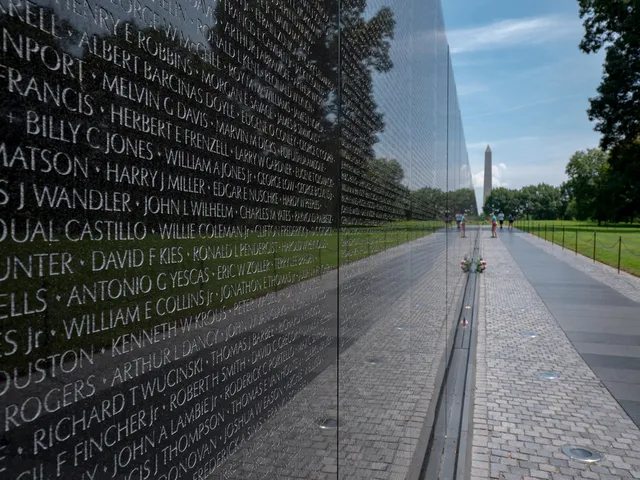
The monument works better as the hinge of a larger walk than as a standalone stop. Pair it with the Lincoln Memorial and the Vietnam Veterans Memorial to the west, or fold in the National Mall museums to the east while you still have energy in your legs.Ticket Strategy
Set an alarm for the 30-day ticket release at 10:00 a.m. ET, because spring, summer, and fall slots disappear fast. Miss that window and the day-before release at 3:00 p.m. ET is your second shot; same-day tickets are free, but the line can start forming before the Lodge opens at 8:45 a.m.
Frequently asked
Is Washington Monument worth visiting?
Yes, if you go up. The real payoff is not the postcard exterior but the 500-foot observation level, where Washington opens in eight framed views and the city suddenly reads like a diagram: US Capitol to the east, White House to the north, Lincoln to the west, Tidal Basin to the south. Outside, you are standing at a monument finished in 1884 after money ran out, politics turned ugly, and engineers had to rebuild weak work at roughly 150 feet, which explains the famous color shift in the marble.
How long do you need at Washington Monument?
Plan 60 to 90 minutes if you have an interior ticket. That covers arriving 15 minutes early, security, the 70-second elevator ride, the narrow observation ring, and the descent past 193 commemorative stones hidden in the shaft walls. If you are only circling the flags and taking photos on the grounds, 20 to 30 minutes is enough.
How do I get to Washington Monument from Washington?
Metro is the cleanest option. Smithsonian and Federal Triangle are the closest stations, both about a 10 to 12 minute walk, and the monument entrance area sits near 15th Street and Madison Drive NW at 2 15th St. NW. Driving works, but parking around the Mall is limited and the open walk can feel longer than it looks on a map.
What is the best time to visit Washington Monument?
Early morning is your best bet, and spring gives you the most memorable setting. Timed tickets in spring, summer, and fall often disappear fast, while the grounds feel calmer and the light cleaner earlier in the day; around cherry blossom season, the white shaft rises behind pale pink bloom like a 555-foot tuning fork. July is trickier because the monument closes the afternoon of July 3 and all day on July 4.
Can you visit Washington Monument for free?
Yes, the monument itself is free year-round. Advance tickets usually carry a $1 non-refundable service fee, while same-day tickets are free and handed out from the Washington Monument Lodge starting at 8:45 a.m. Tickets still matter, though, because everyone age 2 and up needs one to go inside.
What should I not miss at Washington Monument?
Do not miss the top windows and do not rush the ride down. From 500 feet up, the city snaps into place, and on the descent the interior lights shift so you notice the memorial stones set into the walls, a quieter record of states, countries, and old arguments about who got to write national memory. On the grounds, most people walk straight past Jefferson Pier, a squat stone just over two feet square that quietly marks the city plan the monument was supposed to follow before bad soil forced a compromise.
Sources & attribution 13
- National Park Service - Washington Monument FAQ — Provided observation level height, number of viewing windows, interior layout, and the main landmark views from the top.
- National Park Service - Washington Monument History and Culture — Provided construction history, the marble color change explanation, Casey's reconstruction at about 150 feet, and the monument's finished date.
- Recreation.gov - Washington Monument Tickets — Provided current ticket rules, free admission, $1 advance service fee, arrival timing, same-day ticket distribution, and practical visit duration details.
- National Park Service - Washington Monument Directions — Provided the monument address, nearby intersection, and official approach information.
- WMATA - Smithsonian Station — Provided the nearest Metro option and station access details for the walk to the monument.
- WMATA - Federal Triangle Station — Provided the second major nearby Metro option and station access details.
- National Park Service - Washington Monument Hours — Provided daily hours and regular closure details, including July 3 afternoon, July 4, and December 25.
- National Park Service - Washington Monument Fees — Provided ticket release patterns, free entry policy, and peak-season sellout context.
- National Park Service - Cherry Blossoms Announcement March 2026 — Provided the 2026 cherry blossom timing used to support the spring recommendation.
- National Park Service - Physical Mobility at the Washington Monument — Provided interior crowding, narrow observation areas, and approach conditions on the grounds.
- National Park Service - Cognitive and Learning Disabilities Access — Provided the 70-second elevator ride detail and the sensory character of the interior experience.
- National Park Service - Sight Impaired Access — Provided the descent interpretation detail and the way visitors are directed to notice the commemorative stones.
- National Park Service - Jefferson Pier Stone — Provided the Jefferson Pier detail, its size, and its role in the original city geometry.
Built from cited sources · see the method · How we make our guides →
More in Washington.
7 places to discover — a few worth pairing.



Pick up where you left off
Saved and recently read places — kept on this device only.
Photo credits (5)
- Simon Ray (@simonbhray) — Unsplash License (https://unsplash.com/license) — Source: https://images.unsplash.com/photo-1704823825960-7932c21c2618
- Ron Hopper — Pexels License (https://www.pexels.com/license/) — Source: https://www.pexels.com/photo/15805488/
- catdoong kim (@catdoong) — Unsplash License (https://unsplash.com/license) — Source: https://images.unsplash.com/photo-1755505612388-2bc3a53a269d
- Shiona Das (@shionadas) — Unsplash License (https://unsplash.com/license) — Source: https://images.unsplash.com/photo-1723479813377-310f1ddb0eb7
- Wendy Maxwell — Pexels License (https://www.pexels.com/license/) — Source: https://www.pexels.com/photo/6681419/
Photos may have been resized or cropped.