Vietnam Veterans Memorial
WashingtonUnited States 38° N · 77° W Updated Apr 2026
Open all night, the black granite wall turns names into reflections and a Mall checklist into one of Washington's most intimate, unsettled walks after dark.
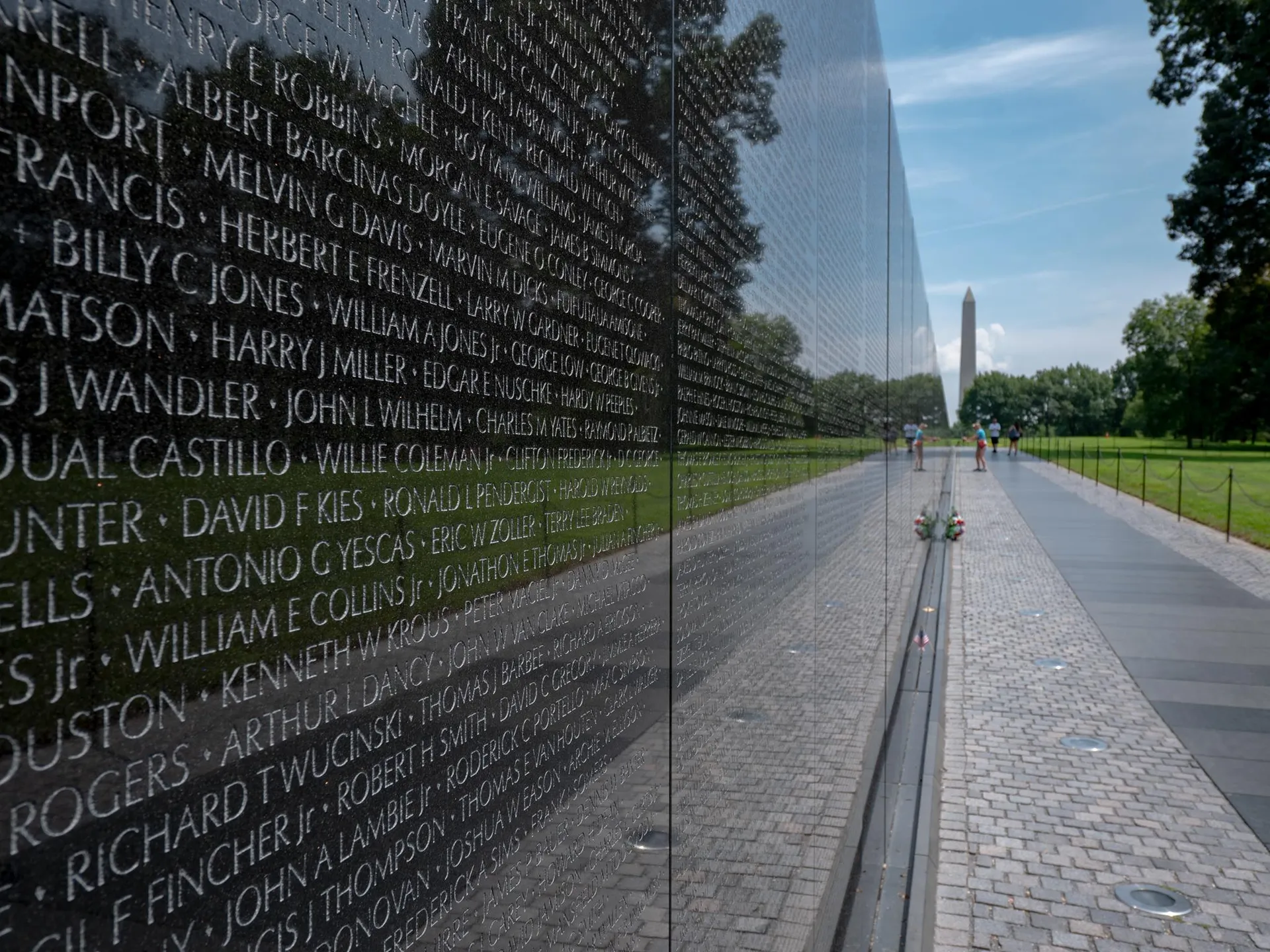 Photo: David J. Jackson · CC BY-SA 4.0
Why does one of Washington's most affecting places look less like a triumphal monument than a wound cut into the ground? The Vietnam Veterans Memorial in Washington, United States, earns the visit because it does something rarer than patriotic pageantry: it turns 58,000-plus deaths into names you can touch. Today you walk down a gentle slope beside black granite polished like still water, with the trees, your own face, and the pale columns of the Lincoln Memorial floating in the stone.
Most first-time visitors expect a national war memorial to instruct them how to feel. Maya Lin's design refuses that bargain. Records show the wall stretches 493 feet tip to tip, about the length of one and a half football fields, yet it feels intimate because the real scale is human: letter-height names, fingertips on stone, a voice catching halfway through a rubbing.
Silence behaves strangely here. School groups lower their voices without being told, shoes scrape on the path, and now and then someone lets out the sharp breath that comes just before tears. The memorial stays open day and night, and that matters; grief keeps odd hours.
Come for the architecture if you like, or for American history, or because the Vietnam War still sits unresolved in the national bloodstream. But the place works best when you let its plainest fact land: each name marks a life cut short, and the wall orders those deaths by date, so you are not reading a list so much as walking through time.
What to see
-
The Wall
Maya Lin was 21 when she drew this memorial in 1981, and her idea still feels almost rude in its clarity: two black-granite wings, each 246 feet 9 inches long, cut into the earth like a wound you can walk inside. Go early or near dusk, when the stone turns mirror-dark and your face floats over names carved in Optima; the wall rises from ankle height to more than 10 feet, roughly as tall as a one-story room, and the hush is broken mostly by footsteps, a few rubbed-pencil swishes, and the low scrape of fingertips tracing letters.
Most people look for a famous panel and leave too soon. Walk the full V instead, because the chronology begins at the apex, runs out along one arm, then returns on the other so the war closes where it started, with the Lincoln Memorial watching from one axis and the Washington Monument from the other; once you notice that fold in time, this stops being a list of the dead and becomes a shaped argument about memory itself.
-
Three Servicemen and the Flag Plaza
The bronze soldiers added in 1984 were a political compromise, but they earn their place because they change the temperature of the visit. After the wall's cold reflection, these three young men in jungle gear look almost unbearably vulnerable, their eyes fixed toward the names, with the flag snapping overhead and the plaza's service emblems underfoot like a ceremonial floor worn smooth by years of pause, salute, and second thoughts.
Stand a little off to one side. From there you catch the memorial's quiet argument in one glance: abstraction first, human bodies after, grief before heroics.
-
Walk the Quiet Loop: Wall, Women's Memorial, In Memory Plaque
Take the wall first, then drift south into the grove of the Vietnam Women's Memorial, dedicated in 1993, where three women bend over a wounded soldier and the air feels different at once: less monumental, more bodily, all strain and care and exhaustion. Eight yellowwood trees stand nearby for the eight servicewomen whose names appear on the wall, a detail easy to miss unless you slow down enough to hear the leaves and notice how the crowds thin.
Finish at the In Memory plaque from 2004, tucked near the northeast corner of the Three Servicemen plaza. That's the point where the story gets harder and more honest, because it honors veterans who survived Vietnam and died later from service-related causes; the war, you realize, did not end neatly in 1975 or at the polished stone.
Plan your visit
- Getting There
- The Wall sits at 5 Henry Bacon Drive NW, just north of the Lincoln Memorial. As of 2026, the cleanest transit route is Metro to Foggy Bottom-GWU on the Blue, Orange, or Silver lines, then a 0.8-mile walk that usually takes 15 to 20 minutes; from the Lincoln Memorial plaza itself, you are only 3 to 5 minutes away on foot. If you drive, look for metered parking along Constitution Avenue NW and near the Mall, but read signs carefully because many spaces cap stays at 3 hours and overnight restrictions are common.
- Opening Hours
- As of 2026, the Vietnam Veterans Memorial is open 24 hours a day, 365 days a year. Rangers are usually on site daily from 9:30 a.m. to 10:00 p.m., and the memorial itself rarely closes, though major civic events around Constitution Avenue and Lincoln Memorial Circle can trigger street closures or bus detours.
- Time Needed
- Give it 15 to 20 minutes if you want a quiet walk along the Wall and one good pause. Most visitors need 30 to 45 minutes to also see the Three Servicemen statue and Vietnam Women's Memorial, while 45 to 75 minutes feels right if you're finding a specific name, doing a rubbing, or staying for a ranger talk that runs about 30 minutes.
- Accessibility
- As of 2026, the memorial is wheelchair accessible, with a level stone approach and a main path about 6 feet wide, roughly the length of a tall adult laid head to toe. Watch the brick edges and gaps, and be careful after rain because the stone can turn slick; benches are nearby, service animals are welcome, and Braille brochures are available onsite.
- Cost & Tickets
- As of 2026, admission is free and no ticket or reservation is needed. That makes the usual National Park fee-free days irrelevant here, and it also means nobody should be selling you official skip-the-line access because none exists.
Photo Gallery


History
The Ritual Never Stopped
The Vietnam Veterans Memorial has kept the same core function since its dedication on 13 November 1982: people come here to name the dead, mourn them in public, and try to stitch private grief back into national memory. The rituals have multiplied since then. The act has not changed much.
Records show visitors still trace letters onto paper, leave boots and medals and beer cans at the base, and return for Veterans Day, Memorial Day, candlelight observances, and the Reading of the Names. Stone made the site famous. Repetition made it sacred.
The turning point
The Wall Was Supposed to Be About Closure. It Became a Practice.
At first glance, the story seems settled: a divided country finally built a memorial, dedicated it, and moved on. Tourists often accept that version because the wall looks finished, precise, almost severe, with every name cut into black granite in a sequence that appears permanent.
Then doubt creeps in. Why are the names not alphabetical, as most memorials would arrange them? And why did Jan Scruggs, the veteran who pushed the project into existence after the 21 January 1970 explosion that killed friends near him in Vietnam, fight so hard for a design that many veterans and politicians initially hated? James G. Watt, Secretary of the Interior, resisted Maya Lin's winning scheme, while critics called it a 'black gash' and treated abstraction as insult rather than honor.
The revelation is that the memorial was never meant to offer a tidy ending. Records show Lin, a 21-year-old Yale student when entry no. 1026 won the anonymous competition in May 1981, arranged the names by date of casualty so the wall would read like the war itself: it begins, swells, and closes back on its starting point. For Scruggs, that mattered personally. He was not chasing a generic monument; he was trying to create a place where men who had come home to indifference could finally be seen, and the turning point came when the anonymous jury chose Lin's design before anyone knew her age or name.
Knowing that changes your gaze. You stop looking for military glory and start noticing behavior instead: a daughter pressing paper to stone, a veteran touching one panel and then another, a stranger leaving a letter at the base. The memorial's real continuity lives in those repeated gestures, not in the granite alone.
What Changed
What Endured
Tips for visitors
Go After Sunset
Dusk changes the place. The polished black stone starts catching the last light like still water, crowds thin out, and the memorial feels less like a stop on the Mall and more like what it is: a public place for private grief.Keep Your Voice Low
NPS warns that visits here can be emotionally intense, and that is not boilerplate. Families come to find names, leave notes, and cry without spectacle, so treat the path like a shared quiet room outdoors.Photo Rules
Personal photography is allowed, and as of 2026 ordinary visitors can also use tripods outside restricted areas. The catch: the Vietnam Veterans Memorial Apex is a restricted zone, and any commercial shoot with crew, models, or special setup should go through NPS first; drones are off the table in Washington's no-drone zone.Eat North, Not Here
Skip random Mall food trucks unless prices are posted clearly; recent enforcement followed reports of tourists being charged absurd amounts for basic snacks. Walk or ride north to Foggy Bottom instead: Maman Foggy Bottom for coffee and pastries at budget prices, CIRCA at Foggy Bottom for a solid mid-range meal, or Rasika West End if you want a splurge that earns it.Pair It Properly
This visit works best when paired with the nearby Lincoln Memorial, because the short walk between them shifts the mood from marble certainty to something far more human. Don't cram too much after it if you can help it; this is one of the Mall's few places that improves when you leave space around it.Bring Water, Not Luggage
Buy water before you reach the west end of the Mall and do not count on honest food-truck pricing or on-site lockers. The memorial has no official luggage storage, and the nearest practical restrooms are at the Lincoln Memorial, so large bags quickly become dead weight.
Frequently asked
Is Vietnam Veterans Memorial worth visiting?
Yes, especially if you give it more than a photo-stop glance. Maya Lin’s wall sinks into the earth and rises to just over 10 feet at the apex, so the visit feels physical before it feels historical; the polished black granite throws your reflection across 58,000-plus names, and that quiet collision is what stays with people.
How long do you need at Vietnam Veterans Memorial?
Most visitors need 30 to 45 minutes. A quick walk to see the Wall takes about 15 to 20 minutes, but give yourself closer to an hour if you want to find a specific name, make a rubbing, and also step over to the Three Servicemen statue, the Vietnam Women’s Memorial, and the In Memory plaque.
How do I get to Vietnam Veterans Memorial from downtown Washington?
The easiest route is Metro to Foggy Bottom-GWU, then an 0.8-mile walk toward 5 Henry Bacon Drive NW near the west end of the National Mall. If you are already near the Lincoln Memorial, the memorial is only a 3 to 5 minute walk north and feels much closer than the map suggests.
What is the best time to visit Vietnam Veterans Memorial?
Early morning and dusk are the best times. The light is softer, the crowds thin out, and the stone works harder then: names sharpen, trees and sky drift across the surface, and the whole place feels less like a stop on the Mall and more like a conversation held in a low voice.
Can you visit Vietnam Veterans Memorial for free?
Yes, admission is free and no ticket or reservation is required. The memorial is open 24 hours a day, 365 days a year, which makes an after-dark visit possible if you want the Wall at its most quiet and reflective.
What should I not miss at Vietnam Veterans Memorial?
Walk the full length of the Wall and notice that the names are arranged by date of casualty, not alphabetically, with the war beginning and ending at the center. Also seek out the small status symbols beside the names, the Three Servicemen statue, the Vietnam Women’s Memorial, and the easy-to-miss In Memory plaque, which honors veterans whose war kept killing them after they came home.
Sources & attribution 14
- National Park Service Directions — Official address, nearest Metro station, walking context, and approach from the National Mall and Lincoln Memorial area.
- National Park Service FAQs — Official explanation of name order on the Wall and practical visitor context.
- Vietnam Veterans Memorial Fund About The Wall — Institutional overview of the memorial and common use of the nickname 'The Wall.'
- National Park Service Vietnam Veterans Memorial — Official history, design summary, dimensions, and core interpretation of the memorial.
- National Park Service Basic Information — Official opening access, location basics, and NPS guidance on visiting at quieter times.
- National Park Service Hours — Official confirmation that the memorial is open 24 hours a day and ranger hours.
- National Park Service Fees — Official confirmation that admission is free and no ticket is required.
- National Park Service Accessibility — Official details on path conditions, benches, and physical access relevant to visit planning.
- Vietnam Veterans Memorial Fund Plan a Visit — Visitor planning details, including help with finding names and the broader visit experience.
- WMATA Foggy Bottom-GWU Station — Transit confirmation for the nearest Metro station used in directions advice.
- Maya Lin Studio: Vietnam Veterans Memorial — Primary design intent, including the memorial as a cut in the earth and the chronology closing at the center.
- National Park Service Three Servicemen Statue — Official information on the companion statue near the Wall.
- National Park Service Vietnam Women's Memorial — Official information on the nearby women’s memorial included in a fuller visit.
- National Park Service In Memory Plaque — Official explanation of the plaque honoring veterans who later died from service-related causes.
Built from cited sources · see the method · How we make our guides →
More in Washington.
7 places to discover — a few worth pairing.


Pick up where you left off
Saved and recently read places — kept on this device only.
Photo credits (3)
- Vietnam Memorial Wall with Washington Monument — David J. Jackson — CC BY-SA 4.0 (https://creativecommons.org/licenses/by-sa/4.0/) — Source: https://commons.wikimedia.org/wiki/File:Vietnam_Memorial_Wall_with_Washington_Monument.jpg
- Vietnam Veterans Memorial — David Reynolds — CC BY-SA 4.0 (https://creativecommons.org/licenses/by-sa/4.0/) — Source: https://commons.wikimedia.org/wiki/File:Vietnam_Veterans_Memorial.png
- Vietnam Veterans Memorial in Washington, D.C — AramilFeraxa — CC BY 4.0 (https://creativecommons.org/licenses/by/4.0/) — Source: https://commons.wikimedia.org/wiki/File:Vietnam_Veterans_Memorial_in_Washington,_D.C.jpg
Photos may have been resized or cropped.