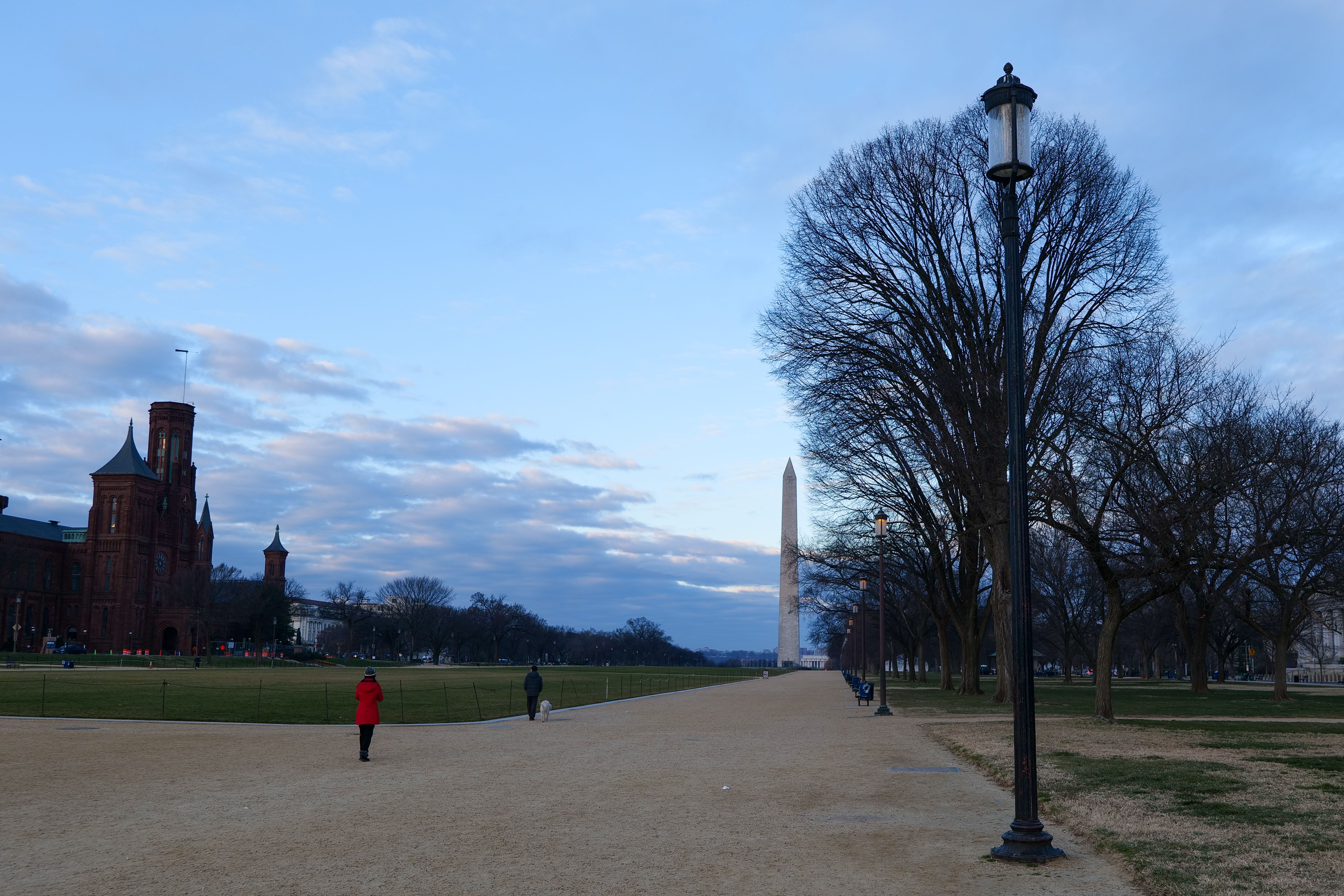
WWhy does the most ceremonial ground in the United States feel, at first glance, like an overgrown contradiction: part park, part protest stage, part national altar? On the National Mall in Washington, United States, you stand between the dome of the US Capitol and the pale shaft of the Washington Monument while sirens fade, tour buses hiss, and flags snap in the wind above grass panels long enough to swallow a dozen football fields end to end. You come here because nowhere else in the country lets you watch American power, memory, grief, argument, and spectacle occupy the same open ground at once.
Most visitors arrive expecting monuments. The better reason to come is the gap between the monuments: this 2-mile east-west sweep, about the length of 35 city blocks, is where the republic keeps testing itself in public.
Morning light turns the museum facades chalky and cool, then the air thickens with food-cart smoke, school groups, joggers, and the slap of shoes on gravel. By evening, the Reflecting Pool catches the sky in a sheet of metal-blue light, and the place starts to feel less like a park than a stage waiting for the next scene.
And the secret is that almost none of this serene openness is as old as it looks. The Mall survives because Americans keep returning to it for the same act, generation after generation: to gather, to remember, to complain, to celebrate, and to insist that the nation listen.
01 What to See
Lincoln Memorial

Washington Monument
Walk the Mall's Quieter Side

Plan and listen to National Mall with Audiala
Audio guide in your pocket, itinerary in your browser. Built for the way you actually visit.
03 Visitor Logistics
Getting There
Opening Hours
Time Needed
Accessibility
Cost and Tickets
05 Tips for Visitors
Go Early Late
Tripod Boundaries
Skip The Trucks
Scam Radar
Pair Nearby Stops
Save On Monument
04 History
The Republic Keeps Coming Back Here
Records show the Mall began in 1791 as Pierre Charles L'Enfant's idea of a 400-foot-wide public avenue, broad enough to reject the closed grammar of royal capitals. The dimensions matter: 400 feet is wider than a soccer field is long, which tells you this was never meant to be a decorative promenade.
Almost everything else changed. Marsh and tidal flats were filled, canals cut through, railroad tracks appeared, war buildings spread across the ground, and planners in 1901-1902 had to rescue the old civic axis from a century of drift. But one function held fast: people still come here to make claims on the nation in full view of its symbols.
The Lawn That Looks Original and Isn't
At first glance, the Mall seems to confirm a comforting story: the founders imagined this grand open greensward, and America, against its usual habits, left it alone. Tourists look west from the US Capitol or east from the Lincoln Memorial and assume they are seeing Pierre Charles L'Enfant's 1791 plan, more or less preserved in grass and symmetry.
But the dates don't behave. National Park Service records show the 19th-century Mall filled with canal edges, gardens, industrial clutter, temporary buildings, and railroad intrusions, while L'Enfant himself lost control of the project in February 1792 after fighting the city commissioners; what was at stake for him was personal as much as political, because the former Revolutionary War engineer wanted the capital's central vista to belong to citizens, not bureaucrats, and that insistence cost him his job.
The revelation is harsher and more interesting: the open Mall people admire now is largely a 1902 revival of L'Enfant's idea, shaped by the McMillan Commission and then built out in the 1930s under Frederick Law Olmsted Jr. Once you know that, the long lawn stops looking like untouched inheritance and starts reading as a recovered argument, one the country keeps having with itself every time a march forms, a vigil begins, or a crowd turns its face toward the White House or the Capitol.
What Changed
What Endured
Listen to the full story in the app
06 Frequently Asked
Is National Mall worth visiting? add
Yes, especially if you want to see Washington thinking out loud in stone, water, and open sky. The Mall is less one attraction than a 2-mile civic axis between the US Capitol and the Lincoln Memorial, with free memorials, Smithsonian museums, and the kind of long sightlines that make your footsteps sound small. Go for the monuments, stay for the strange contrast between formal lawns and the hush under the trees at Constitution Gardens.
How long do you need at National Mall? add
Give it at least half a day, and a full day if you want the place to breathe. A quick skim can take 1.5 to 2.5 hours, but the classic first visit usually runs 3 to 5 hours on foot because the walk from the Capitol side to the Lincoln Memorial is about 2 miles, roughly the length of 35 football fields laid end to end. Add museums or the Tidal Basin, and your “short walk” turns into an all-day affair.
How do I get to National Mall from Washington? add
Use Metro, not a car. Smithsonian station drops you right onto the central Mall at 12th Street and Jefferson Drive SW, while Federal Triangle, L’Enfant Plaza, and Archives-Navy Memorial each serve different edges of the site; driving works, but parking is metered, time-limited, and best treated as a last resort. If you're coming from elsewhere in the city, aim first for Smithsonian because it puts you in the middle of the action instead of leaving you with a long, sun-beaten approach.
What is the best time to visit National Mall? add
Early morning or early evening is best, when the light turns softer and the long lawns feel less like a griddle. Spring brings the cherry blossoms around the Tidal Basin, usually between the last week of March and the first week of April, but that beauty comes with crowds; for quieter air and better photos, locals are right to prefer dawn or dusk. Summer midday can feel punishing because the central greensward is so open that shade is scarce.
Can you visit National Mall for free? add
Yes, the National Mall and its outdoor memorials are free every day. The one famous exception is the Washington Monument, which needs a timed ticket even though admission itself costs nothing; online advance reservations carry a $1 service charge, and a limited batch of same-day tickets is released free at the Washington Monument Lodge from 8:45 a.m. Good deal.
What should I not miss at National Mall? add
Do not miss the slow walk from the Washington Monument to the Lincoln Memorial, because that east-west view is the whole argument of the place. Inside that walk, pay attention to the Korean War Veterans Memorial’s rippling pool and mirrored figures, the tiny Jefferson Pier marker hiding in plain sight near the Monument grounds, and the color break on the Washington Monument, a visible scar from the 1854 construction halt. Most people race the checklist. The better move is to notice what the stone is admitting.
-
verified
National Park Service - Visit National Mall and Memorial Parks
Provided official visitor basics, 24-hour access, free entry to the outdoor Mall, accessibility summary, and broad visit-duration guidance.
-
verified
National Park Service - Directions to National Mall and Memorial Parks
Provided official advice to use public transportation and current access guidance for reaching the Mall.
-
verified
WMATA - Smithsonian Station
Confirmed the most central Metro stop for the Mall and the exact station entrances at 12th Street and Jefferson Drive SW / Independence Avenue SW.
-
verified
WMATA - Federal Triangle Station
Used to identify a practical north-side Metro access point for the Mall.
-
verified
WMATA - L'Enfant Plaza Station
Used to identify a practical south-side Metro access point for the Mall and memorial area.
-
verified
WMATA - Archives-Navy Memorial Station
Used to identify a practical east-side Metro access point near the Pennsylvania Avenue and Capitol end of the Mall.
-
verified
National Park Service - Lincoln Memorial Planning Your Visit
Confirmed that the walk from the Capitol area to the Lincoln Memorial is about 2 miles.
-
verified
National Park Service - Parking on the National Mall
Provided current parking conditions, metered parking details, and the caution that parking is limited and regulated.
-
verified
National Park Service - Basic Information
Supported timing advice about visiting in morning or early evening and the need to watch for event-related closures or crowd conditions.
-
verified
National Park Service - Bloom Watch
Provided official cherry blossom timing context for the best season to visit the Tidal Basin area.
-
verified
National Park Service - Washington Monument Fees
Confirmed timed-ticket rules, the $1 online service charge, and the free same-day ticket release at the Washington Monument Lodge from 8:45 a.m.
-
verified
National Park Service - The Mall
Provided the core description of the Mall as the civic axis of Washington and its role as symbolic public space.
-
verified
National Park Service - Korean War Veterans Memorial
Used for the sensory detail of the Korean War Veterans Memorial and its reflective design.
-
verified
National Park Service - Wall and Pool of Remembrance
Confirmed the memorial's rippling water effect and the doubled visual impression of the statues through reflection.
-
verified
National Park Service - Jefferson Pier Stone
Provided the overlooked Jefferson Pier detail near the Washington Monument grounds.
-
verified
National Park Service - Washington Monument FAQ
Confirmed the visible color change on the Washington Monument and helped explain why visitors should notice it.
-
verified
National Park Service - Washington Monument History and Culture
Supported the explanation that the Washington Monument's color break reflects the long interruption in construction after 1854.
-
verified
National Park Service - Constitution Gardens
Used for the contrast between the Mall's formal central axis and the quieter, tree-shaded mood of Constitution Gardens.
Last reviewed: