
Architectural Origins and Design
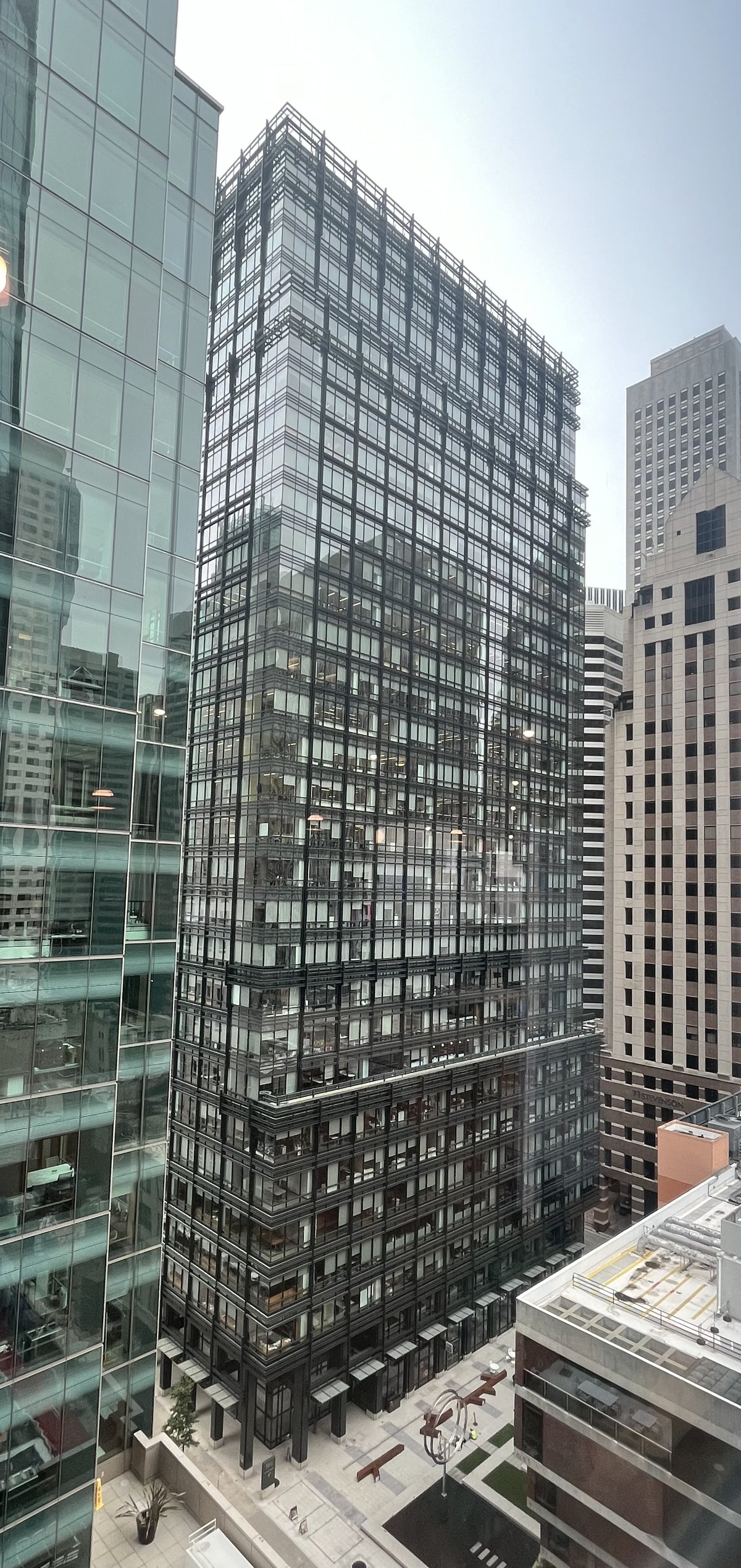
The 560 Mission skyscraper exemplifies Pelli's vision for a luminous, contextual, and enduring urban presence. The building’s façade—an interplay of clear glass and deep green aluminum mullions—creates a shimmering, textured effect that changes with the light and vantage point. This grid recalls the Hallidie Building, the Western United States’ first glass curtain wall structure, embedding 560 Mission in San Francisco’s architectural lineage (Kendall/Heaton Associates).
Subtle setbacks and thoughtful massing reduce the tower’s visual bulk, enhancing its engagement with the street. The transparent base connects indoor and outdoor spaces, while the steel frame allows for open, column-free interiors bathed in daylight. The ground-level plaza, lushly landscaped and open to the public, is both an urban oasis and a model of civic design.
Historical Context and Urban Transformation
The area now known as the Transbay District was once dominated by warehouses and light industry. The development of 560 Mission spearheaded a broader transformation, catalyzing the district’s evolution into a premier business and cultural destination. The building’s completion marked a shift toward sustainable, transit-oriented urbanism, anchoring the neighborhood alongside the Salesforce Transit Center and new residential towers (Urban Pacific SF).
Sustainability and Environmental Leadership
560 Mission is a LEED Platinum-certified pioneer, setting the standard for green high-rise design in San Francisco (Enclos). Notable features include:
- All-Steel Structural System Ensures durability and facilitates recycling at end of life.
- High-Performance Curtain Wall Maximizes daylight, minimizes solar heat gain, and reduces energy consumption.
- Efficient HVAC and Lighting State-of-the-art systems cut emissions and operating costs.
- Water Conservation Low-flow fixtures and drought-tolerant landscaping address California’s water challenges.
- Stormwater Management The plaza’s landscape contributes to urban biodiversity and rainwater control.
The building has earned accolades such as the TOBY Earth Award for large office buildings, reflecting its role in advancing sustainable urban development (Urban Pacific SF).
Role in San Francisco’s Financial Landscape
As JPMorgan Chase’s regional headquarters, 560 Mission houses investment banking, asset management, and wealth advisory operations, underlining the bank’s commitment to the Bay Area economy (World’s Facts). The building’s location and stature reinforce the district’s identity as a nexus of commerce, technology, and culture. JPMorgan Chase’s expansion into flagship branches and luxury services further cements its presence in San Francisco’s evolving financial landscape (SF Standard).
Visitor Information: Access, Hours, and Nearby Attractions
Though primarily an office tower, 560 Mission’s ground-level public plaza is a celebrated gathering spot. Here’s what you need to know:
- Plaza Hours Open to the public Monday through Friday, typically 8:00 AM–6:00 PM. Closed weekends and holidays.
- Building Access Office floors and tenant spaces are restricted; the lobby may be accessible during business hours for viewing, but not for tours.
- Tickets No admission or tickets are required to visit the public space.
- Accessibility Fully ADA-compliant entrances and restrooms.
- Parking Underground parking is reserved for tenants; public garages and metered street parking are nearby.
- Transit Steps from Salesforce Transit Center; accessible by BART, Muni, and F Line streetcar (SF Travel).
- Biking Secure bicycle parking available.
Nearby Attractions:
- Salesforce Park rooftop garden
- San Francisco Museum of Modern Art (SFMOMA)
- Yerba Buena Gardens
- The Hallidie Building
- Embarcadero waterfront
Public Art and POPOS Experience
560 Mission’s plaza exemplifies San Francisco’s POPOS initiative, providing a green urban sanctuary for workers, locals, and visitors (San Francisco Planning Department). Bamboo groves, water features, and shaded seating create a contemplative atmosphere. Public art is a central feature: a kinetic sculpture serves as both a visual focal point and an interactive installation, reflecting the city’s 1% for Art Program (SFCitizen).
The plaza occasionally hosts temporary art exhibits or performances during city festivals, further enriching the cultural experience.
Impact on Urban Development and Community
The building’s integration of public space, art, and landscape has helped set a new standard for urban development in the Transbay District. Its success has inspired further mixed-use and sustainable projects, contributing to the district’s emergence as a vibrant, pedestrian-friendly neighborhood. JPMorgan Chase is also engaged in philanthropic initiatives supporting local economic recovery, small business growth, and clean public spaces (JPMorganChase Press Release).
Frequently Asked Questions (FAQs)
Can I enter the JPMorgan Chase Building’s office floors?
No, office floors are restricted to tenants and authorized personnel. The public is welcome in the plaza during designated hours.
Are there public tours or tickets?
No public tours or tickets are offered. The outdoor plaza is freely accessible.
Is the public plaza open on weekends?
Generally, it is open Monday–Friday, 8:00 AM–6:00 PM, and closed on weekends and major holidays.
Is the building ADA-accessible?
Yes, all public areas are ADA-compliant.
Can I take photographs?
Photography is permitted in public areas; please respect tenant privacy.
Are there restrooms for visitors?
Public restrooms are not typically available in the plaza.
What’s the best way to get there?
Public transit is strongly recommended due to limited and costly parking.
Are there guided tours that include 560 Mission?
Many local architecture walking tours feature the building as a highlight.

