


What Golden Gate University and the Golden Gate Bridge are
Golden Gate University (GGU) is a historic educational institution and architectural landmark in San Francisco’s Financial District. Located at 536 Mission Street, it serves working adults and professionals with programs in law, business, accounting, taxation, and technology.
GGU offers more than 60 degree and certificate programs through the School of Law, Ageno School of Business, School of Undergraduate Studies, and schools of Accounting and Taxation. Programs include advanced law degrees (JD admissions are currently paused), MBA and DBA programs, and AA, BA, and BS degrees. Its curriculum emphasizes hands-on, experiential learning for professionals (Yocket).
The university is accredited by the WASC Senior College and University Commission (WSCUC), routinely ranks among the top 10% of U.S. colleges, and is particularly well regarded for its taxation program (College Factual).
The Golden Gate Bridge connects San Francisco to Marin County across the Golden Gate Strait. Its International Orange color and Art Deco detailing have made it one of the city’s best-known landmarks.
History
GGU began in 1881 as a night school established by the San Francisco Central YMCA. It offered practical education in bookkeeping, mathematics, and related fields to working adults and immigrants at a time when higher education was inaccessible to most. The school became a resource for career advancement in a rapidly changing city (Golden Gate University History).
By 1901, the school had expanded its educational mission and was formally established as an institution focused on flexible, career-oriented programs. Evening classes let students balance work and study, a model that remains central to GGU’s identity (GGU Catalog).
GGU achieved university status in 1972. A modern west wing was added to the campus in 1979, strengthening its presence in the Financial District (GGU Campus). The university has also been a pioneer in online education for nearly three decades, extending its reach throughout the Bay Area and beyond (GGU Catalog).
The Golden Gate Bridge was completed in 1937. At the time, it was the longest and tallest suspension bridge in the world (Golden Gate Bridge Official Site).
What to see
Golden Gate University
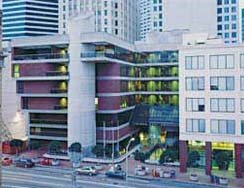
The main university building has a geometric concrete design often described as Brutalist, standing out in the San Francisco skyline. Its architecture offers photo opportunities, and the play of light makes daytime visits suitable for photography.
Visitors can see student lounges, parts of the library, and common areas that reflect the university’s focus on adult education. Photography is welcome in public areas.
Golden Gate Bridge
Viewpoints and nearby spots for seeing the bridge include:
- Battery Spencer Panoramic views from the north.
- Marin Headlands Elevated perspectives.
- Fort Point Close views from directly beneath the bridge.
- Crissy Field A waterfront park with relaxed bridge vistas.
Practical visiting information
Golden Gate University
- Address 536 Mission Street, San Francisco, CA 94105
- Visiting hours Monday–Friday, 8:00 AM–8:00 PM; Saturday, 9:00 AM–5:00 PM; closed Sundays and holidays.
The campus is open to the public during business hours. Regular public tours are not available, but prospective students and interested visitors can arrange a campus tour by appointment through the admissions page. Tours provide more information about the university’s programs and facilities. GGU also occasionally holds open houses and public events; announcements are posted on the official website.
The campus is fully accessible, with elevators, ramps, and accessible restrooms.
Golden Gate Bridge
- Bridge access Open 24/7 to pedestrians, cyclists, and vehicles.
- Visitor Center and Gift Shop Typically open daily from 9:00 AM to 6:00 PM.
- Pedestrian and bicycle access Free of charge.
- Vehicle tolls Charged southbound only, into San Francisco. Payment is accepted via FasTrak, online, or by mail (California Department of Transportation (Toll Information)).
- Guided tours Available through various operators, including walking, bike, and bus tours that offer historical insights and scenic stops.
- Accessibility Wheelchair-accessible walkways and ramps are available, as is accessible parking at the Welcome Center.
- Facilities Restrooms and limited parking are available at the Welcome Center and Vista Point.
Tips
Public transportation is a practical way to reach GGU: Montgomery Street BART station is just minutes away, and multiple Muni lines serve the area. Limited paid parking is available nearby.
For the Golden Gate Bridge, Golden Gate Transit buses and Muni can help visitors avoid parking hassles. Dress in layers, as fog and wind are common, and stay on marked paths while remaining mindful of your surroundings. Early morning or late afternoon can mean fewer crowds and good conditions for photography.
For updates, visitors can check official resources and channels. The Audiala app is also mentioned as a tool for ongoing updates and further insights.
Nearby places
GGU is within walking distance of the San Francisco Ferry Building, Union Square, and the Embarcadero Waterfront. The Financial District, Embarcadero, San Francisco Museum of Modern Art, and Chinatown are also nearby.
Near the Golden Gate Bridge are the Golden Gate National Recreation Area, Presidio, and Sausalito.