Town Club
PortlandUnited States of America 45° N · 122° W Updated Apr 2026
Built in 1931 by nine women who wanted what the all-male Arlington Club had, Portland's Town Club hides a Beaux-Arts interior behind its Mediterranean Revival facade.
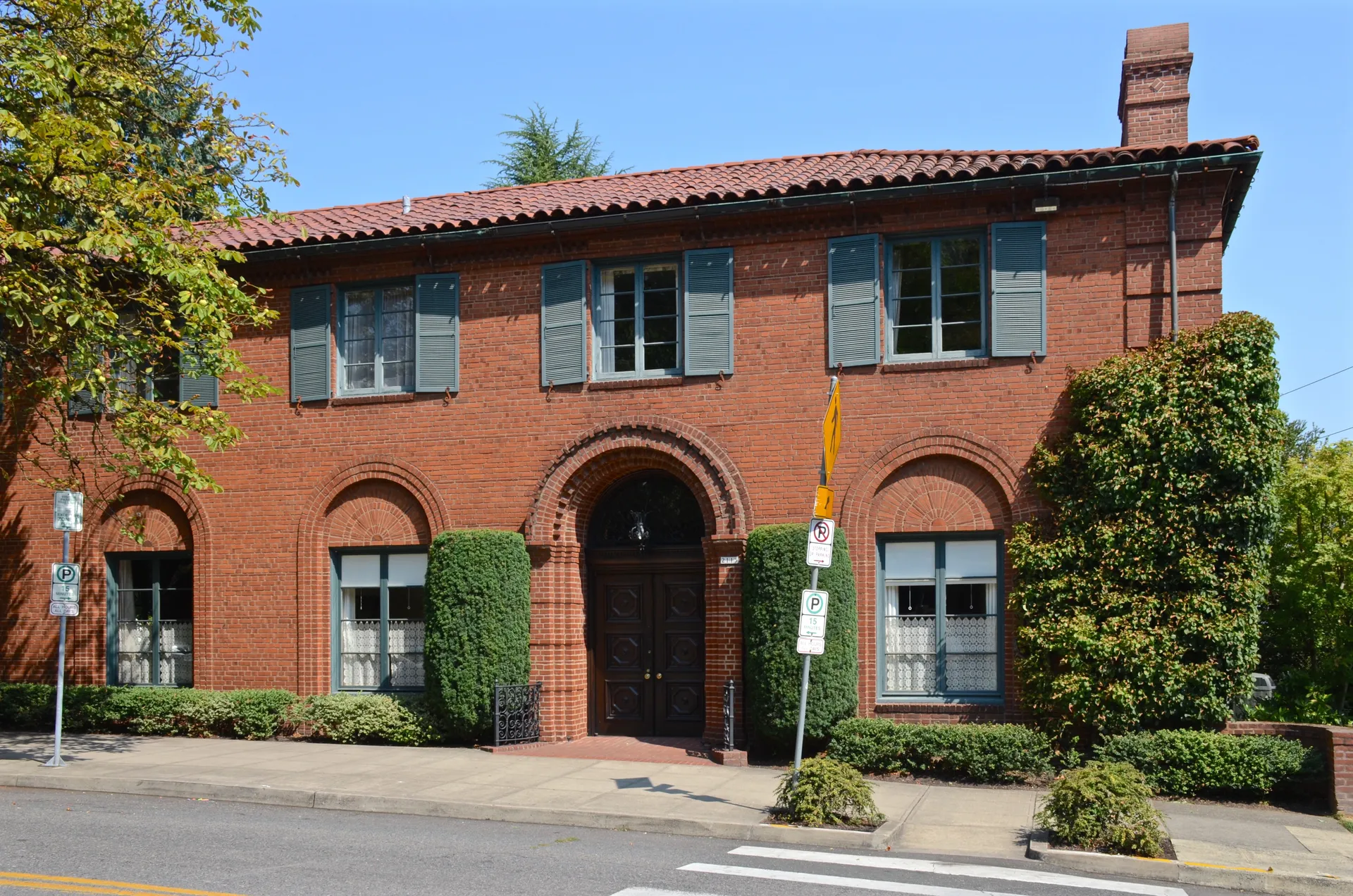 Photo: Steve Morgan · CC BY-SA 3.0
- Time needed
- 2–3 hours (guest events only)
- Entry
- Private club — no public admission fee
Nine women walked into a room in January 1928 and decided Portland, Oregon, needed a club of their own — one that would rival the men-only Arlington Club in ambition if not in square footage. The Town Club, the Mediterranean Revival building they willed into existence at 2115 SW Salmon Street, still stands in the Goose Hollow neighborhood as a private women's institution, its brick facade and mission-tile roof looking like it wandered in from the hills above Lake Como and decided to stay in the United States.
You can't just walk in. That's the first thing to understand. The Town Club is a private, invitation-only organization with roughly 442 dues-paying members, and its doors open to the public only for occasional fine dining events, lectures, and charity functions. But even from the sidewalk, the building tells a story about who got to claim civic space in early twentieth-century Portland — and who had to build their own.
What makes it worth knowing about, even if you never cross the threshold, is the architecture. Folger Johnson, trained at the École des Beaux-Arts in Paris, designed a building that manages to be both restrained and quietly theatrical. The site drops away steeply, so what looks like a modest two-story structure from the street entrance actually conceals five levels and three full stories. It's a building that keeps secrets. That feels appropriate.
Listed on the National Register of Historic Places since 1987, the Town Club sits a short walk from Washington Park and the historic King's Hill district. If you find yourself in Goose Hollow, it's the kind of building that stops you mid-stride and makes you wonder what's inside.
What to see
-
The Lounge and Its Coffered Ceiling
If you're ever invited inside — through a charity event, a guest lecture, or the good fortune of knowing a member — the lounge is the room that earns the building its reputation. The ceiling is coffered cast plaster, its central rosette painted in blue and gold, a color combination that reads as both regal and restrained depending on the light. Paneled woodwork lines the walls, and the fireplace is framed in travertine, the same porous limestone the Romans used for the Colosseum. The scale is domestic rather than grand, closer to a well-appointed living room than a ballroom, which is precisely the atmosphere the founders wanted. Stand beneath the rosette and look up: the plasterwork is detailed enough that you can count individual acanthus leaves from the floor, roughly four meters below. -
The Walled Garden
Behind the clubhouse, enclosed by a brick perimeter wall that matches the building's facade, sits a formal garden that feels startlingly private for a property wedged into a residential neighborhood. The wall blocks street noise and sightlines, creating a pocket of quiet that members have used for receptions and small gatherings since the 1930s. Portland's climate — mild, wet, green for most of the year — means the garden rarely looks bare. In late spring, it's the kind of space that makes you forget you're three blocks from a major arterial road. -
A Private Club, But Not Invisible
You don't need to go inside to appreciate the Town Club. Walk along SW Salmon Street and pause at the recessed entryway: the arched windows, the mission-tile roofline, the brickwork that shifts subtly in color depending on whether it's raining. The building's five-level structure is best understood from the downhill side, where the full height reveals itself and Johnson's trick of architectural modesty becomes obvious. The Town Club occasionally hosts events open to non-members — check their website or call (503) 226-4084 for the current schedule. A collared shirt and soft-soled shoes are expected of all guests, including men.
Plan your visit
- Getting There
- The Town Club sits at 2115 SW Salmon Street in the Goose Hollow neighborhood, about a 10-minute drive west of downtown Portland. TriMet bus lines 15 and 51 stop within two blocks, and the Providence Park MAX station is roughly a 12-minute walk east downhill. Street parking on SW Salmon and nearby King's Hill residential streets is free but limited — arrive early or plan to circle.
- Opening Hours
- As of 2025, the Town Club is a private, invitation-only women's club — there are no public visiting hours. The club occasionally opens for community events, fine dining evenings, and charitable programs, but attendance requires a member's invitation or advance registration for specific events. Contact (503) 226-4084 or [email protected] to inquire about upcoming open events.
- Time Needed
- If you're fortunate enough to attend an event, plan for 1.5 to 2 hours — enough to absorb the Mediterranean Revival interiors, linger in the formal garden enclosed by its brick perimeter wall, and appreciate the coffered plaster ceiling in the lounge. The building spans five levels across three effective stories, so there's more to it than the modest street facade suggests.
- Access & Membership
- This is not a museum. The National Register of Historic Places listing (since 1987) fools many visitors into expecting open doors, but the club remains strictly private with 442 dues-paying members as of recent counts. Applicants must be over 21, live within 25 miles of Portland, and survive a vote by the Board of Governors. Your best shot at seeing the interior is through a member friend or a publicized charitable event.
Photo Gallery


History
A Room of Their Own, in Brick and Travertine
Portland in the late 1920s had its share of private clubs, but they shared a common feature: women weren't welcome as members. The Arlington Club, the city's most prestigious social institution, was strictly male. For women interested in civic engagement, cultural programming, and the simple act of gathering on their own terms, the options were thin.
So nine of them — Josephine Chaney, Elizabeth Davis, Nan Wood Honeyman, Rhoda Madden, Florence Minott, Caroline Matson, Mary Posey, Adelaide Sterling, and Catherine Webster — decided to stop waiting for an invitation that would never come. By May 1928, they were holding their first official meetings in temporary downtown quarters, already planning something permanent.
The turning point
Folger Johnson and the View of Mount Hood
When Nellie Stevens Wilcox donated a parcel of land on SW Salmon Street in September 1929, the founders hired architect Folger Johnson to design their clubhouse. Johnson, a partner in the firm Johnson & Wallwork, had studied at the École des Beaux-Arts and brought back from Europe a specific memory: a modest building he'd seen in northern Italy, unpretentious but elegant. He used it as his model.
The founders gave Johnson two non-negotiable constraints. First, the building must not block the view of Mount Hood from neighboring homes — a demand that shaped every decision about height and massing. Second, construction costs were not to exceed $100,000, roughly $1.8 million in today's money. Johnson broke ground in August 1930. When the club opened in July 1931, the final bill came in at about $125,000, some 25 percent over budget. The members paid it without apparent complaint. They had their building.
What Johnson delivered was a Mediterranean Revival structure of fine brickwork and arched windows, with a recessed entryway and mission-style roof tiles that catch the Portland rain in terracotta channels. The sloping site allowed him to tuck five distinct levels into a form that reads as two stories from the street — a piece of architectural sleight of hand that still impresses architects who visit today.
The Founders and Their Ambitions
A Building That Earned Its Place on the Register
Tips for visitors
Dress Code Enforced
The club expects a polished appearance from all guests. Men accompanying members must wear collared shirts and soft-soled shoes — sneakers and open collars will get you turned away at the recessed entryway.Photography Is Limited
As a private club, interior photography is at the discretion of management and typically restricted. Ask before pulling out your phone — the coffered blue-and-gold rosette ceiling in the lounge deserves a photo, but you'll need permission to take one.Combine With Washington Park
Washington Park is a 10-minute walk uphill to the west, home to the International Rose Test Garden and the Japanese Garden. If you can't get inside the Town Club, the walk past it along SW Salmon still rewards you with views of the building's arched windows and mission-style roof tiles against the West Hills.Eat Nearby Instead
Goose Hollow Inn, a no-frills pub three blocks east on SW Jefferson, serves solid Reuben sandwiches at budget prices — it was once owned by former Portland mayor Bud Clark. For something more refined, Ringside Steakhouse on SW Burnside (a 7-minute drive) has been a Portland institution since 1944, firmly in the splurge category.Know The Backstory
Nine women founded this club in January 1928 as a direct answer to the all-male Arlington Club. They told architect Folger Johnson — trained at the École des Beaux-Arts in Paris — two things: don't block the neighbors' view of Mount Hood, and keep costs under $100,000. He exceeded the budget by $25,000 but delivered a building modeled on a structure he'd seen in northern Italy. Knowing this makes the understated exterior click.
Frequently asked
Is the Town Club Portland open to the public?
No — the Town Club is a private, invitation-only women's club, not a public venue. That said, it does open its doors for select community events, fine dining evenings, and charitable programs, so public access is possible on specific occasions. Check with the club directly at [email protected] to ask about upcoming guest events.
Is the Town Club Portland worth visiting?
If you can get inside, yes — the interior alone justifies the effort. The lounge features a coffered cast-plaster ceiling with a blue and gold central rosette, travertine-framed fireplace, and paneled woodwork that most Portlanders have never seen. The building is listed on the National Register of Historic Places and represents some of the finest Mediterranean Revival architecture in the Pacific Northwest.
How long do you need at the Town Club Portland?
For a guest event or dinner, plan for 2–3 hours to take in the architecture and gardens at a relaxed pace. The building spans five levels across a sloped site — roughly the footprint of a large urban townhouse — so there's more to see than the entrance suggests.
Who founded the Town Club in Portland?
Nine prominent Portland women founded the club in January 1928, among them Nan Wood Honeyman, who later became Oregon's first congresswoman. Their explicit goal was a social and civic counterpart to the all-male Arlington Club, which had no equivalent for women at the time.
What architectural style is the Town Club Portland?
The building is Mediterranean Revival, designed by Folger Johnson, who studied at the École des Beaux-Arts in Paris. Johnson modeled it after a modest structure he observed in northern Italy, producing fine brickwork, arched windows, and mission-style roof tiles on SW Salmon Street. It was listed on the National Register of Historic Places in 1987.
How do you become a member of the Town Club Portland?
Membership requires being over 21, living within 25 miles of Portland, and receiving a vote of approval from the Board of Governors. As of 2021, the club had 442 dues-paying members — a selective group by any measure.
Where is the Town Club located in Portland?
The Town Club sits at 2115 SW Salmon Street in the Goose Hollow neighborhood, close to Washington Park and the historic King's Hill district. You can reach the club by phone at (503) 226-4084.
Sources & attribution 5
- The Town Club Official Website — Primary source for address, contact details, membership criteria, and guest dress code.
- Oregon Encyclopedia: The Town Club — Main reference for founding history, architectural details, NRHP listing, and membership figures.
- Wikipedia: Town Club (Portland, Oregon) — Secondary confirmation of NRHP listing date and general history.
- Archives West: Portland Town Club Clubhouse Plans — Confirmation of August 1930 groundbreaking date and architectural records.
- PDX Monthly: Guide to Portland Private Clubs — Context on the Town Club's founding year and its relationship to other Portland private clubs.
Built from cited sources · see the method · How we make our guides →
More in Portland.
282 places to discover — a few worth pairing.
Pick up where you left off
Saved and recently read places — kept on this device only.
Photo credits (3)
- Town Club south facade in 2015 - Portland Oregon — Steve Morgan — CC BY-SA 3.0 (https://creativecommons.org/licenses/by-sa/3.0/) — Source: https://commons.wikimedia.org/wiki/File:Town_Club_south_facade_in_2015_-_Portland_Oregon.jpg
- The Town Club - Portland, Oregon (2015) — Steve Morgan — CC BY-SA 3.0 (https://creativecommons.org/licenses/by-sa/3.0/) — Source: https://commons.wikimedia.org/wiki/File:The_Town_Club_-_Portland,_Oregon_(2015).jpg
- Town Club Portland — Eaaumi — CC BY-SA 3.0 (https://creativecommons.org/licenses/by-sa/3.0/) — Source: https://commons.wikimedia.org/wiki/File:Town_Club_Portland.JPG
Photos may have been resized or cropped.