Country Music Hall of Fame and Museum
NashvilleUnited States 36° N · 86° W Updated Aug 2026
Its rotunda pillars are spaced to spell 'Will the Circle Be Unbroken'—inside, Elvis's solid-gold Cadillac gleams among the 2.5 million rare recordings.
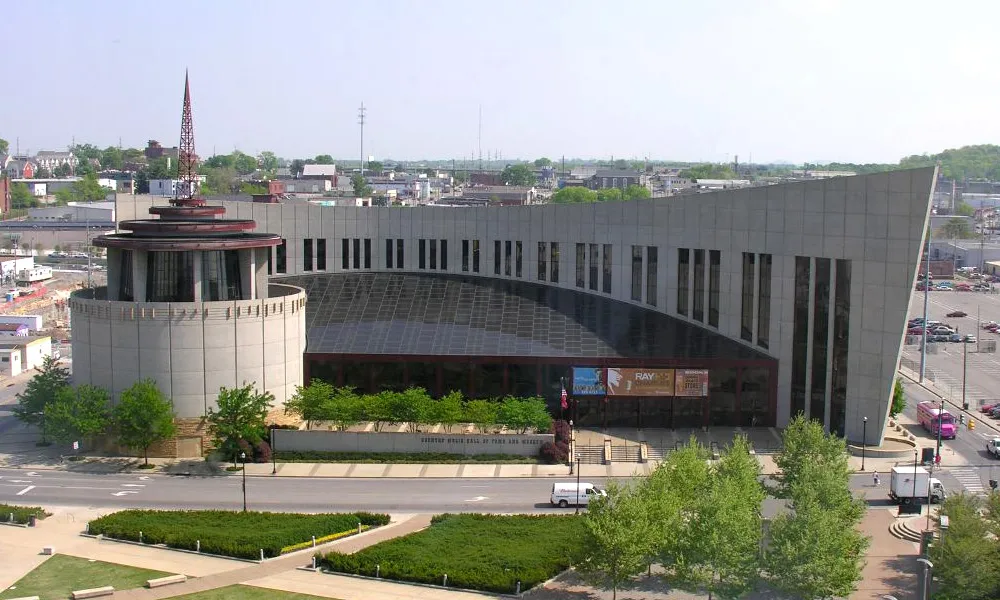 Photo: Sean Russell from Knoxville, TN, USA · CC BY-SA 2.0
- Time needed
- 2.5–3.5 hours
Why would a museum in Nashville, United States, shape its roof like a 1959 Cadillac tailfin? Because the Country Music Hall of Fame and Museum isn't just a display case for cowboy boots and Grammy trophies—it's a 350,000-square-foot argument that country music deserves the same archival seriousness as any symphony or cathedral. You come for Elvis Presley's solid gold Cadillac, but you stay for the unsigned Thomas Hart Benton mural and the realization that this 'hillbilly' genre has always been more interracial, more strange, and more meticulously preserved than Nashville's tourist strip lets on.
Step inside and the first thing you notice is the light. The limestone exterior's vertical windows slice Nashville's sun into piano-key shadows on the terrazzo floor. The Hall of Fame Rotunda rises 70 feet, ringed with bronze plaques of every inductee. Above them, in carved letters, runs the Carter Family lyric: 'Will the Circle Be Unbroken.' It's not just decoration; it's a promise.
This is no corporate theme park. The museum operates as an independent non-profit chartered by the State of Tennessee in 1964, and it holds one of the world's largest music research libraries: over 200,000 sound recordings, thousands of stage costumes, oral histories from session musicians and road managers. The Frist Library and Archive is so serious that scholars come from around the world to study acetates and hand-written lyrics that would otherwise be landfill.
Then there's the weird stuff you only notice if you look twice. The building's footprint draws a bass clef from the sky. The front windows step like piano keys. The roof canopy swoops like the tailfin of Elvis's 1960 Cadillac—which is sitting right inside, painted as gold as a pawn shop ring. This is a museum that hides its secrets in plain sight.
What to see
-
The Building That Plays Piano
The first surprise is outside, before you buy a ticket. Tuck-Hinton Architects designed the 2001 downtown building as a stack of musical metaphors: the curved facade alternates dark glass and pale Crab Orchard sandstone in a piano-key rhythm, and the northern roofline sweeps up like a 1959 Cadillac tailfin. From above, the footprint traces a bass clef. Stand across Rep. John Lewis Way and squint—the building plays itself. -
Sing Me Back Home: The Core Galleries
Elvis's 1960 Cadillac Series 75 sits on the second floor like a gilded whale—24-karat gold-plated trim, crushed diamond and fish-scale paint, a record player in the back seat. The thing cost more than a Nashville house in 1960 and looks it. Nearby, the Gold and Platinum Record Wall climbs the stairwell, thousands of RIAA discs throwing warm light onto the escalator. Don't rush past the handwritten lyric scraps on hotel stationery; Dolly Parton's strike-throughs are a masterclass in editing under pressure. -
The Working Side: Hatch Show Print + RCA Studio B
Skip the gift shop and walk into Hatch Show Print, where master printers have been inking carved woodblocks since 1879. The smell hits first—linseed oil, black ink, damp paper—then the rhythmic thump-clack-hiss of Vandercook presses. You can pull your own poster on antique type. Then board the shuttle to RCA Studio B on Music Row, where Chet Atkins and Owen Bradley built the Nashville Sound and Elvis asked for blue lights to sing 'Are You Lonesome To-night?' The deadened silence in that room, after the press shop's clatter, will rearrange your sense of what a recording actually is.
Plan your visit
- Getting There
- You'll find it at 222 Rep. John Lewis Way S in downtown Nashville, two blocks south of Lower Broadway and one block from Bridgestone Arena. WeGo Public Transit buses stop along Broadway and 4th Avenue, and rideshare drop-offs are on Rep. John Lewis Way S and Demonbreun Street. If you drive, use the Walk of Fame Parking Garage at 161 4th Ave S or SoBro Tower Garage at 210 3rd Ave S for $15 validated parking up to 3 hours.
- Opening Hours
- Open daily 9:00 AM–5:00 PM as of 2026, with galleries cleared at 5:00 and closing announcements starting 15 minutes earlier. Peak crowds hit between 10:00 AM and 2:00 PM. Closed Thanksgiving Day, Christmas Eve, Christmas Day, and during the private Medallion Ceremony, typically the third Sunday in October.
- Time Needed
- Budget 1.5 hours for a highlights pass: the Sing Me Back Home gallery, Elvis's 1960 solid-gold Cadillac, and the circular Hall of Fame Rotunda. A comfortable self-guided visit runs 2 to 2.5 hours. Add 75–90 minutes for the RCA Studio B shuttle tour and another hour for Hatch Show Print if you want the full sweep.
- Accessibility
- The building is fully ADA-compliant, with ramped entrances at Demonbreun and Rep. John Lewis Way S plus elevators to all galleries. Guest Services lends manual wheelchairs free on a first-come basis; power scooters can't ride the Studio B shuttle due to lift weight limits. KultureCity sensory bags, a 2nd-floor sensory room, Braille guides, and free ASL interpretation with two weeks' notice are available.
- Cost & Tickets
- As of 2026, standard adult admission starts around $31.95, youth ages 6–12 about $21.95, and kids 5 and under enter free. Senior, student, and military discounts are available only at the on-site box office. Combo tickets with RCA Studio B or Hatch Show Print run roughly $55 and up; book timed entry online to skip the wait.
Tickets & tours.
These are guided options from our partners — same price as booking direct.
Prices are indicative — final pricing and availability are confirmed at checkout. Audiala may earn a commission from bookings made through these links.
Photo Gallery


History
The Unbroken Circle
The Country Music Hall of Fame was born in 1961 as an honor, not a building. Its first three names were Jimmie Rodgers, Fred Rose, and Hank Williams. But the museum that now anchors downtown Nashville didn't exist until 1967, when a barn-shaped building opened on Music Row. That building was small, cramped, and expanded three times before the institution made its big move.
In 2001, the museum relocated to a custom-built downtown landmark designed by Tuck-Hinton Architects. A $100 million expansion in 2014 doubled its footprint to 350,000 square feet—roughly the size of six football fields—adding the 776-seat CMA Theater, the Taylor Swift Education Center, and a working letterpress shop. Today, the museum also operates Historic RCA Studio B, the 1957 room where Elvis Presley recorded and the 'Nashville Sound' was engineered.
The turning point
The Woman Who Refused to Let Country Music Die
It's easy to assume the Country Music Hall of Fame was always inevitable. Country music fills stadiums, tops charts, and launches global superstars. The rotunda's bronze plaques look permanent, like a pantheon nobody had to fight for.
But in the early 1960s, country music was 'hillbilly' music—too lowbrow for institutional archives, too rural for corporate sponsors. Jo Walker-Meador, the Country Music Association's first executive director, watched the genre's physical history evaporate: acetate master discs sold at estate sales, hand-written lyrics tossed in trash cans, oral histories dying with their tellers. She had no building, no budget, and no guarantee the State of Tennessee would charter a non-profit museum.
Walker-Meador spent years lobbying and fundraising. She convinced Roy Acuff, Tex Ritter, and Minnie Pearl to donate personal treasures and cash. By 1964, the Country Music Foundation was chartered, and in 1967, the barn-shaped museum opened on Music Row. But the real turning point came in 1975, when painter Thomas Hart Benton—commissioned to create the museum's defining mural—finished The Sources of Country Music, told his wife he was going to sign it, and collapsed dead beneath the canvas. The museum inherited a masterpiece that killed its maker, unsigned.
Today, when you stand in the Hall of Fame Rotunda and look up at that unsigned mural, the story shifts. That blank corner of canvas isn't an oversight. It's a record of the exact moment preservation stopped being a cultural afterthought and became a matter of life and death. Country music was never just entertainment; it was memory worth dying for.
Studio B: The Room That Made the Nashville Sound
Hatch Show Print: Inky Fingers Since 1879
Tips for visitors
Flash Kills the Gold
Non-flash stills and short phone videos are fine in most galleries, but flash, selfie sticks, and tripods are banned. Video recording is also prohibited inside Hatch Show Print, on Studio B tours, and during guided museum tours.No Lockers, No Mercy
The museum has no luggage storage, coat check, or lockers, and bags larger than 16″ x 17″ x 8″ won't pass security. Leave the roller bag at your hotel or car before arriving.Skip the Scalper Tax
Book directly through the museum website or box office; third-party resellers routinely inflate general admission prices. RCA Studio B timed tickets are limited and can sell out weeks in advance.Beat the 10 A.M. Wave
Crowds throng the galleries from 10:00 to 2:00, so arrive at 9:00 sharp or after 2:30 for quieter rooms and better light in the rotunda.Park Validated or Pay Double
Surface lots around SoBro use dynamic pricing and hit $40–$60 on event nights. Show your ticket at the information desk and park at Walk of Fame Garage or SoBro Tower Garage for a $15 flat rate up to 3 hours.Go Quiet in the Rotunda
Locals treat the Hall of Fame Rotunda like a secular chapel; lower your voice among the bronze plaques and you'll catch the same hush that hangs beneath the WSM radio tower replica.
Frequently asked
Is the Country Music Hall of Fame and Museum worth visiting?
Yes, even if you don't like twangy radio country. The two-floor Sing Me Back Home exhibit treats the music as a sweaty, interracial American argument, and the artifacts—Elvis's 24-karat-trimmed 1960 Cadillac, Bill Monroe's knife-gouged mandolin—feel less like memorabilia and more like evidence.
How long do you need at the Country Music Hall of Fame and Museum?
Plan 2 to 2.5 hours for the core galleries. Add 75 to 90 minutes for the Historic RCA Studio B shuttle tour and another hour if you want to pull your own letterpress poster at Hatch Show Print.
How do I get to the Country Music Hall of Fame and Museum from downtown Nashville?
Walk. It's at 222 Rep. John Lewis Way S, two blocks south of Lower Broadway and about a 10-minute stroll from Ryman Auditorium. If you're coming from farther afield, WeGo buses serve Broadway and 4th Avenue, and rideshare drop-offs are along Rep. John Lewis Way and Demonbreun.
What is the best time to visit the Country Music Hall of Fame and Museum?
Arrive at 9:00 AM or after 2:30 PM. The galleries clog with tour buses between 10:00 AM and 2:00 PM, especially during summer and CMA Fest; late afternoon light in the Hall of Fame Rotunda is also quieter and prettier.
Can you visit the Country Music Hall of Fame and Museum for free?
Not for free, unless you're a local kid. Youth 18 and under who live in Davidson and six surrounding counties enter free; adults pay around $32, with discounts for students, seniors 60+, and active military at the on-site box office.
What should I not miss at the Country Music Hall of Fame and Museum?
Don't skip the Hall of Fame Rotunda. Bronze plaques circle at equal height under the words 'Will the Circle Be Unbroken,' deliberately unranked—then look for the unsigned Thomas Hart Benton mural, finished minutes before his 1975 heart attack. If you can book ahead, the RCA Studio B tour's blue-light Elvis demo is the most transporting 10 minutes in Nashville.
Is Historic RCA Studio B included in Country Music Hall of Fame admission?
No. Studio B is a separate add-on tour with a shuttle from the museum, and it frequently sells out days ahead. It takes about 75 to 90 minutes total and drops you inside the room where Elvis recorded over 200 tracks, often with the original Steinway still in place.
Where do you park when visiting the Country Music Hall of Fame and Museum?
Use the Walk of Fame Parking Garage at 161 4th Ave S or SoBro Tower Garage at 210 3rd Ave S. Museum validation drops the cost to $15 for up to 3 hours or $25 for up to 6 hours; nearby surface lots can spike to $40–60 during events.
Sources & attribution 14
- Country Music Hall of Fame and Museum — About — Institutional timeline, 1961 Hall of Fame creation, 1964 Country Music Foundation charter, 1967 Music Row opening, 2014 expansion, National Medal of Arts.
- SAH Archipedia — Country Music Hall of Fame and Museum — Architectural history of the 2001 Tuck-Hinton building, 2014 expansion dimensions, Crab Orchard sandstone materials, and Cadillac tailfin symbolism.
- Country Music Hall of Fame — Museum Policies & FAQ — Hours, closures, ticket pricing, parking validation rates, bag policy, photography rules, and accessibility details.
- Country Music Hall of Fame — Know Before You Go — Daily 9:00 AM to 5:00 PM hours, peak visitation windows, and arrival-time guidance.
- Country Music Hall of Fame — Select Your Experience — Admission tiers, Early Access tour pricing, Studio B and Hatch Show Print combo ticketing.
- Country Music Hall of Fame — Historic RCA Studio B — Studio B tour details, Nashville Sound history, Elvis recording history, and shuttle access from the museum.
- Country Music Hall of Fame — Hall of Fame Rotunda — Rotunda layout, equal-height bronze plaques, and the 'Will the Circle Be Unbroken' inscription.
- Country Music Hall of Fame — Local Kids Visit Free — Free admission policy for youth 18 and under in seven Middle Tennessee counties.
- Country Music Hall of Fame — Architecture & Design Details — Bass clef footprint, piano key windows, recording format discs, and WSM tower-inspired spire symbolism.
- Country Music Hall of Fame — Press Release on Historic RCA Studio B — Confirms museum stewardship of Studio B beginning in 1977 and the studio's 1957 construction.
- Parents with Passports — Country Music Hall of Fame — Visitor-reported architectural symbolism, rotunda etiquette, and sensory impressions of exhibits and galleries.
- Tennessee Arts Commission — Country Music Hall of Fame and Museum — Institutional profile, 1964 charter context, and educational outreach scale.
- Saving Country Music — Medallion Ceremony — Details on the private annual Medallion Ceremony, inductee rituals, and critiques of closed-door induction practices.
- Wikipedia — Country Music Hall of Fame and Museum — General institutional history and Museum Row expansion chronology.
Built from cited sources · see the method · How we make our guides →
More in Nashville.
65 places to discover — a few worth pairing.


Pick up where you left off
Saved and recently read places — kept on this device only.
Photo credits (12)
- Country music hall of fame2 — Sean Russell from Knoxville, TN, USA — CC BY-SA 2.0 (https://creativecommons.org/licenses/by-sa/2.0/) — Source: https://commons.wikimedia.org/wiki/File:Country_music_hall_of_fame2.jpg
- Bakersfield Exhibition Entrance Country Music Hall of Fame and Museum — mr_t_77 — CC BY-SA 2.0 (https://creativecommons.org/licenses/by-sa/2.0/) — Source: https://commons.wikimedia.org/wiki/File:Bakersfield_Exhibition_Entrance_Country_Music_Hall_of_Fame_and_Museum.jpg
- Bajo Sexto Taco at the Country Music Hall of Fame — Michael Rivera — CC BY-SA 4.0 (https://creativecommons.org/licenses/by-sa/4.0/) — Source: https://commons.wikimedia.org/wiki/File:Bajo_Sexto_Taco_at_the_Country_Music_Hall_of_Fame.JPG
- Country-Music-Hall-of-Fame-logo — Cmhof dm — CC BY-SA 4.0 (https://creativecommons.org/licenses/by-sa/4.0/) — Source: https://commons.wikimedia.org/wiki/File:Country-Music-Hall-of-Fame-logo.png
- Country Music Hall of Fame 2022c — Antony-22 — CC BY-SA 4.0 (https://creativecommons.org/licenses/by-sa/4.0/) — Source: https://commons.wikimedia.org/wiki/File:Country_Music_Hall_of_Fame_2022c.jpg
- Country Music Hall of Fame Rotunda — edwardhblake — CC BY 2.0 (https://creativecommons.org/licenses/by/2.0/) — Source: https://commons.wikimedia.org/wiki/File:Country_Music_Hall_of_Fame_Rotunda.jpg
- Country Music Hall of Fame 2022b — Antony-22 — CC BY-SA 4.0 (https://creativecommons.org/licenses/by-sa/4.0/) — Source: https://commons.wikimedia.org/wiki/File:Country_Music_Hall_of_Fame_2022b.jpg
- Country Music Hall of Fame 2022d — Antony-22 — CC BY-SA 4.0 (https://creativecommons.org/licenses/by-sa/4.0/) — Source: https://commons.wikimedia.org/wiki/File:Country_Music_Hall_of_Fame_2022d.jpg
- Country Music Hall of Fame and Museum - Circa The Museum Shop (2015-04-09 11.57.43 by prayitnophotography) — Thank You (23 Millions+) views from Los Angeles, USA — CC BY 2.0 (https://creativecommons.org/licenses/by/2.0/) — Source: https://commons.wikimedia.org/wiki/File:Country_Music_Hall_of_Fame_and_Museum_-_Circa_The_Museum_Shop_(2015-04-09_11.57.43_by_prayitnophotography).jpg
- Country Music Hall of Fame Rotunda WSM radiotower Replica (Indoor) — Curtis McPeake, Andy May — CC BY 2.0 (https://creativecommons.org/licenses/by/2.0/) — Source: https://commons.wikimedia.org/wiki/File:Country_Music_Hall_of_Fame_Rotunda_WSM_radiotower_Replica_(Indoor).jpg
- Country Music Hall of Fame and Museum Rotunda — OLE BENDIK KVISBERG — CC BY 2.0 (https://creativecommons.org/licenses/by/2.0/) — Source: https://commons.wikimedia.org/wiki/File:Country_Music_Hall_of_Fame_and_Museum_Rotunda.jpg
- Country Music Hall of Fame and Museum - atrium lobby lounge (2015-04-09 11.24.16 by prayitnophotography) — Thank You (23 Millions+) views from Los Angeles, USA — CC BY 2.0 (https://creativecommons.org/licenses/by/2.0/) — Source: https://commons.wikimedia.org/wiki/File:Country_Music_Hall_of_Fame_and_Museum_-_atrium_lobby_lounge_(2015-04-09_11.24.16_by_prayitnophotography).jpg
Photos may have been resized or cropped.