
What Watts Towers Is
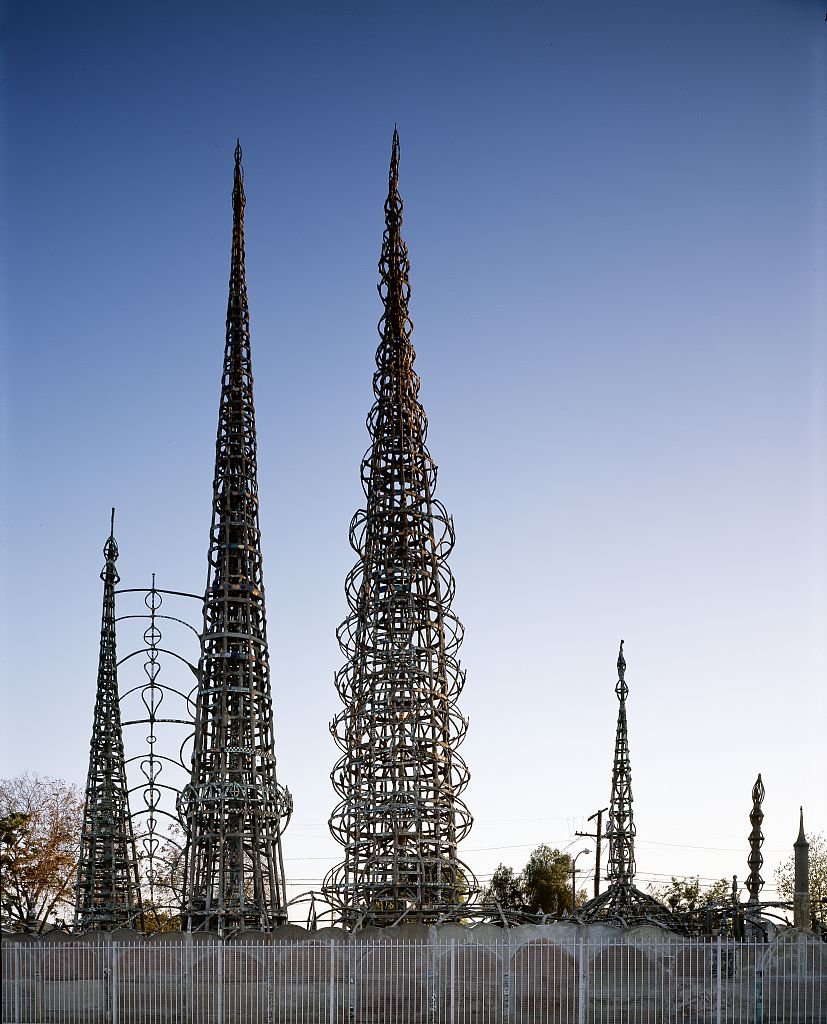
Located in the Watts neighborhood of South Los Angeles, Watts Towers is a landmark of folk and outsider art and a symbol of creativity, cultural resilience, and perseverance. Conceived and built over 33 years by Italian immigrant Sabato “Simon” Rodia, the interconnected towers rise nearly 100 feet. Known as “Nuestro Pueblo” (“Our Town”), they feature mosaics made from found and recycled materials, including broken glass, pottery shards, and seashells. Their designs reflect Italian traditions, Mexican and Native American motifs, and other local multicultural influences.
For current information, see the Watts Towers Arts Center, California State Parks, and Discover Los Angeles.
History
Watts and the early 20th century
Watts was incorporated into Los Angeles County in 1907. The construction of the Pacific Electric Railway’s Watts Station in 1904 helped make the area a hub for working-class families (SAH Archipedia). By the 1920s, Watts had a diverse population that included many African American and immigrant families drawn by affordable land and growing job opportunities.
Simon Rodia and construction
Born in Italy in 1879, Rodia moved to Watts in 1921 and purchased a triangular lot. Inspired to “do something big,” he worked alone for 33 years, without blueprints or machinery, creating 17 interconnected towers and structures from materials sourced from local neighborhoods and businesses (Watts Towers Arts Center; The Cultural Landscape Foundation).
The structures use steel rebar and pipes bent and wired together as a frame, covered in hand-packed Portland cement. Rodia decorated them with mosaics of found and donated objects, including broken glass, seashells, tiles, and pottery shards (Discover Los Angeles). The tallest tower is 99.5 feet; Watts Towers has been described as the world’s largest single construction by one person (Verdant Traveler).
Artistic significance and preservation
Celebrated as a major example of folk and outsider art, the Towers’ mosaics draw on Italian festivals, Mexican folk art, Native American designs, and local multicultural motifs (Islands Magazine). The project predated and influenced the modern assemblage art movement.
Rodia completed the Towers in 1954, deeded the property to a neighbor, and left Watts. In 1957, the city threatened demolition over safety concerns; an engineering test in 1959 proved the structures stable (Discover Los Angeles). The Towers were recognized as a Los Angeles Historic-Cultural Monument in 1963, added to the National Register of Historic Places in 1977, and designated a California Historical Landmark and U.S. National Historic Landmark in 1990 (Wikipedia; Watts Towers Arts Center). Preservation efforts involve the City of Los Angeles, the State of California, and organizations such as LACMA (Saving Places).
What to See and Experience
Visitors can view the Towers’ intricate mosaics and structural details from the perimeter, including when interior access is limited. Docent tours explore the Towers’ construction, techniques, history, and symbolism. The Arts Center’s documentary also adds context and makes a visit engaging for families and school groups.
The adjacent Watts Towers Arts Center hosts exhibitions, workshops, music lessons, and community events, and supports arts education and preservation (Watts Towers Arts Center). Along with the Charles Mingus Youth Arts Center, it provides arts education and programming for the community, nurturing new generations of artists and celebrating Watts’ diverse heritage (Etan Does LA). The Towers have inspired artists and appeared in popular culture, films, and music (Travel in USA).
Practical Visiting Information
Hours, admission, and tours
- Hours Tuesday through Sunday, 10:00 AM to 5:00 PM.
- Closed Mondays and major holidays, also described as major public holidays.
- Admission Free for all visitors.
- Guided tours Tickets are required. Tours run hourly during open hours and are available onsite or through the Watts Towers Arts Center tour page. Tours can be booked in advance online or by phone.
Location, directions, and accessibility
Address: 1765 East 107th Street, Los Angeles, CA 90002
- By car Free parking is available nearby, but spaces are limited. Observe local parking regulations.
- By public transit Metro Bus lines 128 and 55 stop close to the Towers. The Metro A Line, formerly the Blue Line, stops at the 103rd Street/Watts Towers station, about a half-mile walk from the site (Tinybeans Guide).
- Accessibility The site and Arts Center have wheelchair-accessible paved paths, ramps, and accessible restrooms. Interior access may be limited due to preservation work; contact the Arts Center for details. Neighborhood sidewalks may be uneven, so use caution with strollers or wheelchairs.
Tips for Visiting
- Early afternoons are suggested for tours and photography; weekends are a time for festivals.
- Bring comfortable shoes, sun protection, water, and snacks.
- Remain aware of your surroundings in this urban neighborhood.
- Photography is permitted for personal use. Drones and commercial shoots require advance permission.
- Check the official website for current hours, tour schedules, and special events. The Audiala app offers guided audio tours and updates; Watts Towers and the Arts Center also share news on social media.
Nearby Places and Events
Nearby places include the Charles Mingus Youth Arts Center, Watts Train Station (now an art gallery), local parks and public art installations, and Watts Coffee House, which serves Southern-inspired cuisine.
Annual cultural festivals include the Day of the Drum and the Watts Towers Jazz Festival, also called the Simon Rodia Watts Towers Jazz Festival. These events celebrate the site’s multicultural spirit and attract thousands of visitors (Discover Los Angeles).
Frequently Asked Questions
What are the Watts Towers visiting hours?
Tuesday through Sunday, 10:00 AM to 5:00 PM. The site is closed Mondays and holidays.
Is there an entrance fee?
No. Admission is free; guided tours require tickets.
Are guided tours available?
Yes. Tours run hourly during open hours. Book through the Arts Center website, onsite, or in advance by phone.
Is the site accessible for people with disabilities?
The site and Arts Center have paved paths, ramps, and accessible restrooms. Interior access may be limited due to preservation work, and neighborhood sidewalks may be uneven.
How do I get there by public transportation?
Take Metro Bus line 128 or 55, or the Metro A Line to the 103rd Street/Watts Towers station.
Can I take photos or videos?
Photography is permitted for personal use. Drones and commercial shoots require advance permission.