Type 2+ letters to search all countries, cities, and places
/Ctrl KEsc
travel_explore
Type 2+ letters to search all countries, cities, and places
Press Enter to open the top result
Hollywood Walk of Fame
Los Angeles·United States of America·34° N · 118° W·Updated Apr 2026
Over 2,800 coral-pink terrazzo stars span 1.7 miles of Hollywood Blvd — and the first permanent one was laid on March 28, 1960, for a director, not a star.
The most expensive sidewalk in the United States was built not to celebrate fame but to prevent a neighborhood from dying. The Hollywood Walk of Fame stretches 1.3 miles along Hollywood Boulevard and another 0.4 miles down Vine Street in Los Angeles, a coral-pink constellation of over 2,800 brass-rimmed stars embedded in the pavement of America's most mythologized district. It draws roughly 10 million visitors a year, and it costs nothing to walk.
What surprises most people is how ordinary the setting feels. You're not entering a museum or a gated monument — you're standing on a public sidewalk, dodging costumed Spidermen and the sharp smell of street-vendor hot dogs, scanning the ground for a name you recognize. The stars face east and west on Hollywood Boulevard, north and south on Vine, angled so they're always readable to pedestrians walking in either direction. That kind of deliberate, invisible design runs through the whole project.
The Walk is less a tribute to greatness than a record of who had a studio or a label willing to pay for the privilege. That commercial reality — the fact that sponsorship, not merit alone, determines who gets a star — gives it a strange honesty. It's Hollywood's own mythology, laid bare in terrazzo and brass, right under your feet.
Come for the names you love. Stay for the ones you've never heard of, the 1960s television hosts and forgotten radio stars whose five-pointed markers sit quietly between the Marilyn Monroes and the Michael Jacksons. The Walk is at its most interesting when it reminds you how quickly fame fades — and how stubbornly concrete tries to hold it in place.
Researched by the Audiala editorial team from historical records, architectural archives, and local expertise.
What to see
The Stars Themselves — Up Close
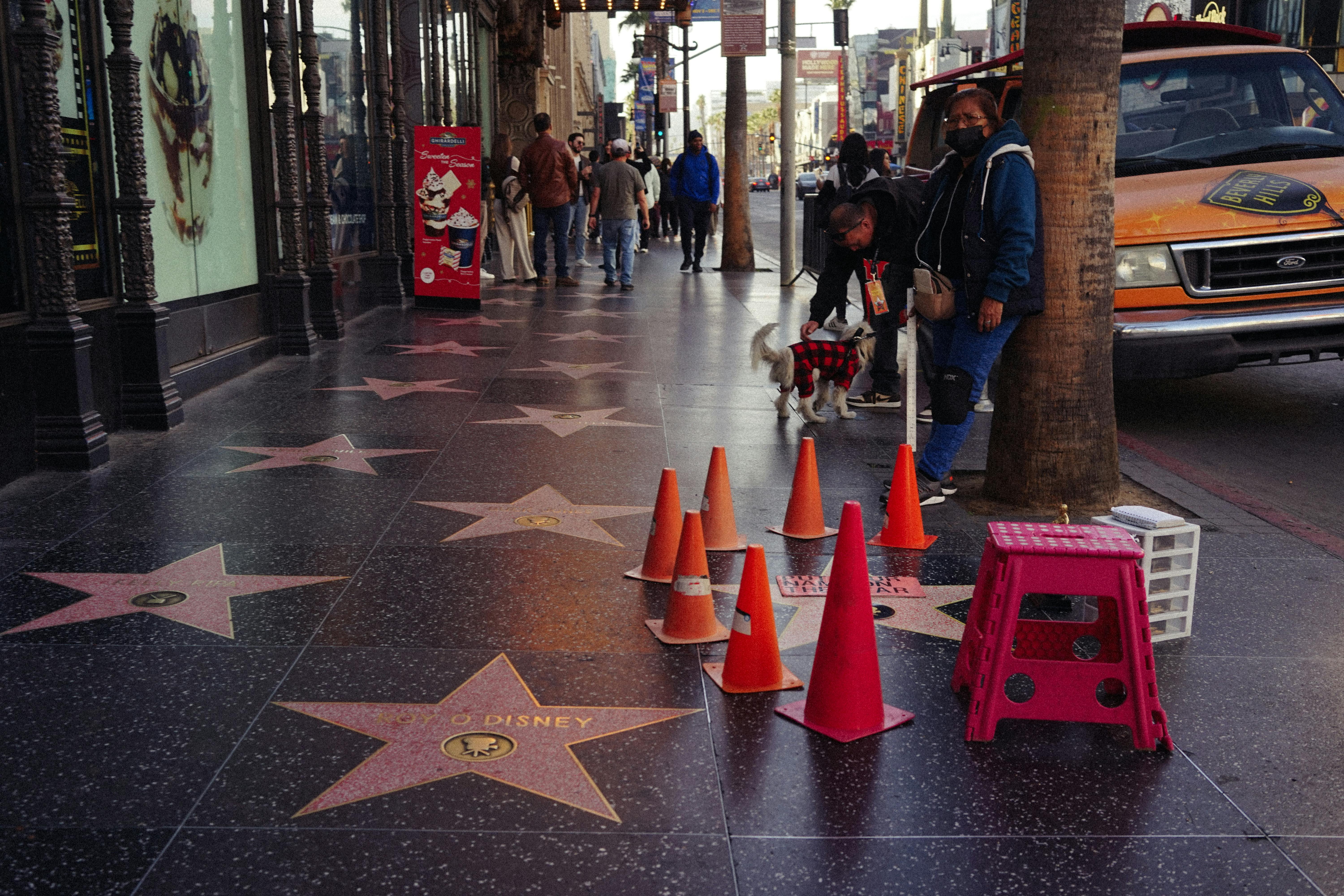
Most people walk right over them. Stop. Each star is a 3-by-3-foot square of coral-pink terrazzo — roughly the size of a café table — rimmed in brass and set into a charcoal background that makes the pink glow even in flat light. Over 2,800 of them stretch across 1.3 miles of Hollywood Boulevard and another 0.4 miles down Vine Street, a distance that would take you from one end of London Bridge to the other and back again. The brass emblems are the real tell: a miniature film camera for motion pictures, a tiny television set for broadcast, a record for music. Run your fingers across one of the older stars — say, a silent-film pioneer near Gower Street — and you'll feel how decades of foot traffic have worn the terrazzo smooth while the brass has oxidized to a deep, almost greenish patina. Compare that to a star laid last year, still sharp-edged and bright. You're reading time with your hands.
And then there's Muhammad Ali. His is the only star not in the sidewalk. It's mounted on the wall of the Dolby Theatre because Ali refused to let the name of the Prophet Muhammad be walked upon. You have to look up to find it, which feels exactly right.
The Apollo 11 Monuments at Hollywood and Vine
Here's something almost nobody expects. At the intersection of Hollywood Boulevard and Vine Street — the most symbolically loaded crossroads in American entertainment — there are no stars at all. Instead, four round moon-shaped monuments honor the Apollo 11 mission and its crew: Neil Armstrong, Buzz Aldrin, Michael Collins, and the mission itself. They were placed here in 1969, and they remain the only non-star tributes on the entire Walk. The logic was simple and grand: landing on the moon was the greatest performance in human history, and it deserved a different shape.
The intersection itself is worth pausing at even without the monuments. Look up from the pavement and you'll see the Capitol Records Building a block north, its stacked circular floors designed in 1956 by Welton Becket to resemble a stack of vinyl records on a turntable — a piece of Googie-era optimism that still reads as futuristic. The contrast between the space-age monuments underfoot and the record-stack tower above captures something true about this stretch of Los Angeles: it has always been a city that confuses ambition with architecture, and sometimes gets it exactly right.
A Morning Walk: Gower to Highland, Before the Crowds
The Walk of Fame is open 24 hours and free, but timing changes everything. Arrive before 9:00 AM — ideally on a weekday — and you'll have the boulevard nearly to yourself. Start at the eastern end near Gower Street, where the oldest and most weathered stars sit in relative quiet, and walk west toward the Hollywood/Highland intersection. The morning light comes from behind you, warming the pink terrazzo and casting long shadows from the palms. You'll pass the façade of the El Capitan Theatre, Disney's 1926 movie palace restored to its Spanish Colonial glory, and the Hollywood Roosevelt Hotel, which hosted the first Academy Awards ceremony in 1929 and still offers a cool lobby to duck into when the sun climbs.
The full walk from Gower to La Brea takes about 30 minutes at a steady pace, but you'll want an hour to actually read the names and notice the details — the way the stars face east-west on the boulevard so they're always legible to pedestrians, or the slight color shifts between terrazzo batches poured decades apart. Take the Metro B Line to Hollywood/Vine to start, and you can catch it again at Hollywood/Highland when your feet protest. From there, the Griffith Observatory is a short drive north into the hills — a fine counterpoint, trading sidewalk glamour for a view that puts all of Los Angeles at your feet.
Plan your visit
Getting There
The LA Metro B Line (Red) is your best bet — exit at Hollywood/Highland to land in the Walk's center, or Hollywood/Vine for the eastern stretch. Driving is a headache: street parking barely exists, and the Ovation Hollywood garage runs $6–$10/hour, though restaurant validation can knock it down to about $3 for two hours. Rideshare drop-off works well on side streets off Hollywood Blvd.
Opening Hours
As of 2026, the Walk of Fame is a public sidewalk — open 24 hours, every day, no gates, no tickets. Star induction ceremonies happen on weekday mornings (check walkoffame.com for the schedule). The area is dramatically quieter before 9 a.m. and considerably grimier after midnight.
Time Needed
A focused walk past the major landmarks — TCL Chinese Theatre, the Dolby Theatre, a few favorite stars — takes 1–2 hours. If you add the Hollywood Museum, the Egyptian Theatre, or a guided tour, budget 3–4 hours. Honestly, many visitors feel satisfied after 30–45 minutes of star-hunting and photos.
Accessibility
The Walk is flat, standard-grade sidewalk — fully wheelchair accessible in theory. In practice, dense crowds, street performers, and vendor tables can narrow the path significantly, especially between Highland and La Brea on summer afternoons. The Metro stations at Hollywood/Highland have elevator access to street level.
Cost
The Walk itself is completely free. Star ceremonies are also free and open to the public — no tickets or reservations needed. Your only costs are parking or transit ($1.75 per Metro ride) and whatever you spend resisting the souvenir shops.
Tickets & tours.
These are guided options from our partners — same price as booking direct.
Prices are indicative — final pricing and availability are confirmed at checkout. Audiala may earn a commission from bookings made through these links.
Photo Gallery
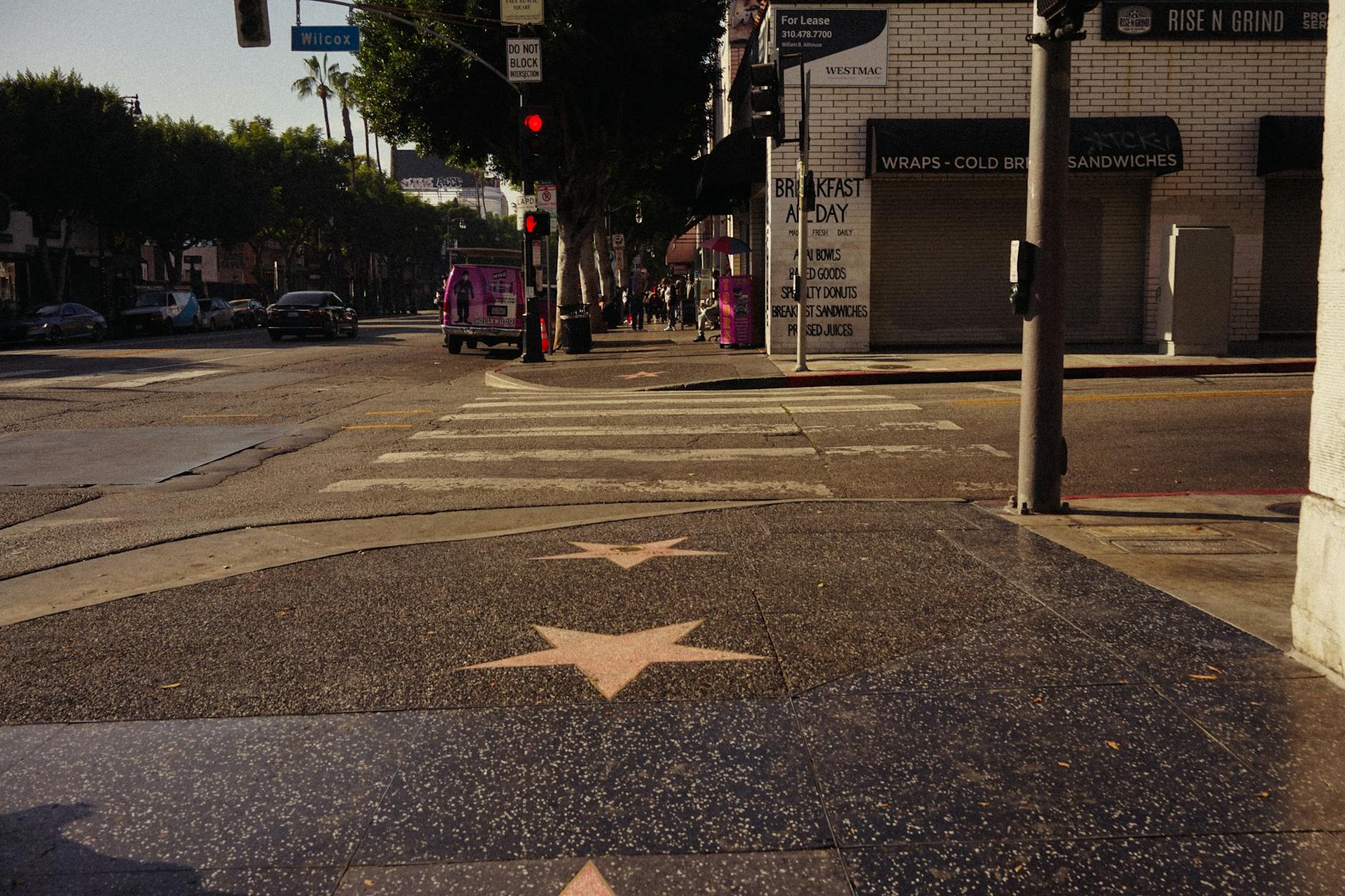
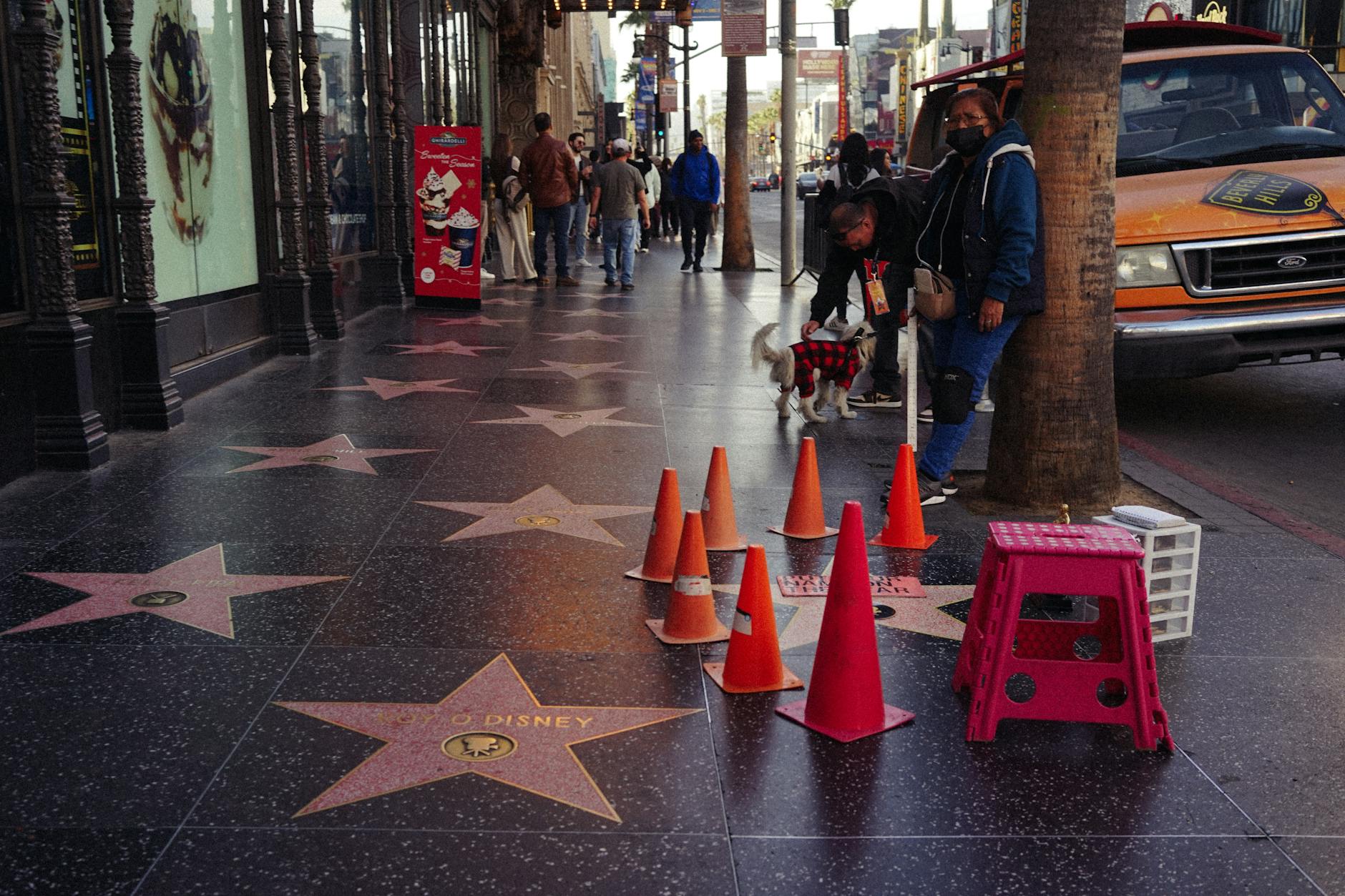
The iconic stars of the Hollywood Walk of Fame line the sidewalk in Los Angeles, honoring legendary entertainers. · Ekaterina Belinskaya on PexelsAn elevated perspective of the bustling Hollywood Walk of Fame in Los Angeles, showing pedestrians navigating the famous stars alongside busy city traffic. · Rino Adamo on PexelsA bright, sunny day on the iconic Hollywood Walk of Fame in Los Angeles, showcasing the historic Wax Museum and surrounding architecture. · ubeyonroad on PexelsThe iconic stars of the Hollywood Walk of Fame glow under the night lights in Los Angeles, California. · Ekaterina Belinskaya on PexelsA morning view of the historic Hollywood Walk of Fame in Los Angeles, showcasing its famous star-inlaid sidewalk and surrounding urban architecture. · Darya Sannikova on PexelsPedestrians and a small dog navigate the iconic Hollywood Walk of Fame sidewalk in Los Angeles, marked by brass stars and orange safety cones. · Darya Sannikova on PexelsA iconic view of the Hollywood Walk of Fame in Los Angeles, featuring the famous Wax Museum signage and a towering palm tree. · ubeyonroad on Pexels
History
The Sidewalk That Saved a Neighborhood
By the early 1950s, Hollywood was in trouble. The major studios had begun migrating west to the Westside and north to the San Fernando Valley, chasing cheaper land and bigger soundstages. The glamorous stretch of Hollywood Boulevard — once home to premieres, supper clubs, and the original Brown Derby — was fading into a strip of pawnshops and discount stores. Television, the new rival, didn't need a physical address in Hollywood at all.
The Walk of Fame was born from that anxiety. Records show the concept was proposed in 1953 by E.M. Stuart, the volunteer president of the Hollywood Chamber of Commerce, as a way to anchor the entertainment industry's identity to the actual geography of Hollywood. The idea was deceptively simple: turn the sidewalk itself into a monument, so that the street would become inseparable from the names it carried. Seven years of lawsuits, design disputes, and funding battles followed before a single star was permanently set into the ground.
The turning point
E.M. Stuart and the Seven-Year Fight for a Sidewalk
E.M. Stuart was not a filmmaker or a celebrity. He was a local businessman who ran the Chamber of Commerce on volunteer energy and civic ambition. When he pitched the Walk of Fame in 1953, he was staking his reputation on the belief that a decorated pavement could reverse an economic decline that had been accelerating since the end of World War II. The Chamber had no dedicated budget for the project. Stuart had to convince local property owners, city officials, and the entertainment industry itself that the idea was worth the disruption.
The early designs nearly killed the project. Original plans called for caricatures of the celebrities to be embedded alongside their names — small cartoon portraits rendered in the sidewalk. According to the Beverly Press, the concept was scrapped after both business owners and potential honorees balked, fearing unflattering likenesses. It was a turning point: vanity won over artistry, and the standardized five-pointed star in coral-pink terrazzo became the universal template. That moment of compromise gave the Walk its clean, democratic uniformity — every star the same size, every name in the same bronze capitals, whether you're Joanne Woodward or a long-forgotten radio announcer.
On August 15, 1958, eight prototype stars were unveiled at the corner of Hollywood and Highland to test public reaction. The response was strong enough to push the project forward. Construction officially broke ground on February 8, 1960, and the first permanent star — director Stanley Kramer's — was laid on March 28 of that year. By November 23, 1960, the full Walk was dedicated. Stuart's gamble had worked. Hollywood had turned its sidewalk into intellectual property.
A Monument That Pays for Itself
The Walk of Fame has never relied on public funding. From the beginning, the Hollywood Chamber of Commerce required sponsors — typically film studios, record labels, or talent agencies — to pay for each star's fabrication and installation. As of 2025, that fee stands at $75,000. The money goes to the Hollywood Historic Trust, which handles ongoing maintenance and restoration. This self-financing model means the Walk is, in effect, a commercial product disguised as a public landmark. It was designated Los Angeles Historic-Cultural Monument No. 194 in 1978, granting it legal protection, but its survival has always depended on the entertainment industry's willingness to keep buying real estate in the sidewalk.
The Stars That Aren't Stars
At the intersection of Hollywood Boulevard and Vine Street, four round monuments break the pattern. They're not stars, and they don't honor entertainers. They commemorate the Apollo 11 moon landing — Neil Armstrong, Buzz Aldrin, Michael Collins, and the mission itself — installed during the Space Race as a gesture toward a different kind of American heroism. Most visitors walk directly over them without registering the shift in shape. The circular markers sit flush with the surrounding terrazzo, easy to mistake for decorative accents. They remain the only non-entertainment honorees on the entire Walk, a quiet reminder that the sidewalk once tried, briefly, to mean something larger than show business.
Tips for visitors
Dodge the CD Scam
If someone hands you a "free" CD or mixtape and starts signing it, walk away immediately — they'll demand $10–$20 and get aggressive. The same goes for anyone offering free bracelets, roses, or other unsolicited items. A firm "no thanks" without breaking stride is your best defense.
Costumed Character Tax
The Spidermen, Marilyns, and Darth Vaders posing along the boulevard are not official — they expect $5–$10 per photo and some get confrontational about it. Agree on a price before posing, or simply keep walking.
Go Before 9 a.m.
Early morning is the only time you'll get clean, crowd-free photos of individual stars. The coral-pink terrazzo catches golden-hour light beautifully, and the sidewalk is almost eerily empty compared to the midday chaos.
Eat Off the Boulevard
Musso & Frank Grill (6667 Hollywood Blvd, mid-range to splurge) has served martinis since 1919 and is the one genuinely historic restaurant on the strip. For better value, head to East Los Angeles for authentic Mexican food, or try the Thai restaurants on Hollywood Blvd east of Western Ave — a different world from the tourist-priced chains near Highland.
Pair with Griffith
The Walk is a 20-minute drive from Griffith Observatory, which offers the actual Hollywood sign views that the boulevard itself lacks. Do the Walk in the morning, then head uphill for sunset — a far more satisfying half-day than spending it all on Hollywood Blvd.
Find the Apollo Oddity
At the intersection of Hollywood and Vine, four round monuments honor the Apollo 11 astronauts — the only non-star tributes on the entire Walk. They're easy to miss in the crowd but are a genuinely strange and wonderful piece of 1960s optimism embedded in the pavement.
Where to Eat
local_dining
Don't Leave Without Trying
French Dip Sandwich—thinly sliced meat on a French roll, dipped in au jus (Philippe the Original, Cole's)Pastrami Sandwich—hand-cut pastrami on double-baked rye bread (Langer's Deli)Chicken and Waffles—fried chicken with massive waffles, a soul food staple (Roscoe's House of Chicken 'N Waffles)Chili Dog—classic LA hot dog topped with chili, mustard, and onions (Pink's Hot Dogs)Al Pastor Tacos—pork carved from a spit with pineapple (Leo's Tacos Truck)Strawberry Donut—massive, fruit-filled pastry available seasonally (The Donut Man)Refugiados—flaky pastries filled with guava and cream cheese (Porto's Bakery)Dodger Dog—iconic baseball stadium hot dog, created 1962
UKA
local favorite
Japanese€€star4.9(157)
Order: The omakase experience—chef's selection of pristine sushi and sashimi that showcases Japanese precision and LA's access to premium Pacific fish.
UKA sits inside the Japan House at Ovation Hollywood and delivers genuine Japanese craftsmanship without the pretension. The 157 reviews and near-perfect rating speak to consistency that's rare on the Walk of Fame corridor.
Order: A proper café con leche and a Cuban sandwich or empanada—this is where locals actually grab breakfast before the tourists wake up.
With 248 reviews, Cafe de Leche has built a loyal neighborhood following by serving authentic Latin American cafe culture on the Walk of Fame itself. It's the real deal, not a tourist trap.
Order: Their coffee and pastries—a small, boutique spot where every review is a 5-star, which means they're doing something right for the locals who've found it.
Bodega is a hidden gem on Highland Ave with a perfect 5.0 rating, the kind of intimate cafe where quality matters more than volume. This is where Hollywood insiders actually drink their coffee.
Order: The warm pretzel with mustard or cinnamon sugar—a quick, reliable bite when you're starving between Walk of Fame stops and don't want overpriced tourist food.
Wetzel's delivers consistent, affordable quality right on Hollywood Boulevard. At 4.8 stars with 88 reviews, it's the best quick bite option when you need fuel without fuss.
checkHit the Hollywood Farmers Market for hidden gems like Venezuelan arepas, Thai coconut pancakes (Kanom Krok), and samosas.
checkGrand Central Market (Downtown LA) is essential for food hall dining and features many iconic LA vendors.
checkMost Hollywood restaurants open early (6–8 AM) for coffee and breakfast—arrive before 9 AM to beat the tourist rush.
checkMany local favorites are cash-friendly; carry small bills for quick transactions at cafes and bakeries.
Food districts:Hollywood Boulevard corridor—Walk of Fame dining hub with mix of tourist and local spotsHighland Avenue—quieter residential stretch with boutique cafes and neighborhood favoritesOvation Hollywood—mixed-use complex with curated dining including Japan House (UKA)
Restaurant data powered by Google
Watch & Explore Hollywood Walk of Fame.
The Hollywood Walk of Fame
Scott Cramer15 min451K
Explore Los Angeles
TOP 10 Things to do in LOS ANGELES - [2023 LA Travel Guide]
Hungry Passport10 min1M
Exploring the REAL HOLLYWOOD BOULEVARD
Yellow Productions25 min123K
Frequently asked
Is the Hollywood Walk of Fame worth visiting?
It depends on your expectations — go for the history, not the glamour. The Walk is a genuine 1960s cultural artifact with over 2,800 brass-and-terrazzo stars stretching 1.3 miles along Hollywood Boulevard, but the surrounding streetscape is gritty, crowded, and aggressively commercial. Locals routinely rank it among LA's most overrated spots, so treat it as a 30-to-60-minute photo stop rather than a half-day destination, and pair it with nearby landmarks like the TCL Chinese Theatre or the Egyptian Theatre to get more out of the trip.
Can you visit the Hollywood Walk of Fame for free?
Yes, it's completely free — the Walk is a public sidewalk open 24 hours a day, every day of the year. Star induction ceremonies are also free to attend, though you'll want to arrive early for a decent viewing spot. The only costs you'll encounter are parking (roughly $6–$10 per hour at Ovation Hollywood) or the Metro fare on the B Line.
How long do you need at the Hollywood Walk of Fame?
Most visitors spend 1 to 2 hours, which is enough to find specific stars, photograph the Dolby Theatre area, and take in the atmosphere. If you want to explore adjacent attractions like the Hollywood Museum or grab a drink at the historic Musso & Frank Grill, budget 3 to 4 hours. The full Walk stretches about 1.3 miles on Hollywood Boulevard alone — roughly the length of 23 American football fields — so comfortable shoes matter.
How do I get to the Hollywood Walk of Fame from Los Angeles?
The easiest route is the LA Metro B Line (formerly the Red Line), which stops at Hollywood/Highland station right in the heart of the Walk. Driving is possible but parking is scarce and expensive; the Ovation Hollywood garage is the main option. Rideshare via Uber or Lyft is a solid alternative, especially if you're coming from neighborhoods like East Los Angeles or the Westside where direct transit connections are slower.
What is the best time to visit the Hollywood Walk of Fame?
Early morning, before 9:00 AM, is the sweet spot — fewer crowds, better light for photographs, and a rare chance to actually see the craftsmanship of the terrazzo stars without dodging selfie sticks. Summer months and holiday weekends bring the heaviest foot traffic. If you're visiting Los Angeles in the cooler months between October and March, the boulevard is noticeably calmer on weekday mornings.
What should I not miss at the Hollywood Walk of Fame?
Find Muhammad Ali's star — it's the only one mounted on a wall (at the Dolby Theatre) rather than embedded in the sidewalk, because Ali didn't want the Prophet's name walked upon. At the intersection of Hollywood and Vine, look for the four round Apollo 11 moon-landing monuments that most tourists step right over without noticing. And if you glance up from the pavement, the early-20th-century facades of buildings like the El Capitan Theatre reward the effort far more than the souvenir shops at street level.
Are there scams at the Hollywood Walk of Fame?
Yes, and they're predictable enough to avoid if you know the playbook. Costumed street performers will pose for photos then aggressively demand tips, sometimes $5–$20 per shot. The classic CD scam involves someone handing you a "free" mixtape, autographing it, then insisting you pay — the safest move is to politely decline anything offered to you on the sidewalk and keep walking.
How much does it cost to get a star on the Hollywood Walk of Fame?
A star is not an award — it's a sponsored commercial product managed by the Hollywood Chamber of Commerce. The sponsor (usually a studio, record label, or fan organization) pays a fee of roughly $75,000, which covers the star's fabrication, installation, and long-term maintenance. This means many legendary performers lack stars simply because nobody nominated and paid for one, while some lesser-known figures have them because a studio footed the bill.
Sources & attribution23
Researched and written by the Audiala editorial team from historical records, architectural archives, and local expertise. Last updated April 2026.
History.com — Key dates including the 1953 concept, 1958 preview stars, 1960 groundbreaking, and 1960 dedication
Wikipedia — Hollywood Walk of Fame — Layout dimensions, star count, design details, Apollo 11 monuments, and 1978 historic landmark designation
LA Times — Star Walk — Historical context and origin of the Walk of Fame concept
WalkOfFame.com — History — Official timeline including first permanent star (Stanley Kramer, March 28, 1960) and construction dates
Strictly necessary cookies keep the site working. Analytics (PostHog, Google Analytics) measures how each visitor uses our pages. Marketing loads YouTube videos and walking-route maps without a tap and lets Google Analytics set advertising cookies. We never sell your data. You can change this any time from the footer.
Analytics and marketing cookies are optional and only load if you agree. Details under Customize.
Privacy
Cookie preferences
Pick what you're okay with. You can change this any time from the footer.
Strictly necessary
Always on
Sign-in, language, navigation. Always on.
Product analytics
PostHog (EU) and Google Analytics record which pages you view and how you use them, under a random identifier stored in your browser. Helps us see which pages work and which need fixing. Google's ad personalisation stays off. No selling.
Marketing
Loads YouTube videos and the walking-route maps (OpenFreeMap) without a tap; without it, they load only when you tap them. If analytics is also on, Google Analytics may set advertising cookies. Ad personalisation stays off.