History of the Watts Towers and 103rd Street
Early Development: Watts began as farmland and transitioned to an urban neighborhood after the Pacific Electric Railway’s Watts Station opened on 103rd Street in 1904. This crucial transport link spurred residential and commercial growth, eventually leading to Watts’ incorporation as a city in 1907. The area around 103rd Street became a central corridor reflecting the evolving social and economic tapestry of South Los Angeles (South LA Recap).
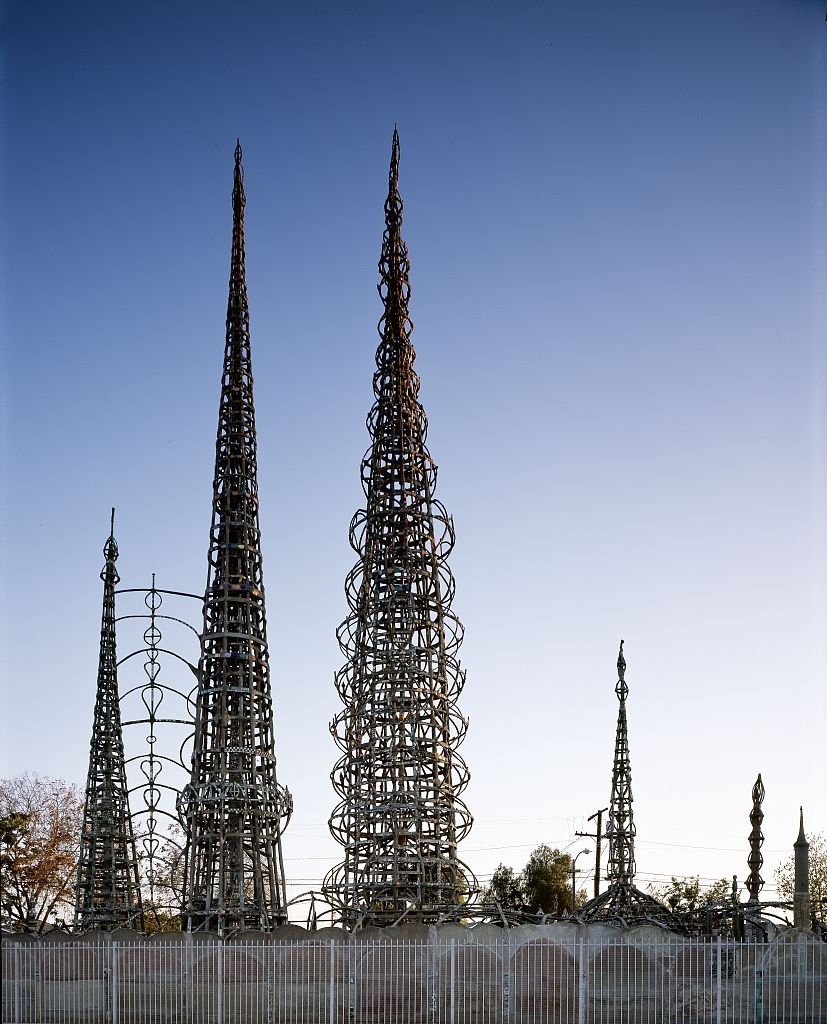
Rodia’s Vision: In 1921, Simon Rodia purchased a triangular lot near the Watts Station and began constructing what he called “Nuestro Pueblo” (“Our Town”). Using hand tools and found materials—broken glass, seashells, tiles, and more—he built 17 interconnected sculptures, including three towers that soar nearly 100 feet high. Rodia’s process was highly personal, intuitive, and innovative, with the tallest tower reaching 99.5 feet supported by a foundation only 14 inches thick (SAH Archipedia; BlackPast; California State Parks).
Social and Demographic Context
When Rodia started his project, Watts was a diverse neighborhood where Black, Latino, and white families lived side by side. Restrictive covenants elsewhere funneled African American families into Watts, and by the 1940s and 1950s, the community became predominantly Black, surrounded by major public housing projects. The area’s evolving demographic makeup and its role as a hub for new arrivals to Los Angeles contributed to the vibrant cultural context in which the towers rose (BlackPast; SAH Archipedia).
Preservation and Recognition
After Rodia completed the towers in 1954 and left Watts, the structures fell into disrepair and faced demolition. Community activists, artists, and preservationists united to save them, culminating in a successful stress test in 1959. The towers were designated a Los Angeles Historic-Cultural Monument in 1963, later earning state and national recognition as a California Historical Landmark and a National Historic Landmark. Ongoing restoration, led by organizations such as LACMA, ensures their preservation for future generations (Saving Places; South LA Recap; Culture LA).
Visitor Information
Hours & Admission
- Watts Towers Arts Center Typically open Tuesday through Saturday, 10:00 AM – 5:00 PM.
- Watts Towers Viewing The towers are visible from the street at all times, but access inside the fenced area and to the adjacent cactus garden is available during guided tours.
- Admission Entrance to the Arts Center gallery is free. Guided tours require tickets—generally $7 for adults and $3 for children/seniors. Donations are encouraged to support preservation.
Always check the official website or call ahead for updates on hours, restoration closures, or special events.
Guided Tours
- Schedule Tours are offered Thursday through Saturday, subject to maintenance and restoration schedules.
- Booking Tickets can be purchased on-site or online. Guided tours provide in-depth history, access to the towers’ interior perimeter, and insights into Rodia’s techniques (Connolly Cove).
Accessibility
- Site Access The Arts Center and main gallery are wheelchair accessible; some outdoor areas and interior tours may have limited accessibility due to historic site conditions.
- Assistance Contact staff in advance for specific accessibility needs (Traveler Bibles).
Transportation & Nearby Attractions
- Metro The 103rd Street/Watts Towers Station on the A Line is a 5–10 minute walk from the site.
- Bus Several Metro bus lines serve the area (Metro schedule).
- Car Parking is available on-site and in nearby lots (Travel in USA).
- Nearby Explore the historic Watts Station, Charles Mingus Youth Arts Center, and local street art (Transiting Los Angeles).
Artistic & Cultural Legacy
The Watts Towers are celebrated as an unparalleled work of folk and outsider art, constructed entirely by Rodia without formal training or assistance. Using recycled materials, he created intricate mosaics and architectural forms that have inspired artists worldwide. The towers’ symbolism—representing perseverance, hope, and creative freedom—resonates deeply within the Watts community and beyond. The Watts Towers Arts Center continues this legacy by offering art, music, and cultural programs, including jazz festivals and youth workshops (Google Arts & Culture; Me Gusta Los Angeles; Islands.com).
Events and Festivals
- Day of the Drum Festival and Simon Rodia Watts Towers Jazz Festival: Held annually in late September, these events celebrate the area’s multicultural heritage with live music, art exhibitions, workshops, and food vendors (Discover Los Angeles).
- Community Programs The Arts Center offers art classes, workshops, and after-school programs for all ages (Culture LA).
Safety & Practical Tips
- Visit during daylight hours (9 AM – 5 PM) for safety.
- Dress neutrally; avoid red or blue clothing due to local gang color associations (Tales of Travel and Tech).
- Stay on main streets; travel in groups if possible.
- Photography Allowed from outside the fence; guided tours may permit closer photography. Commercial photography requires prior permission (Traveler Bibles).
- Restrooms and Gift Shop Available at the Arts Center during open hours.
- Limited dining options on-site; bring water and snacks or explore local cafes.
Frequently Asked Questions (FAQ)
Q: What are Watts Towers’ visiting hours?
A: Typically Tuesday–Saturday, 10:00 AM–5:00 PM. Confirm on the official website.
Q: Are tickets required?
A: Gallery access is free; guided tours require a ticket ($7 adults, $3 children/seniors).
Q: Is the site wheelchair accessible?
A: The Arts Center is accessible; the towers’ interior area has limited access.
Q: How do I get there by public transit?
A: Take the Metro A Line to 103rd Street/Watts Towers Station.
Q: Are there special events?
A: Yes, major festivals occur in late September; check the Arts Center calendar for current events (Discover Los Angeles).
Q: Is it safe to visit?
A: Yes, during the day and with normal urban precautions (Traveler Bibles).