Type 2+ letters to search all countries, cities, and places
/Ctrl KEsc
travel_explore
Type 2+ letters to search all countries, cities, and places
Press Enter to open the top result
Las Vegas Strip
Las Vegas·United States of America·36° N · 115° W·
Verified Apr 2026
Most of what visitors call Las Vegas isn't in Las Vegas at all: this neon corridor in Clark County runs on spectacle, shortcuts, and very long night walks.
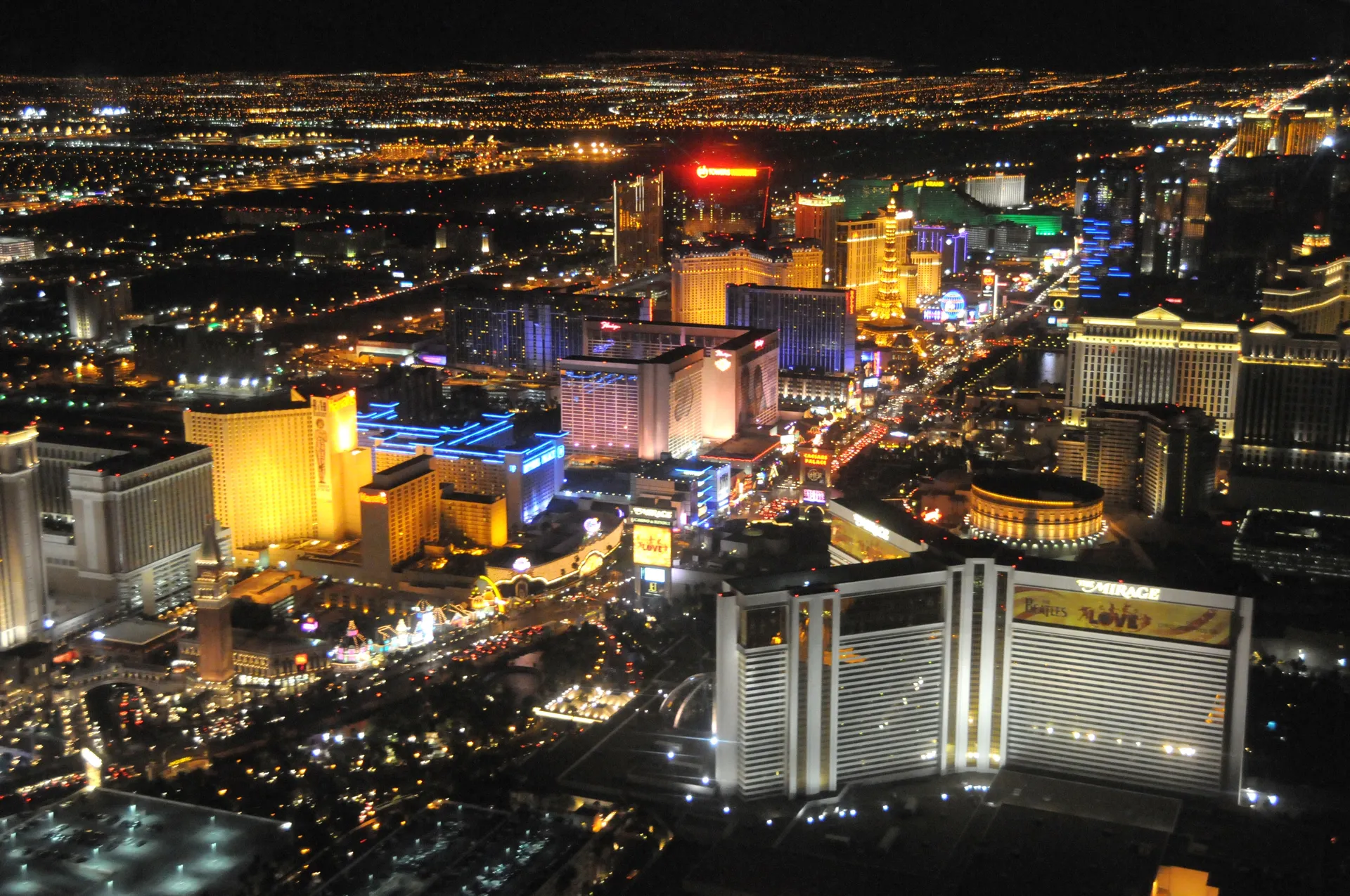
Why does the most famous part of Las Vegas barely belong to Las Vegas at all? The Las Vegas Strip in Las Vegas, United States of America, sits just outside the city line in unincorporated Clark County, and that jurisdictional sleight of hand is one reason to visit: few places reveal American showmanship, money, labor, grief, and reinvention so nakedly. Today you stand on Las Vegas Boulevard between glass towers, fake skylines, clipped palms, and the dry metallic smell of desert heat rising off eight lanes of traffic while fountains leap at the Fountains Of Bellagio, suitcase wheels rattle over expansion joints, and every block tries to outshout the next.
Most first-time visitors come for spectacle. Fair enough. But the better reason to walk the Strip is that it behaves like a stage set with its rigging exposed: wedding chapels still marry couples at industrial speed, cathedral doors open for casino workers coming off late shifts, and the same boulevard that sells fantasy also carries memorial processions, labor marches, and New Year's crowds by the hundreds of thousands.
Records show this corridor grew south of the 1905 railroad town, on what was once desert road and open land beyond the original urban core. That matters. Once you know the Strip was built outside city control on purpose, the place stops looking like a random explosion of neon and starts reading like a very expensive argument about who gets to tax pleasure, police vice, and profit from the mirage.
Visit with good shoes and patience. The distances deceive: a resort that looks two blocks away can be a 20-minute walk through heat, perfume, cigarette smoke, piped-in vanilla, and casino carpet designed to make you lose all sense of time.
Researched by the Audiala editorial team from historical records, architectural archives, and local expertise.
What to see
Bellagio and Its Lake of Choreographed Excess
The smartest way to understand the Strip is to stand at the edge of the lake at Fountains Of Bellagio and watch 8 acres of water, roughly six American football fields laid side by side, behave as if physics had hired a stage manager. Music rolls across Las Vegas Boulevard, mist cools the dry night air for a second, and the hotel behind it plays the aristocrat with perfect manners; then you step inside the conservatory and the smell shifts from hot pavement to cut flowers and damp soil under glass, which is when Bellagio stops being a casino and starts looking like Vegas's most persuasive argument that artifice can still move you.
Sphere After Dark
Sphere looks ridiculous from a distance, which is part of its power: a 366-foot globe, tall enough to swallow the Statue of Liberty, glowing over the Strip like some expensive new moon. Get closer. The skin resolves into thousands of puck-sized lights, the traffic hiss gives way to a low electronic thrum, and the whole idea of a building starts to wobble; Las Vegas has always loved façades, but this one admits the truth outright by turning architecture into a screen larger than three football fields.
Walk the Strip's Greatest Mood Swings
Start at the 1959 Welcome to Fabulous Las Vegas sign, where Betty Willis gave the city its most famous roadside smile, then walk north past Luxor's black-glass pyramid, New York-New York's compressed skyline, and the Eiffel Tower replica at Paris Las Vegas until you reach Bellagio. The route is only about 2.5 miles, less than a leisurely neighborhood stroll on paper, yet the heat, overpasses, perfume clouds, air-conditioned casino thresholds, and sudden blasts of fountain music make it feel like crossing three different cities built by the same showman with a short attention span.
Plan your visit
Getting There
The Strip runs along Las Vegas Boulevard between Sahara Avenue and Russell Road, and what looks close on a map often turns into a half-mile walk through casino corridors. From Harry Reid Airport, Route 109 reaches the South Strip Transit Terminal in about 10-15 minutes, then the 24/7 Deuce runs north along the corridor; from Fremont Street, take the southbound Deuce. The Las Vegas Monorail is faster for east-side hops, running MGM Grand to SAHARA in about 15 minutes end to end, but each station sits behind resorts, so expect extra walking through garages, escalators, and gaming floors.
Opening Hours
As of 2026, the Strip itself never closes: the boulevard, sidewalks, and resort corridor are open 24 hours a day, 7 days a week. Transport has its own clock: the Monorail runs Monday 7 a.m.-midnight, Tuesday-Thursday 7 a.m.-2 a.m., and Friday-Sunday 7 a.m.-3 a.m., while the Deuce runs 24/7. Closures are event-driven rather than seasonal, with the biggest disruption on New Year's Eve, when vehicle access begins shutting down in the early evening and the Strip is fully closed to traffic by about 8 p.m.
Time Needed
Give one central cluster 60-90 minutes if you just want a focused walk around Bellagio, Caesars, and The LINQ, perhaps with a stop at the Fountains Of Bellagio. A good first visit takes 3-4 hours once you add bridge crossings, indoor detours, and one meal. Covering most of the corridor on foot takes 6-8 hours or more; the distance feels less like a promenade and more like an urban hike staged under neon.
Accessibility
As of 2026, the Monorail is ADA compliant with elevators, level boarding, and space for wheelchairs and scooters, and RTC buses have low floors, ramps, and room for two wheelchairs. Sidewalks are generally smooth with curb cuts and audio-visual crossings, while accessible pedestrian bridge routes are specifically provided near Tropicana, Park MGM/Showcase Mall, Flamingo, and Spring Mountain. The hard part is not the paving but the scale: heat, crowds, long setbacks, and occasionally elusive bridge elevators can wear people down faster than the flat terrain suggests.
Cost And Tickets
Walking the Strip costs nothing, because this is a public corridor rather than a ticketed attraction. As of 2026, Monorail fares are $6 for one ride or $5.50 by eTicket, with day passes from $15, while RTC visitor fares are $6 for 2 hours, $8 for 24 hours, and $20 for 3 days; children 5 and under ride free on both systems. Buy Monorail tickets online if you plan to use it, since Scan & Go mobile entry saves time at the gates.
Tickets & tours.
These are guided options from our partners — same price as booking direct.
Prices are indicative — final pricing and availability are confirmed at checkout. Audiala may earn a commission from bookings made through these links.
Also on GetYourGuide
More tours for Las Vegas Strip
Curated from GetYourGuide. Same price as official, free cancellation on most.
Prices shown are indicative — final pricing and availability are confirmed at checkout. Audiala may receive a commission from bookings made via these links.
Photo Gallery
A red open-top tour bus moves along the Las Vegas Strip under sharp desert light. Hotel towers, palm trees, traffic, and waiting pedestrians fill the scene. · Mariordo (Mario Roberto Duran Ortiz)A large aircraft descends toward the runway with the Las Vegas Strip rising behind it. Desert ground, distant mountains, and sharp daylight frame the city skyline. · Staff Sgt. Jake JacobsenClassical columns, winged statues, and dramatic purple lighting frame the Fountain of the Gods on the Las Vegas Strip. The scene captures the theatrical architecture of Las Vegas at night. · Vojeda05White angel statues raise golden trumpets above a classical facade on the Las Vegas Strip. The bright sky gives the scene a theatrical, almost stage-set quality. · istolethetvGlass high-rises and a curved digital facade frame this busy stretch of the Las Vegas Strip. Pedestrians move along the elevated walkway while taxis and cars fill the road below. · ToohoolThe new guitar-shaped Hard Rock tower rises over the Las Vegas Strip, its blue glass facade framed by cranes, traffic, and the early evening glow. · DialhA yellow fire truck moves through traffic on the Las Vegas Strip, framed by casino signs, palm trees, and pedestrians in sharp desert light. · Tomás Del Coro (TDelCoro)
History
A Boulevard Built To Let Ordinary Rules Slip
Long before the first casino tower, this valley worked as a stopping place. Records show Antonio Armijo's trading party named it Las Vegas in 1829 for the meadows fed by springs, and that basic function has never really disappeared: people still come here to pause, resupply, celebrate, disappear for a weekend, or begin a new version of themselves.
What changed is the scale. What endured is the role. From an oasis on the trail to Highway 91 roadhouses, from bungalow casinos to corporate resorts tall as small downtowns, the Strip has kept serving as a corridor where people cross a threshold and behave a little differently than they do at home.
The turning point
The City That Isn't, And Why That Still Matters
At first glance, the Strip looks like the obvious heart of Las Vegas, the place the whole city grew around and the place city hall surely controls. The street signs say Las Vegas Boulevard, the postcards say Las Vegas, and most visitors never doubt the story for a second.
But the map gives the game away. By 1950, when Las Vegas mayor Ernie Cragin tried to annex the booming resort corridor, casino operators had too much at stake to accept city taxes and tighter municipal oversight; according to later accounts, figures including Flamingo executive Gus Greenbaum pushed back hard, and the turning point came when the corridor was secured inside the unincorporated towns of Paradise and Winchester instead.
That decision is the revelation hiding in plain sight: the Strip's public image sells one city, while its power rests on being legally outside it. Once you know that, the boulevard changes before your eyes. Every giant resort reads less like a natural skyline and more like the result of a political bargain, a desert exception preserved so pleasure could be managed on different terms from the rest of Las Vegas.
What Changed
Records show the corridor shifted from Highway 91 motor courts to full resort hotels with El Rancho Vegas in 1941 and the Hotel Last Frontier in 1942. Then came the age of bigger bets: high-rise hotels, corporate finance, convention space, celebrity residencies, luxury retail, and engineered spectacles like the Fountains Of Bellagio. Even the sound changed, from car radios and slot clatter spilling out of low buildings to a constant mix of EDM bass, roller-bag wheels, and multilingual crowd noise under LED screens the size of apartment blocks.
What Endured
The Strip still functions as a ritual corridor. Couples line up for marriage licenses 365 days a year; Catholic churches on and beside the boulevard still hold Mass for workers, residents, and visitors; New Year's Eve still turns the road into a temporary civic square; and remembrance after 1 October remains part of the place's moral geography. Beneath the replicas and reinventions, one purpose stays steady: people come here to mark thresholds, whether that means a wedding, a payday, a vigil, a comeback, or one reckless night they want to remember forever.
Tips for visitors
Dress Changes Fast
The sidewalk is casual, but the mood shifts the moment you step indoors. Bellagio Quick Eats bars tank tops and swimwear, while clubs like OMNIA and Marquee expect upscale nightlife attire, so pack for the venue you actually plan to enter, not the heat outside.
Ask Before Shooting
Phone photos outdoors are normal, but private spaces play by private rules. Casinos, clubs, pools, and shows often ban selfie sticks, detachable-lens cameras, GoPros, tripods, or flash, and drones on the Strip are a bad idea without FAA approval and Clark County permits.
Ignore Street Hustles
Crowds around the Bellagio fountains, casino entrances, and monorail platforms attract pickpockets and distraction theft, so keep bags zipped and your phone out of your back pocket. Skip the shell-game performers entirely, and treat any sidewalk deal that sounds absurdly cheap as professional bait.
Eat Indoors, Strategically
For a reliable budget-to-mid stop, Eataly at Park MGM works well for coffee or a quick meal and stays open later than many grab-and-go counters. Mon Ami Gabi at Paris is a solid mid-range choice with Strip views, while splurge diners should look north to Bazaar Meat at SAHARA; if Strip pricing starts to annoy you, Spring Mountain Road in Chinatown gives far better value 10-15 minutes away.
Best Time Matters
Early morning and late evening are the Strip at its most forgiving, when the light bounces off mirrored towers instead of the pavement trying to roast you. Midday in warmer months can feel like walking across a parking lot the size of a small airport, so plan outdoor stretches before 11 a.m. or after sunset and use resort interiors as cooling stations.
Move By Clusters
Don't try to conquer the whole boulevard in one heroic march unless you enjoy discovering that two towers can be 20 minutes apart. Save money and energy by pairing walking with the Monorail, the Deuce, and free resort trams such as the ARIA Express, then build your day around clusters like Bellagio-Caesars-LINQ or Luxor-Excalibur-Park MGM.
Where to Eat
local_dining
Don't Leave Without Trying
Shrimp cocktailSteakhouse fareChicken and wafflesOversized cocktails
Mon Ami Gabi
local favorite
French Bistro€€star4.7(30349)
Order: The steak frites and the buckwheat crepes are absolute staples that feel like a true slice of Paris on the Strip.
It’s a Vegas classic for a reason; sitting on the patio watching the Bellagio fountains with a glass of wine makes you feel like you’ve been transported to the City of Lights.
Order: The braised beef Benedict or the short rib are perfect for a hearty, elevated take on diner comfort food.
This is the ultimate late-night or early-morning spot at the Cosmopolitan that hits the spot when you need a reliable, high-quality meal outside of normal hours.
checkLook beyond the Strip to nearby neighborhoods for the most authentic Asian, Mexican, and gastropub scenes.
checkHappy hour is commonly observed between 3:00 PM and 6:00 PM.
checkDon't assume restaurants are closed on a specific day; check individual hours as schedules vary wildly in Vegas.
checkFarmers markets are great for local eats but require a drive to Summerlin or Henderson, as they aren't on the Strip.
checkBrunch culture is huge on the weekends, so plan ahead for popular spots.
Restaurant data powered by Google
Frequently asked
Is Las Vegas Strip worth visiting?
Yes, the Las Vegas Strip is worth visiting if you want American theater built at the scale of a city. This 4.2-mile corridor runs through unincorporated Clark County, not the City of Las Vegas proper, and that legal oddity helps explain why the place feels like a self-contained republic of fountains, black-glass pyramids, painted skies, and air-conditioned marble. Go expecting spectacle, not authenticity, and the Strip suddenly makes much more sense.
How long do you need at Las Vegas Strip?
You need at least 3 to 4 hours to get a real feel for the Las Vegas Strip, and a full day if you want to cover most of it. The boulevard stretches about 6.8 kilometers, roughly the length of 75 football fields, and the real time sink is not the map but the detours through resorts, pedestrian bridges, and casino interiors. One tight center-Strip walk can work in 90 minutes, but that barely scratches the lacquer.
How do I get to Las Vegas Strip from Las Vegas airport?
The cheapest official route from Harry Reid International Airport is bus to the South Strip Transit Terminal, then the Deuce north onto the Strip. RTC says Routes 108, 109, and CX serve Terminal 1, while CX also serves Terminal 3; from the transit terminal, the Deuce runs 24 hours a day past the major resort clusters. If you want fewer transfers once you are on the boulevard, the Monorail works well on the east side, though its stations often hide behind hotels and parking structures.
What is the best time to visit Las Vegas Strip?
The best time to visit the Las Vegas Strip is in the evening, and cooler months make the walking far kinder. After dark, the place finally becomes what it was designed to be: fountains throwing mist into music, bronze and black glass catching light, and the Sphere glowing like a new planet over the skyline. Skip New Year's Eve unless you want the full street-party machine, because Clark County closes major sections of Las Vegas Boulevard to vehicles that night.
Can you visit Las Vegas Strip for free?
Yes, you can visit the Las Vegas Strip for free because the boulevard itself is a public corridor with no admission gate. Walking costs nothing, and some of the best moments cost nothing too, including the street-level spectacle around the resorts and the choreography outside Fountains Of Bellagio. Transit, observation decks, clubs, and some resort attractions are where the meter starts running.
What should I not miss at Las Vegas Strip?
Do not miss the Bellagio fountain edge, the Venetian ceiling if you remember to look up, the black-glass bulk of Luxor at night, and one high viewpoint such as Paris's Eiffel Tower deck or the STRAT. Bellagio gives you music, water, and wind; the Venetian swaps the desert for painted daylight and canal echoes; the newer glass campuses around CityCenter show how the Strip moved from fake cities to sleek urban sculpture. And if the Sphere is lit, stop and stare for a minute because its skin is built from thousands of puck-sized lights and still manages to read as one enormous face.
Sources & attribution10
Researched and written by the Audiala editorial team from historical records, architectural archives, and local expertise. Last reviewed April 2026.
Clark County — Confirmed that the Strip is a public corridor in unincorporated Clark County and supports the free-access answer.
Wheelchair Travel — Supported the point that Strip walking is long, flat, and more demanding than it first appears because of distance, crowds, and heat.
UNLV News — Supplied architectural context, the Strip's massive scale, and the Sphere's puck-sized light detail.
Veranda — Provided details on Bellagio, Venetian interiors, CityCenter design, and key viewing experiences.
Saved and recently read places — kept on this device only.
Photo credits (18)
Bellagio fountains in Las Vegas — Capvideo — CC BY-SA 4.0 (https://creativecommons.org/licenses/by-sa/4.0/) — Source: https://commons.wikimedia.org/wiki/File:Bellagio_fountains_in_Las_Vegas.jpg
Sphere - Las Vegas (53685825749) — Shelby L. Bell from Omaha, NE, US — CC BY 2.0 (https://creativecommons.org/licenses/by/2.0/) — Source: https://commons.wikimedia.org/wiki/File:Sphere_-_Las_Vegas_(53685825749).jpg
20180521 201952 - Paris Las Vegas — Ed Bierman — CC BY 2.0 (https://creativecommons.org/licenses/by/2.0/) — Source: https://commons.wikimedia.org/wiki/File:20180521_201952_-_Paris_Las_Vegas.jpg
Welcome to Fabulous Las Vegas — Thomas Wolf, www.foto-tw.de — CC BY-SA 3.0 (https://creativecommons.org/licenses/by-sa/3.0/) — Source: https://commons.wikimedia.org/wiki/File:Welcome_to_Fabulous_Las_Vegas.jpg
High Roller Las Vegas — Noah Wulf — CC BY-SA 4.0 (https://creativecommons.org/licenses/by-sa/4.0/) — Source: https://commons.wikimedia.org/wiki/File:High_Roller_Las_Vegas.jpg
Las Vegas Strip, Las Vegas, Nevada (18011742039) — Ken Lund from Reno, Nevada, USA — CC BY-SA 2.0 (https://creativecommons.org/licenses/by-sa/2.0/) — Source: https://commons.wikimedia.org/wiki/File:Las_Vegas_Strip,_Las_Vegas,_Nevada_(18011742039).jpg
Las Vegas 63 — Lasvegaslover — CC BY 3.0 (https://creativecommons.org/licenses/by/3.0/) — Source: https://commons.wikimedia.org/wiki/File:Las_Vegas_63.jpg
Double deck sightseeing bus Las Vegas 08 2010 9919 — Mariordo (Mario Roberto Duran Ortiz) — CC BY-SA 3.0 (https://creativecommons.org/licenses/by-sa/3.0/) — Source: https://commons.wikimedia.org/wiki/File:Double_deck_sightseeing_bus_Las_Vegas_08_2010_9919.jpg
Fountain Of The Gods — Vojeda05 — CC BY 4.0 (https://creativecommons.org/licenses/by/4.0/) — Source: https://commons.wikimedia.org/wiki/File:Fountain_Of_The_Gods.jpg
Horn section (2202568837) — istolethetv — CC BY 2.0 (https://creativecommons.org/licenses/by/2.0/) — Source: https://commons.wikimedia.org/wiki/File:Horn_section_(2202568837).jpg
63 shopping center Las Vegas — Toohool — CC BY-SA 4.0 (https://creativecommons.org/licenses/by-sa/4.0/) — Source: https://commons.wikimedia.org/wiki/File:63_shopping_center_Las_Vegas.jpg
Hard Rock Las Vegas under construction — Dialh — CC BY 4.0 (https://creativecommons.org/licenses/by/4.0/) — Source: https://commons.wikimedia.org/wiki/File:Hard_Rock_Las_Vegas_under_construction.jpg
Clark County Fire Dept. Paramedic 32 — Tomás Del Coro (TDelCoro) — CC BY-SA 2.0 (https://creativecommons.org/licenses/by-sa/2.0/) — Source: https://commons.wikimedia.org/wiki/File:Clark_County_Fire_Dept._Paramedic_32.jpg
Brown pelican Pelecanus occidentalis Las Vegas Mirage 9277 — ImagePerson — CC BY 4.0 (https://creativecommons.org/licenses/by/4.0/) — Source: https://commons.wikimedia.org/wiki/File:Brown_pelican_Pelecanus_occidentalis_Las_Vegas_Mirage_9277.jpg
Hotel Excalibur Las Vegas — ArticCynda — CC BY-SA 4.0 (https://creativecommons.org/licenses/by-sa/4.0/) — Source: https://commons.wikimedia.org/wiki/File:Hotel_Excalibur_Las_Vegas.jpg
Las Vegas (5951710737) — Moyan Brenn from Italy — CC BY 2.0 (https://creativecommons.org/licenses/by/2.0/) — Source: https://commons.wikimedia.org/wiki/File:Las_Vegas_(5951710737).jpg
Hotel Tropicana Las Vegas — Marshal 10000 — CC BY 4.0 (https://creativecommons.org/licenses/by/4.0/) — Source: https://commons.wikimedia.org/wiki/File:Hotel_Tropicana_Las_Vegas.jpg
Strictly necessary cookies keep navigation working. Analytics cookies (PostHog, Google Analytics) help us learn which pages work — aggregate only, no ads, no selling. You can change this any time from the footer.
Privacy
Cookie preferences
Pick what you're okay with. You can change this any time from the footer.
Strictly necessary
Always on
Sign-in, language, navigation. Always on.
Product analytics
PostHog and Google Analytics, aggregate usage only. Helps us see which pages work and which need fixing. No selling, no ads.
Marketing
Off today. Reserved if we ever run paid acquisition. We will ask again before turning it on.