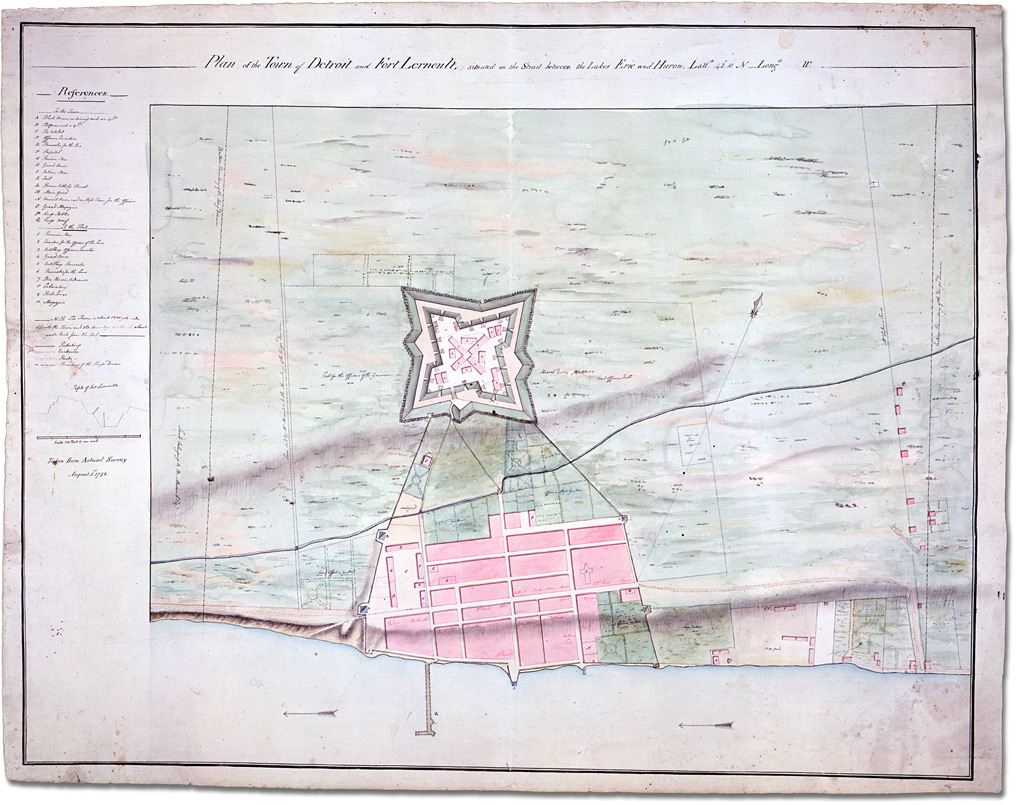
Introduction: Fort Shelby’s Historical and Cultural Significance
Fort Shelby in Detroit, Michigan, stands as a foundational landmark reflecting the city's strategic military, colonial, and urban development. Originally constructed by the British as Fort Lernoult in 1779, it played a critical role in regional control during the American Revolutionary War and the War of 1812. Its legacy includes the dramatic surrender of Detroit to the British in 1812 and subsequent recapture by American forces a year later. Although demolished in the 1820s, Fort Shelby’s memory is preserved through historical markers, museum exhibits, and archaeological artifacts, offering a window into Detroit’s transformation from frontier outpost to major metropolis (military-history.fandom.com; historydetroit.com; secretattractions.com; LocalWiki).
Origins and Construction
Early Beginnings
Fort Shelby began as Fort Lernoult, built by the British between 1778 and 1779 to strengthen their hold over Detroit and control the Detroit River. Captain Richard Lernoult oversaw its construction at the intersection of what are now Fort Street and Shelby Street, within today’s bustling downtown. The fort was a vital bulwark against both American revolutionary forces and Indigenous nations (military-history.fandom.com).
Design and Defenses
The fort’s structure reflected 18th-century military engineering: earth embankments, wooden palisades topped with sharpened stakes, and an outer ditch with a picket fence. By 1779, it housed nearly 400 British soldiers and later saw several upgrades as military needs evolved.
British and Early American Control
Despite the 1783 Treaty of Paris, Britain held Fort Lernoult and Detroit until 1796, when it was surrendered to the United States under the Jay Treaty. Renamed Fort Detroit in 1805, and later Fort Shelby in 1813 (after Kentucky Governor Isaac Shelby), the site grew in strategic importance as American settlement expanded (historydetroit.com).
The War of 1812: Surrender and Recapture
British Victory and American Surrender
During the War of 1812, Fort Detroit (as it was called) was commanded by Brigadier General William Hull. After a failed invasion of Canada and the British capture of Fort Mackinac, the fort was besieged by British and Indigenous forces led by General Isaac Brock. Facing overwhelming odds, Hull surrendered Detroit and the fort in August 1812—a rare and controversial capitulation in U.S. history (ss.sites.mtu.edu).
American Recapture
Following the American victory at the Battle of Lake Erie in 1813, General William Henry Harrison advanced on Detroit, prompting the British to abandon the fort. U.S. forces reclaimed it and renamed it Fort Shelby, honoring Isaac Shelby’s support. The garrison endured harsh conditions that winter, including food shortages and illness (military-history.fandom.com).
Postwar Years and Demolition
After the War of 1812, Fort Shelby’s importance waned. It remained garrisoned until 1826, then was transferred to the city and demolished in 1827 as Detroit rapidly urbanized (ss.sites.mtu.edu).
Visiting Fort Shelby Today
While no original fortifications survive, Fort Shelby’s site is central to downtown Detroit’s landscape. Today, it is marked by a historical plaque at Fort and Shelby Streets and is partially occupied by the DoubleTree Suites by Hilton Downtown Detroit – Fort Shelby hotel (The Clio; Historic Detroit). Nearby, the Theodore Levin United States Courthouse and Penobscot Building frame the site’s historical footprint.
Museums and Artifacts
- Anthropology Museum at Wayne State University: Features over 8,000 artifacts excavated from the fort’s site (LocalWiki).
- Detroit Historical Museum: Offers broader context with exhibits on Detroit’s colonial, military, and civic history (detroithistorical.org).
Visitor Information: Hours, Tickets, Accessibility
- Historical Marker and Site: Open to the public 24/7, no admission required.
- Wayne State University Anthropology Museum: Check the museum’s website for current hours and ticketing information.
- Detroit Historical Museum: Open Tuesday–Sunday, 9:30 AM–4:00 PM; admission fees apply—verify hours and pricing on the museum website.
- DoubleTree Suites by Hilton Downtown Detroit – Fort Shelby: Hotel lobby and public areas are accessible during regular business hours.
Accessibility: The downtown area and museums are ADA-compliant, with accessible entrances and facilities.
Guided Tours and Nearby Attractions
- Guided Walking Tours: Several local organizations, such as Detroit History Tours, include Fort Shelby in broader city tours.
- Nearby Attractions:
- Campus Martius Park: Public events and dining.
- Detroit Riverwalk: Scenic waterfront walking and biking (visitdetroit.com).
- Spirit of Detroit and Joe Louis Monument: Iconic city landmarks (Family Destinations Guide).
- Historic Fort Wayne: A preserved fort offering tours and reenactments (Megan Starr).
Practical Tips for Visitors
- Getting There: The site is accessible by car (with parking at the DoubleTree Suites or nearby garages), public transit (QLINE streetcar, DDOT buses), or on foot.
- Best Time to Visit: Daytime hours offer the best experience; mornings and late afternoons are quieter.
- Amenities: Restrooms and dining are available in nearby hotels and restaurants. Lodging options include the DoubleTree Suites.
- Safety: Downtown Detroit is generally safe during the day. Stay aware of your surroundings, especially at night.
- Photography: The site and surrounding architecture provide excellent photo opportunities.
Frequently Asked Questions (FAQ)
Q: Can I visit Fort Shelby today?
A: Yes, the historical marker and site are accessible at all times. Artifacts can be viewed at Wayne State University’s Anthropology Museum and the Detroit Historical Museum.
Q: Are there guided tours?
A: While there are no tours solely dedicated to Fort Shelby, many city walking tours include the site as a highlight.
Q: Is there an admission fee?
A: No fee is required to visit the marker or site. Museum admissions may apply.
Q: Is the site accessible?
A: Yes, the downtown area and museums are ADA-compliant.
Q: Where can I learn more about Detroit’s history?
A: Visit the Detroit Historical Museum, join local walking tours, or explore online resources linked below.
Listen to the full story in the app
Your Personal Curator, in Your Pocket.
Audio guides for 1,100+ cities across 96 countries. History, stories, and local insight — offline ready.
Audiala App
Available on iOS & Android
Join 50k+ Curators
Sources
- verified
- verified
- verified
- verified
- verified
- verified
- verified
- verified
- verified
- verified
- verified
Last reviewed:


