Type 2+ letters to search all countries, cities, and places
/Ctrl KEsc
travel_explore
Type 2+ letters to search all countries, cities, and places
Press Enter to open the top result
Magnificent Mile
Chicago·United States·41° N · 87° W·Updated Apr 2026
Born from gritty Pine Street warehouses, this mile-long corridor was rebranded in the 1940s into an open-air museum of Chicago’s architectural ambition.
Step-free sidewalks, though holiday crowds limit mobility
Best season
Spring or Fall (April-May / Sept-Oct)
How does a muddy industrial corridor become a global symbol of retail prestige without a single ancient monument to anchor it? The Magnificent Mile in Chicago, United States, survives entirely on engineered spectacle. Visit to watch commercial theater operate at full volume while polished limestone catches the lake wind.
The stretch of North Michigan Avenue from the Chicago River to Oak Street packs thirteen blocks of competing architectural eras into a single walkway. Spanish Colonial flourishes sit beside late-modern structural bravado. Scale shifts constantly.
Municipal archives show the corridor survived financial panics by constantly rewriting its own purpose. It refuses to settle into a quiet residential lane. Visitors come to watch the street reinvent itself in real time.
Researched by the Audiala editorial team from historical records, architectural archives, and local expertise.
What to see
Tribune Tower
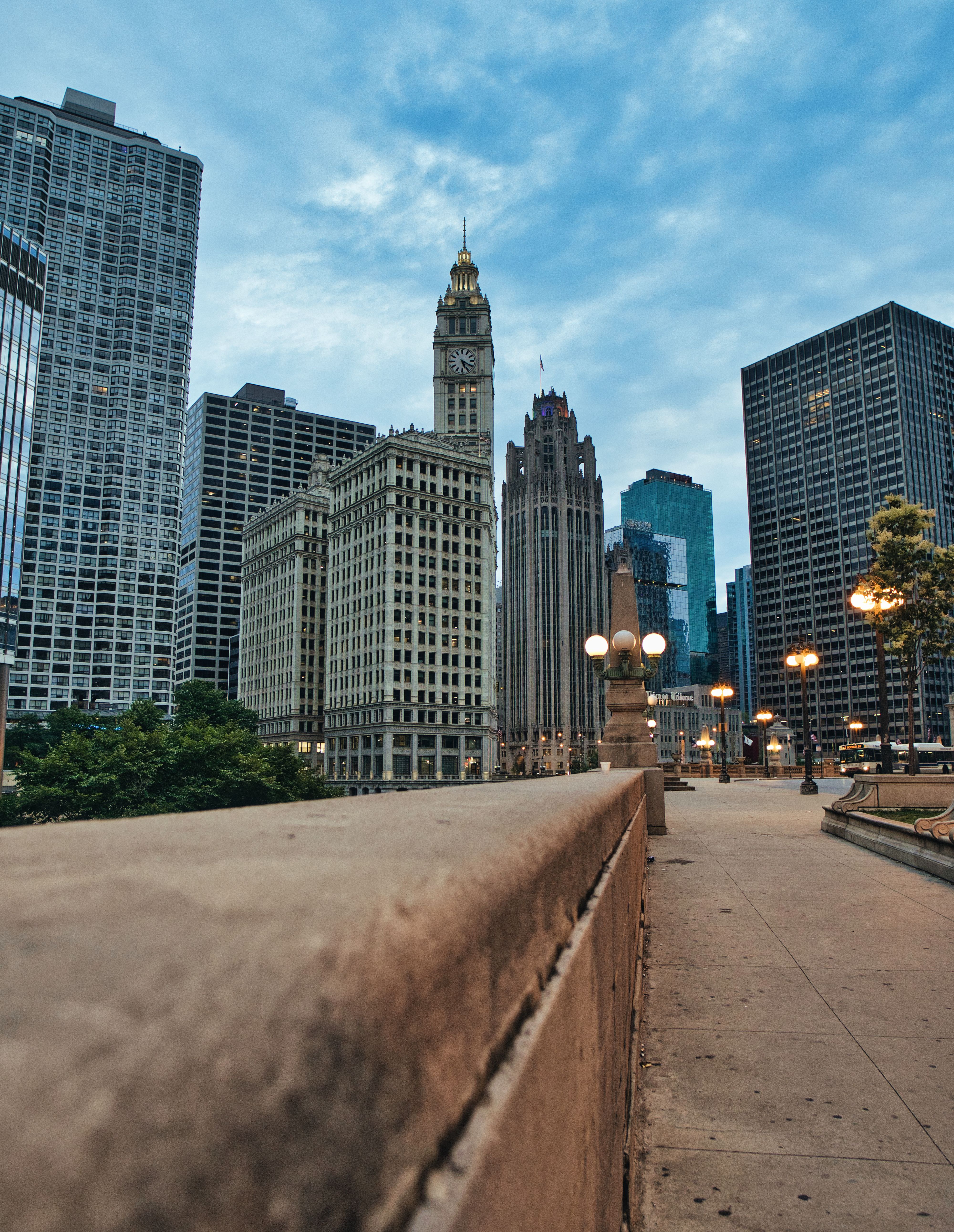
The Tribune Tower opened in 1925 wearing a crown borrowed from Rouen Cathedral, but the real story lives at street level where you can trace fragments from the Berlin Wall and the Parthenon set directly into the Indiana limestone base. Look up. Above the lobby doors, a howling dog stands in stone for architect George Howe while a Robin Hood figure marks Raymond Hood.
Wrigley Building and DuSable Bridge
Cross the DuSable Bridge when a siren wails and the hidden counterweights—each heavier than a freight train—drop into their pits to raise the deck forty feet, roughly the height of a four-story building. Look closer. The Wrigley Building waits on the other side wrapped in six graduating shades of glazed terra cotta, designed to brighten as it climbs toward the 1924 clock face.
River to Oak Street Walk
Start at the river and walk north until the glass retail canyon opens into Streeterville, then push through the heavy oak doors of Fourth Presbyterian’s 1914 sanctuary. Step inside. The wood shuts out the crosswalk signals, leaving only the quiet of painted vaulted ceilings and the faint smell of old hymnals. Keep moving toward Oak Street until the 1869 Water Tower blocks your path with rough limestone walls thicker than a city bus, stubbornly intact after the fire that erased the rest of the block.
Plan your visit
Getting There
Take the CTA Red Line to Grand or Chicago stations for a five-minute walk straight to the southern edge. Riders from Midway should catch the Orange Line to Roosevelt, transfer north on the Red Line, and step onto pavement near the Wrigley Building. Bus routes 3, 4, 6, J14, 146, and 151 drop you directly on Michigan Avenue, while a ten-minute stroll from Millennium Park connects you to the riverfront gateway.
Opening Hours
The avenue operates as a public corridor, so the sidewalks and plazas stay open twenty-four hours a day, year-round. As of 2026, individual storefronts and restaurants follow independent schedules, typically operating from 10 AM to 7 PM with extended hours through December. Temporary vehicle closures appear during the annual Wintrust Lights Festival and summer programming, so check the municipal calendar before your walk.
Time Needed
A brisk architectural walk consumes about an hour, which covers the Wrigley and Tribune facades and a crossing of the DuSable Bridge. Add a Chicago Architecture Center guided tour and you will spend roughly ninety minutes tracing the avenue’s Beaux-Arts and Gothic layers. Block out three to five hours if you plan to browse flagship interiors, linger at Pioneer Court installations, or catch a seasonal art display.
Accessibility
Sidewalks run mostly flat, though the double-deck DuSable Bridge introduces a noticeable incline that slows mobility scooters. Every CTA bus on the corridor deploys automated ramps, and 108 of the city’s 146 rail stations offer step-free access if you verify elevator status via the official trip planner. Major hotels maintain accessible ground-floor restrooms when the public pavement lacks dedicated facilities.
Cost & Tickets
Walking the corridor costs absolutely nothing, though retail pricing will test your patience the moment you cross the river. The Chicago Architecture Center sells a guided walking tour that bundles a seven-day museum entry, saving you from paying separate admission fees later. Private landmark tours require direct booking, and street access never demands a ticket.
Photo Gallery
A view of Magnificent Mile, Chicago, United States. · User:TonyTheTigerA view of Magnificent Mile, Chicago, United States. · en:User:TonyTheTiger, modified by en:User:RuhrfischA view of Magnificent Mile, Chicago, United States. · User:TonyTheTigerA view of Magnificent Mile, Chicago, United States. · TonyTheTiger at English Wikipedia
(Original text: en:User:TonyTheTiger)A view of Magnificent Mile, Chicago, United States. · Nick NumberA view of Magnificent Mile, Chicago, United States. · User:TonyTheTigerA view of Magnificent Mile, Chicago, United States. · User:TonyTheTiger
History
The Engineered Pageant
The corridor has functioned as Chicago’s primary civic stage since the 1920s. Storefronts cycle through luxury brands while the underlying ritual remains completely intact. This continuous performance draws crowds who expect public spectacle as much as shopping.
The turning point
The Survival Campaign
Most visitors assume the district’s prestige emerged organically. Records show the corridor actually faced severe postwar vacancy and suburban flight.
Developer Arthur Rubloff staked his professional reputation on a radical survival pivot. The turning point arrived in 1947. He abandoned traditional leasing for coordinated public spectacle and funded facade lighting across the entire block.
Knowing this origin story alters how you read the street today. Every synchronized holiday light display traces back to Rubloff’s manufactured revival. You see a living civic stage that still trades in engineered awe.
What Changed
The physical inventory shifts constantly as corporate headquarters convert to luxury condominiums. Zoning liberalization in the mid-twentieth century allowed vertical density to replace earlier horizontal retail footprints. The commercial rhythm adapts rather than fractures.
What Endured
Seasonal processions and window merchandising traditions continue to draw crowds. This adaptive performance has outlasted three distinct retail eras.
Tips for visitors
Brace for Lake Wind
The avenue faces Lake Michigan like an open sail channel, turning November through March into a brutal wind tunnel. Walk parallel streets like Rush or State when gusts hit twenty miles per hour, and pack a windproof shell instead of relying on a bulky coat that catches every draft.
Skip the Tourist Traps
Flagship menus along the corridor often carry steep markups for mediocre comfort food. Cross two blocks west into River North for Eataly’s counter-service pasta or grab a reliable all-day plate at Beatrix, where locals actually queue for coffee and flatbread.
Respect Retail Thresholds
Personal photography thrives on the sidewalks, but crossing into flagship interiors for commercial shots triggers strict management pushback. Keep tripods folded outside and remember that drone flights over this corridor violate FAA airspace rules.
Guard Against Pickpockets
Holiday parades and summer foot traffic create dense crowds where bag-snatching and pocket theft spike. Secure valuables in a cross-body bag with a zippered main compartment, and ignore unofficial street vendors hawking overpriced Chicago souvenirs near the bridge.
Read the Stone Facades
Walk the east sidewalk to catch the limestone details of the Tribune Tower and the six-tone terra-cotta Wrigley facade glowing at dusk. Start at Pioneer Court to acknowledge Jean Baptiste Point du Sable’s 1780s trading post, then follow the river west into River North for converted warehouse galleries.
Time the Holiday Parade
If you visit during late November, arrive by early afternoon to claim a spot along the barricades before the 5:30 PM Disney-led procession begins. Secure your viewing angle near Pioneer Court and bring thermoses of coffee to outlast the lake chill.
Where to Eat
local_dining
Don't Leave Without Trying
Deep-dish pizzaItalian beefChicago-style hot dogJibaritosChicken VesuvioMaxwell Street Polish sausageBrowniesCheesecake
The Purple Pig Restaurant
local favorite
Mediterranean Tapas€€star4.6(7313)
Order: The whipped ricotta and the aged pork chop are standout dishes that define their Mediterranean-inspired menu.
A true Chicago institution for food lovers, it balances a chic, open-kitchen vibe with inventive, shareable plates that highlight pork and seasonal produce.
Order: The sweet potato chips with guacamole are a legendary starter, followed by the Mediterranean shrimp salad.
It’s the ultimate upscale sports-bar vibe where the menu is huge and crowd-pleasing, making it perfect for a reliable, delicious meal after walking the Mile.
Order: The baked oatmeal with fresh berries and the jalapeño cornbread are fantastic choices for a unique brunch or lunch.
This is a bright, all-day venue that feels effortlessly cool; it’s a go-to for locals who want fresh, well-made food in a modern, friendly environment.
Yes, provided you approach the thirteen-block stretch, longer than two American football fields, as a living architectural archive rather than a standard commercial corridor. Walk the river side. City records show the 1924 Wrigley Building glows in six progressive shades of terra cotta, while the 1925 Tribune Tower embeds actual stone fragments from global landmarks into its limestone base.
How long do you need at the Magnificent Mile?
Plan for roughly two hours, about the length of a full feature film, if you actually want to read the limestone facades and dodge the heavy pedestrian traffic. Pace yourself. A quick photo loop between Pioneer Court and the Historic Water Tower takes forty minutes, shorter than a standard lunch break, but lingering at the McCormick Bridgehouse Museum adds an extra hour of mechanical theater.
How do I get to the Magnificent Mile from downtown Chicago?
Walk straight across the DuSable Bridge from the Loop, and you will stand at the southern gateway in under ten minutes, barely enough time to grab a single black coffee. Just keep moving. The CTA Red Line drops you at Grand or Chicago stations, leaving you a short five-minute stroll, roughly the distance of three city blocks, from the main retail spine.
What is the best time to visit the Magnificent Mile?
Late April is ideal, when the city plants 100,000 tulips, enough to carpet ten standard football pitches, along the concrete medians and the spring sun finally warms the heavy limestone facades. Watch the wind. Municipal calendars confirm the Wintrust Lights Festival transforms the corridor into a million-bulb spectacle on the Saturday before Thanksgiving.
Can you visit the Magnificent Mile for free?
Absolutely, since the avenue itself functions as a public right-of-way with zero admission gates or ticketed checkpoints, completely free for anyone with walking shoes. Wander freely. You can inspect the castellated 1869 Water Tower, read the carved Hall of Inscriptions inside the Tribune Tower lobby, or sit quietly in the Fourth Presbyterian sanctuary without spending a dime.
What should I not miss at the Magnificent Mile?
Do not skip the hidden river-facing courtyard tucked behind the Wrigley Building’s center doors, which instantly drops the street noise to a hushed murmur. Step inside. Architectural guides note the 1914 Gothic sanctuary at Fourth Presbyterian offers a sudden acoustic retreat from the sales-floor energy, while the 94th-floor 360 CHICAGO deck delivers a 1,030-foot perch, roughly the height of a modern monolith, over the entire urban grid.
Sources & attribution10
Researched and written by the Audiala editorial team from historical records, architectural archives, and local expertise. Last updated April 2026.
Wikipedia: Magnificent Mile — District boundaries, historical timeline, and general urban development context.
Kelly — Pexels License (https://www.pexels.com/license/) — Source: https://www.pexels.com/photo/26821662/
20070513 Guess Amex Gap — User:TonyTheTiger — CC BY-SA 3.0 (https://creativecommons.org/licenses/by-sa/3.0/) — Source: https://commons.wikimedia.org/wiki/File:20070513_Guess_Amex_Gap.JPG
20070513 Magnificent Mile arrow — en:User:TonyTheTiger, modified by en:User:Ruhrfisch — CC BY-SA 3.0 (https://creativecommons.org/licenses/by-sa/3.0/) — Source: https://commons.wikimedia.org/wiki/File:20070513_Magnificent_Mile_arrow.JPG
20070513 Hancock Center - Westin Hotel — User:TonyTheTiger — CC BY-SA 3.0 (https://creativecommons.org/licenses/by-sa/3.0/) — Source: https://commons.wikimedia.org/wiki/File:20070513_Hancock_Center_-_Westin_Hotel.JPG
20070513 Magnificent Mile — TonyTheTiger at English Wikipedia
(Original text: en:User:TonyTheTiger) — CC BY-SA 3.0 (https://creativecommons.org/licenses/by-sa/3.0/) — Source: https://commons.wikimedia.org/wiki/File:20070513_Magnificent_Mile.JPG
142 E. Ontario St., Chicago — Nick Number — CC BY 4.0 (https://creativecommons.org/licenses/by/4.0/) — Source: https://commons.wikimedia.org/wiki/File:142_E._Ontario_St.,_Chicago.jpg
20070513 RL Polo - Banana Republic - Peninsula — User:TonyTheTiger — CC BY-SA 3.0 (https://creativecommons.org/licenses/by-sa/3.0/) — Source: https://commons.wikimedia.org/wiki/File:20070513_RL_Polo_-_Banana_Republic_-_Peninsula.JPG
20160829 Michigan Wolverines and Jumpman logo at Nike Flagship store before opening weekend — TonyTheTiger — CC BY-SA 4.0 (https://creativecommons.org/licenses/by-sa/4.0/) — Source: https://commons.wikimedia.org/wiki/File:20160829_Michigan_Wolverines_and_Jumpman_logo_at_Nike_Flagship_store_before_opening_weekend.jpg
After Westin — Raymond Tambunan — CC BY-SA 3.0 (https://creativecommons.org/licenses/by-sa/3.0/) — Source: https://commons.wikimedia.org/wiki/File:After_Westin.jpg
Along the Magnificent Mile-banner1 — Bert Kaufmann — CC BY 2.0 (https://creativecommons.org/licenses/by/2.0/) — Source: https://commons.wikimedia.org/wiki/File:Along_the_Magnificent_Mile-banner1.jpg
Burberry Chicago — Lacrossewi — CC BY-SA 4.0 (https://creativecommons.org/licenses/by-sa/4.0/) — Source: https://commons.wikimedia.org/wiki/File:Burberry_Chicago.jpg
Strictly necessary cookies keep the site working. Analytics (PostHog, Google Analytics) measures how each visitor uses our pages. Marketing loads YouTube videos and walking-route maps without a tap and lets Google Analytics set advertising cookies. We never sell your data. You can change this any time from the footer.
Analytics and marketing cookies are optional and only load if you agree. Details under Customize.
Privacy
Cookie preferences
Pick what you're okay with. You can change this any time from the footer.
Strictly necessary
Always on
Sign-in, language, navigation. Always on.
Product analytics
PostHog (EU) and Google Analytics record which pages you view and how you use them, under a random identifier stored in your browser. Helps us see which pages work and which need fixing. Google's ad personalisation stays off. No selling.
Marketing
Loads YouTube videos and the walking-route maps (OpenFreeMap) without a tap; without it, they load only when you tap them. If analytics is also on, Google Analytics may set advertising cookies. Ad personalisation stays off.