Introduction: The Carrie Eliza Getty Tomb and Its Significance
The Carrie Eliza Getty Tomb, set within Chicago’s historic Graceland Cemetery, is a profound symbol of architectural innovation and cultural legacy from the city’s Gilded Age. Commissioned in 1890 by lumber magnate Henry Harrison Getty in memory of his wife, Carrie Eliza Anderson Getty, the tomb was designed by Louis Sullivan, one of America’s most influential architects and a pivotal figure in the Chicago School. This monument represents Sullivan’s first major funerary project and is celebrated for its groundbreaking blend of geometric clarity and intricate organic ornamentation, perfectly embodying his “form follows function” philosophy. The tomb marks a key departure from European funerary styles, ushering in a distinctly American approach to memorial architecture. Graceland Cemetery itself is a lush, open-air museum and the final resting place of numerous Chicago luminaries, making the Getty Tomb an essential stop for history and architecture enthusiasts (The Clio; Wikipedia; Graceland Cemetery; Chicago Architecture Center).
This guide provides a thorough overview of the tomb’s history, design, and cultural importance. It also offers practical information on visiting hours, accessibility, tours, and nearby attractions to help you make the most of your experience.
Origins and Commissioning of the Carrie Eliza Getty Tomb
In 1890, Henry Harrison Getty, a leading figure in Chicago’s booming lumber industry, commissioned the tomb as a memorial to his wife, Carrie Eliza Getty, who died that year (The Clio). This period, known as the Gilded Age, was characterized by rapid economic growth and a desire among Chicago’s elite to express their legacy through grand architectural monuments. Getty’s choice of Louis Sullivan as architect reflected both personal grief and a commitment to innovative design. Sullivan, already recognized for his work on Chicago’s commercial buildings, had also designed the Ryerson Tomb in Graceland Cemetery for Getty’s business partner (Wikipedia).
Louis Sullivan and the Chicago School
Louis Sullivan (1856–1924) is regarded as the “father of skyscrapers” and a leader of the Chicago School of architecture. The Getty Tomb was his first major funerary commission and marks a turning point in his career. Working with Dankmar Adler, Sullivan was reshaping Chicago’s architectural identity by prioritizing structural honesty and organic ornament, moving away from European historicism.
The tomb’s design is central to the Chicago School movement, emphasizing new forms and materials suited to the modern city. Sullivan’s approach—melding geometric forms with rich, nature-inspired ornamentation—deeply influenced contemporaries and subsequent architects, including Frank Lloyd Wright (Wikipedia).
Architectural Innovation and Symbolism
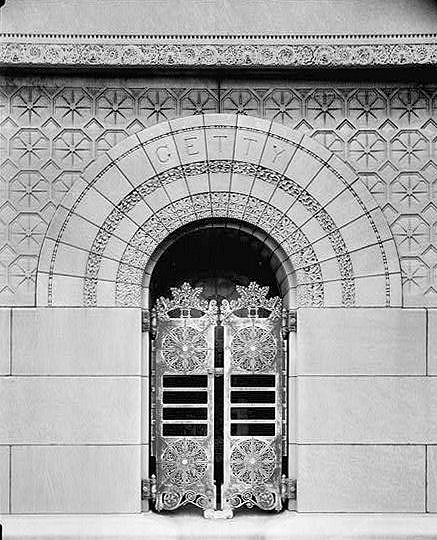
The Getty Tomb’s design is a landmark of American funerary architecture. Sullivan employed a cubic base of highly polished granite, surmounted by a hemispherical dome, echoing classical forms while infusing modern abstraction. The main façade features a horseshoe-arched bronze entrance, surrounded by intricate floral and geometric motifs. The remaining three sides are punctuated by semi-circular, bronze-clad windows, unifying the design’s rhythm.
Sullivan’s ornamentation is not purely decorative—it carries symbolic meaning. The floral motifs, including stylized lotus and acanthus leaves, evoke themes of rebirth and immortality, while the geometric patterns suggest cosmic order. The interplay of light and shadow across these surfaces animates the tomb throughout the day (Chicago Architecture Center). A plaster cast of the tomb’s door won Sullivan an award at the 1900 Paris Exposition, cementing its reputation as a masterpiece (Wikipedia).
Graceland Cemetery and Chicago’s Gilded Age Elite
Founded in 1860, Graceland Cemetery became the burial ground of choice for Chicago’s elite and is renowned for its park-like landscape designed by H.W.S. Cleveland and Ossian Simonds (LS Tours). The cemetery houses monuments to industrialists, architects, and civic leaders, including Daniel Burnham and Ludwig Mies van der Rohe.
The Getty Tomb stands on a prominent triangular plot, underscoring the family’s social prominence. Its construction reflected the era’s spirit, as Chicago’s wealthy families commissioned monuments to assert personal and civic legacy (Wikipedia).
Visiting the Carrie Eliza Getty Tomb: Hours, Tickets, and Tips
Location:
- Graceland Cemetery, 4001 N. Clark Street, Chicago, IL
Visiting Hours:
- April–October: 8:00 AM to 7:30 PM
- November–March: 8:00 AM to 4:30 PM
- Confirm current hours on the Graceland Cemetery website.
Admission:
- Free entry; donations are encouraged to support preservation (Graceland Cemetery Visitor Info).
Guided Tours:
- Offered seasonally (April–October) by organizations including the Chicago Architecture Center.
- Tours last about 90 minutes and may suggest a donation ($10–$20).
- Self-guided visitors can access maps and brochures at the entrance or online. The Getty Tomb is well-marked with interpretive signage.
Accessibility:
- Main paths are paved and generally wheelchair accessible, though some terrain near the tomb may be uneven or grassy. Contact the cemetery office for accessibility details (Graceland Cemetery Accessibility).
Photography:
- Personal photography is encouraged. Use of tripods or professional equipment requires advance permission (Graceland Cemetery Photography Policy).
Etiquette:
- Graceland is an active cemetery. Remain respectful: no loud music, picnicking, or recreational activities.
Nearby Attractions and Related Sites
- Other Graceland Monuments: Martin Ryerson Tomb (also by Louis Sullivan), Daniel Burnham’s family plot, and monuments to other Chicago notables.
- Lincoln Park: Museums, gardens, and the Chicago History Museum.
- Wrigley Field: A short walk south.
- Uptown Theatre: Historic entertainment venue nearby.
- Public Transit: Close to the CTA Red Line (Sheridan or Addison stations) and several bus routes.
Visitor Experience and Practical Advice
- Best Time to Visit: Spring and autumn offer pleasant weather and scenic foliage.
- What to Bring: Comfortable shoes, weather-appropriate clothing, camera, and water.
- Safety: The cemetery is safe during daylight; stay on marked paths.
- Accessibility: The grounds are generally accessible, but contact the cemetery in advance if you have specific mobility needs.
Preservation Efforts and Ongoing Significance
The tomb has been a designated Chicago Landmark since 1971 and is listed on the National Register of Historic Places. Ongoing preservation efforts are supported by groups like Landmarks Illinois and the Graceland Cemetery Board, focusing on protecting the monument’s granite and bronze features from weathering (Landmarks Illinois).
The Getty Tomb continues to be a focal point for architectural tours, scholarly research, and public appreciation, bridging the historical and modern narratives of American design.
Frequently Asked Questions (FAQ)
Q: What are the visiting hours for the Getty Tomb?
A: Generally, 8:00 AM to 7:30 PM (April–October) and 8:00 AM to 4:30 PM (November–March), but check the Graceland Cemetery website for updates.
Q: Is there an admission fee?
A: No, entry is free. Donations are encouraged.
Q: Are guided tours available?
A: Yes, from April through October. See the Chicago Architecture Center for details.
Q: Is the tomb wheelchair accessible?
A: Main paths are accessible, but the area immediately around the tomb may be uneven.
Q: Can I take photographs?
A: Yes, for personal use. Professional photography requires prior permission.
Q: Can I enter the interior of the tomb?
A: No, the tomb’s interior is not open to the public.
Visuals and Multimedia
- Front façade of the Carrie Eliza Getty Tomb, highlighting Sullivan’s organic ornamentation.
- Close-up of bronze-clad window with stylized floral patterns.
- Map of Graceland Cemetery showing the Getty Tomb’s location.

Caption: The Carrie Eliza Getty Tomb in Chicago’s Graceland Cemetery, showcasing Louis Sullivan’s architectural mastery.
Interactive experiences, including maps and virtual tours, are available on the Graceland Cemetery website.
Plan Your Visit
Experience the intersection of history, art, and architecture at the Carrie Eliza Getty Tomb. For more in-depth guides and audio tours, download the Audiala mobile app. Stay updated on tour schedules, events, and Chicago’s architectural heritage by following us on social media.
Audiala2024
Listen to the full story in the app
Your Personal Curator, in Your Pocket.
Audio guides for 1,100+ cities across 96 countries. History, stories, and local insight — offline ready.
Audiala App
Available on iOS & Android
Join 50k+ Curators
Sources
- verified
- verified
- verified
- verified
- verified
- verified
- verified
- verified
- verified
- verified
- verified
- verified
- verified
Last reviewed: