
Introduction
A former Baptist megachurch with room for 4,000 worshippers now shakes under guitar amps and stand-up punchlines. That is The Tabernacle in Atlanta, United States of America, and that mismatch is exactly why you should come: few American venues let you hear a band inside a room built for revival sermons, pipe organ thunder, and public moral combat. The balconies still rise like a theater, the stained glass still catches the light, and the whole place feels one argument away from becoming a church again.
Most people arrive for a show and leave with a stranger story than they expected. Reuben Harrison Hunt designed this place as part of a bigger Baptist complex on Luckie Street NW, where preaching, nursing, and hospital care were meant to work together under one institutional idea.
That older purpose still clings to the room. Sound rolls upward into the galleries, footsteps echo on the stairs, and the stage sits where public persuasion once mattered enough to justify an electric roof sign and a direct line from the pulpit to infirmary beds next door.
Go for the music, yes. Also go because The Tabernacle explains something sharp about Atlanta: this city rarely throws buildings away when it can give them a second job, and sometimes the second life says more than the first.
What to See
The Main Hall From the Balcony
The surprise hits upward, not forward: climb to the second balcony and the old church reveals itself all at once, with Reuben Harrison Hunt's tall room folding around the stage, a crystal chandelier hanging over the crowd, and a pipe organ still presiding as if the sermon might resume at any minute. Sit in one of the 525 original church seats, look past the lit stage to the stained glass and painted trim, and the building stops being a concert venue with good acoustics and becomes something stranger and better: a 1910-1911 Baptist tabernacle that learned how to hold electric guitars without losing its soul.


The Luckie Street Facade
Across Luckie Street, the building still makes a slightly absurd first impression, which is part of its charm: red brick, six white columns, and six ornate red doors announcing a Baptist past just a few minutes' walk from Centennial Olympic Park. Come early and stand back far enough to take in the whole front, because that street view explains the place better than any plaque could; before you hear a note, you can already see Atlanta's favorite trick, turning a 20th-century church into a room where 21st-century crowds line up in black T-shirts.
A Small Pilgrimage Upstairs
Most people hurry to the floor and miss the best part. Start at the red doors on Luckie Street, head up to the first-level balcony to look for the Eden Room's hand-painted Garden of Eden scenes and the Artist Lounge's Atlanta folk art, then climb higher for the full inward view of chandelier, balconies, organ, and stage stacked in one frame; if your ticket allows access to The Room, the surviving pew arrangements finish the story. Set highlight=true, skip the rush, and treat the stair climb like a reading guide to the building, because The Tabernacle makes most sense when you notice how much church fabric still survives beneath the bars, VIP ropes, and bass line.

Photo Gallery
Explore The Tabernacle in Pictures

Courtney Love performs an energetic set on stage at The Tabernacle, a historic music venue located in Atlanta, United States of America.
Ted Van Pelt from Mechanicsburg, PA, USA · cc by 2.0

A vintage architectural rendering of The Tabernacle in Atlanta, showcasing the building's neoclassical design and the bustling street life of the era.
Reuben Harrison Hunt · public domain

The historic cornerstone of The Tabernacle in Atlanta, United States of America, commemorates its founding by Len G. Broughton in 1910.
Tim Farley · cc by-sa 3.0

The historic Tabernacle concert venue stands as a prominent architectural landmark in downtown Atlanta, United States of America.
Tim Farley · cc by-sa 3.0

The historic interior of The Tabernacle in Atlanta comes alive with vibrant stage lights and a packed crowd during a live concert performance.
thebigo · cc by 2.0

The historic Tabernacle concert venue stands prominently in downtown Atlanta, showcasing its classic architectural details and iconic signage.
JJonahJackalope · cc by-sa 4.0

Courtney Love performs with her Rickenbacker guitar on the historic stage of The Tabernacle in Atlanta, United States of America.
Ted Van Pelt from Mechanicsburg, PA, USA · cc by 2.0

The historic interior of The Tabernacle in Atlanta, United States of America, features intricate architectural details and tiered balcony seating.
wordjunky · cc by 2.0

Comedy legends Cheech and Chong perform live on stage at the historic Tabernacle venue in Atlanta, Georgia.
Curtis Palmer · cc by 2.0
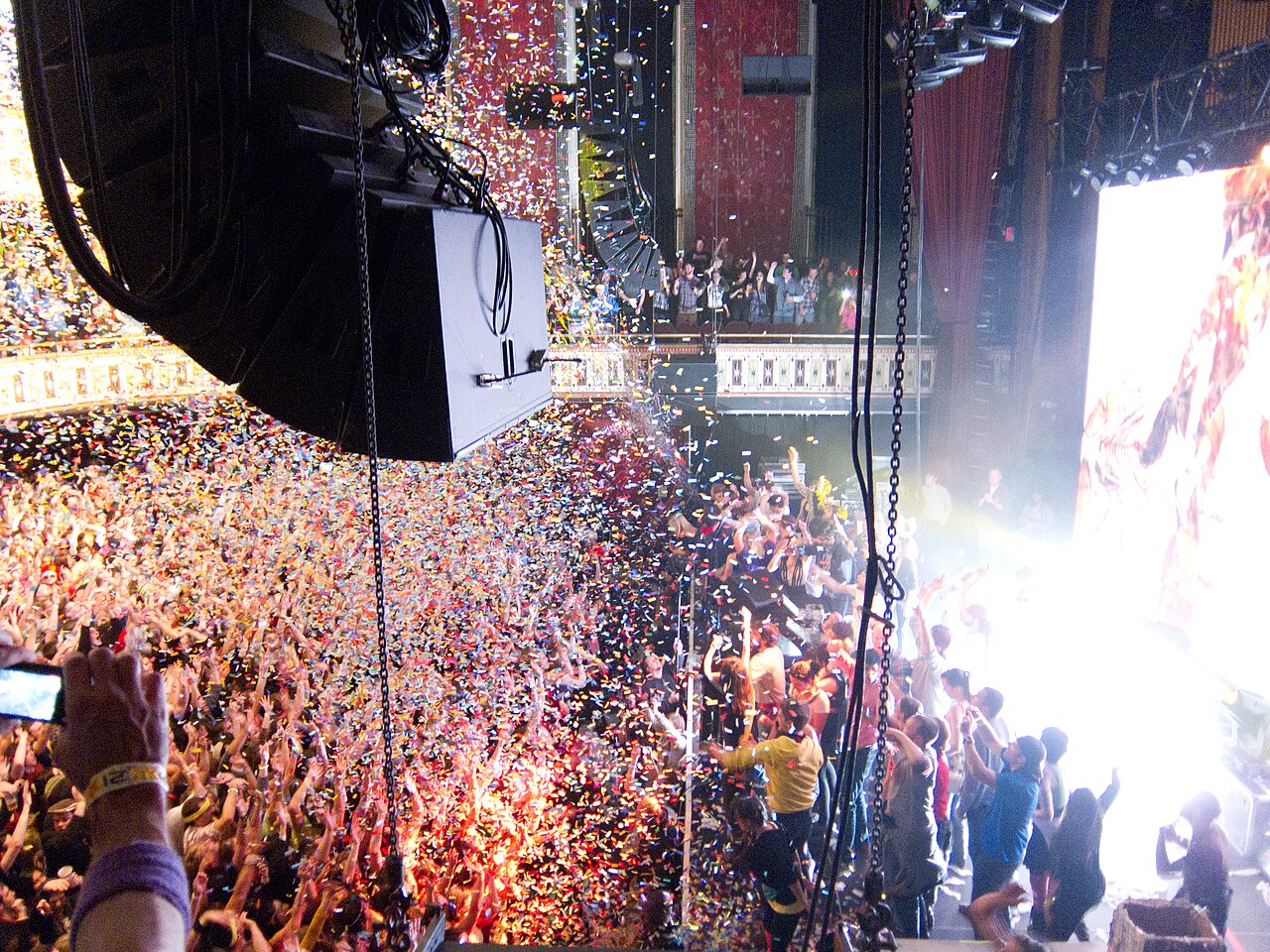
Confetti rains down on an energetic crowd during a live performance at the historic Tabernacle concert venue in Atlanta, United States of America.
Chris Schrier · cc by 2.0

A historic interior view of The Tabernacle in Atlanta, United States of America, showcasing its grand pipe organ and traditional auditorium seating.
P.E. Burroughs · public domain

A band performs on stage at The Tabernacle in Atlanta, United States of America, set against a large screen with bold text.
David Chou from Atlanta, Georgia, USA · cc by-sa 2.0
Visitor Logistics
Getting There
The Tabernacle sits at 152 Luckie Street NW, a few blocks from Centennial Olympic Park. MARTA is the cleanest move: ride the Blue or Green Line to SEC District Station, then walk 5 to 10 minutes west toward Luckie Street; Peachtree Center on the Red or Gold Line also works, though that walk is closer to 10 to 15 minutes depending on which exit you catch. Drivers should aim for the 100 Luckie Street LAZ deck about one block away, and rideshares can drop directly at the entrance.
Opening Hours
As of 2026, this is not a daytime sightseeing stop with regular public hours. Doors usually open 1 hour before showtime, and the box office opens on show days only, 2 hours before the show, then closes when the headliner takes the stage. If no event is scheduled, assume the interior is closed.
Time Needed
Give the facade 10 to 15 minutes if you just want a look outside and a few photos under the old church front. For a real event night, plan 2.5 to 4 hours total; if you want drinks, merch, coat check, and the slow exhale of the post-show crowd, 3.5 to 5 hours is more honest.
Accessibility
The main floor and lower-level Cotton Club area are accessible, and staff can help you through the main entrance if you need the accessible route. Balcony seating is stairs-only, so skip it if climbing steps is an issue; accessible restrooms are downstairs, accessible parking is at the 100 Luckie Street deck, and assistive listening runs through the ListenWIFI app on venue Wi-Fi.
Cost & Tickets
No single entry price exists because every show is ticketed separately. As of 2026, official tickets come through the Tabernacle site, Ticketmaster, or the box office on show days, where purchases add a $5 service charge per ticket plus tax; mobile entry is standard, and some events also sell Fast Lane, lounge access, or Premier Parking add-ons.
Tips for Visitors
Skip Parking Scams
Downtown Atlanta has a steady side hustle of unofficial lot attendants, and locals report cars getting booted after cash payments. Use MARTA, rideshare, or a clearly signed garage like 100 Luckie, and pay at the machine or app, not to someone waving a fluorescent vest.
Camera Rules
Phone shots are usually fine unless the artist bans them, but the house rules get strict fast. GoPros, personal video cameras, detachable lenses, tripods, selfie sticks, drones, and other pro gear are out; some shows, like certain comedy dates, go fully phone-free.
Eat Nearby Smart
This block is better for convenience than romance. For budget to low-mid, grab Aviva by Kameel in Peachtree Center; for mid-range cocktails and a pre-show dinner, Thrive works; if you want a polished downtown table, White Oak Kitchen or Ray's in the City make more sense than whatever is closest to the door.
Pack Small
Bag policy is tighter than many first-timers expect: bags can be up to 12 by 6 by 12 inches, and backpacks or multi-compartment bags are banned even when they look harmless. No official luggage storage exists, so if you're arriving with a roller bag, stash it off-site before you show up.
Best Arrival Time
Get here 30 to 45 minutes before doors if you care where you stand on a GA night; the room rewards early positioning, especially when the floor fills. Show up late and the building's old church bones start working against you, with columns, steep levels, and sightlines that can turn stubborn.
Pair It Nearby
The smartest pairing is Centennial Olympic Park, Georgia Aquarium, or the World of Coca-Cola before the show, since all sit within a short walk. Downtown around Luckie Street runs on event energy: loud and crowded before concerts, then oddly hollow after, so keep to the main lit streets when the night thins out.
Where to Eat
Don't Leave Without Trying
The Food Shoppe
quick biteOrder: The Harrison bagel is a must-try, and their breakfast sandwiches are legendary for good reason.
This place has been a downtown staple for years, offering reliably great comfort food in a no-frills setting. It's the perfect spot for a quick, hearty meal before or after a show at The Tabernacle.
Energy Eatz
quick biteOrder: Their signature power bowls are packed with fresh, local ingredients and are perfect for a quick, nutritious meal.
This tiny spot is a hidden gem for health-conscious eaters, offering fresh, vibrant dishes that are as delicious as they are good for you. It's a great option if you want something lighter but still satisfying.
J.A.T.C Cuisine ATL
local favoriteOrder: The fried chicken is crispy and perfectly seasoned, and the mac and cheese is creamy and rich.
This is a no-frills spot for authentic Southern soul food, run by a local family. The portions are generous, the flavors are bold, and the prices are unbeatable.
Best Of Atlanta Gift shop
quick biteOrder: Their selection of Atlanta-made snacks and treats, like peach cobbler bites and spicy peach salsa, are perfect for a quick, tasty bite.
This gift shop doubles as a great spot to grab local treats and souvenirs. It's a fun, casual place to pick up something sweet or savory to enjoy on the go.
Dining Tips
- check If you're craving classic Atlanta soul food, Busy Bee Cafe is worth the short trip east.
- check For a quick bite before or after a show, The Food Shoppe and Best Of Atlanta Gift shop are both right around the corner.
- check If you want something healthy and fresh, Energy Eatz is a great option with locally sourced ingredients.
Restaurant data powered by Google
Historical Context
From Soul-Saving Machine to Show Room
The Tabernacle's real story starts with an argument against the simplified version. Current venue copy often says 1910, but records show the first services in the present building took place on September 3, 1911, after delays that stretched the wait and sharpened the anticipation.
And this was never just a church. Church-era sources describe a wired institutional complex with telephones, call bells, stereopticons, a huge illuminated sign on the roof, and even a line from the pulpit to infirmary beds, as if preaching and medicine belonged in the same bloodstream.
Len G. Broughton Bet His Reputation on a New Kind of Church
Leonard Gaston Broughton, a physician turned preacher, founded the Tabernacle movement in Atlanta in 1898 and spent the next decade trying to prove that downtown religion could be big, modern, and useful. What was at stake for him was personal as much as spiritual: his name, his money men, and his public authority were tied to an expensive new Luckie Street complex that promised sermons, hospital care, and social reform under one roof.
Records show the congregation broke ground on August 17, 1909, and by June 1911 church publications were proudly describing the almost-finished building's gadgets and scale. Then came the turning point on September 3, 1911, when the new sanctuary finally opened and Broughton used the moment not for gentle gratitude but for attack, turning opening day into a broadside against politicians he believed were blocking prohibition.
That choice tells you what kind of room this was built to be. Less parish church than civic amplifier. The stage mattered from the start, and the crowd-sized architecture you see during a concert was designed for persuasion before it was ever designed for applause.
The Missing Campus
Most visitors read The Tabernacle as a standalone survivor. Secondary histories suggest something larger: Hunt's design belonged to a Baptist campus that also included an infirmary and nurses' housing, much of it now gone. The concert hall is the piece that remained, which gives the facade a slightly orphaned quality once you know what used to stand beside it.
The Tornado That Nearly Took It
If you had stood here on March 14, 2008, you would have seen the building fight for its life. Reports document a downtown tornado ripping open the roof, blowing out windows and stained glass, and sending a chimney crashing into the stage area. After church decline, Olympic reinvention, and years as a music hall, weather nearly erased the whole performance in one night.
Listen to the full story in the app
Your Personal Curator, in Your Pocket.
Audio guides for 1,100+ cities across 96 countries. History, stories, and local insight — offline ready.
Audiala App
Available on iOS & Android
Join 50k+ Curators
Frequently Asked
Is The Tabernacle worth visiting? add
Yes, if you care about live music, old buildings with a second life, or Atlanta history packed into one room. This started as a Baptist megachurch project and still looks like one once you lift your eyes past the bar lines and stage lights. Go for a show, not for a daytime heritage visit, because the building usually opens only for events.
How long do you need at The Tabernacle? add
For the building itself, 10 to 15 minutes outside is enough if you only want a look at the facade. For a real visit, plan on 30 to 45 minutes before doors plus 2.5 to 4 hours for the show, security, drinks, and the slow spill onto Luckie Street afterward. Big nights can run longer.
How do I get to The Tabernacle from downtown Atlanta? add
Walk, take MARTA, or use a rideshare, because The Tabernacle already sits in downtown Atlanta at 152 Luckie Street NW. The easiest rail option is usually SEC District Station on the Blue and Green Lines, about a 5 to 10 minute walk; Peachtree Center on the Red and Gold Lines also works, though the walk is a little longer depending on your exit. If you drive, use a signed garage like 100 Luckie Street rather than handing cash to an unofficial parking attendant.
What is the best time to visit The Tabernacle? add
The best time to visit is 30 to 45 minutes before doors open for your show. That gives you enough time to clear security, find your level, and notice the details people miss, like the balconies, chandelier, and old church bones hiding inside the concert setup. If you only want exterior photos, arrive in late afternoon before the crowd thickens on Luckie Street.
Can you visit The Tabernacle for free? add
You can see the outside for free, but you usually need a ticket to get inside. This is a working concert and comedy venue, not a museum with public touring hours, and the box office opens only on show days. No official free-entry days turned up in current venue information.
What should I not miss at The Tabernacle? add
Don't miss the shock of the room itself: the wraparound balconies, the chandelier, the pipe organ, and the way a former church still reads like a place built for amplified feeling. If your ticket or access level lets you wander, look for the Eden Room's hand-painted Garden of Eden scenes and the original church seats in the upper levels. And outside, step back across Luckie Street so you can take in the red brick facade, white columns, and six red doors in one frame.
Sources
-
verified
The Tabernacle
Official venue homepage with address, venue identity, and current event role.
-
verified
UNESCO World Heritage Centre
Checked to confirm the Tabernacle is not on the U.S. UNESCO Tentative List.
-
verified
The Atlanta Journal-Constitution
Background on the venue's history, nickname, and local significance.
-
verified
The Atlanta 100
Secondary history summary on the church's founding and later life.
-
verified
Georgia Baptist Health Care Ministry Foundation
History of the Tabernacle Infirmary and Georgia Baptist Hospital connection.
-
verified
Clio
Historic summary with architect, dates, and building timeline.
-
verified
Wikimedia Commons
Architectural rendering used for design and early-history context.
-
verified
Georgia Historic Newspapers
Primary-source reporting on the August 17, 1909 groundbreaking.
-
verified
Wikipedia
Secondary overview used for cross-checking dates, capacity, and conversions.
-
verified
Discover Atlanta
Tourism listing reflecting the commonly repeated 1910 date and current venue use.
-
verified
Georgia Historic Newspapers
Primary-source description of the nearly finished building, technical systems, and roof sign.
-
verified
Material Religion
Context on Broughton, the infirmary, and the institutional church mission.
-
verified
Georgia State University Exhibits
Context on nearby Baptist hospital property and Georgia State's early geography.
-
verified
Wikipedia
Biographical overview of Len G. Broughton, the church founder.
-
verified
Pollstar
Report on tornado damage in March 2008.
-
verified
Pollstar
Follow-up on tornado damage and repair status.
-
verified
G&G Architects
Restoration architect project page documenting tornado repairs.
-
verified
Wikipedia
Broader context for the March 14, 2008 downtown Atlanta tornado.
-
verified
Georgia Historic Newspapers
Primary-source confirmation of first services on September 3, 1911.
-
verified
Georgia Historic Newspapers
Primary-source reporting on the dedication period in September 1911.
-
verified
Discover Atlanta Meetings
Current venue listing used for visitor-facing basics and the repeated 1910 date.
-
verified
Proof Pudding
Venue profile with interior features and current event-space framing.
-
verified
Atlanta Downtown
Downtown district guide with brief history and location context.
-
verified
Centennial Park District
District guide with history, location, and neighborhood context.
-
verified
The Atlanta 100
Secondary history piece on roots, scale, and later reinvention.
-
verified
Georgia Historic Newspapers
Primary-source confirmation of the 1909 groundbreaking.
-
verified
UPI
Report on Olympic-era conversion into House of Blues.
-
verified
Ticketmaster Blog
Venue FAQ with current practical details and general orientation.
-
verified
Atlanta Music Guide
Local venue history and rebranding context.
-
verified
ELA Abatement
Case study on 2020 exterior column paint stabilization and refresh work.
-
verified
The Tabernacle Visit
Official visitor policies covering doors, bags, box office, and entry rules.
-
verified
Ticketmaster
Venue ticketing page used for box office and access details.
-
verified
The Tabernacle Calendar
Official April 2026 event calendar confirming active programming.
-
verified
The Tabernacle Calendar
Official May 2026 event calendar confirming active programming.
-
verified
MARTA
Service advisory on Peachtree Center station entrance closures in spring 2026.
-
verified
The Tabernacle Accessibility
Official accessibility details on seating, restrooms, assistive listening, and parking.
-
verified
JamBase
Illustrative example of event-specific pricing range.
-
verified
MARTA
Station information for SEC District, the closest rail stop.
-
verified
MARTA
Station information for Peachtree Center, an alternate rail stop.
-
verified
MARTA
Bus Route 40 information for connections near Peachtree Center.
-
verified
MARTA
Atlanta Streetcar stop information relevant to Centennial Olympic Park access.
-
verified
MARTA
General Atlanta Streetcar service information.
-
verified
Centennial Park District
Park location context and walking approach near the venue.
-
verified
Atlanta.com
Overview of the venue and approach for visitors.
-
verified
Ticketmaster
Example of official parking add-on tied to the 100 Luckie Street deck.
-
verified
Parkopedia
Third-party reference for parking hours, height limit, and indicative rates.
-
verified
ParkMe
Third-party reference for the 100 Luckie Street garage and pricing ballpark.
-
verified
R&B ONLY LIVE
Show-specific timing example used to estimate a full evening visit.
-
verified
Tripadvisor
Nearby restaurant list used for practical dining options.
-
verified
Georgia World Congress Center Authority
Official park hours and visitor guidance for Centennial Olympic Park.
-
verified
Georgia World Congress Center Authority
Official visitor center hours and restroom availability.
-
verified
Georgia World Congress Center Authority
Official park spot listing used for park hours cross-check.
-
verified
Bounce
Third-party luggage storage option near the venue.
-
verified
Ticketmaster
Show-specific example of a phone-free event policy.
-
verified
Live Nation Special Events
Detailed venue layout and interior feature descriptions, including Eden Room and original seats.
-
verified
VPIX Virtual Tour
Virtual-tour inventory of rooms and event spaces inside the building.
-
verified
Wikimedia Commons
Exterior photograph used for facade and streetscape description.
-
verified
Georgia State University
Visual and descriptive notes on the building's exterior appearance.
-
verified
The Tabernacle Private Events
Official venue page describing architecture, red doors, and event-space character.
-
verified
Atlanta.com
General visitor impressions and venue overview.
-
verified
Wanderlog
Crowd-sourced venue impressions including acoustics and visitor feel.
-
verified
SoundPrint
Crowd-sourced sound-level reference suggesting the room can get very loud.
-
verified
Atlanta Concert Reviews
Concert FAQ with sightline and balcony-view context.
-
verified
Tripadvisor
Photo reference highlighting the chandelier from an upper balcony.
-
verified
The Tabernacle Membership
Official premium-membership page used to confirm VIP-style experiences.
-
verified
The Tabernacle Upgrades
Official page for add-ons such as Fast Lane and premium access.
-
verified
ProSoundWeb
Venue nickname and technical venue profile from a sound-system upgrade story.
-
verified
Reddit
Local opinions comparing the Tabernacle with other Atlanta venues.
-
verified
Reddit
Local complaints and warnings about parking, sightlines, and crowding.
-
verified
Reddit
Recent local discussion used for crowd and corporate-feel sentiment.
-
verified
Reddit
Local comparison of the Tabernacle with newer Atlanta venues.
-
verified
The Atlanta Voice
Example of the venue's place in Atlanta's Black arts and music culture.
-
verified
The Atlanta Journal-Constitution
Local music coverage on performances, venue memory, and Atlanta reputation.
-
verified
Centennial Park District
Overview of the district around the venue and its event-driven identity.
-
verified
Reddit
Local discussion used to gauge downtown atmosphere and foot-traffic patterns.
-
verified
Eater Atlanta
Restaurant context for downtown Atlanta dining near the venue.
-
verified
Reddit
Local safety and after-show movement impressions.
-
verified
Atlanta.com
General downtown safety guidance used for practical caution notes.
-
verified
Peachtree Center
Dining cluster and nearby food options in the downtown core.
-
verified
White Oak Kitchen & Cocktails
Restaurant reference for nearby Southern-style dining.
-
verified
Axios Atlanta
Local coverage reinforcing Aviva by Kameel's Atlanta following.
-
verified
Centennial Park District
District restaurant listing for Thrive as a nearby pre-show option.
-
verified
Alma Cocina Downtown
Restaurant reference for a polished pre-show dinner nearby.
-
verified
Ray's in the City
Menu reference for a formal seafood and steak option nearby.
-
verified
Ray's in the City
Dress-code reference used for practical dining advice.
-
verified
Caribou Coffee
Nearby cafe option in Peachtree Center.
-
verified
Axios Atlanta
Nearby redevelopment context and planned Live Nation venue in Centennial Yards.
-
verified
The Wall Street Journal
Commercial development context for new entertainment infrastructure near downtown Atlanta.
-
verified
The Atlanta Journal-Constitution
Local retrospective on the venue after two decades as a music room.
Last reviewed:


