Disneyland Anaheim
AnaheimUnited States 33° N · 117° W Updated Apr 2026
Opened to the public on July 18, 1955, Disneyland still feels like Anaheim's gravitational field: part fantasy kingdom, part city-shaping machine today.
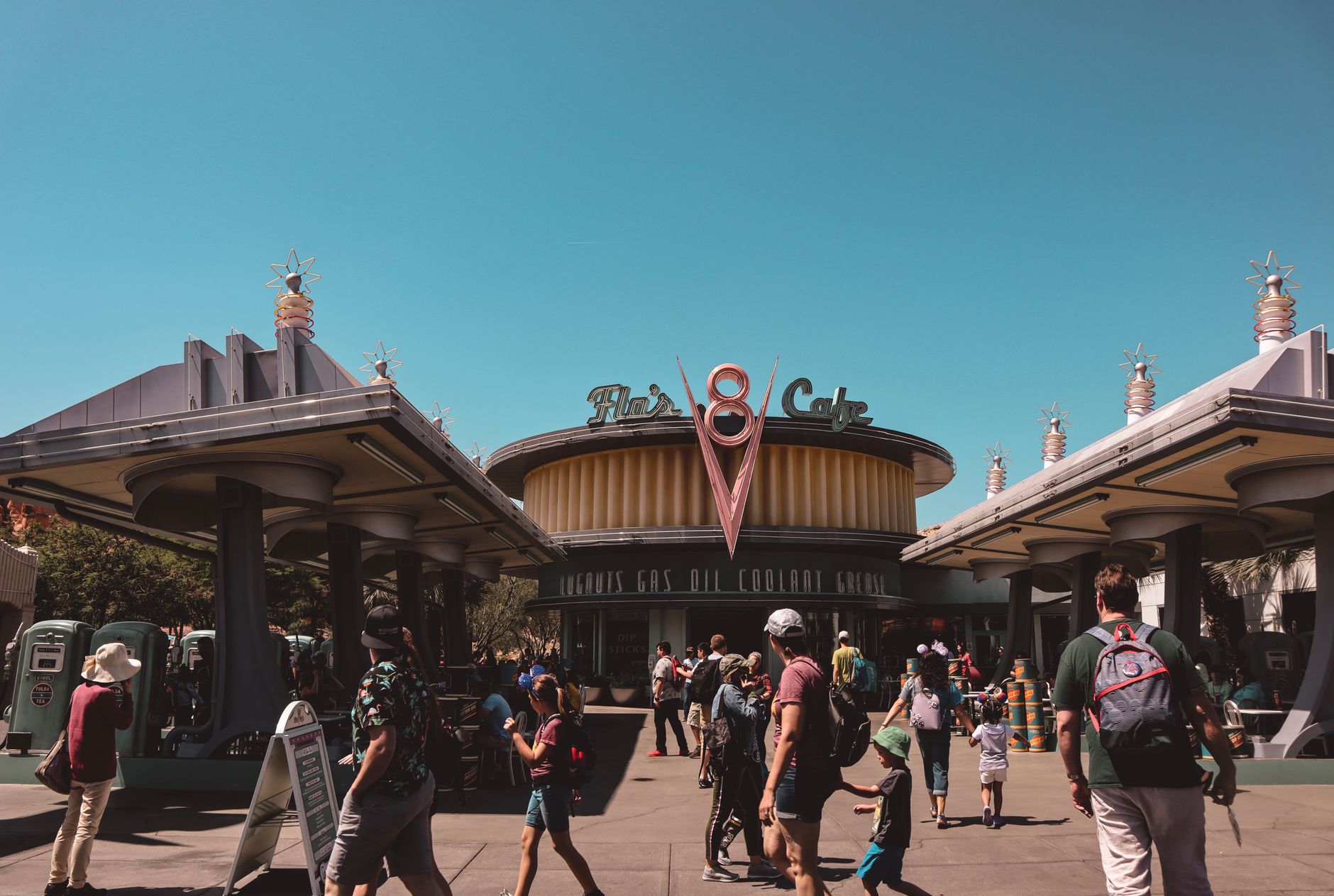
 Photo: Aubrey Odom / Unsplash
- Time needed
- Full day
Why does Disneyland Park feel like a small-town dream when it rose from orange groves beside a six-lane freeway and one of Southern California's biggest tourist corridors? In Disneyland Park, Anaheim, United States, that contradiction is the reason to come: you visit to watch an industrial-strength fantasy machine hide its own machinery so well that a walk down Main Street can still feel oddly personal. Today you smell popcorn, chlorine, and warm pavement, hear the whistle of the Disneyland Railroad circling behind the berm, and watch Sleeping Beauty Castle catch the California light at the end of a street designed to seem longer than it is.
Most first-time visitors think the trick is scale. Partly true. Main Street's upper floors shrink in forced perspective, the castle pulls your eye forward, and a 14-foot earth berm, raised from on-site soil, cuts off the sight of Anaheim beyond the tracks like a stage curtain made of dirt and trees.
But the real draw isn't innocence. It's ambition you can walk through. Walt Disney wanted a place controlled down to the trash cans and sightlines, then filled it with boats, jungles, brass bands, fake snow peaks, and enough choreographed delight to change how the world thinks a theme park should work.
Come for the rides if you want. Come for the argument built into the place if you can: a park that sells spontaneity through obsessive planning, nostalgia through new construction, and intimacy to millions of people a year. Few American places explain postwar optimism, consumer spectacle, and family ritual with such unnerving clarity.
What to see
-
Sleeping Beauty Castle and the Walkthrough
Most people treat Sleeping Beauty Castle as a backdrop, then hurry under it toward rides. Slow down and climb inside. The castle opened with Disneyland on July 17, 1955, and records on the official walkthrough place its interior opening in 1957; the passages are narrow as an old townhouse stair, the dioramas glow with jewel-box light, and Eyvind Earle's medieval storybook style turns a fairy tale into something almost monastic. Outside, the drawbridge has been lowered only twice, which changes the whole building: less a pretty icon than a ceremonial gate you happen to cross in sneakers. -
New Orleans Square After Dark
New Orleans Square is where Disneyland stops acting cute and starts showing off. Walt dedicated it on July 24, 1966, and you feel that extra ambition in the wrought-iron balconies, the gaslamp glow, the slap of water beside Pirates of the Caribbean, and the smell of sugar and frying dough drifting over the pavement. Stand by the river instead of joining the first queue you see. Jazz leaks through the air, the porch shadows get longer, and the whole place begins to read less like a theme-park district than a compressed stage set built by someone who understood that atmosphere can hit harder than speed. -
A Dusk Route from Main Street to Batuu
Start at the Disneyland Railroad station at the top of Main Street, where the view toward the castle stretches like a theatrical aisle, then walk slowly through Adventureland, past the cooler air of the Tiki Room, and out toward the river in Frontierland before ending in Star Wars: Galaxy's Edge. This route works because Disneyland's real magic lives in transitions: horse-car bells giving way to jungle drums, open river wind after tight streets, then the engine rumble and multilingual chatter of Black Spire Outpost, whose rock spires rise like a petrified forest taller than a 10-story building. By the time the lights come on in Batuu, you've felt the park changing key again and again, which is the secret adults tend to miss when they're busy collecting rides.
Plan your visit
- Getting There
- Disneyland sits in Anaheim, not Los Angeles, and that distinction matters once traffic starts to bite. By car, use the Mickey & Friends or Pixar Pals structures or the Toy Story lot; standard parking is $40 as of 2026, with trams from the structures and shuttle buses from Toy Story. Without a car, the clean official routes are Metro Express Line 460 from Norwalk Station, or Amtrak Pacific Surfliner/Metrolink to ARTIC, then ART Route 14 or 15, or OCTA Route 50 to Katella-Harbor Blvd. and a three-block walk; Disney says the ARTIC transfer takes about 30 minutes.
- Opening Hours
- Disneyland's 2026 hours swing hard by date, so the daily calendar matters more than any guidebook sentence. Most spring dates open at 8:00 AM, with many regular days closing at 10:00 PM or 11:00 PM, while After Dark event nights can cut general admission hours to 8:00 PM before separately ticketed events run from 9:00 PM to 1:00 AM. As of 2026, the 70th-anniversary cycle runs through August 9, and April calendars also showed temporary closures such as the Disneyland Monorail, Jungle Cruise, and Roger Rabbit's Car Toon Spin on some dates.
- Time Needed
- A quick sampler takes 4 to 6 hours if you want castle photos, Main Street, a few major rides, and one meal before the queues thicken. A real Disneyland day is 10 to 14 hours, basically from rope drop to nighttime shows, with the park clock stretching like a summer shift that ends in fireworks smoke and tired feet. If you care about parades, slower dark rides, character stops, and evening atmosphere, give it one full day and don't pretend otherwise.
- Accessibility
- Disneyland is fully paved and far easier on wheels than many historic attractions, but distance is the real enemy; the strain comes from miles of walking, queueing, and a day that can run longer than a transatlantic flight. As of 2026, manual wheelchairs rent for $15 per day and ECVs for $60 plus a $20 refundable deposit, with accessible parking at Mickey & Friends, Pixar Pals, and Toy Story, plus wheelchair-accessible trams, shuttles, companion restrooms, Disability Access Service, and attraction queue re-entry options.
- Cost & Tickets
- Entry still requires both a valid ticket and a park reservation for the same date, which catches out more first-timers than any roller coaster does. As of 2026, multi-day tickets start at $335 for a 2-Day 1-Park-Per-Day adult ticket and $435 for a 2-Day adult Park Hopper, while Lightning Lane Multi Pass starts at $34 per ticket per day; children age 2 and under enter free, and Park Hopper switching begins at 11:00 AM. One money-saving angle is the 2026 Kids' Summer Ticket Offer, which gives children ages 3 to 9 a 1-Day Park Hopper for $50 on select dates from May 22 to September 7.
Photo Gallery




History
The Day the Dream Melted
Disneyland's official story likes clean lines: Walt had an idea, bought land in Anaheim, opened the gates, and changed leisure forever. Records do support the broad outline. Construction began in 1954 on roughly 160 acres of citrus and walnut groves, and the park's invited dedication took place on July 17, 1955, before the public opening on July 18.
But smooth legends rarely survive close looking. This place was born in hurry, contradiction, and televised panic, which makes it more interesting than the polished version. Once you know that, even the neat facades on Main Street start to look less like nostalgia and more like controlled recovery from chaos.
The turning point
Black Sunday and Walt Disney's Personal Gamble
At first glance, Disneyland appears to have arrived fully formed on July 17, 1955: a spotless kingdom unveiled by Walt Disney to a national television audience, every turret and turnstile exactly where it should be. That surface story still clings to the park because Disney's cameras were rolling, the dedication speech was calm, and the brand later preferred triumph to embarrassment.
Then the details begin to snag. Documented accounts describe counterfeit invitations, crowds far beyond the expected 15,000, fresh asphalt soft enough to catch high heels, broken drinking fountains, ride failures, and a gas leak bad enough to close part of Fantasyland. Walt Disney had more than pride at stake. He had pushed past skeptical board members, tied the project to ABC financing, and risked the independence of his company on a park many people in Hollywood thought was a reckless side project.
The turning point came not when the gates opened, but when Walt kept performing composure while the opening buckled around him. That is the revelation: Disneyland's founding myth survives because a near-disaster was edited into a creation story. Look at the park now and you see something sharper than whimsy. You see a place built by a man who bet his reputation, his money, and his future on the idea that even visible failure could be folded into the show by nightfall.
From Orange Rows to Empire
The Park That Kept Rewriting Itself
Tips for visitors
Camera Rules
Leave the selfie stick behind; Disney bans it, and drones are banned too. Small folding tripods or monopods are allowed only if they fit inside a standard backpack, while commercial filming needs prior authorization.Buy Direct
The most believable Disneyland scam is a fake discount ticket, not a pickpocket in a striped shirt. Buy through disneyland.com or the official app, because a cheap resale ticket can die at the turnstile after you've already paid for parking.Pick Your Day
Check the official daily calendar before you lock in a date, because one day may run until 11:00 PM and the next may dump regular guests out at 8:00 PM for an After Dark event. Morning light on Main Street is softer, crowds are thinner, and rope drop still does more work than most paid add-ons.Eat Outside
Skip the reflex to eat every meal inside the Disney bubble. Downtown Disney is the easy option without another ticket, with Din Tai Fung, Naples Ristorante e Bar, and Jazz Kitchen Coastal Grill & Patio, but Anaheim gets more interesting in Little Arabia at Little Arabia Restaurant and Le Mirage Pastry, or at the Packing House with Urbana if you have time to step outside the resort script.Harbor Advantage
A hotel on Harbor Boulevard opposite the pedestrian entrance can save more energy than a fancy lobby ever will. Disney lists Courtyard Anaheim Theme Park Entrance at 1420 S. Harbor Blvd. as about a five-minute walk, and hotels around 1650 S. Harbor Blvd. are effectively across the street, while places that look close around Katella often involve a longer, less pleasant walk.Bag Limits
Disney's size rule matters more than people expect: bags, suitcases, coolers, and backpacks larger than 24 x 15 x 18 inches are not allowed into the parks. As of 2026, lockers cost $7 or $10 inside the parks and $7, $10, $12, or $15 in the Esplanade, with unlimited same-day access and no overnight storage.
Frequently asked
Is Disneyland Anaheim worth visiting?
Yes, if you care about themed design as much as rides, Disneyland is still worth your day. This is the original 1955 park, and it feels tighter, stranger, and more art-directed than many bigger resorts. The best part is often the shift in mood: steam and brass on Main Street, cool dark corridors inside Sleeping Beauty Castle, then the rusty market clatter of Galaxy’s Edge.
How long do you need at Disneyland Anaheim?
You need one full day for Disneyland Park, and 10 to 14 hours is the realistic version of that day. A quick sampler can work in 4 to 6 hours, but you’ll spend it choosing between headliners instead of settling into the place. On many 2026 dates the park runs from 8:00 AM to 10:00 PM or 11:00 PM, which gives you a day as long as a transatlantic flight.
How do I get to Disneyland Anaheim from Anaheim?
From within Anaheim, the cleanest public route is usually ARTIC plus a resort bus connection or OCTA Route 50, then a short walk up Harbor Boulevard. Disney’s official directions say Amtrak or Metrolink riders can go to ARTIC, then take Anaheim Resort Transit Route 14 or 15 to the resort, or OCTA 50 to Katella-Harbor Blvd. and walk about three blocks. If you’re driving, standard theme-park parking is $40 and runs through the Mickey & Friends, Pixar Pals, and Toy Story lots.
What is the best time to visit Disneyland Anaheim?
The best time to visit is a non-event weekday when the park keeps its later hours and doesn’t close early for an After Dark party. In spring 2026, regular days often ran until 10:00 PM or 11:00 PM, while some event nights cut general admission off at 8:00 PM. If you want extra atmosphere, the 70th-anniversary cycle runs through August 9, 2026, which adds celebratory details without changing the bones of the park.
Can you visit Disneyland Anaheim for free?
No, not in the usual sense: Disneyland Park does not have official free-entry days in the current 2026 source set. Children age 2 and under do not need a ticket, and everyone else needs valid admission plus a park reservation for the same date. If you just want the resort edge without a park ticket, Downtown Disney is the free part.
What should I not miss at Disneyland Anaheim?
Don’t miss the things that prove Disneyland is better at atmosphere than brute scale: Sleeping Beauty Castle Walkthrough, Pirates of the Caribbean, the Enchanted Tiki Room, and dusk on Main Street from the railroad station. Matterhorn gives you the park’s 1959 Alpine jolt, but quieter details often stay with you longer, like the lamp above the Fire Station window and the sudden cool shade inside the Tiki Room. And if you stay late, New Orleans Square and Galaxy’s Edge do their best work after dark, when the lights turn theatrical and footsteps start echoing off water and stone.
Sources & attribution 14
- Disneyland Resort 70th Anniversary — Confirmed the current 70th-anniversary celebration and its August 9, 2026 run date.
- Disneyland Park Calendar — Provided current daily hours and examples of early closures tied to special-ticketed nights.
- Disneyland Ticket Prices FAQ — Confirmed ticket rules, age bands, and that children age 2 and under do not need a ticket.
- Disneyland Ticket Dates FAQ — Confirmed that valid admission and a park reservation are required for entry.
- Disneyland Parking — Provided current standard parking price and official parking locations.
- Disneyland Getting Here by Train — Provided ARTIC connections, ART routes, OCTA Route 50, and the three-block walk from Katella-Harbor Blvd.
- Disneyland Transportation — Confirmed local transit options and walking connections around the resort.
- Mouse Hacking Disneyland One Day Itinerary — Supported the practical estimate that a solid Disneyland day usually takes a full day, not a quick stop.
- Disneyland Official Park Overview — Confirmed the park’s overall layout and current land structure for experience-focused recommendations.
- Sleeping Beauty Castle Walkthrough — Provided historical context for the castle walkthrough and supported its inclusion as a high-value thing to see.
- Matterhorn Bobsleds — Confirmed the Matterhorn’s official status and 1959 opening context.
- Walt Disney’s Enchanted Tiki Room — Confirmed the attraction’s ongoing presence and helped support atmosphere-driven recommendations.
- Disneyland Railroad — Supported the Main Street railroad-station viewpoint recommendation.
- Disney Parks Blog: Walt Disney’s Legacy at Disneyland Resort — Provided the Fire Station lamp detail and other small in-park features that add texture to the FAQ.
Built from cited sources · see the method · How we make our guides →
Pick up where you left off
Saved and recently read places — kept on this device only.
Photo credits (8)
- Aubrey Odom — Unsplash License (https://unsplash.com/license) — Source: https://images.unsplash.com/photo-1641478862723-c088d2963497
- Aubrey Odom — Unsplash License (https://unsplash.com/license) — Source: https://images.unsplash.com/photo-1641478866763-d0017fb490c0
- Sean Denny — Pexels License (https://www.pexels.com/license/) — Source: https://www.pexels.com/photo/5194709/
- Isaac Garcia — Pexels License (https://www.pexels.com/license/) — Source: https://www.pexels.com/photo/9561667/
- Isaac Garcia — Pexels License (https://www.pexels.com/license/) — Source: https://www.pexels.com/photo/16005383/
- Gela delrose — Pexels License (https://www.pexels.com/license/) — Source: https://www.pexels.com/photo/4941636/
- Lauren — Pexels License (https://www.pexels.com/license/) — Source: https://www.pexels.com/photo/8200255/
- Angel Paz — Pexels License (https://www.pexels.com/license/) — Source: https://www.pexels.com/photo/27276177/
Photos may have been resized or cropped.