Stratford-Upon-Avon
United Kingdom Updated Apr 2026
Applause drifts across the River Avon before you even see the stage, and that is Stratford-upon-Avon, United Kingdom, in one neat scene: swans on the water, half-timbered gables on the bank, actors heading to work as if this were the most ordinary thing in the world. The surprise is how little it feels like a shrine frozen under glass. Stratford still behaves like a market town that happens to have Shakespeare wired into its pavements.
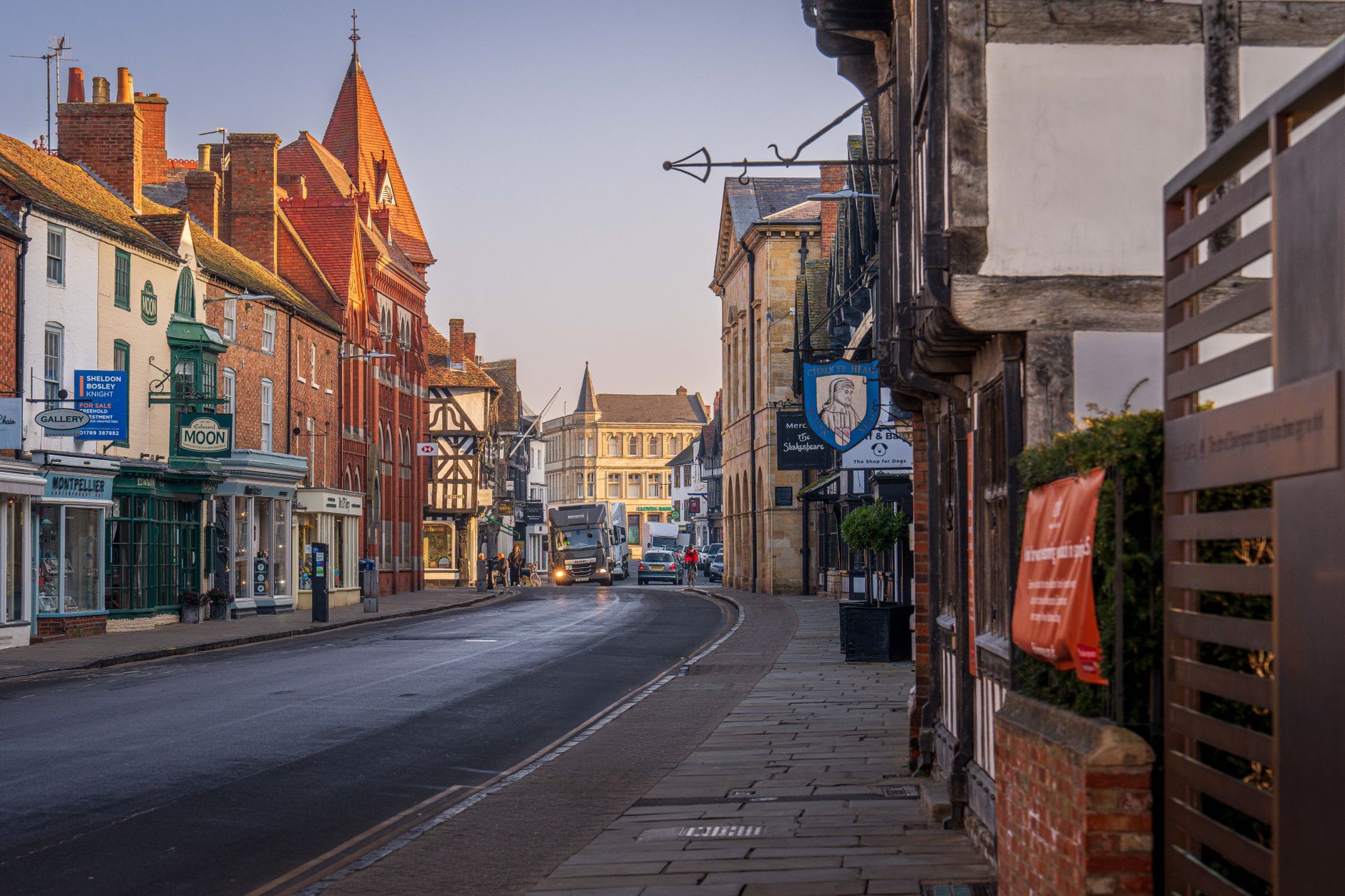 Photo: Mark Stebnicki / Pexels
- Attractions
- 12
- Trip length
- 2-3 days
- Best season
- Late spring to early autumn (April-September)
Why Stratford-Upon-Avon
Built from cited sources · see the method · How we make our guides →
Henley Street gives you the postcard version first: black-and-white timbering, queues at Shakespeare's Birthplace, the sweet smell of fudge aimed at day-trippers. Keep walking south and the town gets older, stranger, and better. The line from the Birthplace through High Street, Chapel Street, the Guild Chapel, and on to Holy Trinity Church reads like one continuous argument between commerce, faith, theatre, and civic pride.
Performance shapes the place more deeply than heritage branding does. The Royal Shakespeare Theatre and Swan Theatre sit on Waterside like working machinery rather than museum pieces, and the rhythm of the day follows them: coffee in the morning, market traffic by noon, early dinners before curtain-up, then a last pint at the Dirty Duck while stage-door gossip drifts through the room.
What stays with you is the scale. Stratford is compact enough that you can hear church bells near Old Town, cross to the Recreation Ground on the 1937 chain ferry, and be back under the RSC tower before the light leaves the river; the whole place fits in your head by evening, which makes its density of stories feel almost unreasonable.
Theatre Runs the Town
Stratford-upon-Avon is one of the rare places where a theatre company shapes the whole civic mood. The Royal Shakespeare Theatre and Swan Theatre sit on Waterside like working engines, not memorials, and the free Play's The Thing exhibition lets you smell the glue, paint, and fabric behind the polished stage picture.More Than Birthplace Pilgrimage
Henley Street draws the first queue, but the stronger story stretches along the Historic Spine to Holy Trinity Church. Guild Chapel, Shakespeare's Schoolroom & Guildhall, timber-framed High Street facades, and the church where he was baptized and buried turn the town into one connected biography.A River Town, Still
The Avon keeps Stratford from feeling like a sealed heritage set. Bancroft Gardens, the canal basin, the Recreation Ground, and the 1937 chain ferry give the place movement: swans scraping the water, theatre crowds spilling out after dark, and locals using the lawns as if Shakespeare had never happened.
Neighborhoods
Where to wander, by quarter — each with its own rhythm.
Henley Street and the Town Centre
This is the Stratford everyone thinks they know, but look past the souvenir windows. Shakespeare's Birthplace anchors Henley Street, Box Brownie and Boston Tea Party keep the daytime caffeine trade moving, and the surrounding lanes still feel like a market town laid out for trade rather than for photographs.Waterside
Waterside is theatre Stratford in full voice. The Royal Shakespeare Theatre, Swan Theatre, Riverside Cafe, Rooftop Restaurant, Bancroft Gardens, and the old canal basin all sit within a few minutes' walk, so you get river light, interval crowds, and the faint air of a town dressing for a performance.Old Town
Old Town slows everything down. Holy Trinity Church stands here at the end of the historic route through town, set among old trees and grass near the river, and the mood shifts from retail bustle to stone, silence, and the long afterlife of Shakespeare's reputation.Chapel Street and Church Street
This stretch holds some of Stratford's sharpest architectural surprises. Shakespeare's New Place, the Guild Chapel, Shakespeare's Schoolroom & Guildhall, the Falcon Hotel, and the Woodsman all cluster here, which means medieval wall paintings, Tudor timber, and a very good pre-theatre dinner can fit into the same hour.Sheep Street
Sheep Street is where central Stratford eats properly. Loxley's and Lambs draw the dinner crowd into sixteenth-century rooms with low beams and polished service, and the street works best in the early evening when the tables fill with people calculating how much time remains before the play starts.Bell Court, Union Street, and Guild Street
This pocket feels newer in mood without losing the old street pattern. Bell Court brings courtyard dining and casual chains, while Guild Street hides places like Phoenix, where the crowd turns more local, the drinks list gets better, and the town shakes off its Bard-themed politeness.Bridge Foot and the Recreation Ground
Cross the river and Stratford becomes less posed. Cox's Yard handles the sociable side with drinks, brunch, and event nights, while the Recreation Ground gives you big lawns, the old chain ferry, and the sense that locals use the Avon as a place to sprawl, not just to admire.Shottery
About a mile west of the centre, Shottery feels like Stratford stepping back into hedgerows. Anne Hathaway's Cottage is the draw, but the real pleasure is the softer setting: cottages, gardens, and quieter lanes that replace the town-centre theatre current with something slower and more domestic.
Plan your trip
Before you go
- Getting There
- In 2026, Birmingham Airport (BHX) is the practical arrival point: the free Air-Rail Link connects the terminal to Birmingham International station in about 2 minutes, then trains run via Birmingham Moor Street to Stratford-upon-Avon. Main rail stations are Stratford-upon-Avon and Stratford-upon-Avon Parkway; by road, the town is reached most easily from the M40 at Junction 15, then the A46 and A3400.
- Getting Around
- Stratford-upon-Avon has no metro or tram system in 2026, which suits the place: most visitors walk. Local transport relies on National Rail, regional buses, and the Park & Ride with 700-plus spaces, buses every 15 minutes, a 10 to 12 minute run into town, and fares of £2.50 adult or £4.00 for up to five people; cyclists should look at Stratford Greenway, a 5-mile traffic-free former railway route.
- Climate & Best Time
- Spring usually sits around 11 to 17°C by day, summer around 20 to 22°C, autumn around 10 to 19°C, and winter around 7 to 8°C, based on the nearest Met Office long-term averages used as a Warwickshire proxy. Rain falls all year, with October the wettest and March the driest; May, June, and September are the sweet spot, while July and August bring the heaviest visitor traffic.
- Language & Currency
- English is the working language everywhere you will need it, from station ticket machines to Shakespeare Birthplace Trust sites. The currency is pound sterling (£), contactless card payment is widely accepted in 2026, and carrying a little cash still helps for markets or smaller independents.
- Safety
- Stratford is generally easygoing, but the sensible caution points are late-night pub streets and riverside flooding after heavy rain. Use licensed taxis only, check for the council licence plate and driver badge, and remember that UK emergency numbers are 999 or 112.
A Market Town That Became the World's Stage
From a Roman ford to Shakespeare's working hometown
- c. 100 CE
A Ford Before Fame
Long before anyone spoke of Shakespeare, a Roman road met the Avon here and needed a place to cross. The name Stratford preserves that fact in plain sight: a street, a ford, a river. Traffic came first; fame arrived much later.
- c. 700
Saxons Settle the Crossing
By about the 7th century, Saxon settlers had turned the crossing into a small agricultural community. Timber halls, livestock, and muddy lanes mattered more than poetry. The river fed fields, ferried goods, and decided where people slept.
- 1196
A Market Charter Arrives
King Richard I granted Stratford the right to hold a weekly market in 1196, pushing it from useful crossing to proper market town. Market day meant wool bales, animal noise, and money changing hands under open sky. A charter can look dry on parchment; in practice, it rearranges a place.
- 1269
Guild and Chapel Take Root
The Guild of the Holy Cross was founded in 1269 and soon shaped Stratford's religious, charitable, and civic life. Its chapel and guild buildings gave the town a center of gravity in stone and timber. Medieval Stratford starts to feel visible here.
- 1553
Edward VI Refounds Stratford
Edward VI's charter re-incorporated Stratford in 1553 and re-founded its grammar school. Local government gained firmer shape, and the schoolroom became a place of hard Latin drill, long benches, and ink-stained ambition. The town's civic and intellectual life tightened around the same few streets.
- 1556
Anne Hathaway of Shottery
Anne Hathaway was born into the farming world of Shottery, just west of Stratford, where orchards and hedged fields still soften the town's edge. Her connection reminds you that Stratford's story was never confined to its market streets. The Shakespeare legend begins partly in mud, milk pails, and country lanes.
Show the full timeline (24 moments)
- 1561
Richard Field Leaves His Mark
Richard Field was born into a Stratford family on Bridge Street and later left for London as a printer's apprentice. He would go on to print Shakespeare's poems, which is a fine local secret: Stratford shaped the press as well as the playwright. Ink mattered here too.
- 1564
Plague Shadows a Birth Year
Plague tore through Stratford in 1564, and parish registers filled with the blunt rhythm of burials. Houses shut against neighbors, and fear would have smelled of smoke, vinegar, and stale rooms. The town that produced England's best-known playwright was, at that moment, listening for death bells.
- 1564
William Shakespeare Is Born
William Shakespeare was born on Henley Street in 1564 and baptized at Holy Trinity Church that April. He grew up among glovers, traders, schoolmasters, and the damp river air of a modest market town. Stratford gave him first sounds that never quite left: church bells, market cries, legal quarrels, gossip.
- 1568
John Shakespeare Takes Office
In 1568 John Shakespeare, William's father, reached the office of bailiff, the town's highest civic post. He was a glover, property owner, and local operator with a sharp eye for status. The family on Henley Street was climbing, and everyone in town would have known it.
- c. 1594
Fire Tests the Timber Town
Fires ripped through parts of Stratford in the 1590s, a constant threat in a town of close-packed timber frames and thatch. A spark in the wrong loft could turn a lane into a furnace before the bucket line formed. Surviving Tudor Stratford looks gentle now because enough of it escaped.
- 1597
New Place Changes Everything
When Shakespeare bought New Place in 1597, he purchased one of the largest houses in town. The deal announced that the boy from Henley Street had returned with London money and serious standing. Success, in Stratford, had an address.
- 1616
Shakespeare Lies in Stratford
Shakespeare died in April 1616 and was buried inside Holy Trinity Church near the chancel. That grave fixed Stratford as more than a birthplace; it became the place where the story closes. Visitors still lower their voices there, and for once the hush makes sense.
- 1623
A Face Carved in Stone
A painted funerary bust of Shakespeare was installed in Holy Trinity Church in 1623, giving Stratford one of its earliest public claims to his likeness. Carved stone did cultural work here. It turned private mourning into civic memory.
- 1642
Civil War Passes Nearby
The English Civil War shook Warwickshire from 1642 onward, though Stratford escaped the kind of siege that scars masonry for centuries. That relative quiet mattered. The town kept much of its fabric while national politics tore at the counties around it.
- 1645
Plague Returns to Stratford
Plague returned in 1645, proving that market towns never enjoy the neat endings historians like to give them. Trade, worship, and kinship all became dangerous at once. In a place this compact, nearly every bell toll had a name attached.
- 1816
The Canal Reaches Town
The Stratford-upon-Avon Canal opened in 1816 and tied the town more tightly to regional trade. Coal, goods, and visitors could now arrive along a ribbon of water cut with locks and towpaths. Industry reached Stratford softly, with mud on boots and rope-burn on hands.
- 1847
Birthplace Becomes Heritage
Shakespeare's Birthplace was bought for preservation in 1847 instead of being left to decay or crude commercial use. That purchase helped invent the modern heritage town, where timber beams became cultural assets. Memory acquired trustees, tickets, and arguments that still haven't ended.
- 1859
Railway Opens the Floodgates
The railway arrived in 1859 and changed the scale of everything. Pilgrims, scholars, and day-trippers could step off a carriage and walk straight into Shakespeare country. Steam turned Stratford into a national habit.
- 1901
Marie Corelli Fights Back
Marie Corelli settled in Stratford in 1901 and used her celebrity to defend the town's old buildings with real force. She opposed schemes that would have flattened its timbered character into something blander and richer. Stratford owes part of its present texture to her stubbornness.
- 1932
A Theatre Claims the River
The Shakespeare Memorial Theatre rose on the riverfront in 1932 after the earlier theatre burned in 1926. Its brick mass on Waterside made performance part of the town's daily skyline, not an occasional ornament. Stratford stopped being only Shakespeare's past and became a place that kept staging him in the present.
- 1964
Scholarship Gets a Home
The Shakespeare Centre opened in 1964, four hundred years after Shakespeare's birth, and brought archives, scholarship, and public interpretation under one roof. Anniversary culture can turn stiff. Here, it sharpened the town's sense of purpose.
- 2012
Machines Join the Story
The MAD Museum opened in 2012 with whirring kinetic art, gears, levers, and mechanical mischief. That matters because Stratford is healthier as a cultural town than as a shrine. Even here, the story did not end in the 17th century.
- 2023
A Living Town Endures
By 2023 Stratford had around 30,000 residents and a global reputation still anchored by the Royal Shakespeare Company, the river, and a tight medieval street plan. Roughly 3 million visitors a year passed through a town that remained lived-in rather than preserved under glass. The surprise is not that Shakespeare dominates the place; it's that market, church, school, pub, and theatre still hold together.
Who lived here
-
Playwright and poet · c.1564–1616
William Shakespeare
Born, lived, and died here
He started in a timber-framed house on Henley Street and ended beneath the stone floor of Holy Trinity Church, which gives Stratford a strange neatness: the world's most quoted playwright begins and ends within a short walk. He'd still recognize the pull of the place, though the souvenir density around his old neighbourhood might test his patience.
-
Historical figure in Shakespeare's life · 1556–1623
Anne Hathaway
Grew up in nearby Shottery and died in Stratford-upon-Avon
Her family home in Shottery has been polished into one of England's great literary side-stories, but the real point is geographic: Shakespeare's romance was never abstract, it was a walk across fields to a village just outside town. She might laugh at how many visitors still make that walk, looking for a marriage story in the beams and orchard.
-
Glover and civic office-holder · late 1520s–1601
John Shakespeare
Worked and held office here
Before Stratford became a shrine to genius, it was John Shakespeare's working town of leather, property, and municipal ambition. His rise as a tradesman and local official explains why Shakespeare's childhood was rooted in a market town that smelled of business as much as books.
-
Printer and publisher · 1561–1624
Richard Field
Grew up here
Field grew up in Stratford and later printed Shakespeare's poems in London, which makes him one of the town's quiet hinge figures. He turns Stratford from birthplace myth into something more interesting: a small town that fed talent into the machinery of English print.
-
Novelist · 1855–1924
Marie Corelli
Lived here 1901–1924
Corelli arrived as a bestselling novelist and ended up fighting for Stratford's old buildings with the zeal of someone who understood that timber frames can vanish one bad decade at a time. Parts of the town look the way they do because she refused to treat heritage as a decorative backdrop.
Insider tips
Small things that change how the city treats you.
Book Pre-Theatre Early
If you're seeing the RSC, reserve dinner in the 4:00-6:30 pm window. Stratford's eating rhythm bends around curtain time, and the better central tables on Sheep Street, Chapel Street, and Waterside fill first.Use The Markets
Rother Street Market runs on Fridays and Saturdays, while the Waterside Upmarket runs on Sundays and Bank Holiday Mondays from March to December. They're one of the cheapest ways to eat well without another booked restaurant meal.Walk The Spine
Treat the town as a walk, not a taxi puzzle. The best route runs from Henley Street through High Street and Chapel Street to Holy Trinity Church, with most headline sights folded into one compact line.Shottery Is Close
Anne Hathaway's Cottage sits about a mile from the centre in Shottery, so most visitors can walk it if the weather behaves. Wear proper shoes; the return feels longer after a full museum day.Mind The Service Charge
Tipping in Britain is lighter than in the US: 10-15% is fine in restaurants if service was good and a service charge hasn't already been added. In pubs, you'll often order and pay at the bar, and a tip usually isn't expected.Eat Sunday Roast
Sunday is the day to lean into Stratford's food habits. Places like Loxley's, Dirty Duck, and Cox's Yard all push roast lunches, so book ahead if you want one rather than settling for whatever is left at 2:30 pm.Coffee Before Crowds
Henley Street works best early, before the Birthplace crowds thicken. Later in the day, shift toward the Royal Shakespeare Theatre side for a quieter coffee with river views.Ignore Old Salt Lists
Older restaurant roundups still send people to Salt, Paul Foster's former Michelin-starred restaurant. It closed in May 2025, so use newer guides unless you enjoy arriving at locked doors.
Gallery
The city, as it actually looks.


Frequently asked
Is Stratford-upon-Avon worth visiting?
Yes, especially if you want more than a Shakespeare checklist. The town works because the theatre scene, medieval streets, riverfront, markets, and church all sit close enough to feel like one continuous place rather than scattered attractions.
How many days in Stratford-upon-Avon?
Two days is enough for the essentials, and three gives the town room to breathe. One day covers Shakespeare's Birthplace, the centre, and the river, but a second day lets you add an RSC performance, Holy Trinity Church, Shottery, or the Guild Chapel without rushing.
Can you visit Stratford-upon-Avon without a car?
Yes. The centre is compact and strongly walkable, and the main sights along the historic core are close together. Even Anne Hathaway's Cottage in Shottery is only about a mile from town.
Do I need to book Royal Shakespeare Company tickets in advance?
Yes, if you want a specific production or a good seat. The RSC is the town's main cultural draw, and theatre nights shape restaurant demand too, so booking the show and dinner together is the sane way to do it.
Is Stratford-upon-Avon expensive to visit?
It can be moderate rather than cheap, especially if you stack theatre tickets and multiple Shakespeare properties in one trip. You can keep costs down by walking the historic centre, using the markets for lunch, and spending time in Bancroft Gardens and along the Avon.
Is Stratford-upon-Avon safe at night?
Generally, yes for most visitors sticking to the central streets around Waterside, Sheep Street, and the theatre quarter. Nightlife is fairly compact and pub-led rather than rowdy, though the usual late-evening care still applies around river paths and after closing time.
How do I get to Anne Hathaway's Cottage from Stratford-upon-Avon town centre?
Walking is the easiest option for many visitors. The cottage is about a mile away in Shottery, so it works as a pleasant add-on if you want a softer, less crowded edge of the Shakespeare story.
What is the best time to visit Stratford-upon-Avon?
Late spring through early autumn is the sweet spot. April brings Shakespeare's Birthday celebrations, and from March to December the Sunday Waterside Upmarket gives the riverfront more life than you get in the quieter winter months.
Pick up where you left off
Saved and recently read places — kept on this device only.
Photo credits (13)
- Mark Stebnicki — Pexels License (https://www.pexels.com/license/) — Source: https://www.pexels.com/photo/31125279/
- Meer Street Stratford upon Avon Warwickshire England 02 — Acabashi — CC BY-SA 4.0 (https://creativecommons.org/licenses/by-sa/4.0/) — Source: https://commons.wikimedia.org/wiki/File:Meer_Street_Stratford_upon_Avon_Warwickshire_England_02.jpg
- "The Other Place", Southern Lane, Stratford-on-Avon - geograph.org.uk - 7263414 — Ruth Sharville — CC BY-SA 2.0 (https://creativecommons.org/licenses/by-sa/2.0/) — Source: https://commons.wikimedia.org/wiki/File:"The_Other_Place",_Southern_Lane,_Stratford-on-Avon_-_geograph.org.uk_-_7263414.jpg
- 30.4.16 1 Stratford 19 (26493408340) — donald judge — CC BY 2.0 (https://creativecommons.org/licenses/by/2.0/) — Source: https://commons.wikimedia.org/wiki/File:30.4.16_1_Stratford_19_(26493408340).jpg
- 30.4.16 1 Stratford 18 (26699193701) — donald judge — CC BY 2.0 (https://creativecommons.org/licenses/by/2.0/) — Source: https://commons.wikimedia.org/wiki/File:30.4.16_1_Stratford_18_(26699193701).jpg
- Meer Street Stratford upon Avon Warwickshire England 01 — Acabashi — CC BY-SA 4.0 (https://creativecommons.org/licenses/by-sa/4.0/) — Source: https://commons.wikimedia.org/wiki/File:Meer_Street_Stratford_upon_Avon_Warwickshire_England_01.jpg
- Costa Coffee flat white Stratford upon Avon — Acabashi — CC BY-SA 4.0 (https://creativecommons.org/licenses/by-sa/4.0/) — Source: https://commons.wikimedia.org/wiki/File:Costa_Coffee_flat_white_Stratford_upon_Avon.jpg
- MOR Bakery croissant, Bell Court, Stratford upon Avon — Acabashi — CC BY-SA 4.0 (https://creativecommons.org/licenses/by-sa/4.0/) — Source: https://commons.wikimedia.org/wiki/File:MOR_Bakery_croissant,_Bell_Court,_Stratford_upon_Avon.jpg
- Full English Breakfast Deli Cafe Stratford upon Avon — Acabashi — CC BY-SA 4.0 (https://creativecommons.org/licenses/by-sa/4.0/) — Source: https://commons.wikimedia.org/wiki/File:Full_English_Breakfast_Deli_Cafe_Stratford_upon_Avon.jpg
- Stratford upon Avon Bear Pit Theatre Rother Street Warwickshire England — Acabashi — CC BY-SA 4.0 (https://creativecommons.org/licenses/by-sa/4.0/) — Source: https://commons.wikimedia.org/wiki/File:Stratford_upon_Avon_Bear_Pit_Theatre_Rother_Street_Warwickshire_England.jpg
- Stratford upon Avon Rother Market Square fruit vegetable stall Warwickshire England — Acabashi — CC BY-SA 4.0 (https://creativecommons.org/licenses/by-sa/4.0/) — Source: https://commons.wikimedia.org/wiki/File:Stratford_upon_Avon_Rother_Market_Square_fruit_vegetable_stall_Warwickshire_England.jpg
- Stratford upon Avon Rother Market Square Shakespeare Memorial Fountain Warwickshire England — Acabashi — CC BY-SA 4.0 (https://creativecommons.org/licenses/by-sa/4.0/) — Source: https://commons.wikimedia.org/wiki/File:Stratford_upon_Avon_Rother_Market_Square_Shakespeare_Memorial_Fountain_Warwickshire_England.jpg
- The Old Thatch Tavern Stratford upon Avon Warwickshire England 02 — Acabashi — CC BY-SA 4.0 (https://creativecommons.org/licenses/by-sa/4.0/) — Source: https://commons.wikimedia.org/wiki/File:The_Old_Thatch_Tavern_Stratford_upon_Avon_Warwickshire_England_02.jpg
Photos may have been resized or cropped.