An introduction.
Researched by the Audiala editorial team from historical records, architectural archives, and local expertise.
WWhy does the greatest Protestant cathedral in England look like it belongs in Catholic Rome? St Paul's Cathedral in London, United Kingdom, is a building born from deception — an architect's quiet rebellion against the very institution that commissioned him. Visit not for the postcard dome, but for the tension hidden inside every column and curve: a 300-year-old argument between faith and reason, frozen in Portland stone.
Step through the west doors and the scale hits you physically. The nave stretches 158 metres ahead, its ceiling vaulting upward into a hush that swallows the shuffle of a thousand daily visitors. Then the dome opens above you — 30 metres across, painted with monochrome scenes of St Paul's life by James Thornhill — and the light changes. It pours down from the lantern in a column so defined you can almost touch its edges. The stone floor, a geometric puzzle of black and white marble, clicks under your heels like a metronome.
This is the fifth cathedral to occupy this patch of Ludgate Hill, the highest point in the old City of London. The first was raised in AD 604. Fire, neglect, and Viking raids destroyed the others. What stands now is Sir Christopher Wren's defiant masterpiece, completed in 1710 after 35 years of construction, compromise, and creative insubordination.
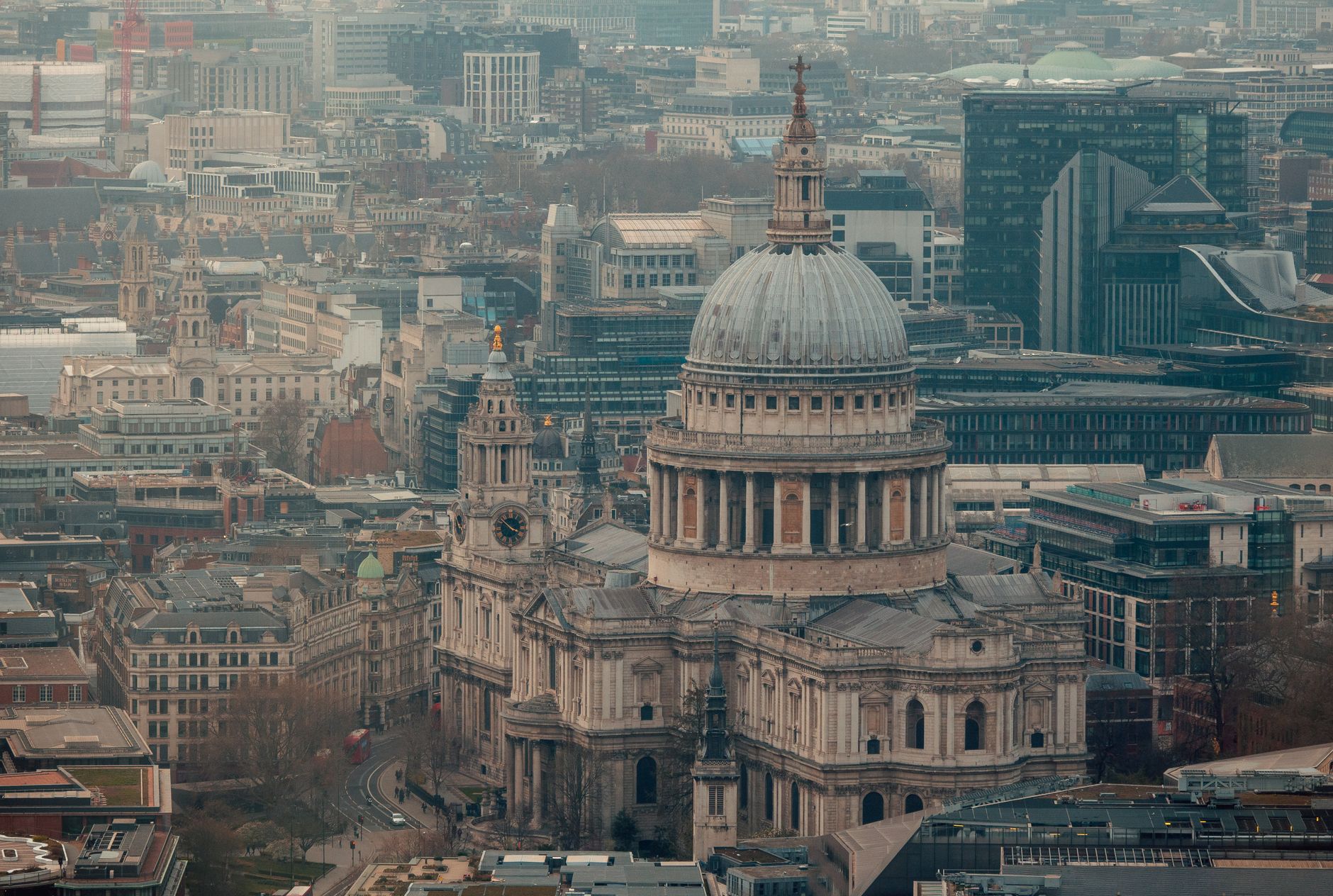
Outside, the dome still commands the skyline from certain protected viewpoints — a fact that generates fierce debate between heritage campaigners and developers every few years. Inside, the building remains a working Anglican cathedral, with daily services, choral evensong, and the low resonance of bells that have marked time in the City for centuries. It is also, unavoidably, the building that survived the Blitz — the dome floating above a sea of fire in that famous photograph of December 1940, an image that became shorthand for an entire nation's refusal to break.
St Pauls Cathedral Tour - From The Very Top To The Crypt, The Iconic Cathedral
London Visited01 What to see.
The Triple-Shell Dome and Its Galleries
Most people assume they're looking at one dome. They're looking at three. Sir Christopher Wren, who spent 35 years on this building, engineered an outer lead-covered timber dome for London's skyline, an inner painted dome for the congregation below, and a hidden brick cone sandwiched between them — the structural spine that actually holds the 850-tonne lantern aloft. Start your ascent at the Whispering Gallery, 30 metres above the cathedral floor, where the curved walls carry a murmur from one side to the other across 34 metres of open air. Press your ear to the cold stone and have someone whisper against the opposite wall. It works, and it's genuinely eerie.
Keep climbing. The Stone Gallery puts you outside, face-to-face with Portland limestone carvings most visitors never see up close. But the real reward sits 85 metres up at the Golden Gallery — a narrow balcony ringing the lantern where all of London unfolds beneath you, from the Thames bending east toward Greenwich to the clock tower of Big Ben catching light to the west. That's 528 steps from the cathedral floor, no lift. Your legs will know it.
The Crypt
Wren built the largest crypt in Western Europe — it runs the entire 175-metre length of the cathedral above. Down here, the air drops a few degrees and the light thins to a quiet amber. Admiral Lord Nelson lies in a black marble sarcophagus originally carved for Cardinal Wolsey in the 1520s, repurposed nearly three centuries later after Trafalgar. The Duke of Wellington's tomb, a massive block of Cornish porphyry, sits nearby. But the grave that stops people is Wren's own, marked by a plain black slab beneath the dome he spent a lifetime building.
Above it, a brass plate carries the inscription his son composed in 1723: Lector, si monumentum requiris, circumspice — Reader, if you seek a monument, look about you. No other epitaph in England says so much with so little. Nearby, look for the diamond-shaped floor plaque honouring the St Paul's Watch, the volunteers who stood on the roof through the Blitz of 1940–41, beating out incendiary bombs with sandbags to save the building while the city burned around it.
The Full Circuit: Millennium Bridge to One New Change
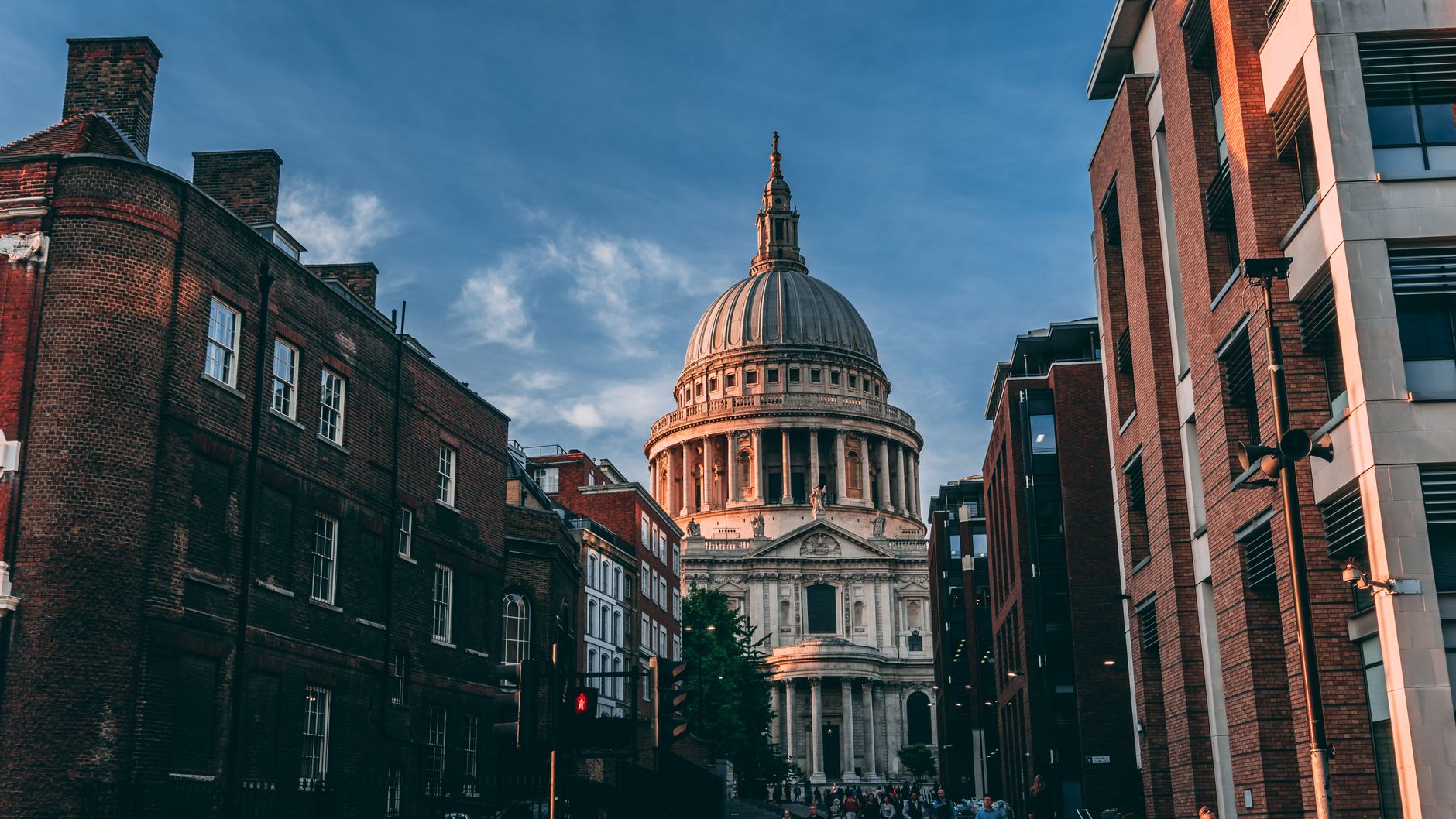
The best way to understand St Paul's is to see it from the outside before you step in. Start on the south bank at Tate Modern and walk north across the Millennium Bridge — the cathedral's west front fills your entire field of vision, perfectly framed by the bridge's steel cables, a composition so deliberate it feels designed (it was, by Foster + Partners and sculptor Anthony Caro). Cross the river, pass through the churchyard where medieval booksellers once traded, and enter through the Great West Door.
After you've climbed the dome and descended into the crypt, exit and walk east along Watling Street — a road that follows the Roman original — to find the ivy-draped ruins of St Dunstan-in-the-East, another Wren church left open to the sky after the Blitz. Then double back to One New Change, the Jean Nouvel–designed shopping centre directly south of the cathedral, and take the free lift to the rooftop terrace. From up there, the dome floats at eye level, close enough to count the columns on the peristyle. Late afternoon light is best — the Portland stone turns the colour of warm honey.
02 In pictures.



Watch & Explore St Pauls Cathedral.
Plan and listen to St Pauls Cathedral with Audiala.
Audio guide in your pocket, itinerary in your browser. Built for the way you actually visit.
Tickets & tours.
These are guided options from our partners — same price as booking direct.
Prices are indicative — final pricing and availability are confirmed at checkout. Audiala may earn a commission from bookings made through these links.
Also on GetYourGuide
More tours for St Pauls Cathedral
Curated from GetYourGuide. Same price as official, free cancellation on most.
 GetYourGuide
London: St Paul's Cathedral Entry Ticket
from
€31
 GetYourGuide
Buckingham Palace & Crown Jewels of London Tour
from
€207
 GetYourGuide
London: Luggage Storage close to St. Paul’s Cathedral
from
€8
Prices shown are indicative — final pricing and availability are confirmed at checkout. Audiala may receive a commission from bookings made via these links.
03 Visitor logistics.
The practical scaffolding for a good visit — kept short.
Getting There
St Paul's Underground station (Central Line) drops you a 3-minute walk away — exit and the dome is already looming above you. City Thameslink rail station is 4 minutes on foot, and Blackfriars (District/Circle lines plus National Rail) about 7 minutes. If you're walking from the Tate Modern, cross the Millennium Bridge — the cathedral fills your entire field of vision as you approach, which is the single best free experience in the City of London.
Opening Hours
As of 2026, sightseeing hours run Monday, Tuesday, Thursday, Friday, and Saturday from 08:30 to 16:30, with last entry at 16:00. Wednesdays open later at 10:00 due to staff meetings. The cathedral is a working church, so special services can shut down tourist access without much warning — always check the official calendar before you go.
Time Needed
A focused visit covering the main floor and Crypt takes 1 to 1.5 hours. If you want to climb the dome — 528 steps to the Golden Gallery at the very top — and linger with the audio guide, budget a full 2.5 hours or more. The Whispering Gallery alone, where a murmur carries 34 metres across the dome's interior, deserves at least 15 minutes of quiet experimentation.
Accessibility
Step-free access is available through the South Churchyard entrance, with elevators reaching the main floor and Crypt. The dome galleries, however, are only reachable via narrow historic staircases — no wheelchair access above ground level. Accessible toilets are in the Crypt, and a new Changing Places facility is scheduled to open in April 2026. Disabled visitors and one accompanying carer enter free.
Tickets & Cost
As of 2026, adult sightseeing tickets start at £27, with concessions (seniors 65+, students) from £24. Book online to guarantee entry and skip the ticket desk queue. Attending a worship service is completely free, though you won't have access to sightseeing areas — a fair trade if you just want to sit beneath that dome and listen to the choir.
04 Tips for visitors.
Small things that change the day.
Dress Respectfully
St Paul's is an active Anglican cathedral. There's no strict dress code enforced at the door, but avoid overly revealing clothing — you'll feel the social pressure from staff and worshippers alike if you show up in beachwear.
No Photos Inside
Photography is strictly prohibited inside the cathedral — no exceptions, no sneaky phone shots. Drones are also illegal to fly anywhere in the City of London without a specific permit, so leave the gadgets for the exterior.
Watch For Pickpockets
The cathedral entrance and the Millennium Bridge are prime pickpocket territory, especially during summer crowds. Keep bags zipped and in front of you, and be particularly alert when people cluster around street performers on the bridge approach.
Eat Nearby Smartly
For budget bites, grab something from the seasonal street food stalls in Paternoster Square, steps from the cathedral's west front. Mid-range, try Haz on Plantation Place for generous Mediterranean plates with outdoor seating. For a proper splurge, Bob Bob Ricard City has those famous 'Press for Champagne' buttons and surprisingly good beef Wellington.
Arrive At Opening
The cathedral is quietest in the first hour after opening — by 10:30 on any given Saturday, tour groups have arrived and the acoustic hush under the dome is gone. An 08:30 Monday arrival gives you the nave almost to yourself, with morning light flooding the eastern apse.
Combine With Neighbours
The ruined church garden of St Dunstan-in-the-East is a 10-minute walk east — another casualty of the Blitz, now reclaimed by climbing vines and ferns. It's free, uncrowded, and the perfect counterpoint to St Paul's grandeur.
Where to Eat
Don't Leave Without Trying
Amalfi Ristorante
local favoriteOrder: Fresh handmade pasta, particularly the seafood risotto and wood-fired pizzas. The tiramisu is a perfect finish.
Amalfi delivers authentic Italian cooking right on the Cathedral's doorstep with nearly 4,000 reviews and a stellar 4.9 rating. This is where locals grab proper Italian without the tourist markup.
Susleny Coffee
cafeOrder: Expertly pulled espresso and flat whites. Pair with a pastry for a proper London coffee break.
A serious specialty coffee spot hidden in Dean's Court—the kind of place where baristas actually care about extraction and temperature. Perfect for a pre-visit caffeine hit or post-tour wind-down.
Vagabond Wines St Paul's
local favoriteOrder: Curated wines by the glass, plus small plates and charcuterie boards. Ask the staff for recommendations—they know their list inside out.
Vagabond brings proper wine culture to Paternoster Square with an unpretentious vibe and a thoughtfully sourced list. It's the spot for a civilized evening drink without the stuffiness.
Bewliehill St Paul's
cafeOrder: Seasonal brunch items, quality coffee, and homemade cakes. The sourdough toast is consistently excellent.
A hidden gem tucked away on Queens Head Passage—this is where locals actually eat breakfast, not tourists. Small, intimate, and genuinely good food without pretension.
Dining Tips
- check The International Food Market at Paternoster Square happens on the last Thursday of every month (10 am – 3 pm) and brings diverse street food vendors to the Cathedral's doorstep.
- check Most restaurants in the area accept card payments, but it's wise to carry cash for smaller cafes and market stalls.
- check Lunch hours (12–2 pm) get busy with City workers—arrive early or book ahead at popular spots like Amalfi.
- check Many restaurants offer set menus at lunch for better value than à la carte pricing.
Restaurant data powered by Google
05 The Architect Who Lied to Build a Masterpiece
The story most visitors hear is simple: the Great Fire of 1666 destroyed Old St Paul's, and Christopher Wren built a new one. True enough. But the real story is about power, ego, and a scientist who smuggled his vision past a committee of clergymen — and got away with it for three decades.
The medieval cathedral that burned was already a ruin. Its spire had collapsed in 1561 after a lightning strike, and by the 1660s the nave was being used as a shortcut by market traders. The fire simply finished what neglect had started. King Charles II saw an opportunity: a new cathedral for a new London, designed by his Surveyor of the King's Works, a former Oxford astronomy professor named Christopher Wren.
The Warrant Deception: How Wren Outmanoeuvred the Church
The surface story is one of harmonious collaboration: Wren designed, the King approved, the cathedral rose. Visitors gaze up at the dome and assume it was always the plan. It wasn't. Wren's first proposal — the "Great Model" of 1673, a centrally planned Greek Cross topped by a massive dome — was rejected outright by the Anglican clergy. They called it too Catholic, too much like St Peter's in Rome. They wanted a traditional Latin Cross with a long nave for processions. For Wren, a man of science and classical proportion, this was an aesthetic catastrophe.
Here is where things stop adding up. Wren submitted a revised plan, the so-called "Warrant Design" of 1675, which gave the clergy their elongated nave and a modest steeple instead of a dome. Charles II approved it — but with a clause, likely inserted at Wren's urging, allowing the architect to make "ornamental" changes as construction progressed. Wren seized on that single word. Over the next 35 years, he systematically transformed the building. The steeple became a dome. The plain walls grew Baroque flourishes. The clergy, who could only see the foundations at first, didn't fully grasp what was happening until the structure was too far along to change. Wren had used a bureaucratic loophole to build the cathedral he wanted all along.
What this means for the visitor standing beneath the dome today is this: you are inside a lie that became the truth. Every soaring arch, every classical colonnade, every inch of that triple-shelled dome — the outer lead-covered timber shell, the hidden structural brick cone, and the painted inner dome you actually see from the floor — exists because one man decided that his aesthetic convictions mattered more than the committee's instructions. The building you see is not what was approved. It is what Wren believed London deserved.
Five Cathedrals, One Hill
The Night the Dome Almost Fell
Listen to the full story in the app
The whole St Pauls Cathedral,
told well.
Audio guides for 1,100+ cities across 96 countries. History, stories, and local insight — offline ready.
06 Frequently asked.
The questions travellers send us most about St Pauls Cathedral.
Is St Paul's Cathedral worth visiting?
Absolutely — it's one of the finest Baroque buildings in Europe and the emotional weight of the place, from Wren's tomb to the Blitz survival story, hits differently in person. The triple-shell dome rises 111 meters (taller than a 30-storey building), and climbing to the Golden Gallery rewards you with a 360-degree panorama of London. Even if you never go inside, the view of the west front from the Millennium Bridge is one of the great architectural sightlines in any city.
How long do you need at St Paul's Cathedral?
Plan for at least two hours if you want to do it properly. A quick walk through the main floor and crypt takes about an hour, but climbing all 528 steps to the Golden Gallery at the top of the dome — pausing at the Whispering Gallery and Stone Gallery on the way — adds another hour easily. If you're attending Choral Evensong (free, and genuinely moving), add 45 minutes to that.
Can you visit St Paul's Cathedral for free?
Yes, but only for worship services — sightseeing requires a ticket starting at £27 for adults. Attending a service like Choral Evensong gets you inside at no cost, though you won't be able to wander the galleries or climb the dome. It's a working Anglican cathedral first and a tourist attraction second, and the pricing reflects that split.
How do I get to St Paul's Cathedral from central London?
The easiest route is the Central Line to St Paul's station, which puts you a three-minute walk from the west entrance. City Thameslink rail station is about 300 meters away, and Blackfriars (District and Circle lines) is a seven-minute walk. If you're coming from the South Bank or Tate Modern, walk north across the Millennium Bridge — you'll get the best approach view of the cathedral as a bonus.
What is the best time to visit St Paul's Cathedral?
Early morning on a weekday, right at opening (8:30, or 10:00 on Wednesdays), gives you the quietest experience and the best chance of hearing your own footsteps echo off the Portland limestone. Avoid Sundays entirely for sightseeing — the cathedral is closed to tourists and open only for worship. Winter months sometimes bring special sound-and-light installations that transform the interior after dark.
What should I not miss at St Paul's Cathedral?
Three things most visitors walk past: the "Resurgam" phoenix carving above the south transept (according to tradition, Wren found the word on a tombstone fragment in the rubble of the old cathedral and took it as an omen), the diamond-shaped floor plaque near the Great West Door commemorating the volunteer fire watchers who saved the building during the 1940 Blitz, and Wren's own epitaph in the crypt — "Reader, if you seek a monument, look about you." The Whispering Gallery is famous for good reason, but these quieter details give the building its soul.
Is photography allowed inside St Paul's Cathedral?
No — photography is strictly prohibited inside the cathedral. This catches many visitors off guard, so get your exterior shots from the Millennium Bridge or the free rooftop terrace at One New Change shopping centre, which gives you an elevated, close-up angle on the dome.
Is St Paul's Cathedral wheelchair accessible?
Partially — step-free access to the main floor and crypt is available via the South Churchyard entrance, with elevators and accessible toilets in the crypt. The dome galleries, however, are not wheelchair accessible due to the narrow 17th-century spiral staircases. Disabled visitors and one accompanying carer enter free of charge.
Verified, and shown.
Researched and written by the Audiala editorial team from historical records, architectural archives, and local expertise.
Opening hours, seasonal variations, and general visitor planning information.
Current ticket pricing for adults, concessions, and children.
Wheelchair access details, step-free routes, and accessibility provisions.
Transport links, nearest stations, and directions.
Online booking portal and entry information.
Rules of conduct, dress code, and photography policy.
Details on daily services, Choral Evensong, and the choral tradition.
Official chronological history from AD 604 to the present.
Architectural details including the dome structure and decorative elements.
News on new accessibility facilities scheduled for 2026.
General history, architectural style (English Baroque), and construction dates (1675–1710).
History of the medieval cathedral begun in 1087 and destroyed in the Great Fire of 1666.
Confirmed founding date of AD 604 and general historical overview.
Details on Wren's design process, the Warrant Design compromise, and the triple-shell dome structure.
Official Grade I listing details and construction period confirmation (1675–1710).
Account of the cathedral's survival during the December 29, 1940 bombing raid.
Cultural significance of St Paul's as a symbol of British resilience.
Details on the 2019 light and poetry installation commemorating the Blitz.
Historical overview, construction materials (Portland limestone), and Wren's epitaph.
Hidden details including the St Paul's Watch plaque and interior features.
Information on restricted areas including the triforium, library, and Model Room.
Confirmed AD 604 founding date and cultural significance analysis.
Acoustic properties and visitor experience of the Whispering Gallery.
Best viewpoints from the Golden Gallery panorama.
Best exterior photo spots including the Millennium Bridge approach.
Accessibility review and estimated visit duration.
Analysis of the Protestant-Baroque design tension in Wren's cathedral.
Seasonal light installations that transform the cathedral interior.
Behind-the-scenes tours accessing restricted areas like the library and roof.
Architectural illusions and optical tricks used by Wren in the interior design.
Coverage of the 2011 Occupy London protest and cathedral closure.
Campaign for UNESCO Intangible Cultural Heritage status for English cathedral choral tradition.
The cathedral's ongoing work addressing its imperial past and racial justice.
Researched from Wikidata, Wikipedia & official sources · fact-checked · How we make our guides →