An introduction.
Researched by the Audiala editorial team from historical records, architectural archives, and local expertise.
TThe reason your phone knows what time it is — right now, this second — traces back to a hilltop in southeast London where a frustrated astronomer once worked out of a garden shed because the grand building behind him was useless. The Royal Observatory in Greenwich, United Kingdom, is where the world's clocks were set, where East meets West along a brass strip in the courtyard, and where the British Empire's global reach was plotted star by star. It's also one of the few places on Earth where you can physically stand on the line that divides the planet in two.
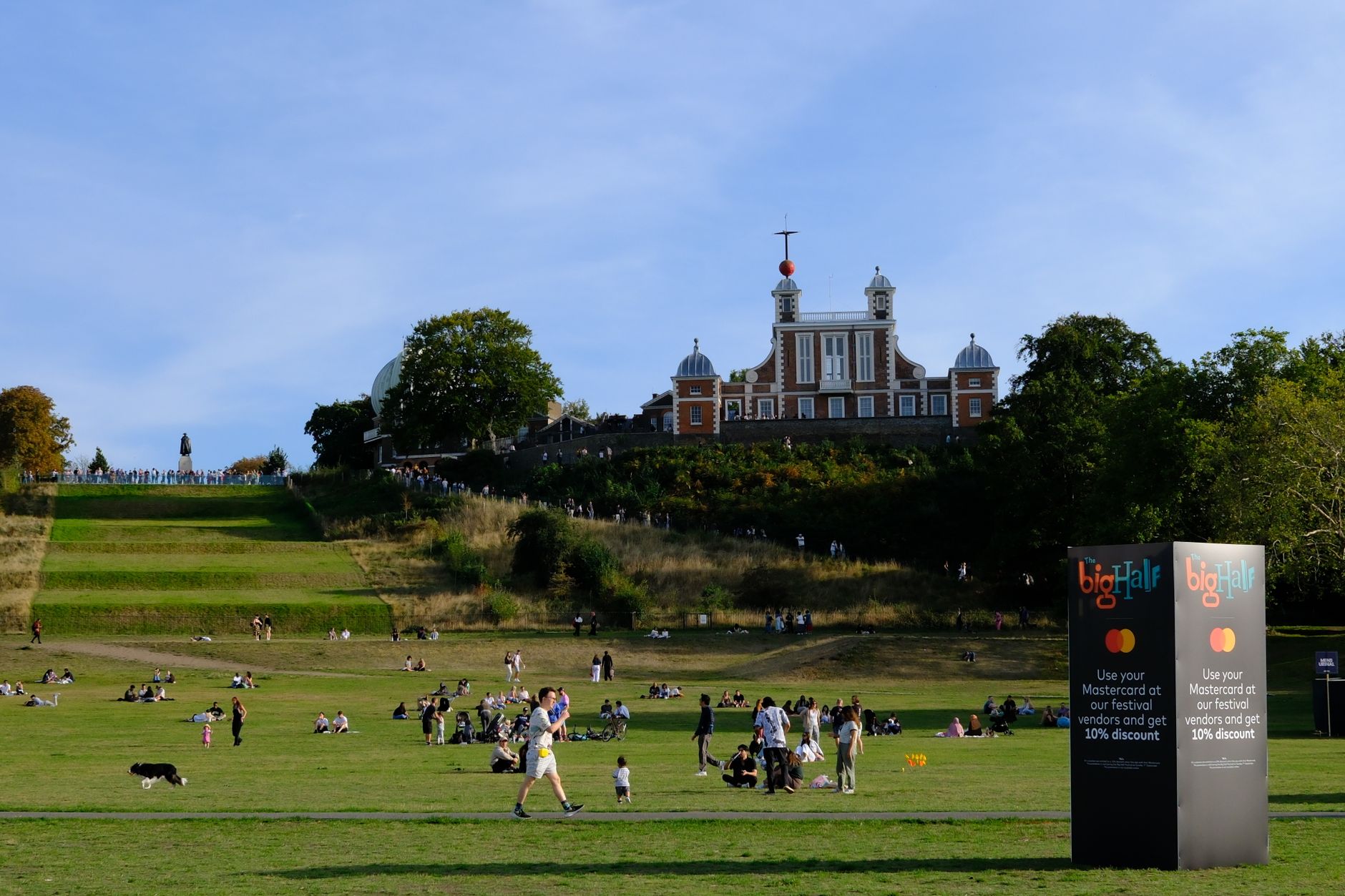
Perched at the top of Greenwich Park, the Observatory commands a view that rolls downhill past Inigo Jones's Queen's House and Christopher Wren's Old Royal Naval College, then across the Thames to the glass towers of Canary Wharf. The contrast is the point. You're looking at 350 years of ambition stacked in a single sightline — from the age of sextants to the age of algorithms.
Most visitors come for the Prime Meridian Line and the obligatory photo straddling hemispheres. Fair enough. But the real draw is the story inside: a king who needed better maps, a clockmaker who spent 31 years solving an impossible problem, and a scientific feud so vicious it makes modern academic rivalries look polite. The building itself, designed by Wren, was finished £20 over budget — a figure so modest it almost sounds like a clerical error.
If you've already explored the riverfront landmarks of London — the Parliament quarter around Big Ben, the medieval ruins of St Dunstan-in-the-East — Greenwich feels like a different city entirely. Quieter, greener, and built around a single idea: that knowing exactly where you are is the most powerful knowledge there is.
01 What to see.
The Octagon Room & Flamsteed House
Christopher Wren designed this room in 1676 on a budget so tight he overran it by only £20 — roughly the cost of a decent horse. He managed it by cannibalizing bricks from the demolished Greenwich Castle and surplus materials hauled over from the Tower of London. The result is a tall, luminous octagonal chamber with seven arched windows that flood the space with a quality of light you rarely find in 17th-century interiors. It feels more like a philosopher's salon than a scientific workspace.
Here's the irony: John Flamsteed, the first Astronomer Royal, found the room essentially useless for serious observation. The foundations were too shaky, the windows faced the wrong way, and the high ceiling made mounting instruments impractical. He ended up doing his real work from a cramped shed in the courtyard below. But the Octagon Room survived as a kind of beautiful accident — a space built for science that became a monument to ambition instead. Stand in the center and look up. The proportions are Wren at his most confident, every angle calculated to impress a king who needed to believe England could master the seas.
The Great Equatorial Telescope & Onion Dome
The telescope is 8 meters long — about the length of a London double-decker bus — and it sits inside a dome that looks like nothing else on the Greenwich skyline. That distinctive onion shape isn't decorative whimsy; it's the engineering consequence of fitting an oversized instrument onto an existing mount. The square midsection of the dome, which most visitors assume is a design choice, was actually a compromise to accommodate the telescope's bulk. Victorian pragmatism dressed up as architecture.
What most people walk past without noticing is the South Building next door, completed between 1891 and 1899. Its dome was constructed from papier-mâché layered over an iron frame — lightweight enough that a single person could rotate the entire structure in 30 seconds. Staff apparently tested this during observatory sports days, which also featured an "anemometer race" (yes, they raced wind-measuring instruments). The building's terracotta detailing is some of the finest decorative work on the hill, quietly outshining the more famous structures. A renovation planned for completion by 2028 will finally open an elevated terrace with views of these ornamental facades from above.
The Prime Meridian to the River: A Downhill Walk
Start at the Meridian Line itself, where you can plant one foot in each hemisphere — a gesture that feels silly until you remember that the problem of longitude killed thousands of sailors before John Harrison's clocks, displayed inside the observatory, finally solved it in the 1760s. His H4 chronometer, barely larger than a pocket watch, is the most consequential timepiece ever built. Spend a moment with it.
Then walk downhill through Greenwich Park, past the statue of General Wolfe where every tourist clusters for the same photograph of the London skyline. The better view, honestly, is from the quieter slopes just east of the path, where Canary Wharf's glass towers frame the Queen's House below like a painting hung between skyscrapers. At the bottom of the hill, the Cutty Sark and the old Naval College open up along the Thames — a 20-minute stroll that covers 350 years of British maritime obsession without a single museum queue. On the way down, glance back at the red-brick observatory perched above you. From below, you finally understand why Charles II put it on a hill: it was meant to be seen as much as to see from.
02 In pictures.
Videos
Watch & Explore Royal Observatory
Why does a ball drop at the Royal Observatory each day?
The clocks that helped define time from London's Royal Observatory collection
The Home Of Time - The Royal Observatory Greenwich
Plan and listen to Royal Observatory with Audiala.
Audio guide in your pocket, itinerary in your browser. Built for the way you actually visit.
Tickets & tours.
These are guided options from our partners — same price as booking direct.
Prices are indicative — final pricing and availability are confirmed at checkout. Audiala may earn a commission from bookings made through these links.
Also on GetYourGuide
More tours for Royal Observatory
Curated from GetYourGuide. Same price as official, free cancellation on most.

Tower of London and Crown Jewels Exhibition Ticket
from
€43

Westminster Abbey Entrance Ticket
from
€36

Buckingham Palace: The State Rooms Entrance Ticket
from
€38

Royal Observatory Greenwich & Prime Meridian Entrance Ticket
from
€28

London: Myths and Monsters of the Thames Walking Tour
from
€30
Prices shown are indicative — final pricing and availability are confirmed at checkout. Audiala may receive a commission from bookings made via these links.
03 Visitor logistics.
The practical scaffolding for a good visit — kept short.
Getting There
Take the DLR to Cutty Sark for Maritime Greenwich, or Southeastern/Thameslink trains to Greenwich or Maze Hill stations. From the DLR stop, it's a 15-minute walk through Greenwich Park—pleasant but genuinely steep, so pace yourself. Bus routes 53, 54, 129, and 386 serve the area, and Thames Clippers (Uber Boat) dock at Greenwich Pier for a scenic approach along the river.
Opening Hours
As of 2025, the Observatory opens daily 10:00–17:00 (last entry 16:15), with extended hours in warmer months: until 18:00 in May and September, and until 19:00 from June through August. Closed December 24–26. The Peter Harrison Planetarium is currently shut for renovations—check the Royal Museums Greenwich closures page before you go.
Time Needed
A focused visit—Meridian Line photo, Flamsteed House, a glance at the Harrison clocks—takes about 1 to 1.5 hours. To properly absorb the South Building galleries, the Great Equatorial Telescope, and the audio guide, budget 2.5 to 3 hours. Add 15 minutes each way for the hill walk from the park gates.
Tickets
As of 2025, adult tickets are £24, children (4–15) £12, and under-4s free. £3 tickets are available for visitors on Universal Credit and select benefits. Book online in advance—walk-up entry is subject to availability, and weekend slots sell out fast.
Accessibility
The hill up from Greenwich town centre is steep and sustained—a real challenge for wheelchair users or anyone with mobility concerns. Some historic areas, including the Octagon Room and the Great Equatorial Telescope dome, have limited step-free access due to the 1676 building's layout. A secure car park at the National Maritime Museum (20 minutes downhill) can be reserved when booking tickets.
05 Tips for visitors.
Small things that change the day.
Photography Rules
Personal photography is allowed throughout, but flash is discouraged in the galleries housing Harrison's delicate 18th-century marine clocks—their mechanisms are still ticking. Drones and professional shoots require a strict permit from Royal Museums Greenwich.
Beat the Meridian Queue
The Prime Meridian line draws its longest queues on weekends and school holidays, sometimes 30+ minutes for a photo. Arrive right at opening on a weekday morning, or visit after 15:00 when coach groups thin out.
Eat Nearby
The Pavilion Café inside Greenwich Park is your closest budget option, steps from the Observatory. For something with more character, The Prince of Greenwich pub does solid mid-range meals in a properly local atmosphere. Avoid the overpriced food stalls near Greenwich Pier—they charge tourist premiums for mediocre quality.
Combine Your Visit
The National Maritime Museum and Queen's House sit at the foot of the hill and are both free—together they can fill another 2 hours easily. While you're in Greenwich, the Victorian-era Greenwich Foot Tunnel lets you walk under the Thames, and a herd of deer roams the park's eastern meadows.
Stay for the Time Ball
Every day at exactly 13:00, a bright red ball drops from the mast atop Flamsteed House—a signal used by ships on the Thames since 1833 to set their chronometers. Position yourself on the north terrace for the best view, and you'll also catch one of London's finest panoramas stretching from Canary Wharf to the distant silhouette of Big Ben.
Save on Entry
Art Pass, Museums Association, and English Heritage members all receive discounts. If you're visiting multiple Royal Museums Greenwich sites, check for combined ticket offers when booking online.
Where to Eat
Don't Leave Without Trying
Dining Tips
- check Greenwich Market offers diverse street food including Andean empanadas, Ethiopian curries, Japanese ramen, and dim sum.
- check Cutty Sark Street Food Market operates Friday through Sunday in Cutty Sark Gardens.
- check Blackheath Farmers Market runs on Sundays in the Blackheath Station car park, featuring locally sourced produce.
- check The area has strong historical ties to tea clipper trade — consider exploring tea service experiences linked to that heritage.
Restaurant data powered by Google
04 A history of reinvention.
The Astronomer, the Pirate Edition, and the Line That Split the World
In the 1670s, Britain had a problem that was killing sailors. Without a reliable way to determine longitude at sea, ships routinely miscalculated their position and ran aground, drifted off course, or simply vanished. King Charles II, prompted by a proposal from a young self-taught astronomer named John Flamsteed, issued a Royal Warrant on March 4, 1675, establishing an observatory dedicated to "rectifying the tables of the motions of the heavens, and the places of the fixed stars, so as to find out the so much desired longitude of places for the perfecting of the art of navigation." The language was bureaucratic. The stakes were existential.
Christopher Wren and Robert Hooke designed the building on the ruins of Duke Humphrey's Castle in Greenwich Park — a site Henry VIII had reportedly used to house mistresses. Wren recycled bricks from the demolished castle and surplus materials from the Tower of London, completing the project by the summer of 1676 for a total overspend of just £20. Flamsteed moved in that July, becoming the first Astronomer Royal. He would hold the post for 43 years, and almost none of them would be easy.
Flamsteed vs. Newton: The Betrayal of 1712
John Flamsteed was a perfectionist working in a building that fought him at every turn. The walls of Flamsteed House weren't aligned with the true meridian, making the elegant Octagon Room — with its tall windows and Wren's soaring ceiling — largely decorative for serious transit observations. He ended up conducting his most precise work from makeshift structures in the grounds, using instruments he'd purchased with his own money. For decades, he painstakingly compiled a star catalogue of unprecedented accuracy, recording the positions of nearly 3,000 stars. He refused to publish until the data was perfect.
Isaac Newton wanted those numbers. As President of the Royal Society, Newton needed Flamsteed's lunar observations to validate his gravitational theories. Flamsteed resisted, insisting the work wasn't ready. In 1712, Newton and Edmond Halley forced the issue: they published a pirated edition of Flamsteed's catalogue — the Historia Coelestis Britannica — riddled with errors and stripped of Flamsteed's careful annotations. The betrayal was both personal and professional. Flamsteed called it "treacherous" and spent his remaining years hunting down copies to burn.
He managed to destroy some 300 of the roughly 400 printed copies before his death in 1719. His widow, Margaret Flamsteed, oversaw the publication of the corrected, authorized edition in 1725. It became the standard reference for navigators and astronomers for a generation. The irony is thick: the man whose work helped Britain rule the seas died feeling robbed by the very institution that was supposed to champion him.
Harrison's Clocks and the Longitude Prize
The Line Itself
Listen to the full story in the app
The whole Royal Observatory,
told well.
Audio guides for 1,100+ cities across 96 countries. History, stories, and local insight — offline ready.

06 Frequently asked.
The questions travellers send us most about Royal Observatory.
Is the Royal Observatory Greenwich worth visiting?
Yes — it's one of the most historically significant scientific sites in the world, and the panoramic view of London from the hilltop is arguably the city's best. Beyond the famous Prime Meridian photo-op, you'll find John Harrison's four marine timekeepers (the clocks that solved the Longitude Problem), the Octagon Room designed by Christopher Wren in 1676, and a Great Equatorial Telescope housed inside a distinctive onion dome. The climb up Greenwich Park hill is steep, but it rewards you with a changed sense of scale — standing where global time was standardized makes Big Ben feel like a local timepiece.
How long do you need at the Royal Observatory Greenwich?
Plan for 1.5 to 3 hours depending on your curiosity. A quick pass through the Meridian Line courtyard and the main historic rooms takes about 90 minutes. If you want to linger over Harrison's clocks, explore the telescope galleries, and use the audio guide, budget closer to 2.5–3 hours — and add 15 minutes each way for the steep walk up and down the hill.
How do I get to the Royal Observatory from central London?
The easiest route is the DLR to Cutty Sark for Maritime Greenwich station, then a 15-minute uphill walk through Greenwich Park. You can also take Southeastern or Thameslink trains to Greenwich or Maze Hill stations, or catch an Uber Boat Thames Clipper to Greenwich Pier for a scenic approach along the river. Buses 53, 54, 129, and 386 serve the area too. Whichever way you arrive, prepare your calves — the final stretch is a proper hill.
What is the best time to visit the Royal Observatory Greenwich?
Weekday mornings, especially outside school holidays, give you the shortest queues at the Prime Meridian Line. Summer evenings are a treat — from June through August the Observatory stays open until 7:00 PM, and the low golden light over London from the hilltop is extraordinary. Winter visits are windier and moodier, but the smaller crowds let you stand in the Octagon Room almost alone, which feels closer to how Flamsteed himself experienced it.
Can you visit the Royal Observatory Greenwich for free?
No — standard adult admission is £24, with child tickets (ages 4–15) at £12 and free entry for under-4s. Discounted £3 tickets are available for visitors on Universal Credit and certain other benefits. However, Greenwich Park itself is free, and the view from the General Wolfe statue — just steps from the Observatory entrance — costs nothing. The nearby National Maritime Museum and Queen's House are also free.
What should I not miss at the Royal Observatory Greenwich?
Don't skip Harrison's marine timekeepers (H1 through H4) — these brass-and-steel machines solved the greatest scientific problem of the 18th century and they're mesmerizing up close. The Octagon Room in Flamsteed House is the original 1676 observation space designed by Wren, though ironically its walls weren't aligned to the true meridian, making it nearly useless for the precise work it was built for. Also look up at the Time Ball on the roof: it's been dropping at exactly 1:00 PM since 1833, and Thames captains once set their chronometers by it.
What are the Royal Observatory Greenwich opening hours?
The Observatory is open daily from 10:00 AM to 5:00 PM, with last entry at 4:15 PM. Extended hours run from May through September: until 6:00 PM in May and September, and until 7:00 PM from June through August. It's closed on December 24, 25, and 26. Book online in advance — walk-up tickets are subject to availability.
What is the Prime Meridian Line at the Royal Observatory?
It's the line of 0° longitude — the reference point from which every time zone on Earth is measured, established here in 1884 at the International Meridian Conference. You can literally stand with one foot in the Eastern Hemisphere and one in the Western, marked by a stainless steel strip set into the courtyard. The queue for the photo can stretch long on weekends, so arrive early or visit on a weekday to avoid the wait.
Verified, and shown.
Researched and written by the Audiala editorial team from historical records, architectural archives, and local expertise.
Confirmation of founding dates, World Heritage Site status, and the Observatory's role in maritime history.
Biographical details on the first Astronomer Royal, including his conflicts with Newton and Halley.
Founding chronology, construction timeline, and historical context of the Observatory.
Current closure information including Planetarium renovation status.
Admission pricing, discount schemes, and booking recommendations.
Transport options including DLR, train, bus, and parking details.
Accessibility information for the hilltop site and historic buildings.
On-site and nearby food and drink options.
Photography policies and visitor conduct rules.
Scheduled Monument listing confirming founding, construction dates, designers, and budget details.
Additional listing details for Observatory buildings.
Architectural history and Wren's involvement in the design.
Confirmation of the Royal Warrant date (March 4, 1675) and academic context.
Details on the upcoming Astronomers' Court project and accessibility improvements.
History of the South Building (1891–1899), Lassell dome construction, and papier-mâché engineering.
Information on calcined clay concrete used in new architectural interventions.
Alternative viewpoint recommendation near the Observatory.
Visitor reviews and practical experience reports.
Independent visitor review with practical tips.
Time Ball history, WWII damage details, and local perspective.
Insider recommendations for the wider Greenwich area.
Local dining recommendations near the Observatory.
Last reviewed
Researched from Wikidata, Wikipedia & official sources · fact-checked · How we make our guides →


