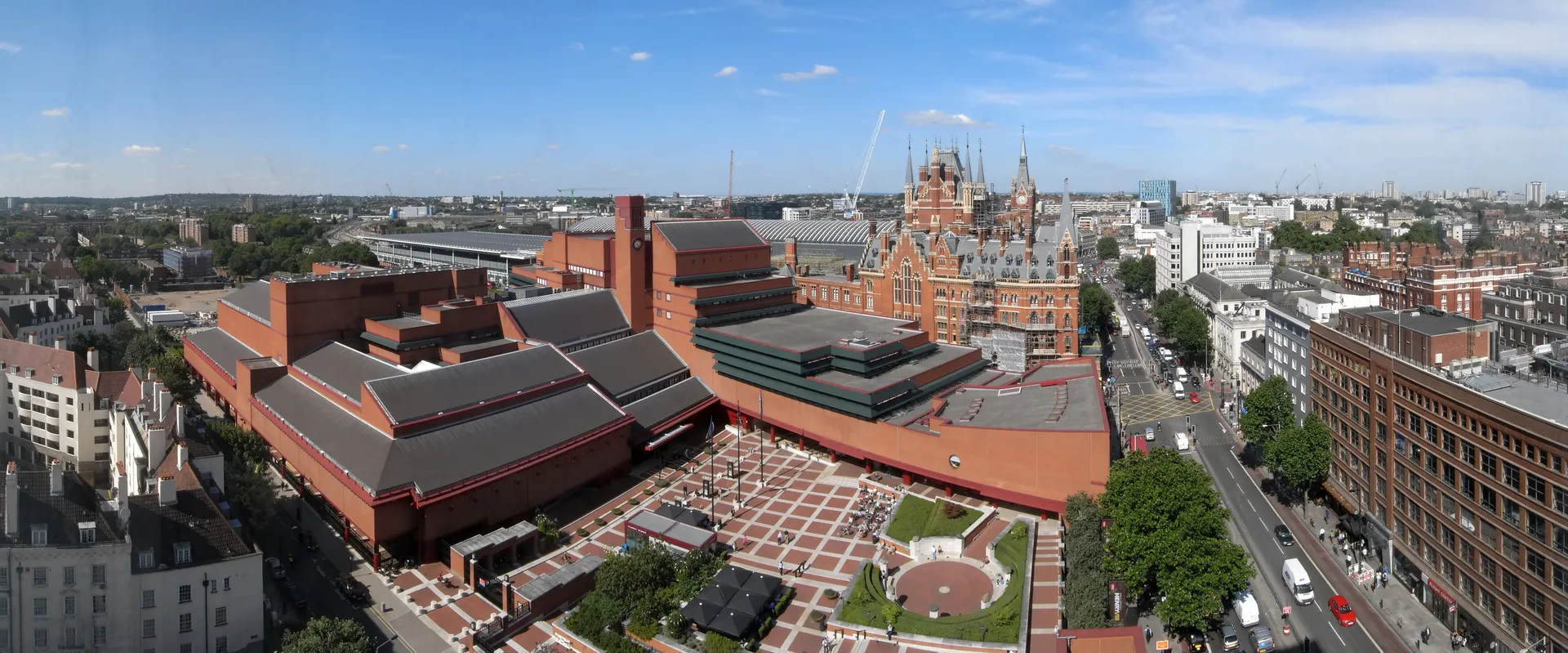
Why does Britain’s national library look less like a temple to books than a red-brick fortress with a glass tower rising through its heart? At the British Library in London, United Kingdom, that puzzle is the reason to come: you visit for the manuscripts and maps, of course, but also to feel how a modern building turned silence, doubt, and sheer stubbornness into one of the country’s great civic rooms. Step in from Euston Road and the city noise drops away; brick warms in the light, copper catches a dull glow, and the King’s Library stands in glass like a lit cabinet the height of a townhouse turned upright.
Most first-time visitors expect something older, grander, more obviously reverent. What they get is better. Sir Colin St John Wilson and M. J. Long designed a place that makes scholarship feel physical: heavy doors, hushed thresholds, staircases that pull you inward, and reading rooms so carefully sealed that the trains under St Pancras might as well belong to another city.
The British Library also fixes a common mistake. This is not a late-1990s newcomer squatting beside King's Cross, but the latest home of a national collection whose roots reach back to 1753, older than the United States and far less interested in posing for photographs than St Paul's Cathedral. Come for the Magna Carta, Shakespeare folios, and recorded voices; stay for the odd, moving fact that Britain chose to hide one of its greatest treasure houses inside a building many people once mocked.
Look closely at the materials and the joke turns back on the critics. The red brick answers St Pancras Station across the road, the black granite absorbs light like wet pavement after rain, and the whole composition feels made for London rather than dropped onto it. Few places in the city explain themselves so slowly, and that slow reveal is the pleasure.
Researched by the Audiala editorial team from historical records, architectural archives, and local expertise.
What to see
The Piazza and Paolozzi's Newton
The surprise starts outside, not under a roof. Colin St John Wilson set the British Library back from Euston Road behind a broad brick forecourt, so the traffic roar from King's Cross suddenly thins and Eduardo Paolozzi's 1995 Newton appears on his plinth, all bronze muscle and geometry, with Antony Gormley's Planets scattered nearby like a private solar system dropped onto stone. Slow down before you go in: the limestone paving holds fossil traces of oysters and snails, a small absurdity that means your first encounter with Britain's national library may be looking down at creatures older than any manuscript inside.
The King's Library Tower and Central Atrium
Most libraries hide their best stuff in basements; this one stacks it six storeys high in the middle of the building and makes you orbit it. George III's books rise inside a glass-and-bronze tower like a lantern of spines, while travertine columns, pale Portland stone and oak terraces catch the top light so softly that even the footfalls seem edited down. Touch the leather-wrapped brass handrails if you can. They were designed to feel like bookbindings, which tells you everything about this place: Wilson and Maggie Eves didn't just build a container for books between 1982 and 1999, they turned the act of reading into architecture.
Treasures Gallery to Sound Gallery
Start in the free Sir John Ritblat Treasures Gallery, where the temperature drops and the light falls low to protect manuscripts, maps and music scores that changed the language of power, prayer and print. Then go downstairs to the Sound Gallery on the Lower Ground Floor, where voices and recordings from an archive of more than 7 million sound and video items remind you that a library is not a mausoleum for paper but a machine for storing human presence. Best move? Take this route late in the afternoon, then come back up for air on the terrace or walk on toward Camden Market if you want London noise again after all that controlled quiet.
Plan your visit
Getting There
King’s Cross St Pancras is the smart arrival point: the Library sits about 4 minutes west on Euston Road at 96 Euston Road, while Euston is about a 6-minute walk east. TfL bus stops named British Library sit outside on Euston Road, served by routes 1, 30, 73, 91, 205 and 390, and drivers can use nearby Ossulston Street for Blue Badge and metered bays; the ramped side entrance is about 100 metres away, roughly the length of a football pitch.
Opening Hours
As of 2026, the main building opens Monday to Thursday 09:30-20:00, Friday 09:30-18:00, Saturday 09:30-17:00, and Sunday 11:00-17:00. Reading Rooms run on a different clock and close more tightly, with Sunday shut entirely, and the St Pancras site is already posted as closed for essential maintenance on 26-27 September 2026.
Time Needed
Give it 45-90 minutes if you want the free Treasures gallery, the glowing King’s Library Tower, and a quick lap of the public spaces. Allow 1.5-2.5 hours with coffee and a slower browse, or 3-4 hours if you add a paid exhibition or one of the 60-minute tours.
Accessibility
The useful accessible route is via the fully ramped Ossulston Street entrance, and key visitor areas including the Treasures Gallery, current exhibition spaces, and the Building Tour are step-free. Manual wheelchairs can be borrowed free if available, accessible toilets sit on all floors, and hearing support includes induction loops at enquiry points and in some event spaces.
Cost & Tickets
As of 2026, entry to the building and the permanent Treasures of the British Library gallery is free, which makes this one of London’s best no-ticket cultural stops. Paid exhibitions are separate: Fairy Tales is £13.50 peak or £11.50 off-peak, the Building Tour is £10, and prebooking online makes more sense than turning up and hoping.
History
The Long Fight to Build a Memory Palace
Records show the British Library became an independent institution on 1 July 1973, but its ancestry runs much deeper: Sir Hans Sloane’s bequest, the Cotton and Harley manuscripts, and later King George III’s library all fed the collection that once lived inside the British Museum. For most of its life, the national library hid in borrowed rooms, growing larger, richer, and more impossible to house.
Then came the hard part. The St Pancras site, once a railway goods yard, demanded decades of argument, redesign, and near-humiliation before Britain accepted that a library could be monumental without columns and humane without nostalgia.
The turning point
The Building Everyone Thought Was Wrong
At first glance, the story seems simple: Britain needed a new national library, hired an architect, and opened a big modern building beside St Pancras. That tidy version suits a visitor walking through calm piazzas and quiet reading rooms, because the building now looks inevitable.
But the dates refuse to behave. Records show the British Library began operating independently in 1973, main construction stretched from 1982 to 1999, public access began in stages in 1997, and Historic England dates Queen Elizabeth II's official opening to 25 June 1998. Sir Colin St John Wilson had more than professional pride at stake by then; according to architectural accounts, he spent years defending the scheme through political attacks, budget cuts, and ridicule sharp enough to sink a career.
The turning point came when the project survived long enough to become real. Once the King's Library was installed at the center, 65,000 royal books stacked in a glass tower like a private collection enlarged to civic scale, the building's argument could finally be seen instead of explained. Knowing that changes your gaze: the brick no longer reads as heavy, the thresholds no longer feel fussy, and the silence in the reading rooms starts to look like a victory that had to be engineered, funded, and fought for door by door.
Before St Pancras
Documented history begins with the British Museum Act of 1753 and the collections of Sir Hans Sloane, then swells through the 19th century under figures such as Sir Anthony Panizzi. Panizzi pushed for broader access and a library worthy of serious readers, which is one reason the British Library matters even if you never request a book: it preserves an old argument that knowledge should belong to more than the well-connected.
War, Railways, and Reinvention
During the Second World War, over 1 million volumes were evacuated from Bloomsbury, a paper exodus on a scale closer to moving a small city archive than a reading room. The present site then rose over old railway land and above active lines, which explains the building's concrete raft foundation and its obsession with vibration, noise, and controlled thresholds; this place was designed to hold still while London shakes beneath it.
Tips for visitors
Reading Room Rules
Reading Rooms are run like working research spaces, not a casual public library: pencils only, no food or drink, phones silent, and bags larger than 29 x 21 x 10 cm stay out. The hush is part of the atmosphere; footsteps soften and even a zip opening sounds louder than it should.
Ask Before Shooting
Casual photos in public spaces may be fine, but ticketed events normally do not allow cameras or recording devices unless staff say otherwise. Skip the tripod fantasy, and forget drones around King’s Cross and St Pancras unless you enjoy arguments with transport security.
Watch Your Bag
The real risk here is station-zone theft, not some theatrical scam: King’s Cross and St Pancras are prime ground for phone snatches, pickpockets, and luggage theft. Keep your phone off cafe tables, zip bags in queues, and do not leave cases unattended while ordering coffee.
Eat Nearby
For budget food, Paolina Thai Cafe and Hawker’s Kitchen are better bets than grabbing the first station sandwich; both have the sort of loyal following built on actual repeat customers. Mid-range, Dim Sum Duck is worth the queue, while splurge diners should look at The Yellow Bittern on Caledonian Road if a cash-only lunch with opinions sounds appealing.
Use The Lockers
Large bags hit a hard limit here: anything over 56 x 45 x 25 cm is not allowed into the Library. The free cloakroom and digital lockers on the Lower Ground Floor save the day, though the staffed cloakroom shuts on Sundays even if the lockers remain available.
Pair It Well
The British Library works best as part of a King’s Cross day rather than as a stand-alone trophy stop: do the free Treasures gallery, then walk on to Granary Square or save your bigger museum energy for the Natural History Museum another day. And skip the Platform 9¾ queue unless you truly need a photo with a luggage trolley disappearing into a wall.
Where to Eat
local_dining
Don't Leave Without Trying
Fish and chips — battered cod, chunky chips, salt + malt vinegar, mushy peasSunday roast — roast beef or lamb with roast potatoes, Yorkshire pudding, gravy (pub weekend tradition)Scotch egg — boiled egg wrapped in sausage meat, breadcrumbed and friedPie and mash — minced meat pie, mash, parsley liquor sauce (East London classic)Full English breakfast — bacon, sausage, eggs, baked beans, black pudding, grilled tomato (weekend indulgence, not everyday)Sticky toffee pudding — date sponge with toffee or butterscotch sauceChicken tikka masala — widely called Britain's national dish (British-invented, not Indian)Bangers and mash — sausage, mash, onion gravy
Victoria House Coffee & Food
cafe
British brunch & modern cafe€€star4.8(7957)
Order: Golden Sunrise Hash Benedict or The Scrambled Spicy Shakshuka — bold, beautifully plated brunch dishes where the eggs are perfectly cooked and every element sings.
Warm neighborhood brunch obsessed with quality ingredients. This is what London breakfast culture looks like when a kitchen actually cares.
Order: Beef momos and lollipop chicken — crispy, innovative small plates that explain why this tiny spot has nearly 20,000 reviews. Try the mix-and-match momos.
Compact Indo-Chinese gem where the service feels genuinely personal and the momos are a masterclass in technique. This is London neighborhood cooking done right.
Order: Start with the sourdough and mushroom parfait, then follow with smoked cod head or roasted halibut — nose-to-tail cooking that's simultaneously daring and deeply satisfying.
Contemporary British that's genuinely adventurous. The nose-to-tail cooking and carefully sourced ingredients represent what London's culinary future looks like.
checkService charge (12.5%) is auto-added at mid/high-end restaurants—that IS your tip. Do not add more. You can legally ask to remove it.
checkNo service charge on the bill? Tip 10–15% for good service. Tipping is entirely discretionary.
checkBook dinner for 19:00–20:00 to snag the best tables. Monday is London's quietest dining night; many restaurants close on Sunday.
checkContactless payment is standard (>90% of transactions). Coin/cash tipping is unnecessary.
checkBreakfast culture: Londoners grab coffee and toast. The Full English is weekend indulgence, not daily food.
Food districts:Bloomsbury & King's Cross — home to the British Library; neighborhood cafes and quieter diningCovent Garden — central tourist and cultural hub with casual to upscale optionsMayfair & St James's — fine dining and contemporary restaurantsSoho — late-night cosmopolitan dining, including Chinese and Indian restaurantsBrick Lane — Sunday street food markets (Ethiopian, Japanese katsu, Jamaican patties)
Restaurant data powered by Google
Watch & Explore British Library.
British Library Tour: It’s Not Just Books! Spend the Day with Me
Paulina Maria21 min8K
This library has every book ever published.
Tom Scott4 min2M
The British Library - A Short History and Tour
A Slice of Lunim's Life6 min43K
Frequently asked
Is British Library worth visiting?
Yes, especially if you like places where the building does part of the storytelling. Free entry gets you the Treasures Gallery, the piazza sculptures, and that six-storey King’s Library Tower rising through the middle like a glass bookshaft; even a short visit gives you Magna Carta-level history without a museum-sized slog.
How long do you need at British Library?
Most visitors need 45 to 90 minutes for the free highlights, and 3 to 4 hours if they add a paid exhibition or a tour. The quick version is Treasures plus a look at the atrium and King’s Library Tower; the longer version lets you settle into the cool, dim gallery light, take a building tour, and stop for coffee instead of racing back to King’s Cross.
How do I get to British Library from London?
The easiest route is to go to King’s Cross St Pancras and walk west along Euston Road to 96 Euston Road. The station is served by six Underground lines, and bus stops called British Library sit outside with routes including 1, 30, 73, 91, 205, and 390, so this is one of the simpler major cultural stops in London to reach.
What is the best time to visit British Library?
Weekday mornings are best if you want the building before the crowds and the reading culture feels most alive then. Sunday opens later at 11:00, temporary exhibitions can draw thicker crowds, and the public spaces feel calmer when the light is still fresh on the red brick instead of bouncing off Euston Road at rush hour.
Can you visit British Library for free?
Yes, the building is free to enter and the permanent Treasures of the British Library gallery is free too. You only pay for temporary exhibitions and certain tours, which makes this one of London’s better-value cultural stops: rare manuscripts, hushed galleries, and a landmark interior for the price of a Tube ride.
What should I not miss at British Library?
Don’t miss the Treasures Gallery, the King’s Library Tower, and the little details outside on the piazza floor. The gallery shifts the mood at once with cooler air and lower light for fragile manuscripts, while the limestone outside hides fossil traces and the Paolozzi Newton waits near the entrance like a warning that this is a place for obsessive minds.
Sources & attribution8
Researched and written by the Audiala editorial team from historical records, architectural archives, and local expertise. Last updated July 2026.
British Library Visit — Official visitor information used for address, free entry, opening hours, access, luggage rules, and transport basics.
Treasures of the British Library — Used for the free status of the permanent Treasures Gallery and gallery-specific visitor details.
Historic England Official Listing — Used for architectural details including the atrium sequence, materials, and the design significance of the St Pancras building.
British Library Building Tour — Used for the existence, length, and value of the official architecture-focused tour.
Saved and recently read places — kept on this device only.
Photo credits (7)
King's Library Tower from Members' Room, British Library — The wub — CC BY-SA 4.0 (https://creativecommons.org/licenses/by-sa/4.0/) — Source: https://commons.wikimedia.org/wiki/File:King's_Library_Tower_from_Members'_Room,_British_Library.jpg
London - Euston Road - The British Library - Statue 'Newton, after William Blake' 1995 by Sir Eduardo Paolozzi — Txllxt TxllxT — CC BY-SA 4.0 (https://creativecommons.org/licenses/by-sa/4.0/) — Source: https://commons.wikimedia.org/wiki/File:London_-_Euston_Road_-_The_British_Library_-_Statue_'Newton,_after_William_Blake'_1995_by_Sir_Eduardo_Paolozzi.jpg
Euronewsweek Media — Unsplash License (https://unsplash.com/license) — Source: https://images.unsplash.com/photo-1736766920526-eb514209f89f
Kevin Grieve — Unsplash License (https://unsplash.com/license) — Source: https://images.unsplash.com/photo-1771139576882-95890e299938
The Piazza, the British Library - geograph.org.uk - 4106223 — John Lord — CC BY-SA 2.0 (https://creativecommons.org/licenses/by-sa/2.0/) — Source: https://commons.wikimedia.org/wiki/File:The_Piazza,_the_British_Library_-_geograph.org.uk_-_4106223.jpg
British Library Exterior IMG 1174 — Deror_avi — CC BY-SA 3.0 (https://creativecommons.org/licenses/by-sa/3.0/) — Source: https://commons.wikimedia.org/wiki/File:British_Library_Exterior_IMG_1174.JPG
British Library + St Pancras 7527-31hug — Patche99z — CC BY-SA 3.0 (https://creativecommons.org/licenses/by-sa/3.0/) — Source: https://commons.wikimedia.org/wiki/File:British_Library_+_St_Pancras_7527-31hug.jpg
Strictly necessary cookies keep the site working. Analytics (PostHog, Google Analytics) measures how each visitor uses our pages. Marketing loads YouTube videos and walking-route maps without a tap and lets Google Analytics set advertising cookies. We never sell your data. You can change this any time from the footer.
Analytics and marketing cookies are optional and only load if you agree. Details under Customize.
Privacy
Cookie preferences
Pick what you're okay with. You can change this any time from the footer.
Strictly necessary
Always on
Sign-in, language, navigation. Always on.
Product analytics
PostHog (EU) and Google Analytics record which pages you view and how you use them, under a random identifier stored in your browser. Helps us see which pages work and which need fixing. Google's ad personalisation stays off. No selling.
Marketing
Loads YouTube videos and the walking-route maps (OpenFreeMap) without a tap; without it, they load only when you tap them. If analytics is also on, Google Analytics may set advertising cookies. Ad personalisation stays off.