Plan and listen to Abbey Court House, Holyrood Abbey, Holyrood Palace, Edinburgh with Audiala.
Audio guide in your pocket, itinerary in your browser. Built for the way you actually visit.
Introduction: History and Significance
At the foot of Edinburgh’s Royal Mile lies a historic tapestry woven from centuries of royal, judicial, and ecclesiastical tradition. The Abbey Court House, the atmospheric ruins of Holyrood Abbey, and the majestic Holyrood Palace together form an extraordinary nexus reflecting Scotland’s architectural grandeur and national identity. Visitors to these interconnected sites are treated to a journey spanning medieval monasticism, Renaissance courtly life, and modern royal ceremony. The Abbey Court House, once the seat of the Abbey Court and today the headquarters of the High Constables of Holyrood, preserves architectural elements dating to the 16th century (Historic Environment Scotland). Adjacent Holyrood Abbey, founded in 1128 by King David I, is steeped in legend and royal association (Truly Edinburgh). Overlooking both is Holyrood Palace, the official Scottish residence of the British monarch, whose layers reveal Scotland’s evolving story (palaceofholyroodhouse.co.uk).
This detailed guide offers essential information on visiting hours, ticketing, accessibility, architectural and historic highlights, and practical tips for exploring these landmarks. Whether you are eager to immerse yourself in Scotland’s royal heritage, admire Gothic and Renaissance architecture, or enjoy the palace gardens and surrounding attractions, this resource will help you make the most of your visit (Royal Collection Trust, VisitScotland).
Abbey Court House
Historical Development
Situated at the entrance to Holyrood Palace, the Abbey Court House is deeply entwined with both Holyrood Abbey and the palace itself. Its origins trace to the early 16th century when James IV constructed a palace on the abbey guesthouse site. Though the original gatehouse was destroyed in 1743, fragments remain in the current building, notably the stairtower and arcading (Historic Environment Scotland). The present structure dates mainly from 1822–1823 (Robert Reid) and 1857 (Robert Matheson), commissioned during Queen Victoria’s reign, but incorporates 16th-century masonry.
Architectural Features
The two-storey, four-bay crowstepped design is constructed of random rubble with ashlar margins. The northeast corner’s circular corbelled stairtower, capped with a conical roof, is the standout feature. The north elevation’s pointed-arch blind arcading directly references the original gatehouse. Notable details include:
- 12-pane timber sash windows
- Grey slate roofs
- Heraldic panel inset with James V’s arms
- Stone turnpike stair and historic fire surrounds inside
These elements collectively preserve the site’s architectural continuity (Historic Environment Scotland).
Judicial and Administrative Role
Historically, the Abbey Court House hosted the Abbey Court, which handled civil disputes within the abbey precincts until 1880. The building replaced a former guardroom (used from 1746), underscoring its administrative importance in the palace complex (Historic Environment Scotland).
The High Constables of Holyrood
Since its restoration in 1958, the Court House has served as headquarters to the High Constables of Holyrood—a ceremonial guard responsible for royal visits, with roots in the 18th century. This enduring function connects the space to centuries of royal tradition (Historic Environment Scotland).
Archaeological and Cultural Significance
The Abbey Court House stands on archaeologically significant ground. The entire palace and precinct are scheduled monuments, with potential for important structural and sub-surface remains (Historic Environment Scotland). The building’s features offer an insight into Scotland’s evolving royal and religious architecture.
Visiting Abbey Court House: Hours, Tickets, and Accessibility
- Location: South side of Holyrood Palace forecourt (EH8 8DX) (VisitScotland)
- Public Access: The Abbey Court House is not open independently, but its exterior can be viewed during palace visits.
- Hours: Align with Holyrood Palace (typically 09:30–18:00 April–October; 09:30–16:30 November–March; closed certain days and royal events)
- Tickets: Included with Palace of Holyroodhouse admission (VisitScotland)
- Accessibility: Grounds are accessible; contact in advance for special needs (VisitScotland)
- Photography: Permitted outdoors; restrictions apply inside palatial buildings (The Tourist Checklist)
Nearby Attractions
- Holyrood Abbey (Wikipedia)
- Palace of Holyroodhouse (Palace of Holyroodhouse)
- Abbey Strand, Queen Mary’s Bath House, Palace Gardens
Holyrood Abbey
Foundation and Early History
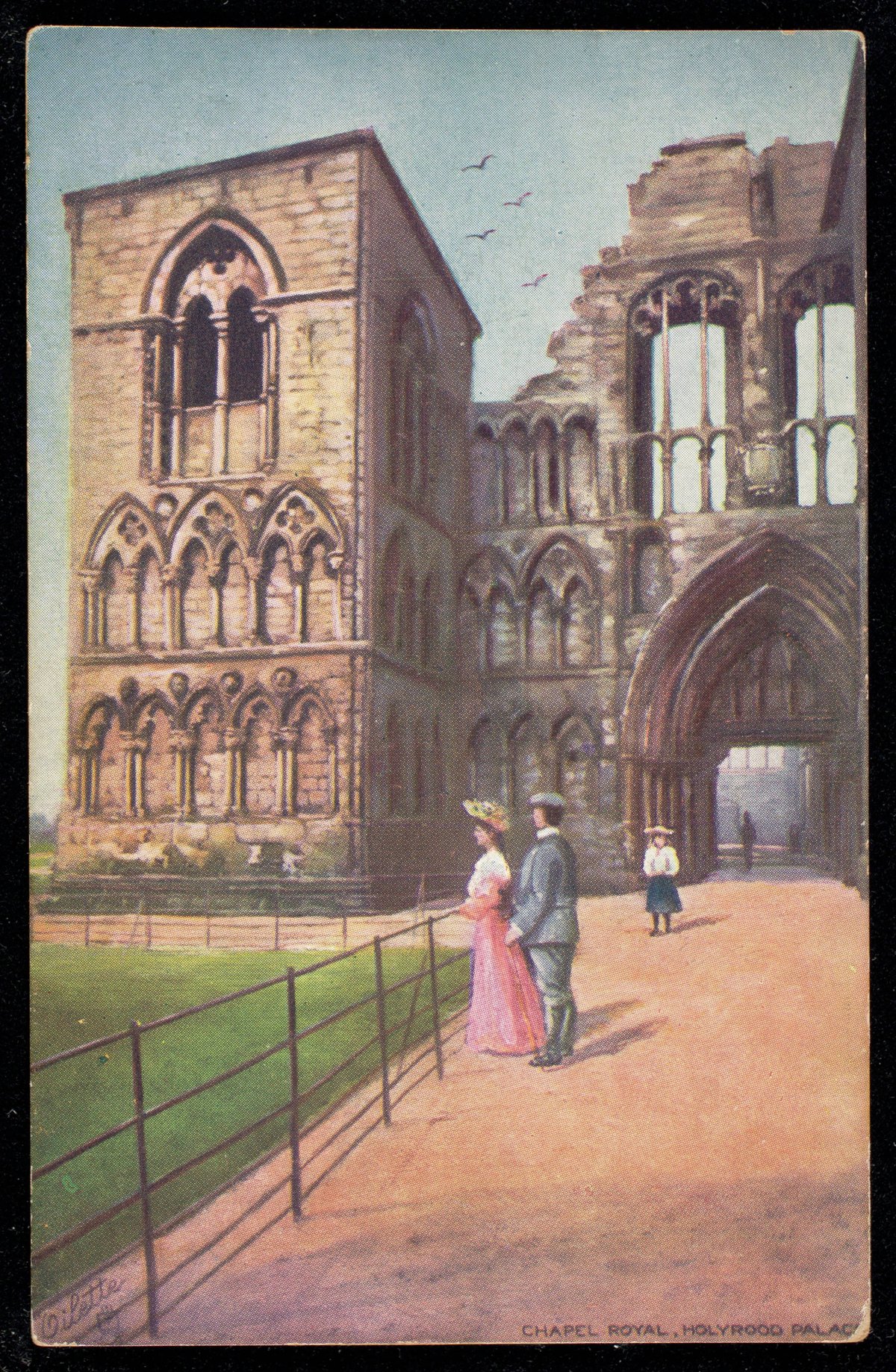
Founded in 1128 by King David I, Holyrood Abbey emerged from legendary origins—David’s encounter with a stag bearing a holy cross. The abbey’s name (“Holyrood” meaning “Holy Cross”) also links to relics brought by St. Margaret (Truly Edinburgh; Visitors Guide to Scotland).
Medieval Prosperity and Royal Connections
The abbey became a major Augustinian house and a favored royal venue—James II was born here, and notable royal marriages took place within its walls. The abbey also navigated turbulent periods, such as the Wars of Independence (Visitors Guide to Scotland; Truly Edinburgh).
Decline, Destruction, and Ruin
Holyrood Abbey suffered English attacks in the mid-16th century and was further damaged during the Scottish Reformation. The collapse of its roof in 1768 left it an evocative ruin. Despite this, the abbey remains a royal burial ground (Visitors Guide to Scotland; Truly Edinburgh).
Architectural Features
Romanesque and Gothic Elements
The abbey’s stonework reflects Romanesque origins (rounded arches, massive columns) with later Gothic enhancements (pointed arches, rib vaults, large windows) (Visitors Guide to Scotland). Surviving features include intricately carved capitals and remnants of the chapter house (Truly Edinburgh).
Notable Features
- West Front: Remnants of a large window and impressive stonework
- Nave: Soaring columns, open to the sky
- Burials: Royal tombs, including Lord Darnley
- Archaeological Finds: Medieval coins, a Roman denarius (Truly Edinburgh)
Integration with the Palace
From the early 16th century, the abbey’s royal chambers were developed into the Palace of Holyroodhouse (Truly Edinburgh).
Visiting Hours and Tickets
- Hours: Typically 09:30 to 17:30/18:00 (varies by season)
- Tickets: Included with palace admission; adults ~£20, youths £13, children £10, under-4s free (The Better Vacation)
- Guides: Audio and guided tours available; check Royal Collection Trust
Visitor Experience
- Accessibility: Most areas are accessible; some rooms require stairs (The Better Vacation)
- Facilities: Café, restrooms, gift shop
- Transport: Lothian Buses #35 stops nearby
Nearby Attractions
- Holyrood Park, Arthur’s Seat, Royal Mile, Scottish Parliament, Queen’s Gallery (TravelSetu)
Holyrood Palace
Historical Development
From Abbey to Royal Residence
Holyrood Palace grew from the abbey’s medieval guesthouse. James IV’s palace construction (1501–1505) and James V’s Renaissance remodelling cemented its royal status (palaceofholyroodhouse.co.uk; explorial.com). The palace supplanted Edinburgh Castle as principal royal residence by the mid-16th century.
Renaissance, Turmoil, and Restoration
Mary, Queen of Scots’ residence (1561–1567) was marked by intrigue and tragedy (notably the murder of David Rizzio). The palace was damaged during the English Civil War, then restored by Charles II, with designs by Sir William Bruce (portal.historicenvironment.scot). The palace declined after the 1707 Act of Union but was revived in the 19th and 20th centuries.
Modern Era and Royal Use
George IV’s 1822 visit prompted restoration; George V modernized the palace, and it remains the monarch’s Scottish residence, hosting state occasions and official events (palaceofholyroodhouse.co.uk; scotlandcitytours.com).
Architectural Highlights
- Exterior: Gothic, Renaissance, and Neoclassical elements; Doric columns at entrance, square courtyard, Abbey Strand outbuildings (glasgowarchitecture.co.uk)
- Interior: 289 rooms, 17 open to visitors; State Apartments with period furnishings, Great Gallery with portraits of Scottish monarchs (brightbustours.com)
- Mary, Queen of Scots’ Apartments: Historic furnishings and artifacts, site of David Rizzio’s murder (palaceofholyroodhouse.co.uk)
- Gardens: Four hectares of formal gardens, 17th-century sundial, ornate fountain, Queen Mary’s Bath House (scotlandcitytours.com)
- Holyrood Abbey Remnants: Medieval nave, East Processional Doorway, royal vault (lostinlandmarks.com)
Royal Connections and Significance
Holyrood Palace has hosted Scottish and British monarchs, state ceremonies, and momentous events from the Renaissance to the present. It is the center of “Holyrood Week,” a key annual event in Scotland’s royal calendar (palaceofholyroodhouse.co.uk).
Preservation and Public Access
Managed by the Royal Collection Trust and Historic Environment Scotland, the palace is the focus of ongoing restoration and visitor facility improvements (glasgowarchitecture.co.uk).
Practical Visitor Information
- Location: Foot of the Royal Mile, accessible by foot, bus, or tram (explorial.com)
- Opening Hours: 09:30–18:00 (summer); 09:30–16:30 (winter); check official site for changes
- Tickets: £20 (online), £22 (box office); includes audio guide (scotlandcitytours.com)
- Guided Tours: Offered daily; pre-booking advised (palaceofholyroodhouse.co.uk)
- Accessibility: Most areas accessible; manual wheelchairs available (brightbustours.com)
- Time Required: Allow 2–3 hours (lostinlandmarks.com)
Accessibility and Practical Considerations
General Accessibility
Edinburgh’s historic core is increasingly accessible, though some medieval structures pose challenges (discoveringedinburgh.com). Advance planning and review of official resources are recommended.
Holyrood Palace
- Entrances: Step-free, with accessible toilets and ramps
- Wheelchairs: Available to borrow
- Audio/Visual Aids: Multimedia guides, BSL, descriptive audio (buggirladventures.com)
- Assistance Animals: Welcome
Holyrood Abbey
- Terrain: Uneven and gravel paths; benches provided (allaboutedinburgh.co.uk)
Abbey Court House
- Accessibility: Ground floor accessible; upper floors via stairs (allaboutedinburgh.co.uk)
Parking and Transport
- Accessible Parking: Limited Blue Badge spaces; pre-booking recommended (buggirladventures.com)
- Public Transport: Buses and trams are wheelchair accessible
Facilities
- Restrooms: Accessible and gender-neutral options available
- Café: Offers vegetarian, vegan, and traditional fare (discoveringedinburgh.com)
- Shops: Souvenirs, Scottish crafts, and local products
Additional Tips
- Security: Bag checks; large luggage not permitted
- Photography: No photography in State Apartments, permitted outdoors and in abbey ruins
- Weather: Dress in layers, bring waterproofs (discoveringedinburgh.com)
Special Events, Tours, and Surrounding Attractions
- Events and Workshops: Seasonal programs for families, schools, and groups
- Photography: Best spots are in the gardens, abbey ruins, and Holyrood Park
- Nearby: Royal Mile, St Giles’ Cathedral, Museum of Edinburgh, Scottish Parliament, Arthur’s Seat (edinburghtourist.co.uk)
- Queen’s Gallery: Rotating exhibitions from the Royal Collection (planetware.com)
- Day Trips: Rosslyn Chapel, Stirling Castle, North Berwick (thrillophilia.com)
- Emergency: Dial 999; nearest hospital is Royal Infirmary of Edinburgh (edinburgh.org)
Frequently Asked Questions (FAQ)
Q: What are Holyrood Palace visiting hours?
A: Usually 09:30–18:00 in summer, 09:30–16:30 in winter; check official site for changes.
Q: How much are tickets?
A: £20 online for adults; concessions and family passes available.
Q: Is the palace wheelchair accessible?
A: Most public areas are accessible; some historic rooms have limited access.
Q: Can I take photos?
A: Yes, in gardens and abbey ruins; not inside State Apartments.
Q: Are guided tours available?
A: Yes, including options for British Sign Language and audio description.
Listen to the full story in the app
The whole Abbey Court House, Holyrood Abbey, Holyrood Palace, Edinburgh,
told well.
Audio guides for 1,100+ cities across 96 countries. History, stories, and local insight — offline ready.

Verified, and shown.
Researched and written by the Audiala editorial team from historical records, architectural archives, and local expertise.
Researched from Wikidata, Wikipedia & official sources · fact-checked · How we make our guides →