Brighton
United Kingdom Updated Apr 2026
Salt hangs in the air, gulls heckle from the roofline, and Brighton, United Kingdom, keeps slipping out of whatever tidy idea you had of an English seaside city. Onion domes from the Royal Pavilion rise a few minutes from pebbled beach and arcade noise, while the burnt frame of West Pier still stands offshore like a warning against good manners. Few places in Britain swing this fast between Regency fantasy and salt-streaked improvisation.
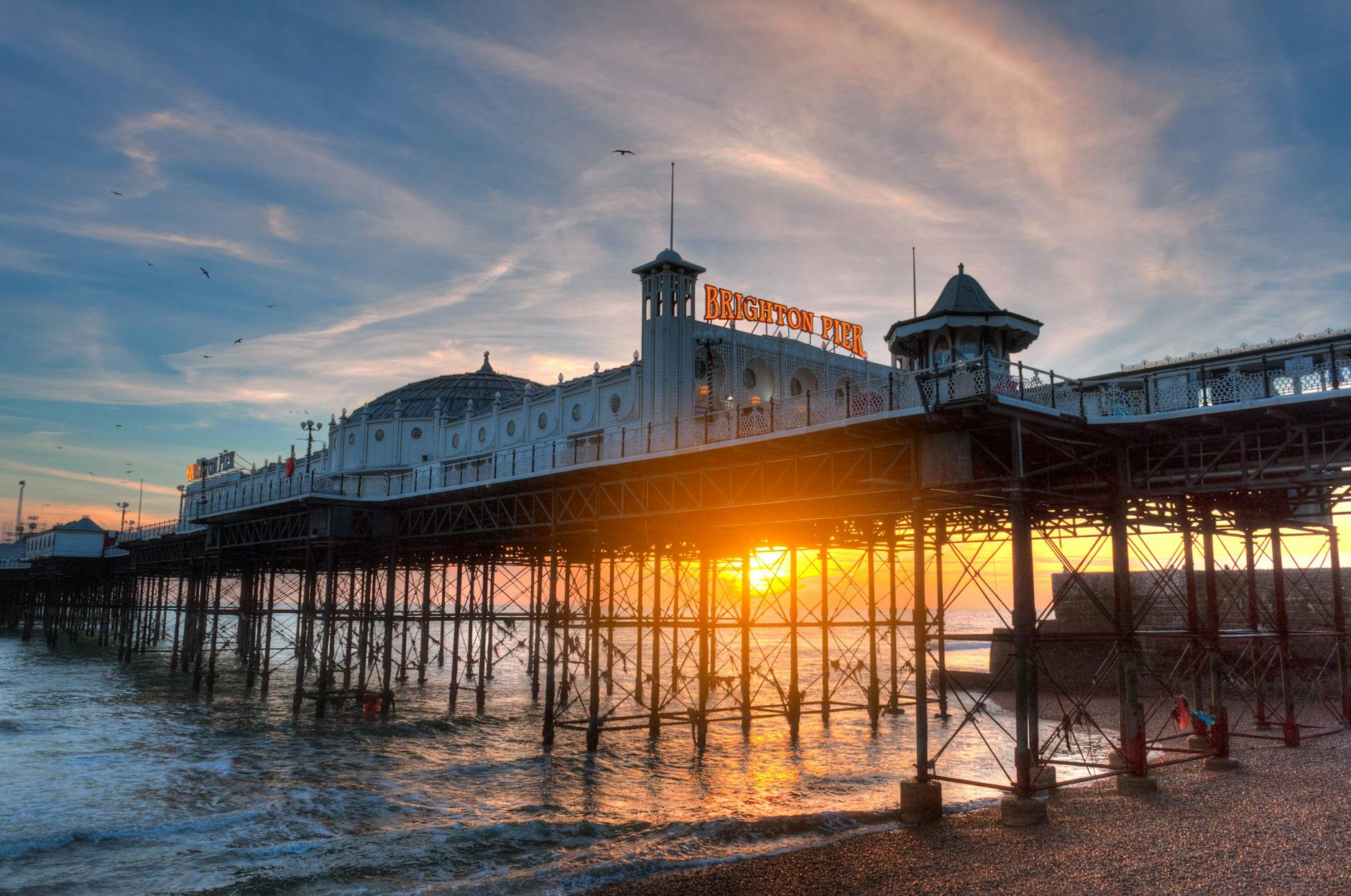
 Photo: Bob Jenkin / Pexels
- Attractions
- 15
- Trip length
- 2-3 days
- Best season
- Late spring (May-June)
Why Brighton
Built from cited sources · see the method · How we make our guides →
Brighton was remade for display, and you can still feel that performance in the streets around Old Steine and the Royal Pavilion Estate. John Nash gave the prince regent an Indo-Saracenic fever dream; the old stables became Brighton Dome, where concerts and festivals now fill rooms built for horses and spectacle. The city never quite stopped acting, which helps explain why a casual Tuesday here can end with cabaret at Komedia or a string quartet under a painted ceiling.
The sea matters, but the clichés don't help much. Brighton's beach is flint and shingle, the wind can turn sharp in minutes, and the real pleasure often comes from the edges: walking east on the Undercliff Walk with chalk rising above you, or watching evening light flatten the horizon beyond Hove Lawns after the central seafront has grown noisy and a little sticky with spilled beer.
What gives Brighton its charge is the friction between polish and refusal. The Lanes still twist with old alleys and jewellers' windows, North Laine runs on coffee, vintage rails, and posters in shopfront glass, and 20 minutes later the South Downs open up at Devil's Dyke and Ditchling Beacon as if the city has simply run out of patience with walls. That's the trick here: Brighton looks theatrical, then keeps revealing how much real life is packed behind the set.
Royal Pavilion Shock
Brighton's signature building looks as if John Nash dropped a fantasy of domes and minarets onto the Old Steine, then let the sea air polish the joke. The surprise deepens when you see the wider Royal Pavilion Estate around it: museum, garden, Dome, Corn Exchange, and Studio Theatre packed into one unusually dense cultural quarter.Two Labyrinths, Two Brightons
The Lanes and North Laine get confused by first-timers, which is a pity because they reveal different versions of the city. The Lanes keep the older tangle of alleys, jewellers, and low-lit pubs; North Laine runs on vintage shops, cafe steam, murals, and the scruffier energy that makes Brighton feel less like a resort and more like a habit.Nightlife With Brains
Brighton after dark is not just stag-party spillover. Brighton Dome, Theatre Royal, Komedia, The Old Market, Fabrica, and BOAT give the city a working cultural life, so a night out can mean cabaret in North Laine, a touring play, or an art show inside a former church on Duke Street.Sea Edge, Then Open Downs
Few English cities change gear this fast: one hour you're on the pebbles facing the ruined West Pier, the next you're standing at Devil's Dyke or Ditchling Beacon with the South Downs rolling away behind you. The Undercliff Walk and Stanmer Park make the point clearly: Brighton is a seaside city with a back door straight into chalk hills and wind.
Neighborhoods
Where to wander, by quarter — each with its own rhythm.
The Lanes
Brighton's oldest commercial maze still feels slightly damp with history, all tight alleys, crooked corners, pubs, and jewellers tucked into former fishing-town passages near the seafront. Come for the texture rather than trendiness; this is where you wander, look up, and notice how quickly the city turns from souvenir gloss to old brick and quiet courtyards.North Laine
North Laine is where Brighton stops posing and starts talking in its own voice. Between the station and the Pavilion area, you'll find vintage shops on Kensington Gardens, strong coffee on Gardner Street and Sydney Street, street art, record stores, brunch spots, Komedia, and the kind of independent retail that makes chains look faintly embarrassed.Kemptown
Kemptown has a sharper after-dark pulse and a stronger local streak than the postcard center. Its Regency terraces face the sea, but the real draw is inland on St James's Street and nearby roads, where queer nightlife, small pubs, late food, and a slightly scruffier confidence give the area more character than polish.Brunswick Town
West of central Brighton, Brunswick Town tells the Regency story with less noise and better proportions. The crescents and squares here were planned as a grand resort extension toward Hove, and places like the Regency Town House make clear that this was never just decoration; it was social engineering in stucco, built for people who wanted sea air without giving up rank.Seven Dials
Seven Dials is the part of Brighton many visitors end up wishing they had booked near in the first place. Roads spread out from the roundabout into a hilltop district of cafes, bakeries, pubs, and terraced houses, and the mood is calmer without feeling sleepy; good for mornings when you want coffee, newspaper rustle, and fewer selfie sticks.Hove Seafront
When Brighton beach gets overcrowded, locals drift west. Hove seafront trades arcade clang and pier theatrics for wider lawns, cleaner lines, beach huts, and a slower pace, with long views that make the coast feel broad again rather than staged for a weekend crowd.Preston Street and Western Road
This corridor is less photogenic than the old center and more useful, which is often a better deal. You'll find everyday Brighton here: lunch traffic, practical shopping, and a mix of restaurants that reflects the city's appetite for variety without dressing it up as a concept.Rottingdean
Rottingdean sits just east of the city and feels like Brighton's quieter cousin who kept the family silver. The village lanes, beach, Kipling Gardens, and access to the Undercliff Walk make it an easy escape when you want sea air without the central racket, and its smuggling lore gives the place a faintly amused relationship with respectability.
Plan your trip
Before you go
- Getting There
- London Gatwick Airport (LGW) is Brighton's real airport, with direct Southern and Thameslink trains to Brighton station in under 35 minutes and up to 8 trains an hour in 2026. London Heathrow Airport (LHR) works too, usually by National Express coach 025 from Brighton Coach Station or by rail via London; main rail arrivals are Brighton station, with Hove and Preston Park useful secondary stops, and the road approach is usually via the A23/M23 from London or the A27 east-west along the coast.
- Getting Around
- Brighton has no metro and no city tram, so local movement in 2026 runs on buses, trains, feet, and bikes. Brighton & Hove Buses is the backbone, with adult single fares capped at £3 until 31 December 2026, 1-day citySAVER at £6.80 on bus, PlusBus at £5.00 for rail arrivals, and Beryl BTN Bikes offering 780 bikes with bundles from £8 for 50 minutes; Volk's Electric Railway is a seafront pleasure ride, not daily transport.
- Climate & Best Time
- Shoreham's 1991-2020 Met Office averages are the best proxy for Brighton: spring runs roughly 10-16C by day and 3-8C at night, summer 19-21C and 11-13C, autumn 12-19C and 5-11C, winter 8-9C and 2-3C. Rain is usually lightest from March to June and heaviest from October to December, with sea breezes cooling hot days; July and August draw the biggest crowds, while May, June, and September give the cleanest balance of warmth, light, and breathing room.
- Language & Currency
- English is the working language across transport, hotels, and museums. The currency is pound sterling (£), cards and contactless are widely accepted in 2026, and Brighton's buses are built around tap-on and tap-off payments, though a little cash still helps for small shops or market stalls that set minimum spends.
- Safety
- Brighton is easy to handle with ordinary city caution, but the pressure points are clear: busy nightlife streets late at night, crowded central areas where distraction theft happens, and the seafront when the weather turns. Safe Space Brighton runs at St Paul's Church on West Street from 11:30pm to 4:00am on Friday and Saturday nights, and for the beach the council advises swimming only between red-and-yellow flags during lifeguard season.
A Seafront Town Forever Rewritten
From Neolithic ritual ground to royal resort, rail-built playground, and self-inventing city
- c. 3500 BCE
Whitehawk Marks the Hill
People cut rings of ditches into Whitehawk Hill and made one of Britain's earliest known ritual enclosures. The chalk would have flashed pale in the sun above the sea, a place built to be seen. Long before Brighton had streets, it already had ceremony.
- c. 1500 BCE
The Amber Cup Burial
A Bronze Age grave at Hove held an amber cup about 3,500 years old, delicate and improbable, as if someone buried sunlight. The find hints at wealth, trade, and careful ritual on this stretch of coast. Brighton's story starts with people who were already plugged into a wider world.
- 1086
Bristelmestune Enters the Record
The Domesday Book names the settlement as Bristelmestune and records a rent of 4,000 herrings. That detail matters. You can almost smell the fish racks and salt wind behind the clerk's neat Latin.
- c. 1350
St Nicholas Watches Over Town
St Nicholas Church rose on high ground above the cramped fishing town and remains Brighton's oldest surviving building. Its flint walls and churchyard still feel slightly apart from the modern city below. That distance tells the truth: old Brighthelmstone was once small, exposed, and very local.
- 1514
French Raiders Burn Brighthelmstone
A French fleet attacked and almost completely burned the town, leaving smoke, wrecked houses, and a long civic memory of vulnerability. Brighton was not yet a pleasure resort. It was a working coast that enemies could reach in a morning.
- 1753
Richard Russell Prescribes the Sea
Dr Richard Russell turned salt water into fashion by promoting sea bathing and then basing his practice here. Patients came for cures, dipped in cold surf, and paid handsomely for the privilege. Brighton's reinvention began with medicine, money, and a bracing shock to the body.
Show the full timeline (29 moments)
- 1783
The Prince Finds Brighton
George, Prince of Wales, arrived looking for pleasure, privacy, and distance from London. He found a town ready to indulge him. Brighton's future changed the moment royal taste met sea air.
- 1787
A Farmhouse Becomes a Pavilion
Henry Holland began enlarging the Prince's rented farmhouse on the Steine into the Marine Pavilion. The project started politely enough. Then Brighton acquired the architectural habit it still has: if a little spectacle works, try far more.
- 1803
The Royal Stables Rise
Work began on the Royal Stables and Riding School, the astonishing building later known as the Dome and Corn Exchange. The great dome spans the space with almost theatrical confidence. Brighton was learning to build for display as much as use.
- 1821
Sake Dean Mahomed Sells Steam and Soap
Sake Dean Mahomed opened his Shampooing and Vapour Baths and turned Brighton wellness into a sharper, stranger performance. Clients came for steam, massage, and the prestige of modern treatment. The city has been mixing health with showmanship ever since.
- 1823
Chain Pier Reaches into the Sea
The Royal Suspension Chain Pier opened as a daring line of iron and timber over open water. Visitors walked out above the chop and spray rather than merely looking at it from shore. Brighton had found one of its favorite tricks: turning the sea itself into a stage set.
- 1841
Railway Brings the Crowds
Brighton Railway Station opened on 21 September 1841 and cut the London journey to about 1 hour 45 minutes. That changed everything. Day-trippers, workers, performers, and weekend escapees could now pour in at industrial speed.
- 1850
Victoria Lets the Town Keep It
Queen Victoria sold the Royal Pavilion estate to the town for £52,000 after deciding Brighton offered too little privacy for royal life. Her withdrawal could have dimmed the place. Instead, the palace became civic property and public memory.
- 1854
Brighton Becomes a Borough
A royal charter incorporated Brighton as a municipal borough, giving the fast-growing resort firmer local government. The step sounds administrative. On the ground, it meant a town of visitors and speculation was becoming a city in the making.
- 1859
Art School Starts in Palace Kitchens
Brighton School of Art opened in the Royal Pavilion kitchens, an origin story the city could hardly have scripted better. Students learned under the shadow of royal fantasy and municipal ambition. The future University of Brighton began in rooms built for feasts.
- 1866
West Pier Opens to Elegance
West Pier opened as a cleaner, more refined pleasure pier than its predecessor, with ironwork, theatre, and sea air sold as civilized entertainment. Victorian Brighton understood class distinctions perfectly. Even leisure came with its own architecture of manners.
- 1872
Aquarium Opens Under the Front
Brighton Aquarium opened after years of construction along the seafront and still claims the title of the world's oldest operating aquarium. Behind ornate arches, visitors watched marine life in filtered light while waves crashed outside. Science and spectacle were sharing the same ticket office.
- 1896
Storm Takes the Chain Pier
After decades of decline, a storm on 4 December 1896 destroyed the Chain Pier. Brighton has always loved the sea a little recklessly. The same water that made the town rich kept reminding it who held the stronger hand.
- 1899
Palace Pier Begins Its Reign
Brighton Marine Palace and Pier opened on 20 May 1899, bigger and brasher than what had come before. The formulas were all here: rides, lights, noise, snacks, wind, and that salty metallic smell of amusement machinery by the sea. Brighton's modern seafront had arrived.
- 1914
Royal Rooms Become a War Hospital
The Royal Pavilion, Dome, and Corn Exchange were turned into hospitals for wounded Indian soldiers from the Western Front, with the first patients arriving in December 1914. Onion domes built for royal fantasy suddenly framed cots, bandages, and surgical wards. Few episodes expose Brighton's imperial story more clearly.
- 1921
The Indian Gate Remembers
The Indian Gate was unveiled in 1921, and the Chattri memorial on the Downs marked the soldiers cremated nearby during the war. Memory in Brighton is often tied to sea leisure and Regency glamour. These monuments insist on another truth: empire passed through here in pain as well as ceremony.
- 1940
The Brighton Blitz Begins
From 1940 to 1944, Brighton and Hove endured 56 air raids that killed 198 civilians and injured hundreds more. Beaches were mined, parts of the piers were cut away, and the familiar promenade became a defensive edge. Under blackout skies, the resort looked hard and frightened.
- 1961
Sussex University Opens on the Edge
The University of Sussex received its Royal Charter on 16 August 1961 and planted a new campus at Falmer, just beyond the old resort core. That mattered far beyond education. Brighton was becoming a place of research, argument, and restless youth, not just deckchairs and boarding houses.
- 1967
Festival City Takes the Stage
The first Brighton Festival in 1967 gave the city a new annual rhythm of performance, visual art, and temporary reinvention. For a place already skilled at self-display, this fit perfectly. Brighton stopped being only a resort and started acting like a cultural capital on purpose.
- 1974
ABBA Wins at the Dome
On 6 April 1974, ABBA won Eurovision at Brighton Dome with "Waterloo." One song, one night, and suddenly a former royal riding school sat inside global pop history. Brighton does that well: old buildings keep slipping into new roles.
- 1984
Bomb at the Grand Hotel
The IRA bombed the Grand Hotel on 12 October 1984 during the Conservative Party conference, killing five people and injuring more than thirty. The facade still looked grand against the promenade. Inside, politics had become rubble, dust, and shock in the small hours.
- 1997
Brighton and Hove Join Forces
On 1 April 1997, Brighton and Hove merged into a single unitary authority. The union formalized what the streets and shoreline already suggested: two neighboring places with different tempers, one more flamboyant, one more controlled, tied together by growth and geography.
- 2001
City Status Becomes Official
Brighton and Hove received the formal Letters Patent for city status on 15 February 2001 after the Millennium award of 2000. The paperwork mattered because names shape ambition. Resort town no longer covered it.
- 2016
The i360 Redraws the Skyline
The 162-metre Brighton i360 opened beside the skeletal remains of West Pier in August 2016. Its glass pod lifts visitors above a coast already crowded with memory: Regency terraces, bomb scars, piers, colleges, and weather. Brighton still builds arguments with its own past, often in plain view.
Who lived here
-
King · 1762–1830
George IV
Commissioned and used the Royal Pavilion as a seaside retreat
George IV came to Brighton when it was still more escape hatch than polished resort, then turned a modest house into the outrageous pleasure palace that now defines the city’s skyline. He’d probably recognize Brighton’s appetite for spectacle at once, though he might be startled by how democratic the party became.
-
Architect · 1752–1835
John Nash
Redesigned the Royal Pavilion in the early 19th century
John Nash gave Brighton its great visual joke: an Indo-Islamic fantasy dropped beside the English Channel, all domes and theatrical confidence. Walk past the Pavilion at dusk and you can still feel how completely he changed the city’s idea of itself.
-
Architect · 1745–1806
Henry Holland
Expanded the original Marine Pavilion for the Prince of Wales
Before Nash went wild, Henry Holland shaped the Pavilion’s earlier, more restrained life. His work helped turn Brighton from a coastal health resort into a place where royal taste could set the tone for an entire town.
-
Writer · 1865–1936
Rudyard Kipling
Lived in Rottingdean, 1897–1902
Kipling lived at The Elms in Rottingdean between 1897 and 1902, when the village still sat just far enough from Brighton to keep its own pace. He’d find the city louder now, no question, but the chalk light and the pull of the coast would still make sense to him.
-
Architect · 1788–1845
Charles Busby
Shaped Brunswick Town in Hove
Busby helped draw the Regency face that still makes the walk into Hove feel like stepping onto a carefully staged set. Those long terraces are less flashy than the Pavilion, but they explain Brighton’s ambition just as clearly.
-
Architect · 1907–1976
Sir Basil Spence
Designed the building now used by the Attenborough Centre for the Creative Arts
Spence’s building on the University of Sussex campus carries a different Brighton story: postwar confidence, concrete, and a belief that culture belonged in working public spaces. He might approve that it still hosts contemporary performance rather than sitting politely behind a rope.
Insider tips
Small things that change how the city treats you.
Book May Early
Brighton’s busiest cultural month is May: Brighton Festival runs 1-25 May 2026, Brighton Fringe 1-31 May, and Artists Open Houses fill most weekends. Hotels and popular dinner slots go fast, so lock them in before you book trains.Add PlusBus
If you’re arriving by train, add a PlusBus ticket to your rail booking for unlimited local bus travel. It’s a cheap fix for hopping between the station, seafront, Hove, and Breeze buses out to Devil’s Dyke or Stanmer Park.Skip Pier Beach
On hot days, the stretch beside Palace Pier gets noisy and crowded fast. Walk west to Hove Lawns or head east from Brighton Marina onto the Undercliff Walk if you want more sea and fewer portable speakers.Read The Pub
At Brighton pubs, watch the invisible queue at the bar and wait your turn; people do notice. Tipping for drinks isn’t expected, though a casual 'keep the change' is fine if service has been especially kind.Eat Off-Pier
For fish and chips, smaller seafront stalls usually feel more like Brighton than the Palace Pier strip. If you want variety, Shelter Hall gives you seven rotating kitchens in one stop; if you were eyeing The Salt Room, check first, because its own site says it is closed for renovation until Spring 2026.Swim Between Flags
Brighton’s sea can look calm and still pull hard around piers and groynes. During lifeguard season, swim between the red and yellow flags; outside the season, remember there may be no lifeguard cover at all.
Gallery
The city, as it actually looks.


Frequently asked
Is Brighton worth visiting?
Yes, especially if you like cities with edges. Brighton gives you a royal palace with onion domes, Regency crescents, a working arts scene, good coffee, and the South Downs within easy reach, which is a stranger mix than most English seaside towns manage.
How many days in Brighton?
Two to three days works well for a first trip. That gives you time for the Royal Pavilion Estate, North Laine and the seafront, then one slower half-day for Hove, Rottingdean, Stanmer Park, or Devil’s Dyke.
Can you do Brighton as a day trip from London?
Yes, and plenty of people do. Direct trains from London Victoria take about 52 minutes, from London Bridge about 58 minutes, so a day trip is easy, though Brighton makes more sense when you stay long enough to see it after the day-trippers leave.
How do I get around Brighton without a car?
Very easily. Central Brighton is compact enough to cover on foot, buses are frequent across the city, and the seafront cycle route makes bike hire practical if the wind behaves itself.
When is the best time to visit Brighton?
Late spring is the sweet spot. May brings Brighton Festival, Brighton Fringe, and Artists Open Houses, while June usually keeps the long light and sea air without the same crush on the central beach.
Is Brighton expensive?
It can be, especially on festival weekends and along the seafront hotel strip. You’ll spend less if you stay a few streets back, use buses instead of taxis, and eat in North Laine, Preston Street, or food-hall spots rather than defaulting to pier-front places.
Is Brighton safe for swimming?
It’s safe when you treat the sea with respect. The council advises swimmers to avoid piers and groynes, watch for offshore winds and runoff after heavy rain, and use lifeguarded beaches during the season from late May to early September.
Pick up where you left off
Saved and recently read places — kept on this device only.
Photo credits (5)
- Bob Jenkin — Pexels License (https://www.pexels.com/license/) — Source: https://www.pexels.com/photo/29989603/
- Altaf Shah — Pexels License (https://www.pexels.com/license/) — Source: https://www.pexels.com/photo/27849192/
- Scott Barber — Pexels License (https://www.pexels.com/license/) — Source: https://www.pexels.com/photo/37242747/
- Andras Stefuca — Pexels License (https://www.pexels.com/license/) — Source: https://www.pexels.com/photo/17938478/
- Hert Niks — Pexels License (https://www.pexels.com/license/) — Source: https://www.pexels.com/photo/3224151/
Photos may have been resized or cropped.