Introduction
The Birmingham and Midland Institute (BMI) is a vital part of Birmingham's educational and cultural legacy. Established in 1854, the Institute has been at the forefront of adult education, scientific advancement, and civic culture in the Midlands for over 170 years. Housed in a striking Grade II* listed neo-Gothic building, the BMI continues to serve as a hub for learning, creativity, and community engagement. This comprehensive guide provides essential information for visitors, including a historical overview, practical details on opening hours, ticketing, accessibility, and tips for exploring Birmingham’s rich tapestry of historical sites.
Founding and Early Vision
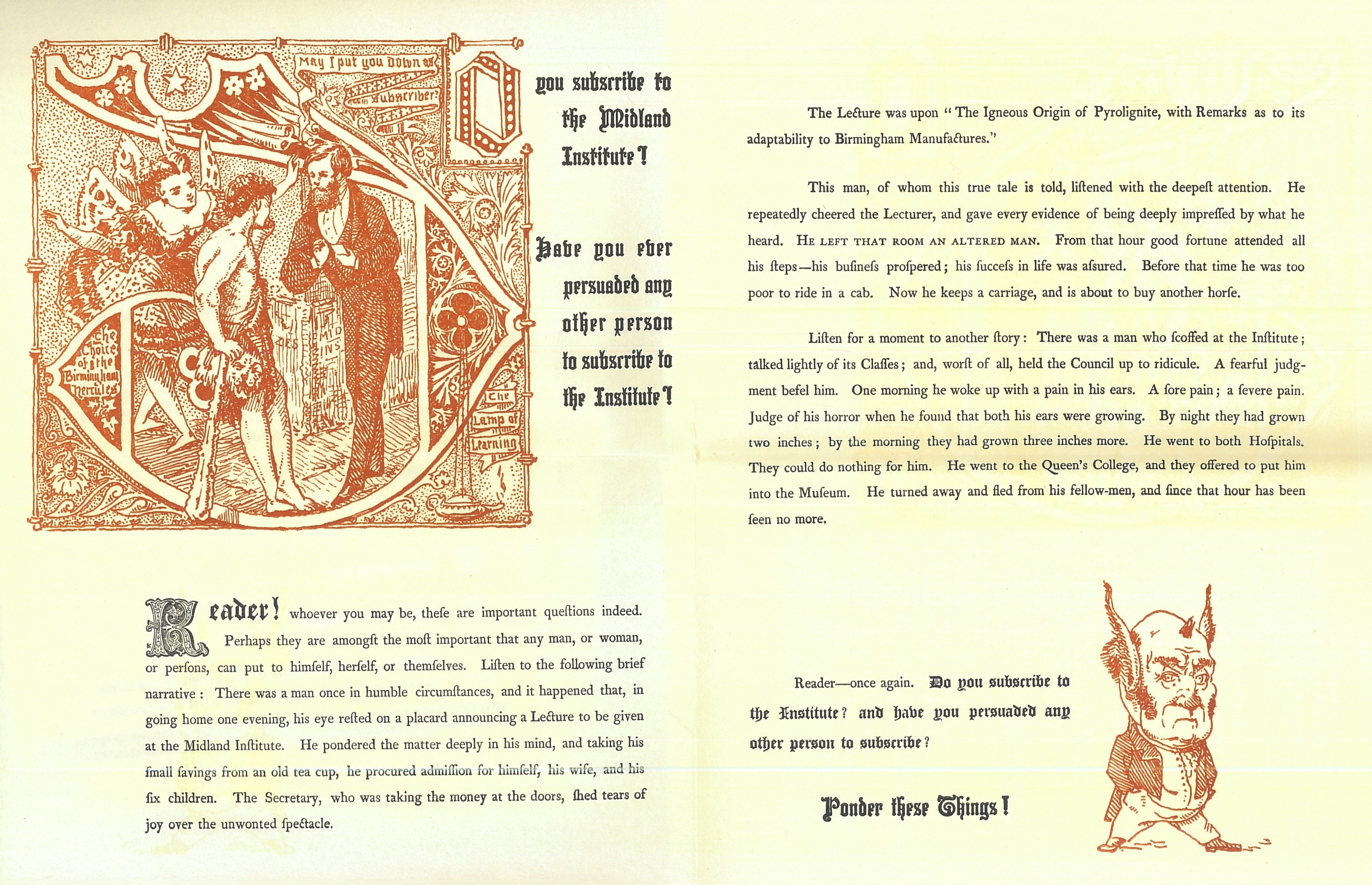
The BMI was established following the dissolution of the Birmingham Philosophical Institution, created under the Birmingham and Midland Institute Act 1854. Its founding mission was "the Diffusion and Advancement of Science, Literature and Art amongst all Classes of Persons resident in Birmingham and the Midland Counties" (everything.explained.today; bmi.org.uk). Visionaries such as Arthur Ryland, George Dixon, and John Jaffray were instrumental in championing the Institute, addressing Birmingham’s growing need for accessible adult education during the Industrial Revolution.
Architectural Significance
The original building, designed by Edward Middleton Barry, was situated near Birmingham Town Hall, with its foundation stone laid by Prince Albert in 1855—a testament to its early importance (everything.explained.today). In 1965, the Institute moved to its current location at 9 Margaret Street, an impressive Grade II* listed structure designed in 1899 by Jethro Cossins, F. B. Peacock, and Ernest Bewley (bmi.org.uk). The building's interiors, with ornate stonework, stained glass, and period woodwork, capture the essence of Victorian Birmingham.
Notable Figures and Cultural Impact
Charles Dickens, serving as BMI’s President in 1869, actively supported the Institute through public recitals and fundraising, leaving a lasting legacy (birminghammail.co.uk). The BMI also played a pivotal role in founding the School of Metallurgy, which eventually became Aston University, and contributed to the establishment of Birmingham’s first public museum (Science Museum Group; Wikipedia).
Library and Collections
The BMI’s renowned library boasts over 120,000 volumes, including rare archives and the historic Birmingham Library collection dating back to 1779. Highlights include the Shakespeare Memorial Library, one of the oldest in the country, and special collections focusing on local history, science, and the arts (artuk.org; Visit Birmingham – Museums & Galleries).
Practical Visitor Information
Location and Accessibility
- Address: 9 Margaret Street, Birmingham, B3 3BS
- Transport: Easily accessible via Birmingham New Street and Snow Hill stations; ample nearby parking and public transport connections (Visit Birmingham – Things to See and Do).
- Accessibility: The BMI is wheelchair accessible, with step-free entry, accessible toilets, lifts to all public areas, and participation in the AccessAble scheme. Assistance dogs are welcome.
Visiting Hours
- General Opening: Monday to Saturday, 9:00 AM – 5:00 PM
- Library Hours: Open to members and day visitors during public hours
- Note: Hours may vary for special events or holidays. Always confirm on the official BMI website before your visit.
Entry and Tickets
- General Admission: Free. Access to main exhibitions, library, and most public areas.
- Special Events/Tours: Some concerts, lectures, workshops, and guided tours require advance booking and may carry a fee.
- How to Book: Purchase tickets online via the BMI website or at the venue (subject to availability).
Facilities and Amenities
- Café: On-site café serving light refreshments, teas, and coffees.
- Wi-Fi: Free throughout the building.
- Restrooms: Accessible and well-maintained facilities on ground and upper floors.
- Cloakroom: Available for storing coats and bags.
- Gift Shop: Small shop with books, souvenirs, and local crafts.
Photography and Conduct
- Photography: Permitted in most public areas (no flash/tripods). Restrictions may apply in the library and during performances.
- Quiet Zones: Please respect designated quiet areas such as the Reading Room.
Cultural Programming and Events
Exhibitions and Galleries
- Sir William Blake Richmond Gallery: Rotating exhibitions featuring local and national artists.
- Recent/Upcoming Highlights:
- Stephen Nicol Exhibition (April 2025)
- Members Summer Exhibition (August–September 2025)
- Victorian Buildings Foyer Exhibition by Barbara Shackley
- “Children of the Railway: The Partition of India 75 Years On”
- “Grandbabs” Portrait Project
Lectures, Concerts, and Workshops
- Year-round calendar of lectures, concerts (including lunchtime recitals and jazz festivals), and educational workshops in arts, languages, and creative writing.
- Hybrid and digital formats available for many events, increasing accessibility.
Societies and Community Engagement
- Home to societies such as the Ruskin Club, Birmingham Savoyards, and Victorian Society.
- Partnership with Midland Ancestors supports family history research and local heritage projects.
Guided Tours
- Offered by prior arrangement; ideal for groups and those seeking in-depth exploration of the BMI’s history and collections.
- Tours include access to the Reading Room, library, and highlights of the Institute’s Victorian architecture.
Planning Your Visit
Travel and Nearby Attractions
- Central Location: Walking distance to Birmingham Museum & Art Gallery, Town Hall, the Library of Birmingham, and the Jewellery Quarter.
- Travel Tips: Weekday mornings are generally quieter. Public transport recommended due to limited parking.
- Nearby Dining: Numerous restaurants and cafés are within easy reach of the Institute.
Visitor Tips
- Family Friendly: Occasional workshops and events for children; all ages welcome.
- Membership: Offers borrowing rights, priority event booking, and invitations to exclusive gatherings. Day passes available for short-term access to the library and events.
Frequently Asked Questions (FAQ)
Q: What are the Birmingham and Midland Institute’s visiting hours?
A: Monday to Saturday, 9:00 AM to 5:00 PM. Always check the official website for current times.
Q: Is general admission free?
A: Yes, most areas and exhibitions are free. Some events and tours require a ticket.
Q: Is the Institute wheelchair accessible?
A: Yes. Step-free access, lifts, accessible toilets, and support for assistance dogs.
Q: Are guided tours available?
A: Yes, by prior arrangement or during special exhibitions/events.
Q: Can I take photos inside?
A: Yes, in most public areas, but please respect restrictions in the library and during performances.
Q: Are there refreshments on site?
A: A café is available for light snacks and drinks. Many dining options are nearby.
Q: How do I become a member?
A: Membership details are available on the BMI website. Discounts apply for students, seniors, and families.
Preservation, Legacy, and Modern Significance
The BMI remains a registered charity and a living landmark, balancing ongoing preservation of its historic fabric with a commitment to digital engagement and accessibility. Ongoing conservation projects ensure its Victorian architecture and collections endure for future generations (Birmingham Mail). The Institute’s programming continues to inspire learning and community, making it a cornerstone of Birmingham’s cultural landscape (artuk.org).
Plan Your Visit
Explore the Birmingham and Midland Institute—a destination where history, culture, and education converge. For the latest visiting hours, ticket information, events, and digital content, visit the official BMI website. Download the Audiala app for guided tours and up-to-date event notifications. Follow BMI on social media for the latest news and exclusive content.
Listen to the full story in the app
Your Personal Curator, in Your Pocket.
Audio guides for 1,100+ cities across 96 countries. History, stories, and local insight — offline ready.
Audiala App
Available on iOS & Android
Join 50k+ Curators
Sources
- verified
- verified
- verified
- verified
- verified
- verified
- verified
Last reviewed: