Roman Baths
BathUnited Kingdom 51° N · 2° W Updated Apr 2026
Built around a hot spring sacred before Rome, Bath's famous pool is only the surface; below it lie curse tablets, drains, and the machinery of an ancient spa.
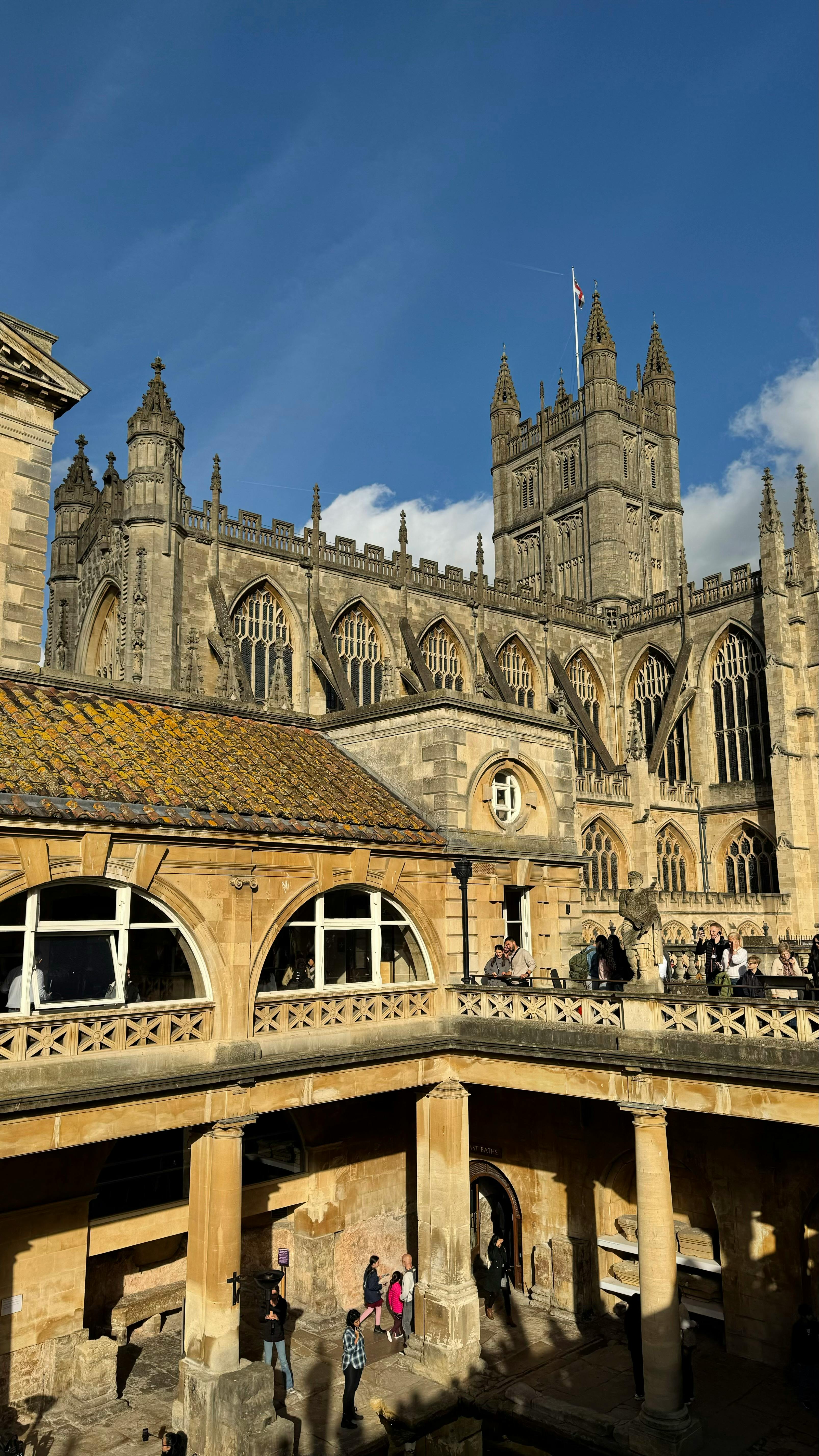 Photo: Stephan Leuzinger / Pexels
- Best season
- Winter mornings
Why does Bath's most famous Roman monument feel less like a ruin than a place still waiting for its bathers to come back? At the Roman Baths in Bath, United Kingdom, green water breathes steam beneath honey-colored stone, Bath Abbey rises close enough to feel like part of the same dream, and the air carries that faint mineral tang of hot springs and wet masonry. Visit because nowhere else in Britain lets you watch 2,000 years of worship, medicine, vanity, and civic self-invention gather around one pool.
Most visitors arrive expecting a neat Roman bathhouse. Records and archaeology show something stranger: this was a sacred spring before Rome, then a temple to Sulis Minerva, then a bathing complex, then a medieval healing place, then a Georgian spa obsession, then a Victorian excavation staged with almost theatrical flair.
Look at the Great Bath now and the paradox sharpens. The water glows an eerie jade, the columns reflect in a surface broken by ripples from the rising spring, and the whole place seems open and inevitable, though official Roman Baths interpretation confirms the main hall was roofed in the 2nd century AD.
That is why the place rewards more than a quick circuit with a camera. You come for the big Roman drama, yes, but you stay for the human scale: the stolen clothes cursed on thin lead tablets, the patients who trusted the water, the excavators who argued over what they had found, and the stubborn fact that Bath has kept returning to this spring for almost two millennia.
What to see
-
The Great Bath
The first shock is scale: that green pool below street level looks calm in photographs, then you step onto the terrace and realise the Roman Baths were built around water that still rises here at about 46°C, pouring up from the earth at roughly 1,170,000 litres a day, enough to fill nearly half an Olympic swimming pool before lunch. Steam drifts off the surface in cold weather, the Bath stone turns honey-gold when the light catches it, and the lead-lined basin sits with a strange dignity in the middle of it all, as if the ruin has simply paused for 1,600 years rather than ended. -
The Sacred Spring and Temple Court
The real heart of the place hides in the darker rooms, where the Sacred Spring bubbles inside the chamber the Romans built for Sulis Minerva between about AD 60 and 70, its foundations driven into mud on oak piles and lined with lead like some extravagant waterproof box. Stand here a minute and the site changes shape: less health spa, more shrine, with curse tablets scratched by angry bathers, mineral air that smells faintly metallic, and little details most people miss, like the owl tucked into the temple pediment or the rivet holes in Minerva’s bronze hairline where her helmet once sat. -
Follow the Water Through the Baths
Start on the terrace for the big reveal, then move quickly past the postcard view and follow the water’s logic through the Great Bath, the Sacred Spring, the heated rooms and the plunge pools, because the clever part of this site is engineering, not scenery. The best moment comes under your feet: a glass panel over the Roman drain still carrying water toward the Avon, with its channels and timber lining laid out like the plumbing diagram of an empire, and suddenly Aquae Sulis stops being a dead monument and becomes a machine that never quite shut off.
Plan your visit
- Getting There
- The Roman Baths sit at Abbey Church Yard, BA1 1LZ, in Bath’s pedestrian core beside Bath Abbey. From Bath Spa railway station or Bath bus station, walk 5 to 10 minutes via Dorchester Street, Stall Street, and York Street; drivers should use Lansdown Park & Ride service 31 or city-centre car parks at Manvers Street (24/7, 2m height limit) or Charlotte Street (24/7, no height limit), because there is no parking on site.
- Opening Hours
- As of 2026, the Roman Baths open daily from 9:00am to 6:00pm, with last entry at 5:00pm. They close on 25 and 26 December, and the official site says Christmas Eve and New Year’s Day hours change, so check before you go; 2025 had late summer evening openings, but no 2026 late-hours programme had been confirmed in the research.
- Time Needed
- Give it 60 to 90 minutes if you want the Great Bath, the temple remains, and the main audio-guide stops without lingering. Most visitors need 1.5 to 2 hours, while a full look with the museum galleries, curse tablets, and an added guided tour takes 2 to 3 hours.
- Accessibility
- The site is about 90% accessible and has four lifts, level access to the entrance and shop, two accessible toilets, BSL and descriptive audio guides, and some tactile or Braille support. But the baths lie 6 metres below street level, about the height of a two-storey house, and parts of the Roman paving are uneven or slippery; staff advise contacting them ahead if you need lift access at a specific time because only four wheelchair users can be on the lower levels at once.
- Cost & Tickets
- As of 2026, timed-entry tickets are cheapest when booked online, usually saving £2 over walk-up prices, and weekday prices run lower than weekends or bank holidays. Adult advance tickets ranged from £23.50 on January weekdays to £33 on April or June weekends; children under 6 enter free with a booked ticket, carers go free with eligible visitors, and Bath & North East Somerset Discovery Card holders get free entry.
Photo Gallery


History
One Spring, Many Faiths
Records show the hot spring has remained the fixed point while everything around it changed language, empire, theology, and fashion. The Romans built Aquae Sulis between about AD 60 and 75 around a place already treated as sacred, and every age after them found its own reason to keep coming back: prayer, cure, ceremony, status, archaeology, spectacle.
That continuity matters more than the usual rise-and-fall story. The Baths no longer serve Roman bathers, and the water in the Great Bath is now unsafe to touch or drink, yet the spring still shapes Bath's identity in a way few monuments can match; the city still gathers around thermal water, whether in the Pump Room, modern spas, museum rituals, or the hush that falls when visitors reach the edge of the pool.
The turning point
The Bath Was Never Just a Bath
At first glance, the Roman Baths look like a leisure complex that happened to survive unusually well. Tourists see the Great Bath, the statues, the grand rectangle of water, and assume the Romans came here much as modern visitors come to a spa: to soak, gossip, and feel improved by expensive surroundings.
But the evidence does not sit that neatly. Official Roman Baths research shows the sacred spring came first, the temple to Sulis Minerva was founded between about AD 60 and 75, and the Great Bath most people imagine as an open-air pool was, in Roman use, enclosed beneath a high vault; even the curses scratched onto lead between the 2nd and late 4th centuries AD remind you that this was a place where divine justice and everyday humiliation mixed in the same water.
The hidden truth is that Bath's surface story was rewritten more than once, and Major Charles Edward Davis became the turning-point figure in that rewrite when he excavated the Great Bath in 1878-1880. His stake was personal as well as professional: he helped pull Roman Bath back into daylight, yet the final Victorian presentation that fixed the site's public image did not belong entirely to him, because later design decisions and civic ambition turned archaeology into a carefully framed national showpiece.
Know that, and the place changes in front of you. You stop seeing one Roman relic and start seeing layered acts of belief: Iron Age reverence, Roman devotion to Sulis Minerva, medieval healing, Georgian spa culture, Victorian myth-making. Even the famous view across the water becomes an argument in stone about what each century wanted Bath to be.
What Changed
What Endured
Tips for visitors
Go Early
Before 10:00am is your best shot at hearing the place rather than the crowd: dripping water, shoe soles on old stone, the low museum hum instead of phone speakers. Summer crush hours flatten the mood, so early slots or winter weekdays are the better bet.Skip The Tripod
Personal photos are allowed, but tripods are banned during opening hours unless you arrange permission in advance. Don’t stop dead on the terrace for the postcard shot; the narrow pedestrian flow around the Great Bath backs up fast.Pack Light
Large luggage is not allowed, and the site only permits small backpacks up to 30 litres. Bath Luggage Storage Centre is the nearest off-site option, so sort your suitcase before you reach Abbey Church Yard.Water Stays Sealed
This is a museum, not a spa: you cannot bathe, touch, or drink from the Great Bath, and only water in a sealed bottle is allowed inside. The green water looks tempting in photos, but it is untreated and off-limits for a reason.Eat Nearby
For old Bath theatre, book the Pump Room next door and try the spa water once; the taste has all the charm of warm coins, which is part of the point. Sally Lunn’s on North Parade Passage works for a budget-to-mid Bath ritual, Cortado Cafe is a solid budget coffee stop, and Sotto Sotto is the splurge table if you want dinner after the site.Pair It Well
Bath Abbey is beside the entrance, so this is the easiest same-block double act in the city; do the Baths first, then climb into the Abbey’s cooler, quieter volume after all that steam and stone. If you want a longer historical thread, add the Bath World Heritage Centre on York Street.
Frequently asked
Is Roman Baths worth visiting?
Yes, especially if you want the one place that explains why Bath exists at all. The hot spring was sacred before Rome arrived, and the whole city grew around this pocket of steaming water beneath Abbey Church Yard. Most visitors come for the green Great Bath, then realize the sharper secret is underground: curse tablets, temple fragments, and a shrine that mattered as much as the bathing rooms.
How long do you need at Roman Baths?
Allow 1.5 to 2 hours for a good visit. One hour feels rushed unless you only want the terrace view and a quick loop, while 2 to 3 hours suits anyone using the audio guide, lingering by the Sacred Spring, or adding a guided tour. The site looks compact from above, but less than a quarter of the complex is visible from the terrace.
How do I get to Roman Baths from Bath?
From Bath Spa station, walk; it usually takes 5 to 10 minutes. Head through the pedestrian center toward Bath Abbey, then follow Stall Street or York Street to Abbey Church Yard, where the entrance sits beside the Abbey. Driving is the awkward option, since the Baths have no parking on site and the historic center is tighter than it first appears.
What is the best time to visit Roman Baths?
The best time is the first slot of the day, or a cold day when the steam shows itself properly. Before 10am is quieter, and winter gives the water more drama: 46°C spring water meeting cold air means visible vapor, mineral smell, and a stronger sense that the ground is still working under your feet. Evening late openings can be atmospheric too, but early beats crowded.
Can you visit Roman Baths for free?
Most visitors cannot, but a few groups can. Children under 6 enter free with a ticket, carers can enter free with an eligible visitor, local Discovery Card holders get free entry, and some Bath-area students also qualify. Everyone else should assume paid timed entry, and online booking usually saves £2.
What should I not miss at Roman Baths?
Don't miss the Sacred Spring, even if the Great Bath gets all the photographs. The spring chamber is the real heart of the place: dark, enclosed, lined with lead and oak foundations, with water still rising from deep underground. Also look for the gilt bronze head of Sulis Minerva, the curse tablets complaining about stolen clothes, and the tiny owl tucked into the temple pediment.
Sources & attribution 13
- Roman Baths Visit — Official visitor information used for opening hours, location, walking access from central Bath, on-site rules, and practical planning.
- Roman Baths FAQs — Official FAQ used for timed entry, booking advice, free-entry categories, walking time from Bath Spa station, and the fact that visitors cannot bathe in the Roman Baths.
- Roman Baths Accessibility — Official accessibility guidance used for quieter visiting times before 10am and general site logistics.
- Roman Baths Walkthrough — Official walkthrough used for the structure of the visit, the terrace reveal, the scale of the complex, and key features such as the Sacred Spring and Great Bath.
- Roman Sacred Spring — Official history of the spring used for the religious importance of the site and the 46°C thermal water rising from underground.
- Roman Bathing Complex — Official interpretation used for the Great Bath, the broader bathing complex, and why the site is larger than the main pool suggests.
- Roman Curse Tablets — Official source used for the curse tablets and the detail that many relate to stolen clothes, which helps explain the human texture of the site.
- Minerva's Head — Official source used for the gilt bronze head of Sulis Minerva as a key object visitors should seek out.
- Temple Pediment and Gorgon's Head — Official source used for the temple pediment and the small owl detail that many visitors miss.
- Tripadvisor Roman Baths FAQ — Recent visitor-reported timing used to support the practical estimate of 1.5 to 2 hours for most visits.
- Roman Baths Tickets April 2026 — Official ticketing page used for current paid-entry structure, online savings, and free-entry categories such as Discovery Card holders and carers.
- Bath and North East Somerset Discovery Card Roman Baths — Council page used to confirm free Roman Baths entry for local Discovery Card holders.
- UNESCO World Heritage Centre: City of Bath — UNESCO source used for the larger point that the baths and hot springs sit at the center of Bath's long development and identity.
Built from cited sources · see the method · How we make our guides →
Pick up where you left off
Saved and recently read places — kept on this device only.
Photo credits (12)
- Stephan Leuzinger — Pexels License (https://www.pexels.com/license/) — Source: https://www.pexels.com/photo/29184552/
- 2023-09-15 ancient Roman Baths in Bath, United Kingdom, an many tourists seen from the roof of Bath Abbey — Bernd Schwabe — CC BY-SA 4.0 (https://creativecommons.org/licenses/by-sa/4.0/) — Source: https://commons.wikimedia.org/wiki/File:2023-09-15_ancient_Roman_Baths_in_Bath,_United_Kingdom,_an_many_tourists_seen_from_the_roof_of_Bath_Abbey.jpg
- Bath 2023 - Roman Baths - by-RaBoe 013 — Raboe001 — CC BY-SA 3.0 (https://creativecommons.org/licenses/by-sa/3.0/) — Source: https://commons.wikimedia.org/wiki/File:Bath_2023_-_Roman_Baths_-_by-RaBoe_013.jpg
- Ariston men hydor. (Greek, Water is best.) - panoramio (1) — Immanuel Giel — CC BY 3.0 (https://creativecommons.org/licenses/by/3.0/) — Source: https://commons.wikimedia.org/wiki/File:Ariston_men_hydor._(Greek,_Water_is_best.)_-_panoramio_(1).jpg
- Bath 127 — FrDr — CC BY-SA 4.0 (https://creativecommons.org/licenses/by-sa/4.0/) — Source: https://commons.wikimedia.org/wiki/File:Bath_127.jpg
- Bath - Roman Baths - 20240730223654 — GZagatta — CC BY-SA 4.0 (https://creativecommons.org/licenses/by-sa/4.0/) — Source: https://commons.wikimedia.org/wiki/File:Bath_-_Roman_Baths_-_20240730223654.jpg
- Bath England 0400 101 — FrDr — CC BY-SA 4.0 (https://creativecommons.org/licenses/by-sa/4.0/) — Source: https://commons.wikimedia.org/wiki/File:Bath_England_0400_101.jpg
- Bath England 0400 103 — FrDr — CC BY-SA 4.0 (https://creativecommons.org/licenses/by-sa/4.0/) — Source: https://commons.wikimedia.org/wiki/File:Bath_England_0400_103.jpg
- Bath England 0400 100 — FrDr — CC BY-SA 4.0 (https://creativecommons.org/licenses/by-sa/4.0/) — Source: https://commons.wikimedia.org/wiki/File:Bath_England_0400_100.jpg
- Bath England 0400 104 — FrDr — CC BY-SA 4.0 (https://creativecommons.org/licenses/by-sa/4.0/) — Source: https://commons.wikimedia.org/wiki/File:Bath_England_0400_104.jpg
- Bath Abbey - geograph.org.uk - 5385403 — Chris Thomas-Atkin — CC BY-SA 2.0 (https://creativecommons.org/licenses/by-sa/2.0/) — Source: https://commons.wikimedia.org/wiki/File:Bath_Abbey_-_geograph.org.uk_-_5385403.jpg
- Bath England 0400 102 — FrDr — CC BY-SA 4.0 (https://creativecommons.org/licenses/by-sa/4.0/) — Source: https://commons.wikimedia.org/wiki/File:Bath_England_0400_102.jpg
Photos may have been resized or cropped.