Place
United Kingdom Updated Apr 2026
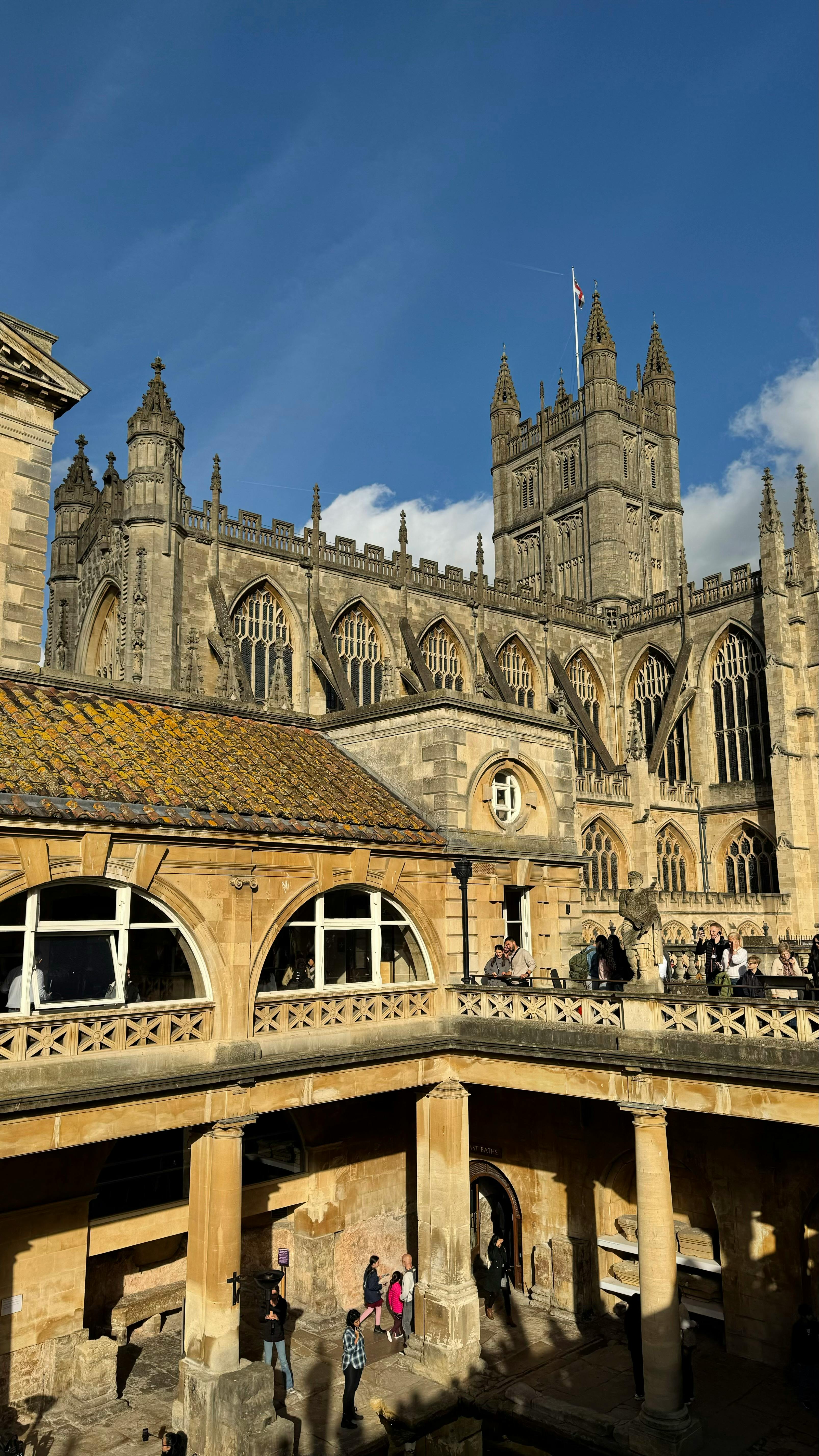
Steam still curls above the water in Bath, United Kingdom, and that one detail explains more than the honey-colored stone ever could. This is a city built because the ground runs warm, then dressed centuries later in crescents, terraces, and theatrical squares so elegant they can seem almost unreal in the wet English light. Roman engineers came for the spring. Georgian speculators turned it into a stage set.
 Photo: Jocelyn Erskine-Kellie / Pexels
Built from cited sources · see the method · How we make our guides →
Bath works because its scale never breaks the spell. You can walk from the Roman Baths to the Royal Crescent in under 20 minutes, passing Abbey bells, the mineral tang near the spa quarter, and streets of pale limestone that glow gold at four in the afternoon and almost grey before rain. Few British cities feel this composed.
The secret is that Bath is not simply pretty. UNESCO’s case for the city rests on a rare overlap: one of the most important Roman bath complexes north of the Alps, then an 18th-century urban experiment by John Wood the Elder and John Wood the Younger that tied architecture to hills, gardens, and long views. The city teaches you how to look. Stand in Queen Square, walk through the Circus, then watch Royal Crescent pull the surrounding green slopes into the picture.
Bath can, at first, seem polished to the point of self-satisfaction. Then the edges show: Walcot Street gets scruffier, Bathwick grows quieter, Sydney Gardens fills with dog walkers, and the whole place starts to feel less like a museum piece and more like a small city with unusually good bones. Stay long enough for that shift. It changes everything.
Not every monument, just the ones we'd walk you past ourselves.
Where to wander, by quarter — each with its own rhythm.
Before you go
From a sacred spring in a marshy valley to a world heritage city built on ritual, style, and survival
Most scholars place the earliest human activity around Bath in the Mesolithic, when hunters moved through the Avon valley long before streets or stone facades. The place already had its magnet: warm water rising from the ground, steaming in cold air, strange enough to stop people in their tracks.
By the late Iron Age, the hot springs had become a sacred site for the Britons, dedicated to the goddess Sulis. This was not leisure bathing. The spring was a threshold place, smelling of minerals and wet earth, where healing and prophecy blurred together.
After the Roman conquest of Britain, engineers and administrators turned the sacred spring into Aquae Sulis, the 'Waters of Sulis.' They did not erase the local goddess; they paired her with Minerva instead, a practical piece of imperial diplomacy carried out in stone and steam.
The main temple and bath complex took shape in the late 1st century, fed by spring water at about 46°C and handled with the sort of Roman confidence that still feels slightly showy. Pools, hypocausts, altars, drains: the whole place was built to impress, heal, and remind visitors who ran Britain now.
By the 2nd and 3rd centuries, bathers were dropping thin lead curse tablets into the sacred spring, asking Sulis Minerva to punish thieves who had stolen cloaks, coins, and dignity. The tablets survive because mineral water kept them safe. Petty crime, preserved forever.
When Roman rule in Britain collapsed in the early 5th century, Aquae Sulis lost the imperial machine that kept it working. Channels silted, buildings decayed, and the grand bathing complex slowly sank into mud and memory while the hot water kept rising anyway.
The Battle of Dyrham handed Bath and the surrounding region to the West Saxons after a sharp, decisive victory over the Britons. That mattered far beyond one battlefield. Bath shifted from a fading Roman shrine-town into a frontier settlement in the growing kingdom of Wessex.
Records point to a major Saxon church at Bath by the 8th century, anchoring the settlement around Christian worship rather than Roman bathing. The city was changing its accent. Sacred water remained, but abbey bells had begun to dominate the soundscape.
King Edgar was crowned at Bath in 973 in a ceremony that later shaped the English coronation rite. The choice of Bath was deliberate: ancient, holy, and politically useful, a place where royal authority could borrow gravity from old stones and older ritual.
After the Norman Conquest, a new bishop moved his seat to Bath and began a vast cathedral-priory complex in 1090. The project reordered the city around Norman power, replacing the battered Saxon church with something heavier, grander, and impossible to miss.
Bishop Oliver King began rebuilding Bath Abbey at the end of the 15th century, giving the city the Perpendicular Gothic shell that still catches afternoon light so well. Tradition says a dream inspired him. Dream or not, the work hauled Bath back from ecclesiastical ruin.
Henry VIII's Dissolution of the Monasteries stripped Bath Abbey of its monastic life, wealth, and much of its fabric. The great church survived, but barely. For a time, the city looked less like a rising spa and more like a place that had misplaced its purpose.
Richard 'Beau' Nash became Bath's Master of Ceremonies in 1704 and turned a scruffy spa town into the social stage of Georgian England. He banned swords in assembly rooms, pushed back against duelling, and made manners into municipal infrastructure. Bath's elegance was managed as much as built.
Around 1728, John Wood the Elder began turning Bath into a piece of urban theatre, starting with Queen Square and a vision steeped in Palladian order and Roman nostalgia. He wanted symmetry, procession, and honey-colored stone in every direction. Ambition shows.
Ralph Allen's wealth from postal reform and Bath stone quarries helped finance the city's Georgian remaking. He supplied the honey-colored limestone that gives Bath its famous glow, then proved its possibilities in buildings like Prior Park. Taste needs money. He had plenty.
Construction of the Circus began in 1754, a ring of townhouses arranged with almost unnerving confidence. Its three curving segments create a space that feels ceremonial and faintly theatrical, as if everyday life in Bath deserved a classical set.
William Herschel came to Bath in 1766 as a musician, working in the city's concert life before astronomy swallowed him whole. At 19 New King Street, he built telescopes by hand and trained his eye on the night sky from a city better known for candlelit ballrooms than planets.
Work started on the Royal Crescent in 1767, the boldest line Bath ever drew across a hillside. Thirty houses read as one great facade, a curved stone screen facing open lawn and sky. Few urban set pieces make aristocratic self-confidence look so graceful.
Pulteney Bridge opened in 1774, linking the old city to the planned expansion at Bathwick and Great Pulteney Street. Shops lined the bridge from the start, which was both practical and a little theatrical. Bath rarely chooses between utility and display when it can have both.
Jane Austen arrived in Bath in 1801 and lived here until 1806, watching the city's rituals at close range. She understood what Bath did to people: how assembly rooms, walks, and chance meetings could rearrange reputations overnight. That knowledge runs straight through Northanger Abbey and Persuasion.
Mary Shelley stayed in Bath in 1816 at 5 Abbey Churchyard, where she worked on Frankenstein during a year already crowded with grief and scandal. The setting matters. Few places mix church towers, ancient water, and polite Georgian order quite so neatly while a modern monster is being imagined indoors.
The coming of the Great Western Railway in 1840 tied Bath more tightly to London and the wider country. Travel grew faster, cheaper, and less aristocratic, and the city shifted from elite seasonal resort to a place reached by timetables and day tickets. Steam altered the social chemistry.
During the Baedeker raids of April 1942, German bombing struck Bath's historic center and tore into houses, churches, and streets that had seemed almost too elegant for war. Abbey glass shattered, terraces broke open, and firelight bounced off pale stone. The city learned how fragile beauty can be.
The University of Bath was founded in 1966, giving the city a new intellectual engine on Claverton Down. This was a different kind of Bath prestige, less about ceremonial rooms and more about laboratories, lecture halls, and students remaking the city's rhythm term by term.
UNESCO inscribed Bath as a World Heritage Site in 1987 for the rare overlap of Roman archaeology, Georgian planning, and green setting. The designation did more than flatter the city. It forced every future argument about traffic, development, and preservation to take history seriously.
Thermae Bath Spa opened in 2006, returning public bathing to the hot springs in a modern form after centuries of interruption. Bath had always sold water as story, cure, and status. Now people could step into the steam again, rooftop wind in their faces, with the Abbey and hills around them.
In 2021, Bath gained a second UNESCO inscription as part of the Great Spa Towns of Europe, placing it alongside places that built entire civic identities around mineral water and ritualized healing. The pairing sharpened the point: Bath is not just Georgian prettiness. It is a spa city with two thousand years of muscle memory.
Novelist · 1775–1817
Lived here 1801–1806
Bath gave Austen material she could both use and quietly mock. She walked the same assembly rooms and circulating libraries her characters would later haunt, and the city entered her fiction in "Northanger Abbey" and "Persuasion" with all its polished surfaces and social strain.
Novelist · 1797–1851
Lived here in 1816
Mary Shelley stayed at 5 Abbey Churchyard in 1816, and local accounts say she wrote much of "Frankenstein" while in Bath. The setting feels almost too neat: a city built on healing water, then a young writer imagining a body brought to life by force.
Astronomer and musician · 1738–1822
Lived and worked here from 1766
Herschel arrived in Bath as a musician, then turned a house on New King Street into a workshop for telescopes and a launchpad for one of astronomy's great discoveries. Uranus changed his life, but the strange part is where it happened: not in a royal observatory, in a refined spa city listening to concerts.
Astronomer · 1750–1848
Worked here with William Herschel
Caroline Herschel's Bath years were not an afterthought to her brother's career; they were part of the engine room. From the same New King Street house she helped with observations and calculations before becoming a comet discoverer in her own right, which gives Bath a sharper scientific edge than its pump-room image suggests.
Master of Ceremonies · 1674–1761
Directed Bath society from 1704 until 1761
Beau Nash helped turn Bath from a place with hot water into a place with rules, rituals, and social voltage. He choreographed who met whom, where they walked, and how they behaved, so much so that parts of Georgian Bath still feel like a stage set built to flatter his sense of order.
Entrepreneur and philanthropist · 1693–1764
Built Prior Park and shaped Georgian Bath
Ralph Allen made money from postal reform, then used Bath stone and ambition to remake the city around him. Prior Park was his hilltop statement, but his larger legacy sits all over Bath in that warm gold stone that seems to catch every scrap of evening light.
Architect · 1704–1754
Designed key Georgian Bath schemes
John Wood the Elder looked at Bath and saw not a provincial town but a chance to build urban theatre on a Roman script. Queen Square and the Circus were part architecture, part argument, insisting that streets and facades could shape how a city imagined itself.
Architect · 1728–1782
Extended his father's vision in Bath
The son finished what the father started, and Bath is better for that continuity. Royal Crescent carries his name into postcard fame, yet in person the curve reads less like a postcard than a controlled piece of spectacle, stone bending around green space with almost absurd confidence.
Where locals actually book dinner — not the tourist menus.
Bath's signature bread is a large, airy bun with a tender crumb and a faint sweetness, descended from a recipe the city has been arguing about for centuries. Try it at Sally Lunn's on North Parade Passage, where the smell of toasted butter hits before the history does.
This dry, crisp biscuit was created in the 18th century for spa patients who were meant to avoid richer food, which tells you something about Bath's old medical manners. Eaten with cheese, smoked fish, or butter, it has the clean snap of a water biscuit with more character.
Bath Chap is cured and smoked pig's cheek or jaw, once common working food and now a small act of local culinary archaeology. When a menu has it, order it: soft fat, deep salt, and a texture halfway between ham hock and bacon done properly.
Yes, it is polished and yes, it leans ceremonial, but the setting earns the ritual. Taking tea beside the Roman Baths, with chandeliers overhead and that faint mineral note in the air, makes more sense in Bath than almost anywhere else.
Bath sits close enough to cheddar country that local cheese boards often outperform more elaborate desserts. Look for farmhouse Somerset Cheddar with real bite, not the rubbery export version, and pair it with chutney or a Bath Oliver if the kitchen knows what it is doing.
Bath's compact centre rewards grazing rather than one grand meal. Walcot Street, Kingsmead Square, and the lanes around Milsom Street have the stronger independent coffee-and-pastry energy, which is where the city feels less posed and more lived in.
For dinner with a local pulse, this restaurant inside the old Green Park Station usually beats the more generic central options. The room still carries its railway bones, and live jazz, funk, or soul gives the evening a looseness Bath sometimes hides by day.
Many of Bath's better restaurants work from the same regional larder: Somerset lamb, local vegetables, cider, and cheeses from the surrounding hills and valleys. Skip any place trading only on Georgian atmosphere; the stronger kitchens let the West Country speak on the plate.
Small things that change how the city treats you.
The city, as it actually looks.

Yes, especially if you want one city that can give you Roman engineering, Georgian urban design, and working spa culture in the same walkable center. Bath is compact enough for a short break, but layered enough that you keep finding odd corners: a scientist discovering Uranus on New King Street, a Palladian bridge in a landscaped valley, steam rising from water that drew people here two thousand years ago.
Two to three days is the sweet spot for most travelers. One day covers the Roman Baths, Abbey area, Royal Crescent, and Pulteney Bridge; a second gives you time for Prior Park, the Skyline, Holburne Museum, or a spa session without sprinting.
Mostly yes in the historic center, and that is Bath's great advantage. But the city climbs hard once you head to viewpoints and gardens, so walks to Prior Park, Alexandra Park, Beckford's Tower, or sections of Bath Skyline feel longer than the map suggests.
Yes, Bath leans expensive by UK standards, especially for central hotels, spa entry, and major attractions. You can trim costs by using free stops such as the World Heritage Centre, parks, church visits, and the permanent collection at Victoria Art Gallery, then paying for one or two headline experiences.
Yes, Bath is generally a low-stress city for visitors, with a busy central core and strong foot traffic around the main sights. The bigger practical risk is not crime but slips on wet stone, steep streets after dark, and crowds bunching around Abbey Churchyard and the bridge approaches.
Train-and-foot is the smart way to do Bath. The center is compact, parking is limited, and many of the best experiences are walks between the station, Abbey, Roman Baths, Pulteney Bridge, the Circus, and Royal Crescent.
Spring and early autumn are the best balance of light, greenery, and manageable footfall. Summer brings long evenings and rooftop-pool appeal, but the center gets crowded; winter can be atmospheric, though damp cold on honey-colored stone has a way of getting into your bones.
No, you can visit the Roman Baths but not bathe in them. For actual thermal bathing, Thermae Bath Spa is the modern option and remains Britain's only naturally warm, mineral-rich thermal spa for bathing.
Give time to the Georgian city as a whole, not just one building. Walk the sequence from Queen Square to the Circus to Royal Crescent, then cross to Great Pulteney Street and Bathwick; that is where Bath stops being a checklist and starts making sense.
Saved and recently read places — kept on this device only.
Photos may have been resized or cropped.