An introduction.
Researched by the Audiala editorial team from historical records, architectural archives, and local expertise.
WWhy does a memorial built for the dead feel so alive? At Wahat Al Karama in Abu Dhabi, United Arab Emirates, that question meets you the moment the leaning slabs frame Sheikh Zayed Grand Mosque across the road, and it is exactly why you should come: this place shows how the UAE turns memory into ceremony, architecture, and public emotion all at once.
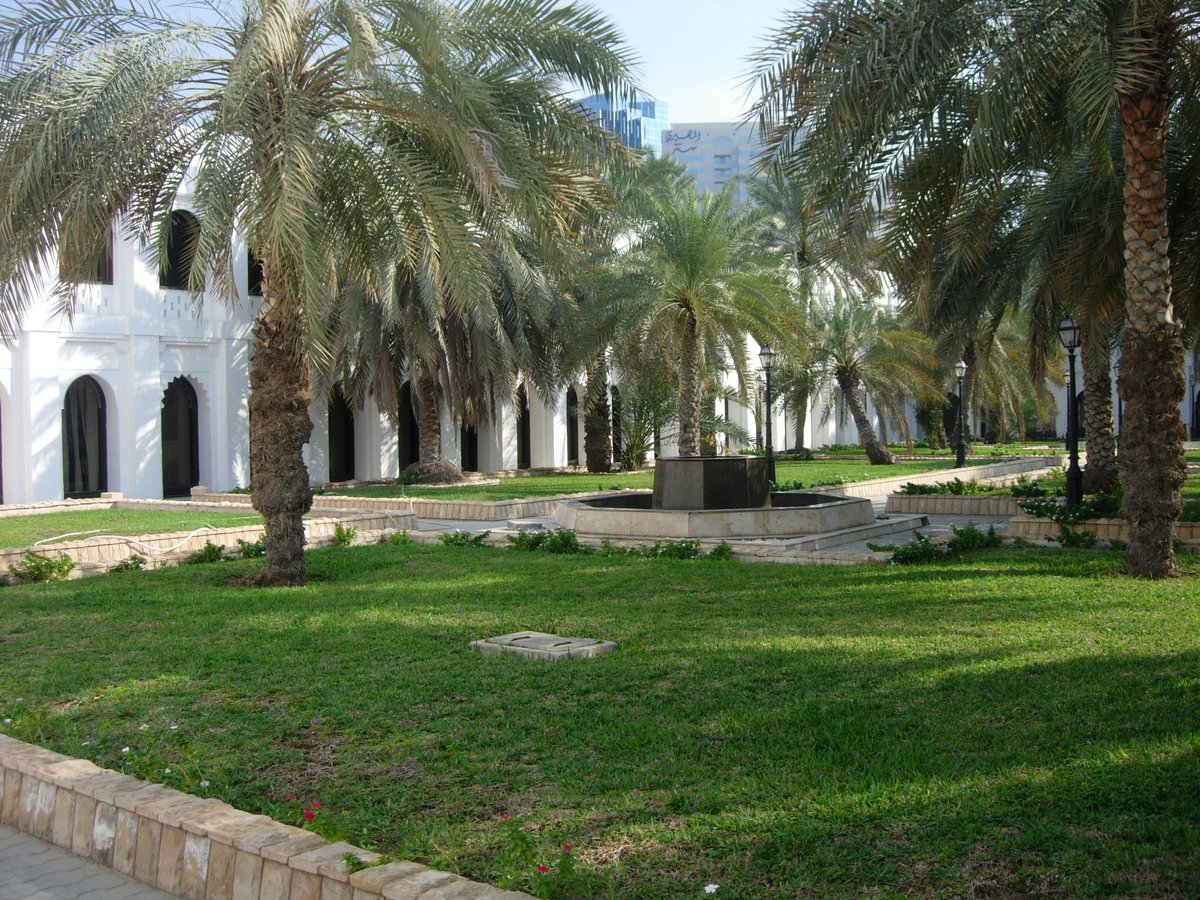
From the entrance, the site reads almost like a puzzle in stone and water. Forty-two to forty-six thousand square metres of plaza, pavilion, and garden spread out opposite the mosque, a memorial precinct roughly the size of six football pitches, yet the mood is hushed enough that you notice shoe soles on paving and the thin slap of water before you notice the scale.
Most visitors assume it is a war memorial and leave it at that. The official story is wider: records show Wahat Al Karama honors Emiratis who died in military, police, civil, diplomatic, and humanitarian service, which means the names gathered here belong to soldiers, yes, but also to men who were carrying aid files and diplomatic papers.
Come for the architecture if you like. Stay for the argument the place makes. Those giant leaning tablets are not just monumental props; they stage a conversation about sacrifice, union, and the kind of state the UAE wants to imagine itself to be when the flag rises and the brass band starts.
Wahat Al Karama: A Quiet Reflection
Ash's Wanderlust Haven!01 What to see.
The Memorial and Reflection Pool
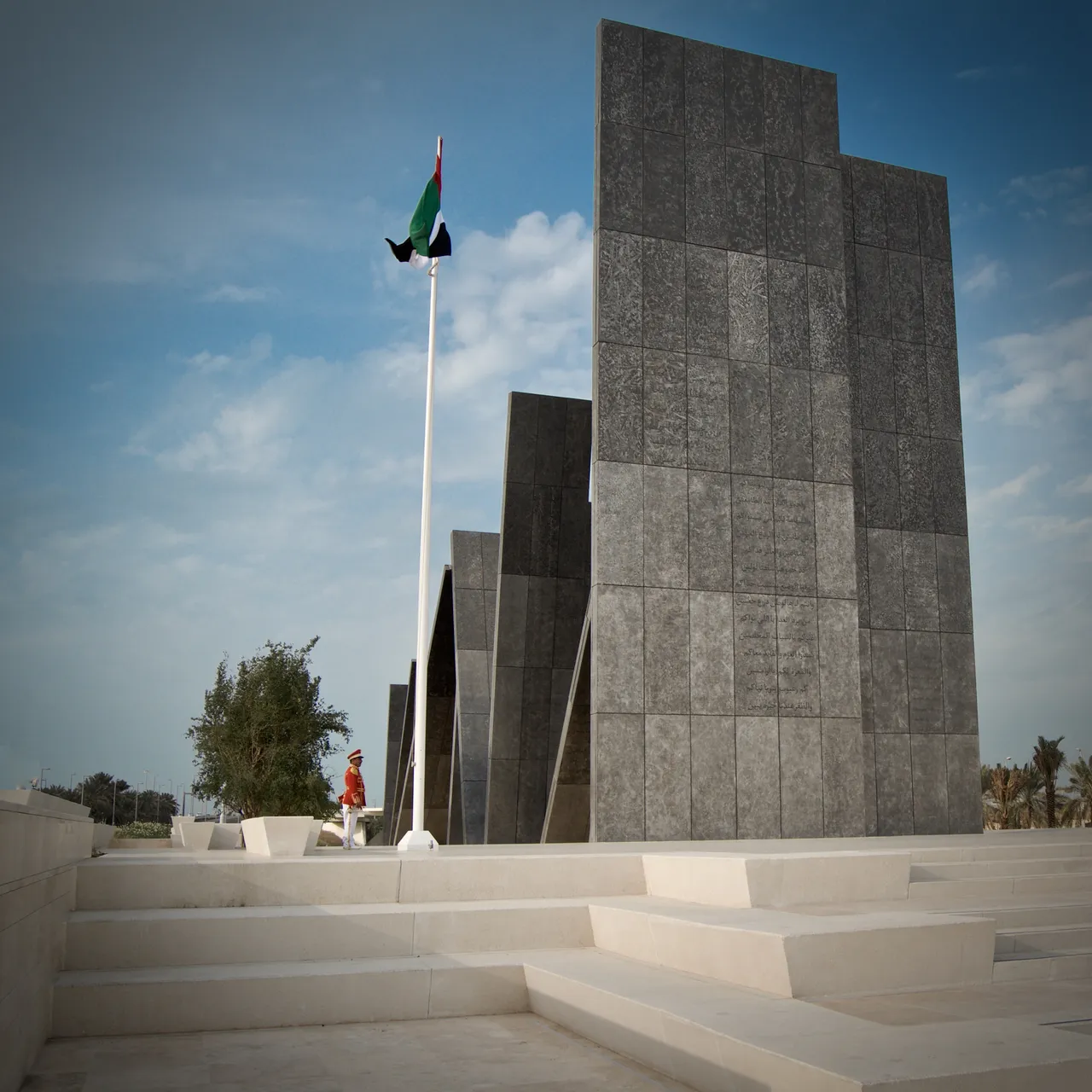
The surprise at Wahat Al Karama is how gentle the main monument feels once you stand beneath it. Idris Khan and UAP turned a national memorial into a 90-meter line of 31 aluminium-clad tablets, each one leaning into the next like a row of doors caught mid-whisper, and the 15-millimeter reflection pool at their feet is so shallow you can walk through it without breaking the mirror of Sheikh Zayed Grand Mosque for more than a second.
Come close. Most people take the wide photograph and miss the better part: poems and quotations sandblasted into the metal, plus the long supporting spine behind the tablets carrying the Pledge of Allegiance of the UAE Armed Forces. In late afternoon the cladding stops glaring and starts holding light, which changes the monument from a big object into an argument about mutual support, grief, and public memory.
Pavilion of Honour
The smartest move here happens underground, or close enough to feel that way. A descending approach pulls you out of the open plaza and into a circular chamber lined with illuminated plates naming the fallen, while seven glass panels for the seven emirates rise from moving water at the center, their reflections trembling softly across the floor like light inside a lantern.
Read the plates slowly. The memorial stops being ceremonial rhetoric when a name is followed by rank, branch, place, and date of death, and the aluminium matters too: official sources say these wall plates were made from reclaimed UAE Armed Forces vehicles, turning military metal into something far quieter. Footsteps hush, voices drop, and the whole room seems built to make you stand straighter without being told to.
A Dusk Walk from the Visitors' Centre Roof to the Plaza
Start on the Visitors' Centre roof an hour before sunset, because that is where the site finally makes visual sense. From up there you can line up the memorial, Sheikh Zayed Grand Mosque, and Sheikh Zayed Bridge in a single sweep of pale stone and white domes, then walk down toward the 4,000-square-meter plaza, a disk of Turkish travertine broad enough to feel like half a football pitch cleared for silence.
Time your descent for the Honour Guard march before sunset, then linger by the pool as the mosque gathers gold and the tablets turn darker, softer, more human. Skip the urge to rush back to the mosque gates; Wahat Al Karama works best when you let the evening stretch, because the site begins as public spectacle and ends as something much more private.
02 In pictures.


Watch & Explore Wahat Al Karama.
Plan and listen to Wahat Al Karama with Audiala.
Audio guide in your pocket, itinerary in your browser. Built for the way you actually visit.
03 Visitor logistics.
The practical scaffolding for a good visit — kept short.
Getting There
Wahat Al Karama sits opposite Sheikh Zayed Grand Mosque, linked by a pedestrian bridge that usually takes about 10 to 15 minutes on foot from the mosque side. Abu Dhabi has no metro here, so the practical options are taxi, car, or bus to the Eastern Ring Road / Sheikh Zayed Grand Mosque stops, where routes 54, 160, 162, 44, and A1 have all surfaced in 2026 transit data; if you are pairing the two sites, the official shuttle runs every 30 minutes from 10:00 AM to 7:15 PM.
Opening Hours
As of 2026, the safest planning window is 9:00 AM to 7:00 PM if you want the Visitor Centre definitely open and tours still running. Official Abu Dhabi sources conflict on the wider site hours: one lists the public site as 9:00 AM to 10:00 PM, another shows 9:00 AM to 10:45 PM, while the plaza itself is also described as accessible 24 hours; late-evening access is best checked on the day, especially around ceremonies and official events.
Time Needed
Give it 20 to 30 minutes if you only want the memorial axis, the mosque view, and a few photographs. Most visitors need 45 to 75 minutes, and 1.5 to 2 hours feels right if you want the Pavilion of Honour, the Visitor Centre, and enough time to watch the light shift across the reflecting pool.
Accessibility
The main route appears friendly to wheelchairs: broad paved stone, low gradients, and a formal outdoor layout built for processions rather than rough terrain. Official pages confirm public access to the Visitor Centre roof and describe the reflecting pool as only 15 millimeters deep, thin as two stacked coins, but I did not find a 2026 page confirming lifts, accessible toilets, or loan wheelchairs, so call +971 2 668 1000 if those details matter.
Cost & Tickets
As of 2026, entry is free, and I found no separate free-entry days because the site already costs nothing. Guided tours in English and Arabic are offered, with the last tour listed at 6:00 PM daily, but no reliable official booking flow surfaced; the same phone number, +971 2 668 1000, is the safest way to confirm a tour.
04 Tips for visitors.
Small things that change the day.
Memorial Manners
This place works best when you treat it as a memorial first and a viewpoint second. Dress modestly, keep voices low, and skip the jokey posing around the reflecting pool; Emirati families and official visitors use the site with real seriousness.
Photo Rules
Phone photography is normal here, especially at sunset when the mosque glows across the water like white marble floating in ink. Big rigs are another matter: I found no published Wahat permit page for commercial shoots, and nearby military-sensitive buildings make it wise to keep your frame tight and your setup small.
Drone Ban
As of 2026, drone flying in the UAE is under a temporary national suspension, so this is not the place to test the rule. Security attention arrives fast in this corridor, and the combination of memorial site, mosque, and nearby military zone leaves little room for improvisation.
Go At Dusk
Come for sunset into blue hour if you can. The stone cools, the crowd thins, and Sheikh Zayed Grand Mosque turns into a mirrored apparition across the water; morning is quieter for galleries, but evening gives the site its emotional punch.
Eat Nearby
Wahat Al Karama is not where you come to eat, so plan your meal after. Souq Al Jami' at the mosque is the practical stop for toilets and casual options, Al Qana works well for dinner with places like Grand Beirut and Mado in the mid-range, and Qaryat Al Beri suits a longer sit-down meal with Sofra bld or The Meat Co. if you want to spend more.
Pair The Mosque
The smart pairing is Sheikh Zayed Grand Mosque first, then Wahat Al Karama, then dinner at Al Qana or Qaryat Al Beri. Use Gate 6 at the mosque side, cross by pedestrian bridge or shuttle, and remember the mood shift: one site dazzles, the other asks for silence.
Where to Eat
Don't Leave Without Trying
Al Khayma Heritage Restaurant Abu Dhabi
local favoriteOrder: Order the lamb machboos, the cold appetiser platter, and warm naan; if you have room, finish with the date pudding, which one reviewer called the best dessert they had in the UAE.
This is the clearest pick if you want a meal that actually speaks to Abu Dhabi rather than a generic all-day menu. The portions are generous, the service gets praised again and again, and the setting by Sheikh Zayed Grand Mosque gives it the kind of occasion that still feels grounded in local food.
Cello SOL Restaurant Abu Dhabi
cafeOrder: Go for the fettuccini burrata and burrata pizza, then add a Cello Cap or Cello Berry if you want the full house style.
Cello SOL sounds like the sort of place locals keep returning to because it gets the basics right: warm room, big portions, serious coffee, and staff who notice the table without hovering. It works especially well if you want something polished but not stiff after visiting Wahat Al Karama.
Bovini Restaurant & Cafe
local favoriteOrder: The pizza and burger are the safest bet from the reviews, and the roasted chicken also gets strong praise for being tender and well cooked.
Bovini wins on ease. Families clearly like it, portions are generous, and the room seems lively without tipping into chaos, which matters more than concept when you just want a reliable lunch near central Abu Dhabi.
Swiss Butter - Novotel Al Bustan
fine diningOrder: Order the beef if you want the signature experience, though several reviewers say the chicken is even more flavorful; save space for the molten chocolate cake.
This is the least local pick on the list, but it earns its place because the menu is focused and people leave talking about the execution rather than the branding. Good choice when you want a dependable dinner and don't feel like gambling on a sprawling hotel menu.
Dining Tips
- check Abu Dhabi restaurants commonly operate daily; a citywide weekly closing day was not identified in the source set.
- check Breakfast often starts around 6:30 AM.
- check Lunch commonly centers around 12:30 PM to mid-afternoon.
- check Dinner service commonly starts around 6:30 PM, but social dining often peaks later in the evening, especially on weekends.
- check Tipping is not expected but is commonly practised.
- check Many fine-dining and high-end restaurants may add around a 10% service charge and a 6% tourism levy.
- check If service charges are not included, adding 10% to 15% is suggested by Abu Dhabi tourism guidance.
- check Credit and debit cards are widely accepted, but cash is better in souks and smaller shops.
Restaurant data powered by Google
05 A Memorial That Invented Its Own Rituals
Wahat Al Karama looks settled, almost inevitable, as if Abu Dhabi had always reserved this ground for national mourning. The record says otherwise. This is a very recent place, inaugurated on 30 November 2016, and its history begins less with old stone than with a modern state deciding how grief should be seen, heard, and repeated.
That makes its past unusually sharp. Instead of layers from centuries of rebuilding, you get documented turning points: a death on Greater Tunb in 1971, the declaration of Commemoration Day in 2015, the naming of the site in late November 2016, then the first grand ceremony that fixed its meaning in public memory.
The Flag on Greater Tunb Never Really Came Down
At first glance, the surface story seems simple: Wahat Al Karama is a memorial that rose after the UAE's recent military losses, especially the shock of Yemen in 2015. That reading makes sense when you see the ceremonial scale, the honor guards, and the military symbolism pressed into every line of the site.
But one date keeps pulling against that easy version: 30 November. Records show the memorial was inaugurated on 30 November 2016 because that day already belonged to Salem Suhail bin Khamis Al Dahmani, the Ras Al Khaimah policeman killed on Greater Tunb on 30 November 1971 after he refused to lower his flag during the Iranian seizure of the island. For him, the stake was painfully personal. He was not defending an abstract slogan; he was standing with a six-man police force two days before the UAE's formal union, and the turning point came when surrender would have meant lowering the emblem of a state that was not even fully born yet.
The revelation is that Wahat Al Karama was designed to stretch one man's death across the whole national story. Documented official descriptions make clear that the memorial does not only gather soldiers killed in battle. It also gathers police officers, diplomats, civil servants, and humanitarian workers, which is why the logic of the place runs from Salem Suhail in 1971 to the Emirati diplomats killed in Kandahar in 2017. The surface story exists because military ceremony is what visitors see first. The deeper story is about the state choosing one founding sacrifice as the hinge for all the others.
Once you know that, the site changes. The slabs no longer read as a generic monument to war; they look like a salute frozen in metal, leaning together the way the seven emirates lean into one union, while the eighth slab in the Pavilion of Honour marks the martyrs themselves. And the silence here stops feeling empty. It feels staged with intent.
How a Ceremony Became a Place
Still in Use, Still Changing
Listen to the full story in the app
The whole Wahat Al Karama,
told well.
Audio guides for 1,100+ cities across 96 countries. History, stories, and local insight — offline ready.
06 Frequently asked.
The questions travellers send us most about Wahat Al Karama.
Is Wahat Al Karama worth visiting?
Yes, especially if you want one of Abu Dhabi's most thoughtful places rather than another quick photo stop. The memorial's 31 leaning tablets, the shallow reflection pool, and the line of sight to Sheikh Zayed Grand Mosque give it real emotional weight. Go for the quiet, not for spectacle.
How long do you need at Wahat Al Karama?
Most visitors need 45 to 75 minutes. That gives you time for the memorial plaza, the Pavilion of Honour, and a slow walk instead of the five-minute dash some itineraries suggest. If the Visitor Centre is open and you want the full story, give it 1.5 to 2 hours.
How do I get to Wahat Al Karama from Abu Dhabi?
A taxi or car is the easiest way from most parts of Abu Dhabi. If you're already at Sheikh Zayed Grand Mosque, the smart move is the pedestrian bridge or the shuttle that runs every 30 minutes from 10:00 AM to 7:15 PM. Public buses also stop near the mosque on Eastern Ring Road, then it's a short walk.
What is the best time to visit Wahat Al Karama?
Sunset into blue hour is the best time to visit Wahat Al Karama. The aluminium surfaces soften, the reflection pool turns glassy, and the mosque across the way starts to glow instead of glare. October to March is the sweet spot, because summer heat hits this exposed stone site hard.
Can you visit Wahat Al Karama for free?
Yes, Wahat Al Karama is free to visit. Official listings agree on free entry, though they do not agree perfectly on late closing times, so the safest planning window is 9:00 AM to 7:00 PM if you want the Visitor Centre open. The outdoor plaza has also been listed as accessible later, and in one official source as 24 hours.
What should I not miss at Wahat Al Karama?
Don't miss the Pavilion of Honour, the 15-millimetre reflection pool, and the inscriptions cut into the tablets. Most people photograph the big slabs and leave, which means they miss the names engraved on illuminated aluminium plates made from reclaimed military vehicles and the roof view back to the mosque and Sheikh Zayed Bridge. If you're there near sunset, stay for the honour guard sequence or, on Saturdays, the 5:00 PM ceremony introduced in April 2026.
Verified, and shown.
Researched and written by the Audiala editorial team from historical records, architectural archives, and local expertise.
Checked for UNESCO World Heritage or Tentative List status; used to confirm Wahat Al Karama is not listed.
Background on Salem Suhail bin Khamis Al Dahmani and the story behind Commemoration Day.
Official page on Commemoration Day, its 2015 declaration, and the memorial logic tied to 30 November 1971.
Official-style microsite confirming the memorial's inauguration date and project framing.
Reporting on the late-November 2016 naming announcement for Wahat Al Karama.
WAM-syndicated coverage of the naming announcement; used for date cross-checking.
Official 2015 statement on declaring 30 November as Martyr's Day / Commemoration Day.
Contemporaneous reporting on the 2015 declaration of Martyr's Day.
Official notice on the 2015 three-day mourning period after casualties in Yemen.
Reporting on the 2015 mourning period; used for political and emotional context.
Military publication confirming the naming announcement date.
Coverage of the memorial's official name and public framing.
Coverage of the 30 November 2016 inauguration ceremony and site scale.
Reporting on the inauguration ceremony, attendance, and ceremonial details.
Reporting on the site's public opening in December 2016 and early visitor access.
Official report on the 2017 cabinet meeting held at Wahat Al Karama.
Protocol coverage of the cabinet meeting at the memorial in March 2017.
Reporting on the Kandahar bombing and the inclusion of diplomats in the memorial's story.
International reporting on the Kandahar attack for cross-checking diplomatic casualties.
Reporting on Ambassador Juma Al Kaabi's death from wounds sustained in Kandahar.
Used to confirm the interactive visitor center was in use by late 2017.
Project page for the visitor center experience and exhibit design.
Primary official visitor source for opening hours, free entry, tours, features, and practical planning.
Official project page with architectural details, symbolism, measurements, and memorial components.
Used for detail on where the names are placed and the memorial's physical elements.
Fabrication and design details for the tablets and pavilion materials.
Used for a stark human detail connected to diplomats remembered at the site.
Project page used for site area and design context.
Official cultural listing with visiting hours and site description.
Official mosque hours used to compare scheduling if pairing both sites.
Used to confirm the weekly Saturday 5:00 PM ceremony launched in April 2026.
Historical opening notice mentioning possible closures for official events.
Transit mapping for nearby bus stops and route numbers.
Additional nearby bus stop data for public transport planning.
Official shuttle and parking information between the mosque and Wahat Al Karama.
Official directions and visitor access details for the mosque side of the route.
Traveler note used to support the on-foot timing from the mosque.
Map listing for the named Wahat Al Karama parking area.
Alternate Waze listing for the parking location.
Third-party parking database used for non-official parking context.
Visitor-oriented page used for accessibility and respectful dress guidance.
Third-party guide used for accessibility and practical context.
Traveler reviews used to estimate visit length and crowd feel.
Third-party planning guide used to cross-check visit duration.
Used to note that some itinerary pages understate the time needed.
Official source for nearby visitor services and facilities at the mosque.
Official source for Souq Al Jami' dining and shopping near the memorial.
Official dining listing for a nearby restaurant in Qaryat Al Beri.
Official dining listing for a nearby restaurant option.
Official dining listing for a nearby waterfront restaurant.
Official area guide for the nearby Qaryat Al Beri dining and shopping cluster.
Official area guide for Al Qana, suggested as a post-visit stop.
Non-official guide referenced for nearby locker or cloakroom mentions at the mosque.
Official mosque etiquette and dress code for travelers pairing both sites.
Photography-focused guide supporting sunset and blue-hour recommendations.
Photo-location guide noting composition tips and caution around sensitive neighboring buildings.
Architecture coverage used for design language and intent behind the leaning slabs.
Project page with details on interactive elements in the visitor center.
Architectural project page used for details on surface treatment and approach choreography.
Lighting design details for the visitor center.
Official climate guidance used for seasonal visit recommendations.
Local discussion used for resident shorthand and practical sentiment.
Local discussion used for quiet-night and viewpoint context.
Local discussion supporting the site's reputation for calm and evening views.
Local discussion used for practical access and event-friction context.
Local discussion used for route and event-related practical context.
Official announcement of the weekly Saturday ceremony, including time and format.
Official coverage showing Wahat Al Karama's continuing role in annual Commemoration Day ritual.
Official example of the site being used for civic and ceremonial events beyond memorial observance.
Official reporting on a public event beginning at Wahat Al Karama.
Official report showing the memorial's use in broader public culture.
Local discussion used for practical dress expectations in Abu Dhabi.
Local discussion used for taxi, traffic, and safety context.
Official dining listing referenced for Emirati-food context elsewhere in the city.
Local discussion referenced for food suggestions and layover-style practical advice.
Alternate official cultural listing for the memorial used for cross-checking.
Official district site used for area context and managed-venue photography caution.
Official safety decision used to confirm the 2026 UAE drone suspension.
Local discussion used for taxi and payment hassle context.
Local discussion used for practical safety and transport context.
Local discussion used for routine traveler concerns in Abu Dhabi.
Official restaurant listing used for a nearby dining recommendation.
Local discussion supporting Al Qana as a dinner area after the visit.
Official cafe listing used for a nearby coffee stop suggestion.
Official cafe and dessert listing used for nearby dining suggestions.
Official restaurant listing for a polished nearby dinner option.
Official restaurant listing for Qaryat Al Beri dining.
Official restaurant listing for nearby hotel dining.
Official confirmation of silent prayer observance at the memorial.
Official coverage of Commemoration Day ceremony at the memorial.
Used for the national timing of flag-lowering, silence, and flag-raising on Commemoration Day.
Official coverage of Flag Day observance at Wahat Al Karama.
Official coverage of another year's Flag Day event at the memorial.
Official coverage reinforcing the site's role in annual Flag Day ritual.
Reporting on Commemoration Day family voices and ceremony.
Reporting on 2024 Commemoration Day and family testimony.
Used for family memory and intergenerational testimony tied to the memorial.
Family testimony used to describe how private grief and public pride meet at the site.
Official foreign-affairs coverage showing diplomatic use of the memorial.
Official report showing Wahat Al Karama's educational and youth-oriented civic role.
Researched from Wikidata, Wikipedia & official sources · fact-checked · How we make our guides →