An introduction.
Researched by the Audiala editorial team from historical records, architectural archives, and local expertise.
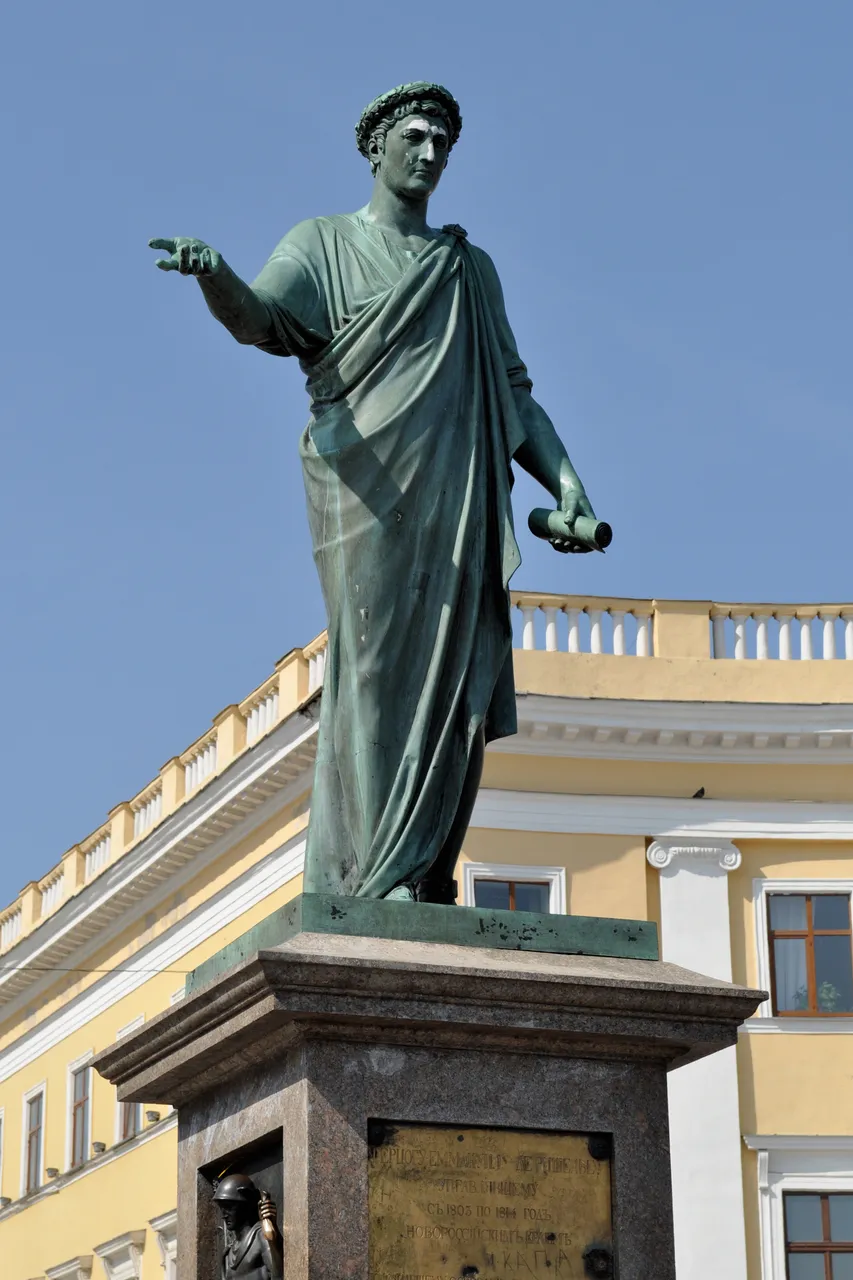
WWhy does a French aristocrat who fled the Revolution and twice served as France's prime minister now gaze over Odesa, Ukraine, a port he never legally founded? The bronze Duc de Richelieu, arm tucked in a Roman toga, stands at the top of Odesa's Potemkin Stairs on Primorsky Boulevard — and locals still call him 'Our Duke' with a shrug that says family. You visit because this single statue holds Odesa's whole origin myth, its humor, its scars, and its stubborn refusal to be simplified.
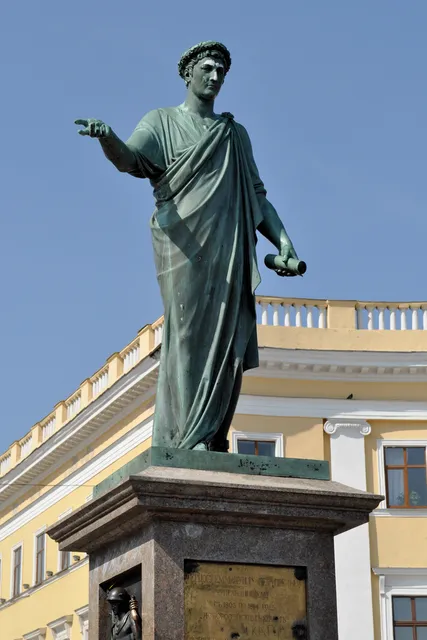
The figure is smaller than many first-time visitors expect: a Roman-toga bronze on a pink granite pedestal, one arm extended toward the harbor, the other holding a scroll. Behind and below him, the Potemkin Stairs descend toward the port in a single optical rush. Salt wind roughs the acacia leaves and gulls work the thermals along Primorsky Boulevard.
You visit because this is the place Odesa meets, mourns, and mocks itself. Volunteers buried the bronze in 6,500 sandbags in 2022 — 185 tonnes of armor against Russian missiles. Conservationists removed the bags in 2024 and found surface corrosion but no broken bones; the old abrasion from an 1854 cannonball still marks the pedestal.
🇺🇦 Odessa by Drone | 4K Drone Footage | Ukraine
ExploreTheWorld01 What to see.
The Duke of Richelieu
Potemkin Stairs
Primorsky Boulevard Loop
02 In pictures.


Plan and listen to Statue of the Duc de Richelieu in Odesa with Audiala.
Audio guide in your pocket, itinerary in your browser. Built for the way you actually visit.
03 Visitor logistics.
The practical scaffolding for a good visit — kept short.
Getting There
Walk 5–8 minutes east from Derybasivska Street or 4–5 minutes from the Opera House along Lanzheronivska Street to Primorsky Boulevard. The Odesa funicular connects the port level below directly to the top landing beside the statue; buses and marshrutkas stop on Lanzheronivska, Preobrazhenska, or Derybasivska.
Opening Hours
As of 2026, the outdoor monument on pedestrian Primorsky Boulevard is accessible 24/7, 365 days a year. Odesa's martial law curfew, usually midnight to 05:00, still applies. During air-raid sirens, leave the open boulevard for the nearest civil defense shelter.
Time Needed
Allow 10–15 minutes for the statue, its three bronze bas-reliefs, and the view down the 192 Potemkin Stairs. For a fuller loop along Primorsky Boulevard to Vorontsov Palace and back via the funicular or staircase, give yourself 45–60 minutes.
Accessibility
The top of Primorsky Boulevard is broad, paved, and step-free, with ramps from the historic center. The 192 steps below are not wheelchair accessible; use the adjacent funicular from Prymorska Street to reach the statue without stairs.
Cost & Tickets
Entry is free, with no tickets, reservations, or permits required to view the statue or walk the boulevard as of 2026. Free walking tours often meet here, but private guided tours are available through local operators.
04 Tips for visitors.
Small things that change the day.
Find the second manhole
Stand on the second manhole cover left of the statue, facing the port, and look at the Duke's scroll. Locals have treasured the resulting visual joke for generations.
Rub Mercury's money bag
On the pedestal's bas-reliefs, find Mercury holding a bag of money and rub it—Odesites claim it brings financial luck and exam success. The bronze is visibly worn from generations of students.
Beware the photo touts
Handlers with pigeons, doves, or imperial costumes will place props on your shoulders, then demand 200–500 UAH for the photo. Politely decline and keep walking past the top landing, especially on weekends.
Order forshmak nearby
Skip harbor kiosks and try forshmak (herring spread on rye) at Maman on Derybasivska, or splurge on Bernardazzi's wine list in the Philharmonic courtyard. Casual coffee kiosks along the boulevard work for a quick filter brew.
Ride the funicular down
Walk down the 192 Potemkin Stairs for the view, then take the funicular back up to save your legs; it runs from Prymorska Street to the statue in about a minute. Come early or near sunset to avoid midday crowds.
Keep lens discipline
Handheld photos of the statue are fine, but do not photograph port defenses, naval vessels, checkpoints, or military personnel from the boulevard. Drones are banned across Odesa under martial law.
05 A Bronze Thank-You Note
Odesa's most beloved monument isn't really about empire. Armand-Emmanuel du Plessis, 5th Duke of Richelieu, ran this port from 1803 to 1814, built the harbor, planted acacias, and walked unflinchingly into plague wards. When he died in Paris in 1822, the city refused to let him go.
A Frenchman Who Didn't Found Odesa
Walk the plane trees of Primorsky Boulevard and guidebooks will tell you Richelieu founded Odesa. The bronze figure in a Roman toga holds a scroll toward the harbor like a man taking his city's pulse. The pose reads imperial, a single man credited with a whole port.
Except Odesa already existed. Catherine the Great's engineers laid the grid in 1794, nine years before Richelieu took the governor's post. And when he died in Paris in 1822, he was not here to see it. Count Louis Alexandre Andrault de Langeron, his successor and old friend, staked his political reputation on a risky question: would ordinary Odesites pay for a statue to a foreigner who had gone home?
Records show the gamble paid in kopecks, not imperial rubles. Aristocrats gave, but so did Greek and Jewish grain merchants, Italian dock foremen, and day laborers. Ivan Martos cast the bronze in St. Petersburg; Viktor Skarzhinsky supplied the giant blocks of polished pink granite from his Southern Bug estates. On 22 April 1828, the canvas dropped before a crowd speaking every language of the port.
A second turning point came in the 1920s. Bolsheviks ordered tsarist monuments removed, then checked the subscription ledgers and found no treasury money. So the Duke stayed. Look again at the pedestal: Themis has no blindfold. This is not a claim of power; it is a thank-you note.
The Cannonball That Stayed
Six Thousand Sandbags
Listen to the full story in the app
The whole Statue of the Duc de Richelieu in Odesa,
told well.
Listen to sourced travel stories with local history and practical context — ready offline.
06 Frequently asked.
The questions travellers send us most about Statue of the Duc de Richelieu in Odesa.
Is the Duke de Richelieu statue in Odesa worth visiting?
Yes—this is Odesa's unofficial compass and the quickest way to understand the city's self-image. The bronze Duke stands at the top of the 192 Potemkin Stairs, framed by twin neoclassical colonnades and a working port view. Come for the sea air and the cannonball still lodged in the pedestal from the 1854 Crimean War bombardment.
How long do you need at the Duke de Richelieu statue in Odesa?
Allow 10–15 minutes for the statue itself, longer if you inspect the three bronze bas-reliefs and hunt for the embedded cannonball. The semi-circular plaza and Potemkin Stairs pull you outward, so budget 45–60 minutes with a slow walk along Primorsky Boulevard.
How do I get to the Duke de Richelieu statue from central Odesa?
From Derybasivska Street or City Garden, walk east down Havanna or Lanzheronivska Street for 5–8 minutes and the statue appears where Primorsky Boulevard opens to the sea. Coming from the port level, ride the funicular up alongside the Potemkin Stairs—about one minute and far easier than climbing 192 steps.
Can you visit the Duke de Richelieu statue in Odesa for free?
Yes. It is an outdoor monument on a pedestrian promenade with no tickets, reservations, or gates. Casual photos are allowed, but keep your lens away from port infrastructure and military positions under martial law.
What should I not miss at the Duke de Richelieu statue?
Look for the rusted iron cannonball patching the sea-facing pedestal corner—it marks an Anglo-French shell strike from April 10, 1854. Then rub Mercury's coin bag on the Trade relief; locals have polished it to a shine for luck in business and exams. Walk about 15 paces left of the Duke and glance back for the infamous manhole-cover optical joke, if you enjoy Odesa's irreverent humor.
What is the best time to visit the Duke de Richelieu statue?
Go at golden hour; low sun turns the bronze a deep olive against the Black Sea and flattens shadows across the granite. May evenings add acacia blooms and buskers, but check curfew timing—Odesa currently observes nighttime martial-law restrictions, often midnight to 05:00.
Why was the Duke de Richelieu statue in Odesa covered in sandbags?
Odesa wrapped the monument in roughly 6,500 sandbags after Russia's 2022 full-scale invasion to shield it from missile fire and shrapnel. Workers removed the damp, corrosive covering in August 2024; inspectors found no severe fractures but are designing a ventilated protective structure.
Verified, and shown.
Researched and written by the Audiala editorial team from historical records, architectural archives, and local expertise.
World Heritage status and danger listing for the Historic Centre of Odesa, the core zone containing the monument.
Official city description of the Duke's role as governor and the monument's location.
Construction dates, sculptor Ivan Martos, foundation time capsule, and pedestal inscription discrepancy.
Unveiling ceremony, Crimean War cannonball patch, and local folklore about the statue.
Details on the 1854 bombardment damage, the unblindfolded Themis relief, and the noontime cannon tradition.
Wartime sandbag protection of the monument after the 2022 Russian invasion.
Inspection findings after the protective covering was removed, noting no significant damage.
Removal of the sandbag protection and the monument's symbolic role during wartime.
Free access, 24/7 availability, Potemkin Stairs logistics, and nearby transport options.
Biography of Richelieu and background on the monument's creation and unveiling.
Built from cited sources · see the method · How we make our guides →