Place
Ukraine Updated Apr 2026
Salt, diesel, and acacia hang in the air above the Black Sea, and then Odesa, Ukraine, begins to explain itself. The city feels theatrical from the first climb: a planned 19th-century port spread across a bluff, with broad streets, pale façades, and the sea flashing between them. Even the famous Potemkin Stairs play tricks on your eyes, stretching and narrowing like stage scenery built by someone who understood drama.
 Photo: Natanaval, Haidamac, Posterrr, Brizhnichenko, J budissin, Alex Levitsky & Dmitry Shamatazhi · CC BY-SA 4.0
Built from cited sources · see the method · How we make our guides →
Odesa rewards walkers more than checklist collectors. UNESCO inscribed the historic center on January 25, 2023, and what matters here is less one monument than the ensemble: Prymorskyi Boulevard above the port, the Opera's gilded interior, courtyards hidden behind sober facades, and that constant drop from upper city to harbor. Stand still for a minute on a bench by the boulevard. The city does the rest.
The city's character comes from mixture rather than purity. Trade pulled Ukrainians, Jews, Greeks, Bulgarians, Armenians, Italians, and others into the same streets, and you still taste that in forshmak, fried Black Sea fish, tomatoes with brynza, and the market salt of Pryvoz, where fish scales catch the light and vendors talk as if every sale might become a joke. Odesa's famous humor is real, but it sits on top of something harder: a port city's instinct for survival.
Beauty here is never just decorative. The current Opera rose between 1884 and 1887 after the first city theatre burned in 1873, and the whole center now carries the added weight of wartime damage, repairs, and watchfulness. That changes the way you see the colonnades and balconies. Odesa stops being a pretty backdrop and becomes a lived argument about why cities matter.
Not every monument, just the ones we'd walk you past ourselves.
Where to wander, by quarter — each with its own rhythm.
Before you go
From a windswept Black Sea anchorage to a city still defending its memory under fire
Most scholars date the first Greek trading presence on this stretch of coast to the mid-6th century BCE. They came for grain, fish, and a workable harbor, leaving behind the oldest layer in Odesa's habit of facing outward. The sea made the argument early.
The first documentary mention of the port appears in 1415, when a chronicle records grain being shipped from Kotsiubiyiv, later known as Khadjibey, toward Constantinople. That single line matters because it shows the place already doing what it would do for centuries: turning steppe harvests into maritime wealth.
By the late 15th century, Ottoman control had reached this shore, pulling Khadjibey into the empire's Black Sea system. The settlement remained small, more frontier outpost than grand port, with wind, salt, and military caution shaping daily life.
Ottoman authorities built the fortress known as Yeni Dunya to hold this exposed coast more firmly. Stone walls and gun positions changed the bluff above the water into a military hinge. A city was not here yet. The strategic logic was.
During the Russo-Turkish War, Russian forces captured the fortress and the settlement around it. Cannon smoke cleared, and the future of the bay shifted northward toward St. Petersburg's imperial plans. Odesa begins, in part, as a spoil of war.
Catherine II decreed the foundation of a naval harbor and trading city here in 1794, giving imperial policy a street address on the Black Sea. The site was chosen for depth, exposure, and ambition. Grain would pay for much of what followed.
Work began on the Transfiguration Cathedral almost at once, because new empires like to build in stone before memory catches up. Bells, scaffolding, and lime dust announced that this was meant to be more than a port. It was meant to look permanent.
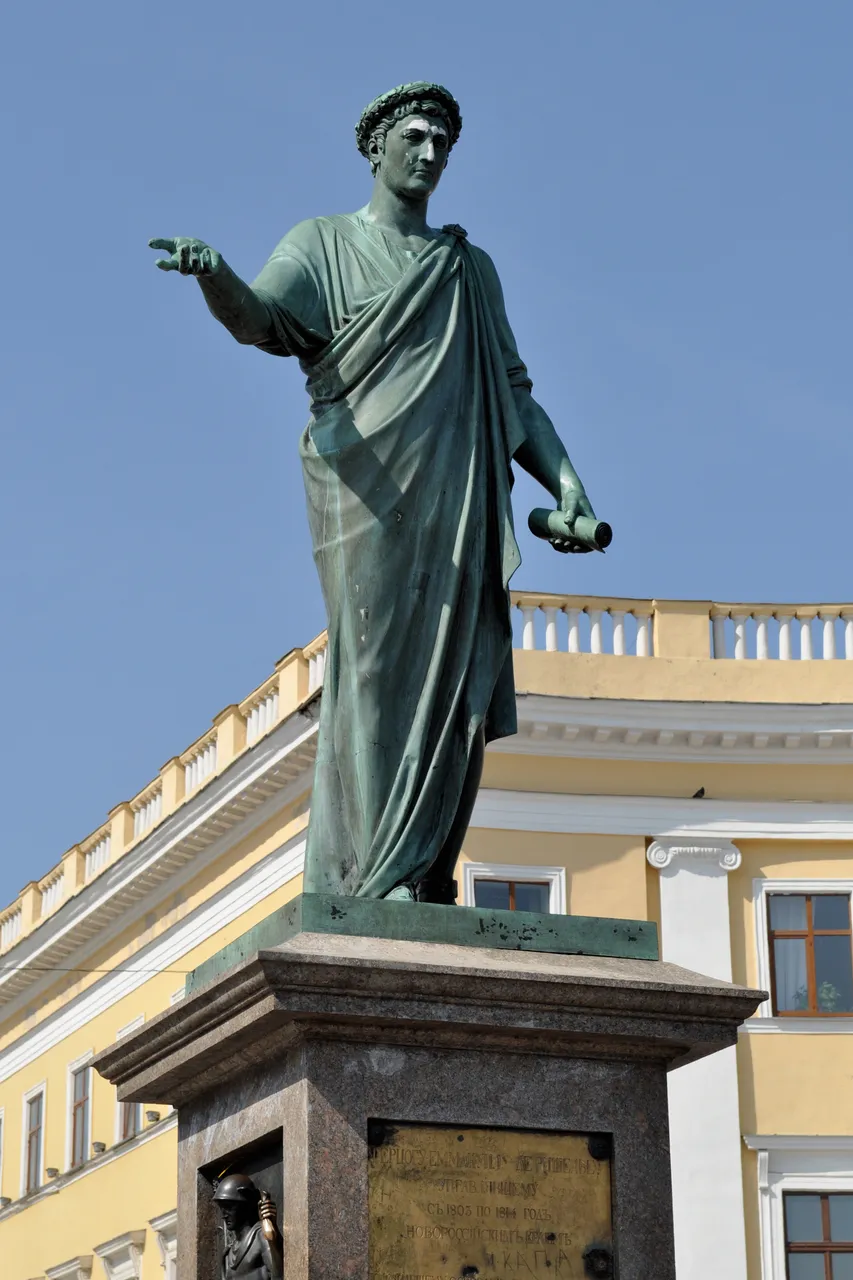
Armand-Emmanuel du Plessis, Duke de Richelieu, arrived as governor and turned a raw imperial project into a functioning city. He pushed streets, sanitation, port works, and administration with the brisk logic of a man who knew mud could ruin a grand plan. Odesa still keeps his bronze figure above the sea for a reason.
Free-port status transformed Odesa from promising outpost into a commercial magnet. Greeks, Jews, Italians, French, Armenians, Germans, and others came for lower duties and faster money, bringing languages, recipes, prayer houses, and rivalries with them. The city began to sound like a crowded quay.
Alexander Pushkin spent part of his southern exile in Odesa, where the port's flirtatious, polyglot energy suited him better than official discipline did. He watched the sea, fell into scandal, and wrote under skies far brighter than St. Petersburg's. Odesa entered literature early, and with style.
The city's first major monument, the Duke de Richelieu statue, was unveiled above the escarpment. It crowned what is now Primorskyi Boulevard with a statesman in Roman drapery, a touch theatrical and perfectly Odessan. The pose says empire. The placement says port.
The great staircase, later known as the Potemkin Stairs, tied the city plateau to the harbor below in 192 broad steps. From the bottom, the flights seem endless; from the top, they narrow into geometry and light. Odesa understood stagecraft in stone.
The Odesa-Balta railway linked the port more tightly to the grain-rich interior. Wheat that once crawled south in carts now arrived in heavier, faster streams, and the harbor's smell of tar and salt mixed with chaff and engine smoke. Trade moved at a new tempo.
Ze'ev Jabotinsky was born in Odesa into the charged, argumentative world of its Jewish community. Journalism, politics, and sharp urban wit shaped him before Zionism did. The city taught him something lasting: words can organize people as effectively as armies.
After the first opera house burned, Viennese architects Ferdinand Fellner and Hermann Helmer gave Odesa a new theater in 1887. Gilded interiors, plush acoustics, and a façade full of curves announced that this was a port city with expensive taste. Even the staircases seem to enter on cue.
Isaac Babel was born in Odesa and carried the city's Jewish districts, gang legends, and hard comedy into modern literature. His Odesa is never postcard pretty; it smells of dust, horse sweat, and danger. That's why it lasts on the page.
The year of revolution hit Odesa with sailors' revolt, strikes, and murderous anti-Jewish violence. The Battleship Potemkin mutiny turned the harbor into political theater, while pogroms revealed how thin urban civility could become under pressure. One city held both myth and horror at once.
Odesa Film Studio emerged in the turbulence after empire, helping turn the city into one of the region's early cinematic centers. A place already built on stairs, façades, fog, and sudden light hardly needed lessons in visual drama. The camera simply caught up.
Sergei Eisenstein's "Battleship Potemkin" gave the staircase an afterlife that no architect could have planned. The baby carriage sequence fixed Odesa in world cinema, even for people who knew nothing else about the city. Film turned masonry into myth.
Axis forces besieged Odesa for 73 days before the city fell in October 1941. Under Romanian occupation, tens of thousands of Jews were shot, burned, deported, or left to die in Transnistria; the October massacres remain one of the darkest chapters in the city's history. The port became a killing ground.
Soviet troops retook Odesa on 10 April 1944. Liberation ended occupation, but not grief; whole communities had vanished, and the familiar streets now carried absences as plainly as tram wires. Reconstruction began among ash, broken masonry, and names no one could answer to.
Odesa received the title of Hero City, folding wartime endurance into the Soviet cult of sacrifice and victory. The honor was real, but selective: public memory celebrated defense while often muffling the city's Jewish dead and its complicated occupation years. Monuments spoke. Silence did too.
With Ukrainian independence, Odesa passed out of the Soviet state and into a harder, more improvisational era. Port wealth, smuggling routes, private money, and civic reinvention collided in the 1990s. The city remained multilingual, funny, and wary.
On 2 May 2014, clashes between pro-Ukrainian and pro-Russian groups ended in a deadly fire at the Trade Unions Building, killing 48 people. Soot blackened the façade; mistrust blackened politics long after. Modern Odesa cannot be understood without that wound.
Russia's full-scale invasion turned Odesa back into a frontline city, with missile strikes, drone attacks, naval threat, and repeated pressure on its port. Sirens now cut across opera façades and courtyard laundry lines alike. History here has a bad habit of returning armed.
UNESCO inscribed the historic center of Odesa on the World Heritage List and, at the same time, on the List of World Heritage in Danger. The decision recognized what locals already knew: these stairways, courtyards, cathedrals, and theaters are not backdrop. They are the argument.
Poet · 1889–1966
Born here
Anna Akhmatova entered the world in Odesa before becoming one of the defining poetic voices of the 20th century. She would probably recognize the city's habit of hiding pain behind elegance; Odesa has always known how to keep its posture while the weather turns.
Physicist and cosmologist · 1904–1968
Born here
George Gamow was born in Odesa, a city that trained people to think beyond the horizon because the horizon was always right there. The port's appetite for distance suits a man who helped explain the birth of the universe rather well.
Violinist · 1908–1974
Born here
David Oistrakh was born in Odesa and later studied in its conservatory world, where technique mattered but tone mattered more. Stand outside the opera house before a performance and you can still imagine the city teaching a musician how to turn discipline into warmth.
Writer and political thinker · 1880–1940
Born here
Ze'ev Jabotinsky grew up in Odesa's multilingual, argumentative port atmosphere, which helps explain the steel in his politics and the polish in his prose. A city of traders, editors, and debaters rarely produces quiet ideologues.
Pianist · 1916–1985
Born here
Emil Gilels was born in Odesa and studied in the city's musical institutions before carrying that authority onto the world's great stages. Odesa likes virtuosity with backbone; Gilels fit the type perfectly.
Rocket engineer · 1908–1989
Born here
Valentin Glushko, one of the central engineers of Soviet rocketry, began in Odesa far from any launchpad. Then again, ports and space programs share a habit of turning maps into invitations.
Bacteriologist and immunologist · 1860–1930
Born here
Waldemar Haffkine was born in Odesa before developing vaccines against cholera and plague, work that saved lives on a scale few city guides can measure. A trading port knew disease intimately; his career feels like one answer to that fact.
Footballer · born 1960
Born here
Igor Belanov was born in Odesa and rose from the city's sporting culture to international football fame. He belongs to another side of Odesa's character: less salon wit, more raw acceleration.
Where locals actually book dinner — not the tourist menus.
This old Jewish-Odesa staple turns salted herring into something softer and slyer, usually mixed with apple, onion, and butter until it becomes a spread with bite. Order it with black bread and a shot of something cold. It tastes like the port city Odesa used to be.
Mussels show up all over Odesa menus for a reason: they carry the sea better than any postcard does. Look for them steamed with garlic and herbs or cooked in a light broth you will finish with bread whether you planned to or not.
Rapana, a predatory sea snail from the Black Sea, is one of those dishes that sounds dubious until the first bite. Chewy, saline, slightly sweet, it usually appears grilled, fried, or sliced into salads with enough lemon to wake everything up.
At Pryvoz Market, fried gobies, sprats, and whatever came in that morning offer the city in its bluntest form: hot oil, paper plates, sea salt, no ceremony. Eat standing up if you can. That feels right.
Odesa's version of eggplant caviar leans smoky, garlicky, and just rough enough to remind you somebody made it by hand, not by factory. It appears as a starter in homes and old-school restaurants, especially in late summer when the vegetables actually taste alive.
The region around Odesa feeds the city as much as the sea does, and placinta proves it: flaky dough wrapped around cheese, potato, cabbage, or pumpkin. Buy one hot and you understand why borderlands make better comfort food than empires.
Borscht in Odesa often arrives darker, sweeter, and more fragrant with dill than visitors expect, sometimes paired with fish nearby rather than treated as a stand-alone national symbol. Add sour cream, tear off bread, and stop analyzing.
Drinking in Odesa should include the region, not just the city, which is why local lists often point toward Shabo wines and Shustov cognac. One gives you the steppe and the limestone cellars; the other gives you 19th-century industry dressed as refinement.
Small things that change how the city treats you.
Yes, if you want a Black Sea port city with wit, opera-house grandeur, market life, and a street culture that feels different from inland Ukraine. Odesa's pull comes from contrast: aristocratic facades above the port, fish stalls a tram ride away, and a humor tradition so strong the city built a festival around April 1.
Three to four days is the sweet spot. That gives you time for the old center, the opera, Pryvoz, at least one museum, and either the catacombs or a seafront evening without racing from sight to sight.
Conditions can change quickly, so check local alerts and confirm plans day by day. The most immediate visitor issues are practical ones: changing opening hours under wartime conditions and the need to use official guided tours in the catacombs.
The historic center is best on foot, especially around Deribasivska, City Garden, Primorsky Boulevard, and the Potemkin Stairs. Save taxis for longer hops such as Arcadia or outer districts, and group nearby sights so you are not zigzagging across town.
Late spring to early autumn works best, with May to September giving you long evenings and seafront weather. April has Humorina around April 1, while late summer and early autumn usually bring the city's film and jazz rhythm, though formats can shift.
No, it can be done on a moderate budget if you mix market eating with one or two bigger nights out. Opera gallery tickets can start around 100 UAH, and a day built around coffee, Pryvoz, and casual local food costs far less than chasing upscale terraces.
Start with forshmak, black bread, and one Black Sea fish dish. Tyulka, fried gobies, mussels, fish soup, eggplant spread, and market tomatoes tell you more about Odesa than a generic plate of 'Ukrainian cuisine' ever will.
Yes, and you should treat that as non-negotiable. The network is vast, confusing, and low in places, so official guided entry is the normal and sensible way to see it.
Saved and recently read places — kept on this device only.
Photos may have been resized or cropped.