Place
Ukraine Updated Apr 2026
The first thing you notice in Lviv is the coffee that arrives unbidden—tiny porcelain cups materializing on café tables the moment you sit down, as if the city itself is testing whether you understand ritual. Ukraine's westernmost major city doesn't ask for attention; it assumes you're already paying it. Cobblestones echo differently here, softer somehow, worn smooth by five centuries of Habsburg boots, Polish processions, and Soviet soldiers who never quite left the shadows.
 Photo: Yusuf Cap / Pexels
Built from cited sources · see the method · How we make our guides →
This is a city where architecture argues with itself in the best possible way. Gothic spires needle upward beside Baroque curves that somehow survived both world wars. The Armenian cathedral's 14th-century frescoes share a street with a coffeehouse that roasts beans in the same cast-iron drum since 1829. Even the air tastes layered: woodsmoke from basement restaurants, yeast from basement bakeries, something metallic that might be tram tracks or might be history.
What makes Lviv disorienting isn't that it's beautiful—everyone expects that—but that it's honest about its contradictions. The opera house gleams white and gold while around the corner, bullet holes from 1918 pockmark a brick wall like acne scars. Students spill out of universities founded in 1661, talking on phones while stepping over 700-year-old stones. The city survived Mongol sieges, Nazi occupation, and Soviet planners who wanted to flatten the center for wider streets. They failed. The streets remain medieval-narrow, forcing you to walk like people did before cars, before certainty.
Come here for the coffee that predates Vienna's, for the beer brewed by monks who never quite followed Rome's rules, for cemeteries where marble angels weep over Ukrainian poets and Polish generals with equal conviction. But mostly come because Lviv understands something most cities forgot: memory isn't a museum piece to display, but a conversation you're invited to join mid-sentence.
Not every monument, just the ones we'd walk you past ourselves.




Where to wander, by quarter — each with its own rhythm.
Before you go
From Ruthenian fortress to modern Ukrainian heart
King Danylo Romanovych plants a wooden fortress on a hill above the Poltva River and names it for his son Lev. The walls rise where trade routes from the Black Sea meet northern forests. Within a decade, Magdeburg rights arrive, turning a military outpost into a town with self-rule and Thursday markets.
Casimir the Great's knights batter the wooden ramparts with catapults until the Ruthenian garrison surrenders. The king rebuilds in stone, imports German artisans, and grants the first Polish municipal charter. Lviv becomes Leopolis—Latin for 'lion city'—and begins its centuries as a border fortress of Latin Christianity.
Merchants escaping Mongol raids in Crimea lay the first stone of their cathedral on Virmenska Street. The pointed arches and carved khachkars make it the oldest Armenian church north of the Caucasus. Their scriptorium becomes the city's first printing house, turning Lviv into a bridge between Constantinople and Kraków.
A baker's oven ignites a city of timber. Two-thirds of Lviv vanishes in a single night, including the town archives. Survivors rebuild in brick and stone, creating the tight maze of pastel houses that still frames Rynok Square.
The Muscovite exile Fedorov drags a wooden printing press over the Carpathians and sets up shop on today's Stavropihijska Street. His Slavonic *Apostolos* becomes the first dated book printed in Ukraine. The press still stands—its courtyard smells of ink and damp stone.
Bohdan Khmelnytsky's riders encircle the walls for six weeks. Inside, Polish nobles and Jewish refugees crowd into the cathedral crypts. The siege fails, but the city loses half its population to starvation and plague. Tombstones in Lychakiv still tilt toward the spot where the Cossacks camped.
Charles X's Protestant troops storm the Catholic citadel during the Deluge. They loot the cathedral, melt the organ pipes into cannonballs, and leave the Dominican monastery a charred shell. Lviv's golden age never fully recovers; trade routes shift north to safer Kraków.
In a townhouse on the corner of Rynok 18, the future twice-king of Poland draws first breath. The boy will grow up to marry his daughter to Louis XV and rule Lorraine from exile. Locals still point to the faded sundial where his mother once rocked the cradle of a royal pretender.
The First Partition hands Lemberg to Vienna without a shot fired. Austrian surveyors redraw maps, German becomes the language of courts, and the city loses its Magdeburg rights overnight. Baroque facades hide behind new stucco as the empire remakes the city in its own image.
Emperor Joseph II's court architect tears down the Gothic towers and wraps the medieval cathedral in swirling Baroque. Inside, gilded cherubs sprout from columns; outside, twin bell towers rise to 65 meters—high enough to rival the Town Hall. The cathedral becomes the visual anchor of every panorama postcard sold to this day.
The boy who will give the world the word 'masochism' enters life in a narrow house on Serbska Street. His novels—*Venus in Furs* set in the snow-covered Galician capital—turn private obsessions into literature. Lviv remembers him with a discreet plaque and a wink from tour guides.
A British engineer lamplighter climbs the Town Hall tower at dusk and strikes the first match. Forty cast-iron lanterns cast a sickly yellow glow over cobblestones where merchants once haggled by torchlight. The city that never slept now stays awake under imperial light.
Students tear down the double-headed eagle from the town hall and raise the blue-and-yellow flag of a hoped-for Ruthenian republic. Habsburg artillery shatters the barricades on Svobody Avenue; 27 bodies lie in the square. The uprising collapses, but the memory of a Ukrainian Lviv smolders for seventy years.
The first locomotive whistles into Lviv from Przemyśl, shrinking the journey to Vienna from weeks to hours. Brick warehouses sprout around the new terminal; wheat from Podolian estates pours into European markets. Overnight, Lemberg becomes a provincial capital instead of a border fortress.
Neo-Renaissance facades, gilded velvet, and Hedy Fürstenberg's voice in *La Traviata*—all for the price of a loaf of bread. The house seats a thousand under ceiling frescoes of Slavic pagan gods disguised as muses. It's still the one place where Poles, Ukrainians, and Jews applaud the same high C.
In a tenement on St. Nicholas Street, the mind that will invent Banach spaces and rewrite functional analysis takes its first breath. Decades later he scribbles theorems on marble tabletops in the Scottish Café while air-raid sirens wail outside. Lviv's mathematicians still order coffee 'the Banach way'—black, no sugar, infinite refills.
Sparks fly as copper overhead lines replace leather reins. The first bright-yellow tram clangs from the rail yard to the university, carrying students past cafés where Polish poets argue with Ukrainian journalists. Horse manure disappears from Svobody Avenue; progress smells like ozone and hot brakes.
Russian shells arc over the 19th-century citadel, turning Ivan Franko Park into a moonscape. The Austrians evacuate archives westward; the tsar's censor bans the Ukrainian word for 'Ukraine'. After nine months the front moves east, leaving shattered ramparts that teenagers now use for summer picnics.
At 4 a.m. the blue-and-yellow flag rises over the opera house. The declaration lasts three weeks before Polish legions retake the city in a street-by-street fight. Bullet holes still pockmark the façade of the Dominican church; tour guides run fingers across the scars and count the calibers.
In a flat smelling of iodine and printer's ink, the boy who will write *Solaris* and sell 30 million books opens his eyes to a city of trams and pogrom rumors. His earliest memory: the clatter of cavalry boots on cobblestones during the Polish-Soviet war. Decades later he sets a novel on a distant planet that looks suspiciously like pre-war Lwów.
Tank treads grind past the opera house while NKVD officers sip tea in the Grand Hotel. Polish professors vanish from lecture halls; their lecture notes reappear in Soviet archives labeled 'evidence of bourgeois nationalism'. The city becomes Lvov again, and the first deportation trains leave at dawn.
Wehrmacht motorcycles roar into Rynok as German soldiers photograph the intact medieval core. Within days the Gestapo orders Jews to stitch yellow stars; the ghetto walls rise along the old canal. By war's end 120,000 of Lviv's Jews have vanished into Belzec and bullets in the forest.
Soviet artillery pounds the High Castle ruins; German sappers blow the railway bridges. When the smoke clears, Lviv's population is half what it was in 1939. The city emerges renamed once more, this time in Russian: Львов. Street signs change overnight; so do the textbooks.
The soprano who saved Puccini's *Butterfly* dies in her apartment overlooking the opera house she once commanded. Mourners queue around the block to file past the open coffin; her voice echoes from a scratchy Soviet recording played on a portable gramophone. They bury her in Lychakiv under a marble lyre.
On August 24 the blue-and-yellow flag returns to the town hall for the first time since 1918. Students pull down the Lenin statue on Svobody Avenue with a streetcar cable; the bronze head rolls into the fountain. The city signs read Lviv again, and passport stamps change from USSR to Україна.
Half a million people pack Rynok in freezing November, waving orange flags and camping in pup tents. The smell of kerosene heaters mingles with coffee from 24-hour vendors. After twelve days the Supreme Court orders a re-vote; democracy tastes like hot borscht served from plastic cups.
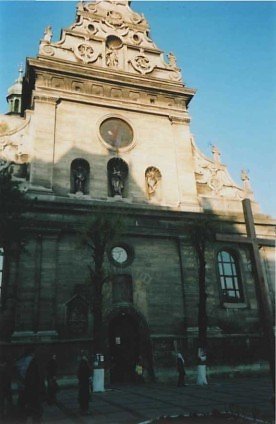
German engineers rip up Soviet-era asphalt around the stadium and lay glass-sided tram tracks. The airport gets a transparent roof; medieval cellars become craft-beer bars. For one summer the city smells of fresh paint and hope as Dutch fans sing on the steps of the Bernardine church.
Air-raid sirens replace church bells. Sandbags rise two meters high around the Boim Chapel; stained-glass windows wear plywood vests. Trains heading west carry grandmothers and laptops; those arriving bring volunteers, generators, and the displaced. The opera house projects a blue-and-yellow spotlight onto passing clouds.
Mathematician · 1892–1945
Lived, worked and died here
He turned the Scottish Café into the world’s most famous maths canteen, scribbling theorems on marble tabletops. Today the café is gone, but the bench outside still carries a plaque—locals like to say the equations are in the coffee stains if you know where to look.
Science-fiction writer · 1921–2006
Born here
The boy who watched Austro-Hungarian trams become Soviet tanks later sent spaceships to imaginary oceans. Walk past 4 Karpacka Street: the house is plain, yet every other balcony in Lviv still feels like a launchpad for Solaris.
Opera soprano · 1872–1952
Born nearby, died and buried here
Her voice rescued Puccini’s Madama Butterfly at La Scala; her return to Lviv was quieter, teaching in a third-floor flat whose windows rattle when the opera house organ rehearses across town. Buy a ticket—acoustics designed for her still make glass tremble.
Poet & linguist · 1856–1916
Lived and died here
He rewrote Ukrainian grammar between tram shifts and court appearances for socialist agitation. The university that now bears his name stands one block from the prison where he spent nights; students pass both without noticing the irony.
Biologist · 1883–1957
Career based here
In a wartime lab on Św. Teodora Square he bred lice to make the first typhus vaccine, hiring Jewish scholars to keep them alive. The building is still a microbiology institute—peek through the gate and you’ll see the original ventilation chimneys.
Writer · 1836–1895
Born here
He set Venus in Furs in these streets, giving the world the term masochism. The house on Serbska 7 is now a vanilla apartment block; the cellar bar next door sells fur-lined handcuffs as souvenir shot glasses—subtlety was never Lviv’s strong suit.
Where locals actually book dinner — not the tourist menus.
Small things that change how the city treats you.
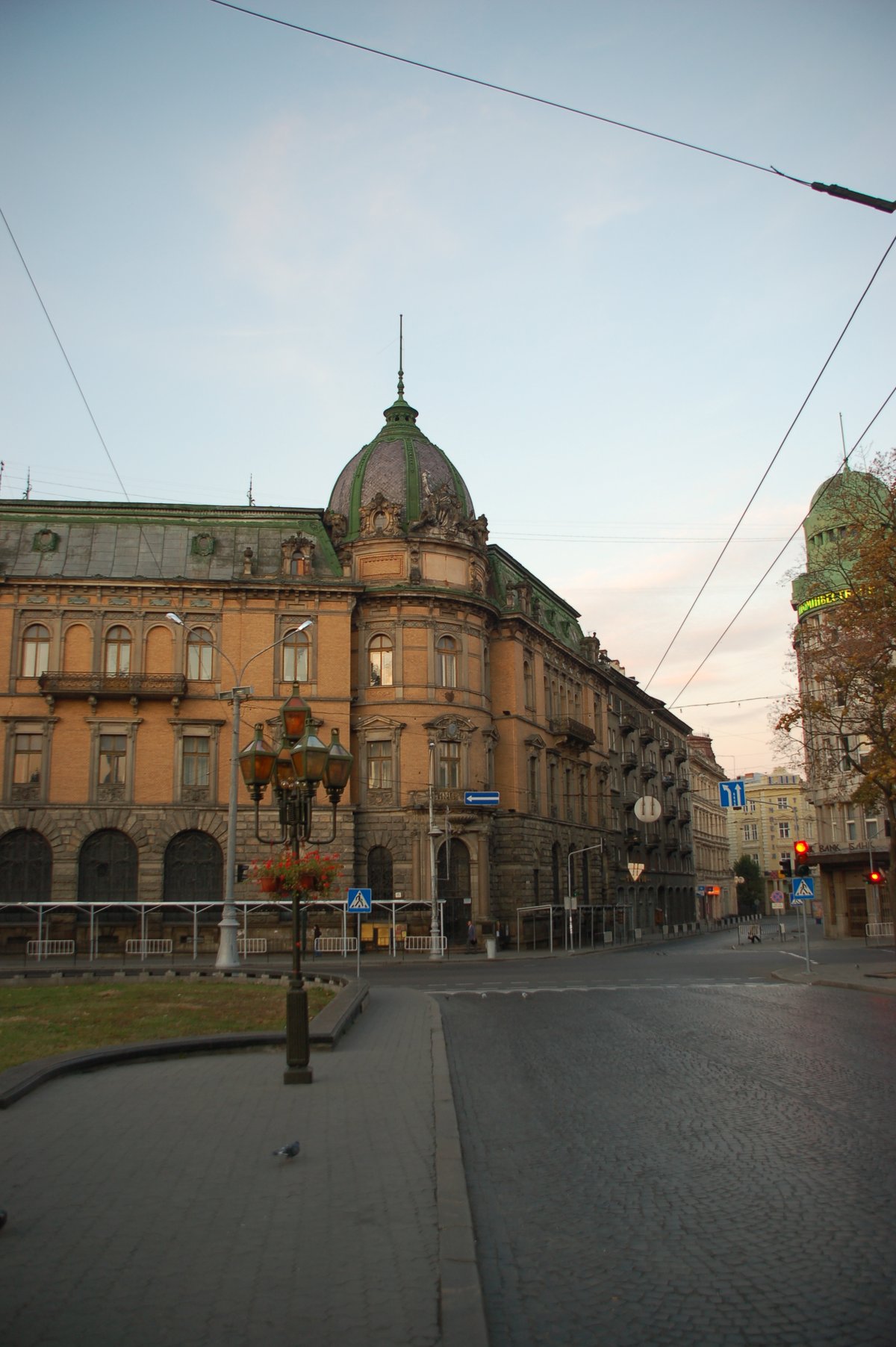
The city, as it actually looks.


Yes, if you accept the risks. The old town is intact, museums stay open between alerts, and cafés keep serving 24-hour coffee—yet air-raid sirens, nightly curfew and closed airspace mean you must plan like a resident, not a tourist.
Three full days covers the centre, Lychakiv cemetery and Shevchenkivskyi Hai open-air museum. Add a fourth if you want day-trips to castles or the Carpathian foothills.
No commercial flights land—the airport is shut until insurers agree war-risk cover. Enter overland: nightly sleeper from Warsaw (8 hrs) or daytime buses from Przemyśl, Kraków, Budapest.
Only before curfew. Streets are well-lit and violent crime is low, but after 23:00 only police and soldiers remain—civilians risk ID checks or fines.
They understand it, but Ukrainian is the default since 2022. Start with ‘Dobryi den’ and switch to English; Russian can feel tone-deaf here.
Expect 60–90 UAH (≈1.5–2 USD) for an espresso and croissant in the centre—half Kyiv prices and still absurdly cheap by European standards.
171 places to discover










Showing 1–48 of 171 places
Saved and recently read places — kept on this device only.
Photos may have been resized or cropped.