
Place
Turkey Updated Jul 2026
Salt hangs in the air even this far inland, and by sunset the light off Lake Van turns the old fortress rock the color of baked apricots. Van, Turkey, lives on that kind of contradiction: a high eastern city with a soda lake big enough to feel like sea, breakfast tables that begin at 4:00 a.m., and a skyline still haunted by the Urartian capital that stood here nearly 3,000 years ago.
 Photo: Buğra / Pexels
Built from cited sources · see the method · How we make our guides →
Van makes sense once you stop expecting a neat single identity. Records and archaeology tie the city to Tushpa, capital of the Urartian kingdom between the 9th and 6th centuries BC, while Akdamar's 10th-century Armenian church rises from the lake like a carved reliquary set adrift. Ottoman mosques, modern apartment blocks, ferry docks, and ancient inscriptions all share the same basin. Few cities wear their layers so openly.
Van's daily pleasures are less monumental and just as telling. Breakfast here is an institution, not a meal: herbed otlu peynir, honey thick as varnish, murtuğa rich with butter and egg, hot kete, endless tea. Then the city slows, only to gather itself again along Cumhuriyet Caddesi and the lakefront, where conversation stretches late and the evening smells of grilled pearl mullet, tobacco, and dust cooling after heat.
What stays with you is Van's scale of time. You can stand under the 100-meter rock of Van Fortress, look toward a lake so alkaline it feels almost improbable, then board a boat to an island church whose stone reliefs still catch the afternoon sun with surgical precision. The place doesn't ask for easy admiration. It asks you to notice how much can survive.
Not every monument, just the ones we'd walk you past ourselves.
Where to wander, by quarter — each with its own rhythm.
Before you go
From Urartian capital to modern eastern Anatolian crossroads
Archaeological layers around the Van Fortress mound and nearby Tilkitepe point to settlement deep in the Early Bronze Age. People chose this shore for the same reason rulers later did: fresh water, rich soil, and a rock ridge that watches the plain like a sentry that never blinks.
Sarduri I turned a sheer limestone outcrop above Lake Van into Tushpa, capital of the Urartian kingdom. His inscription still reads like a stone handshake across 28 centuries: a ruler announcing that this cliff, this water, this horizon now belonged to a state with ambition.
Massive walls, terraces, tomb chambers, and storage spaces cut into the rock transformed Tushpa from a strong point into a working capital. The fortress stretched across a ridge 1,345 meters long, and every ledge was used with almost stubborn intelligence.
Under Sarduri II, the southeastern slope of the fortress gained a formal sacred area with rock niches and inscribed stelae. Ritual, kingship, and military power stood side by side here; on windy days, you can imagine prayers and royal boasting carried over the water together.
After generations of war with Assyria and mounting regional pressure, the Urartian kingdom collapsed. Tushpa did not vanish overnight, but the royal court, the official inscriptions, and the hard-edged confidence of the Urartian state were gone.
Roman control reached the region, and Van became part of a frontier zone fought over by Rome, Parthia, and later Sasanian Persia. Border cities learn a harsh lesson early: walls matter, but so does whoever controls the road outside them.
The Abbasid commander Bugha al-Kabir brought the region more firmly into the caliphal orbit. Van's story kept changing rulers, yet the city stayed valuable for the same old reasons: grain, routes, and the lake basin that tied mountain country to wider empires.
Gagik I Artsruni emerged as king of Vaspurakan, the Armenian kingdom centered on the Lake Van basin. He used Van's geography with flair, turning island and shoreline into statements of legitimacy rather than mere refuges.
The monk-architect Manuel began shaping the Church of the Holy Cross on Akdamar Island for King Gagik. He dressed the church walls in carved saints, vines, animals, and Bible scenes, as if the stone itself had decided to start telling stories.
The Church of the Holy Cross rose on the island between 915 and 921, its compact mass crowned by a dome and wrapped in relief sculpture. Inside, lake light filters differently than city light; it softens the stone, then sharpens every carved line.
The Byzantine annexation of Vaspurakan ended Armenian royal rule around Van, and sources record the departure of thousands of Armenian families westward. A city can survive conquest. Losing so many households at once changes its voice.
After earlier raids, Seljuk power fixed itself more firmly in the Van basin in the eleventh century. Political control changed, trade routes adjusted, and the city began another long chapter as a meeting ground of Turkic, Armenian, Persian, and Islamic traditions.
By the thirteenth century, Van was part of the Seljuk world, and the old city south of the fortress developed the urban fabric that survived for centuries. Gates, mosques, churches, lanes, courtyards, and workshops pressed against one another in a tight, lived-in maze.
Timur descended on the Van basin and captured the fortress after a siege said to have lasted twenty days. The citadel endured, but frontier cities pay for every empire's ambition in smoke, emptied granaries, and hurried burials.
During Suleiman's eastern campaigns, Ottoman forces took Van Castle, though Safavid power soon returned. The episode made one fact plain: Van was no provincial afterthought but a key hinge on the Ottoman-Safavid frontier.
The Ottomans secured Van more firmly in their second campaign against the Safavids and shaped it into a frontier stronghold. Garrison life, taxation, repairs, and imperial paperwork followed the cannon smoke; empires settle in through clerks as much as soldiers.
As governor, Hüsrev Pasha sponsored a mosque complex in the age of Mimar Sinan, giving Van one of its defining Ottoman monuments. This was frontier architecture with manners: a place for prayer, study, charity, and the daily traffic of a serious city.
Modern excavations at Van Fortress began at the end of the nineteenth century and continued in the 1930s, pulling Urartian history back into view. Broken inscriptions, cut chambers, and foundation lines started speaking again, though archaeology always makes you work for the conversation.
War, siege, massacre, flight, and fire shattered the old city during the First World War. The destruction was so severe that the historic settlement was abandoned, leaving roofless walls and broken streets where an eight-century urban life had stood.
With the founding of the Republic of Turkey, Van entered a new political order and rebuilt away from the devastated old city, about 7 kilometers to the east. The move was practical, but it carried a hard truth: modern Van was born beside ruins, not on top of them.
Mustafa Kemal Atatürk sent Education Minister Mustafa Necati to examine the case for a university in Van, an idea that would take decades to become real. Even as a proposal, it mattered; a frontier city was being imagined as a place that could produce knowledge, not just defend territory.
Yüzüncü Yıl University was founded on 20 July 1982 after years of local pressure and unrealized plans. A city long described through fortresses and border wars gained lecture halls, laboratories, and a different kind of future.
After restoration in 2005 and 2006, the Church of the Holy Cross reopened as a monument museum on 29 March 2007. That return did more than repair masonry; it pulled one of Lake Van's most layered buildings back into public life.
A magnitude 7.1 earthquake struck near Van on 23 October 2011, collapsing buildings and exposing the frailty of modern construction. Ancient walls had seen sieges before, but this damage came from below, with a violence no army could command.
Tushpa, the Van Fortress mound, and the old city were added to Թուրքիայի UNESCO Tentative List in 2016, formalizing what the site had long made obvious on its own. Few places hold 5,000 years of settlement in such a compressed strip of earth between cliff and lake.
Urartian king · reigned c. 840–830 BC
Founded Tushpa as capital
Sarduri I chose this rock above Lake Van for a reason: it was defensive, theatrical, and impossible to ignore. The cuneiform inscriptions at the fortress still carry his political voice, cut into stone with the confidence of a ruler who meant the city to last.
Urartian king · reigned early 9th century BC
Commissioned the Shamran/Menua Canal near Van
Menua understood that cities survive on water as much as walls. His canal, stretching about 70 kilometers, still threads through the region's agriculture, which means part of ancient Van remains practical rather than merely picturesque.
Urartian king · reigned 8th century BC
Expanded ritual and fortress structures at Van
Sarduri II pushed Van beyond a hilltop stronghold into a more ceremonial capital, adding sacred terraces and monumental works around the citadel. He would recognize the skyline at once, even if the traffic below would puzzle him.
Achaemenid king · c. 518–465 BC
Left a trilingual inscription at Van Fortress
Xerxes did not build Van, but he made sure Persia's presence was carved into its cliff face in Old Persian, Babylonian, and Elamite. That inscription later helped scholars decipher Old Persian cuneiform, which gives Van an odd afterlife in the history of reading itself.
Where locals actually book dinner — not the tourist menus.
This is the meal Van built a reputation on: a long table of small plates rather than one heroic dish. Expect herb cheese, honey, kaymak, olives, tomatoes, cucumbers, eggs, fresh bread, preserves, and endless tea; go hungry, and don’t book an early lunch.
Van’s herb cheese is the city in edible form: sheep’s milk, salt, and local mountain herbs such as sirmo, heliz, thyme, and wild mint. The smell arrives before the taste, grassy and sharp, and it earns its place on nearly every serious breakfast table.
Butter, flour, and eggs sound plain on paper. In the pan they become rich, nutty, and unexpectedly comforting, especially with hot bread and tea while the morning is still cold.
Kavut is a toasted grain mixture, often sweetened and enriched with butter, honey, or nuts, somewhere between breakfast dish and old-fashioned comfort food. Its flavor is earthy and warm, the kind of taste that makes sense in a high-altitude city with long winters.
Keledoş is one of Van’s deeper, older dishes, built from pulses, wheat, meat, and dairy in combinations that feel designed for endurance rather than elegance. Try it when you want something local with weight and history instead of another grill plate.
These Van-style meatballs usually mix meat with fine bulgur and chickpeas, then cook in a savory sauce rather than landing on the table as a dry kebab companion. The texture is softer, fuller, and more interesting than the name suggests.
Lorik is Van’s herb-laced curd cheese, lighter than otlu peynir and often used at breakfast or alongside bread. It carries that same mountain-herb perfume, though in a gentler register.
The classic sweet ending to a Van breakfast is thick clotted cream with local honey, eaten with bread while the tea glasses keep coming. It sounds excessive. It is, and that’s partly the point.
Small things that change how the city treats you.
The city, as it actually looks.


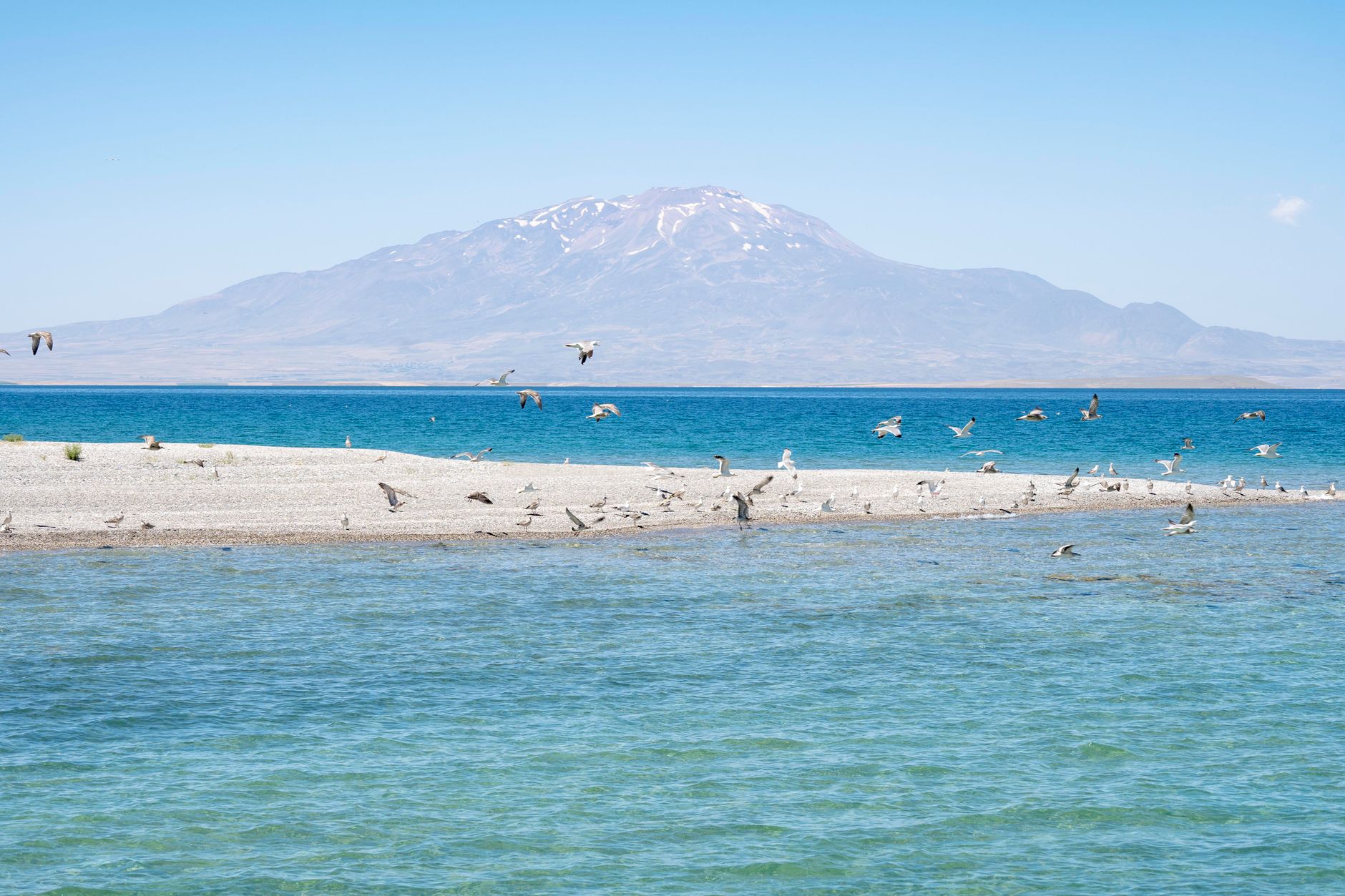
Yes, especially if you like places where history sits out in the open. Van gives you a Urartian capital on a sheer rock, a 10th-century Armenian church on an island, and Turkey's largest lake in the same frame.
Two to three days works well for most travelers. That gives you time for Van Fortress and the old city area, a boat trip to Akdamar Island, a long breakfast, and either the museum or a nature side trip such as Muradiye Waterfalls.
The cheapest option is municipal Bus 351 from outside the arrivals terminal. The ride usually takes 15 to 25 minutes and costs about 33 TRY, while taxis make the trip in around 10 to 15 minutes if traffic behaves.
First go south to Gevaş, then take a boat to the island. The church is not a casual walk-up sight from the city center, so plan the transfer and crossing as a dedicated outing.
Generally yes for standard cultural travel, with the usual big caveat that this is eastern Turkey and security presence is more visible than in Istanbul or Izmir. Keep valuables close, use registered transport, and do not photograph military areas or checkpoints.
No, Van can be fairly budget-friendly by Turkish city standards if you use local transport and eat where residents eat. Bus 351 from the airport is far cheaper than a transfer, and the city's social life runs on tea houses, breakfast salons, and straightforward local restaurants rather than polished tourist pricing.
Late spring and early autumn are the sweet spots. Late April to June and September give you milder temperatures for the fortress and lake trips, while winter can interrupt flights and make road travel harder.
Yes. Cards cover hotels, car rentals, and bigger restaurants, but cash still matters for buses, dolmuş rides, small shops, and tips.
Start with Van breakfast, which is less a meal than a tabletop performance of cheese, honey, herbed dairy, murtuğa, and pastries. Also look for inci kefali from Lake Van and regional dishes such as keledoş if you want something rooted in the local kitchen rather than the national greatest hits.
Saved and recently read places — kept on this device only.
Photos may have been resized or cropped.