Type 2+ letters to search all countries, cities, and places
/Ctrl KEsc
travel_explore
Type 2+ letters to search all countries, cities, and places
Press Enter to open the top result
Temple of Ephesian Artemis
Selçuk·Turkey·37° N · 27° E·Updated Jul 2026
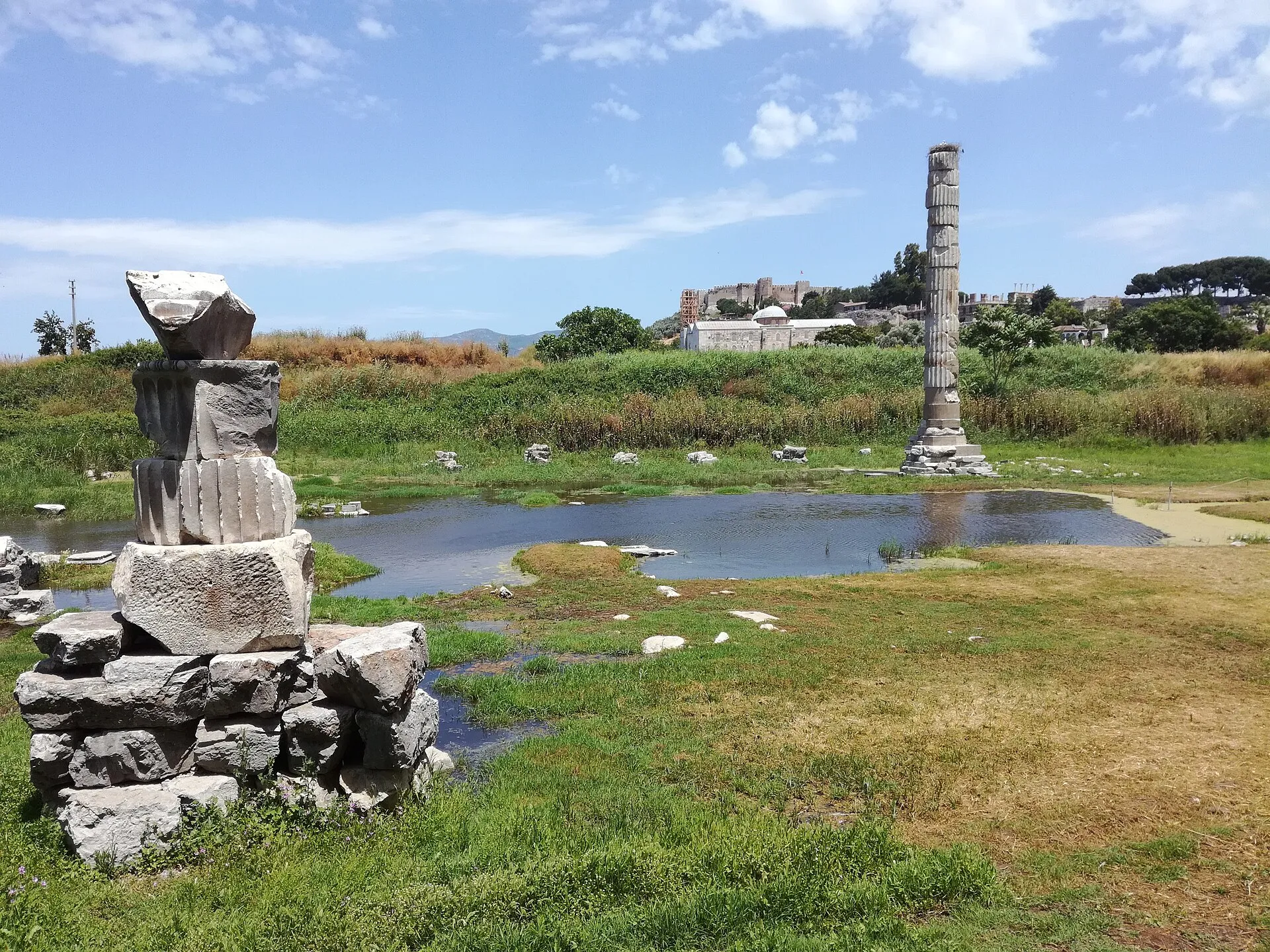
One of the Seven Wonders now survives as a lone column in a marsh, with storks overhead and Selçuk's layered skyline rising toward Ayasuluk Hill behind it.
How can one of the Seven Wonders feel almost absent? At the Temple of Ephesian Artemis in Selçuk, Turkey, you face a lonely reconstructed column rising from wet grass and reed beds, with storks overhead and Ayasuluk Hill behind, while the ground under your shoes once held a sanctuary that pulled pilgrims across the Mediterranean. Come for that shock of scale reversed: this is where a world-famous monument teaches you how history vanishes, and how a place can still feel charged after the marble is gone.
Most visitors arrive expecting grandeur and get a marsh. That is exactly why the site works. The silence, the damp air, the frogs in the waterlogged ground, the broken drums half-sunk in earth all force you to imagine the missing building instead of admiring a ruin that still does the work for you.
And the missing building was enormous. Ancient sources attribute 127 columns to the Hellenistic temple, each about 18 meters high, roughly the height of a six-storey apartment block, standing around a cult image of Artemis who looked nothing like the neat huntress of Greek postcards and much more like an Anatolian mother goddess wrapped in symbols of power and fertility.
The Temple of Ephesian Artemis also makes more sense when seen with nearby Ephesus Ancient City and the Christian monuments on Ayasuluk Hill. One field, one column, one goddess, then a basilica uphill: few places in Selçuk show so clearly how one sacred world gives way to another.
Researched by the Audiala editorial team from historical records, architectural archives, and local expertise.
What to see
The Lone Column and the Temple Beneath It
The shock of the Artemision is how little rises from the ground: one rebuilt marble column, a few scattered blocks, and a silence that feels almost insolent when you remember this was once one of the Seven Wonders. Look closer. The base under that column belongs to the later temple, with another base from an earlier phase beneath it, so a five-minute stop becomes a lesson in layered time; records and excavations tie the sanctuary here to the early first millennium BCE, while the famous marble rebuilding followed the fire of 356 BCE, and the whole lost building stretched about 115 meters by 55 meters, roughly the footprint of a modern football pitch pressed into a marsh.
The Marsh Plain and Ayasuluk Skyline
Most ruins ask you to admire what survived; this one asks you to imagine what wet ground swallowed, and that makes the setting half the monument. Stand back until the column, the reeds, Isa Bey Mosque, and the bulk of St. John’s Basilica on Ayasuluk Hill line up in the same frame, and Selçuk suddenly reads like a stack of civilizations rather than a town with old stones; in spring, storks often nest on the column from April into September, clattering their bills above the marsh while the afternoon light turns the plain silver and the whole scene starts to explain why a visit here pairs so well with Ephesus Ancient City.
Walk the Missing Wonder
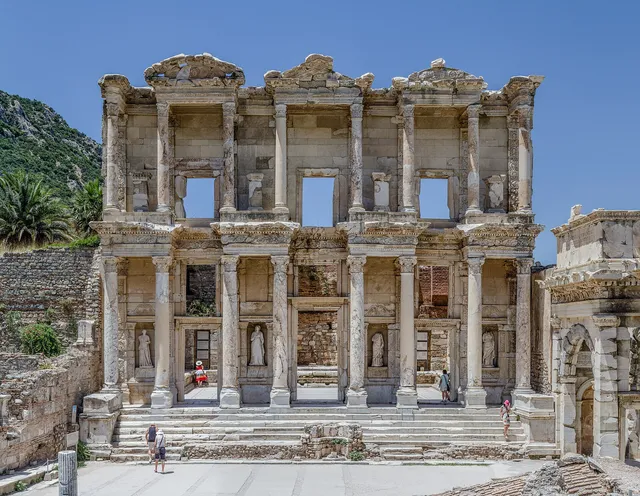
The smartest way to see this place is not to isolate it. Start at the temple early, when the heat has not yet flattened the plain and the birds are louder than the road, then continue to the Ephesus Museum for the Artemis finds and on to the hilltop basilica; the field gives you absence, the museum gives you form, and by the time you reach the viewpoint above Selçuk you understand why the bare column matters more than a prettier ruin ever could. If you have extra time, save Library of Celsus for later in the day and let the Artemision work first as contrast.
Plan your visit
Getting There
The surprise is how close this world wonder sits to ordinary town life: the site at Atatürk Mah., Park İçi Yolu No:12 is about 930 meters, or 11 minutes on foot, from Selçuk İZBAN/TCDD station. From the Ephesus Archaeological Museum or St. John’s Basilica, count on about 15 minutes walking; from the main Ephesus Ancient City entrance, it is roughly 3 kilometers or about 5 minutes by car, with only informal roadside parking nearby.
Opening Hours
As of 2026, exact posted hours are frustratingly unclear because the Temple of Artemis works more like an open-access archaeological stop than a tightly staffed museum gate. Recent listings conflict between 08:00-19:00 and 08:30-17:30, but current evidence points to daily access with no confirmed weekly closure, so go in daylight and avoid leaving this for the last hour of the afternoon.
Time Needed
Give it 15-20 minutes if you want the single reconstructed column, the marshy field, and a quick photo with Ayasuluk Hill behind it. Stay 30-45 minutes if you want the site to make emotional sense, walk the perimeter, and then pair it with the Ephesus Ancient City, St. John’s Basilica, or the museum where Artemis finally regains her missing scale.
Accessibility
Flat ground helps, but the surface does not: expect uneven grass, gravel, cobbles, and soft marshy patches after rain, like walking across a damp vacant lot with 2,000 years of memory under it. As of 2026, no paved wheelchair route, elevator, or strong onsite support is documented, so wheelchair users and anyone with a stroller will likely need assistance and may be limited to the easier edges of the site.
Cost & Tickets
As of 2026, current evidence strongly suggests free entry, with no temple-specific ticket, no booking system, and no skip-the-line advantage to buy because the place is already open and lightly controlled. That makes the real money-saving move simple: see the ruins here for free, then spend your paid entry where the objects survive, especially the museum in Selçuk.
History
The Wonder That Refused to Stay Dead
Records and excavation evidence show that this sanctuary long predates the famous marble wonder. Before the grand temple rose here, the site already held an altar and earlier shrines in the 7th and early 6th centuries BCE, set on marshy ground near the Cayster delta where engineering mattered as much as devotion.
What followed was never one clean story of rise and fall. Kings paid for prestige, architects experimented with unstable soil, an arsonist gambled on immortality, and later builders stripped the marble for other monuments. The field you see now is the end of a fight over memory.
The turning point
Herostratus Wanted a Name
At first glance, the Temple of Ephesian Artemis seems like a simple tragedy: a glorious pagan wonder burned down in 356 BCE and passed into legend. That version is tidy, and tourists like tidy stories. One catastrophe, one loss, one famous ruin.
But the dates spoil that neat version. Ancient accounts document the fire in 356 BCE, yet records also describe Alexander the Great arriving in Ephesus in 334 BCE and offering to pay for rebuilding. Why offer money to a dead monument if its story had already ended? Because it had not. And because the man who changed everything, Herostratus, had aimed at more than wood and marble.
Herostratus set the temple on fire for personal fame, staking his whole future on a single night of destruction. Ephesian authorities answered with the harshest punishment they could imagine: they banned his name from memory. That turning point failed spectacularly. His name survived, the temple was rebuilt on a grander Hellenistic scale, and Alexander's offer was refused in a line sharp enough to survive with it: one god should not build a temple for another. Look at the site now and the gaze shifts. You are not seeing a monument that died in flames; you are seeing a place rebuilt after arson, enriched by civic pride, then dismantled piece by piece until absence itself became the final architecture.
Croesus and the Price of Splendor
Ancient tradition and later scholarship strongly associate the archaic temple with Croesus, king of Lydia, whose gifts were so lavish that some scholars call that version the Temple of Croesus. What mattered to him was not piety alone. A sanctuary on this scale advertised wealth and influence to every merchant, pilgrim, and rival crossing western Anatolia.
From Shrine to Quarry
The temple survived far beyond the age many visitors imagine. It stood through the Hellenistic and Roman periods as a pilgrimage center, treasury, and asylum site, then declined in late antiquity as pagan worship lost imperial support and the region's sacred gravity shifted uphill toward Christian monuments. Much of its marble was later reused, and local tradition strongly links some of that afterlife to St. John's Basilica on Ayasuluk Hill.
Tips for visitors
Go Early
Morning works best. The field has little shade, the wet ground reflects heat, and the low sun gives the lone column and stork nest a softer outline instead of the flat white glare that hits by midday.
Shoot By Hand
Handheld photography appears normal here, and flash barely matters outdoors. Drone use is a different matter in Turkey’s heritage zones, and tripod use is safest treated as permission-only unless local staff say otherwise.
Pair It Properly
The ruins alone can feel almost rude in their sparseness; the fix is to combine them with the Ephesus Ancient City or, better yet, the museum in Selçuk where the Artemis statues restore the site’s lost grandeur. If you only have an hour, do the temple first, then walk uphill to St. John’s Basilica and across to İsa Bey Mosque.
Eat In Town
Skip any hope of onsite snacks and walk back into Selçuk instead. Selcuk Pidecisi is a solid budget stop for pide, Nur Restaurant is a dependable mid-range choice near the center, and Ayasoluk Restaurant is the splurge pick if you want dinner with heritage-hotel polish.
Ignore Coin Sellers
Selçuk feels relaxed, but the old trick near the heritage zone is the fake ancient coin pitch, especially around St. John’s Basilica. Don’t buy coins, don’t follow any 'friendly guide' without checking credentials, and treat surprise invitations to rug or souvenir stops as sales work, because that’s what they are.
Pack For Ground
Normal sightseeing clothes are fine for the temple itself, but the real issue is footing and facilities: uneven stones, damp soil, and almost no dependable shade, toilets, or café service on site. Bring water before you arrive, and if you are continuing to İsa Bey Mosque afterward, cover shoulders and knees and be ready to remove your shoes there.
Where to Eat
local_dining
Don't Leave Without Trying
Çöp şişKeşkekAegean olive oil vegetable dishesWild greens and herb dishesStuffed vegetables and grape-leaf dolmaVillage breakfastGözlemePideTahinli pideVillage-style sweets
Ayasuluk Şehir Lokantası
local favorite
Traditional Aegean-Turkish home cooking€€star4.9(752)
Order: Go for the chicken soup, rice pudding, and a spread of counter dishes such as meatballs in tomato sauce, minced beef with eggplant, and whatever vegetable trays look best that day.
This is the kind of place locals actually use: trays at the counter, fast turnover, and staff who will walk you through the food if your Turkish is thin. Its spot by the market matters too, because Selçuk's best meals often start with what was fresh that morning.
Homestyle Turkish cooking with strong vegetarian options€€star4.9(110)
Order: Order the scrambled eggs with herbs, eggplant-and-cheese gozleme, keşkek, and a glass of the homemade ayran.
Ayşe's Kitchen sounds like what many travelers hope to find in Selçuk: women cooking regional food, plenty of vegetable dishes, and someone willing to point you toward local staples instead of the safest tourist choice. Keşkek especially makes sense here, since it is one of İzmir Province's signature ceremonial dishes.
Cafe for tea, dessert, light lunch, and modern casual plates€€star4.9(185)
Order: Come for tea and dessert, especially the San Sebastian cheesecake; if you want something more substantial, reviewers liked the falafel bowl and the quiches or sandwiches from the neighboring kitchen setup.
Not every meal near Ephesus needs to be a heavy Turkish spread. Münire works when you want a slow tea, a slice of cake, and a break from grills and stews, with the square life of Selçuk moving past in front of you.
Turkish and mixed grill restaurant with rooftop views€€star4.9(138)
Order: Settle in for dinner rather than just tea, and use the photo menu to pick a proper spread; reviewers consistently praised the freshness of the food more than any single dish.
The draw here is obvious: rooftop views toward Ayasuluk Hill and a service style that feels personal rather than transactional. It is the one pick on this list for a slower evening meal after you've spent the day in ruins and want a table with some air around it.
checkBreakfast in Turkey is typically 08:00-11:00, and around Selçuk it can be a slow meal rather than a quick stop.
checkLunch usually lands between 12:00 and 14:00, which fits the rhythm of lokanta-style places serving cooked dishes from trays.
checkMany central Selçuk restaurants appear to trade daily, but small family-run spots may close Sunday or keep shorter Sunday hours.
checkThe best-confirmed central market is the Saturday general market in Atatürk Mah. on 1013, 1014, 1016, 1017, and 1019 Sokak plus Tahsin Başaran and Şehabettin Dede Caddesi.
checkSelçuk also has a Monday market in Cumhuriyet Mah., a Wednesday market in Zafer Mah., and a Thursday market in Çamlık Mah. on Çamlık Ercüment Bozdoğan Caddesi.
checkA seasonal night market runs Tuesday to Friday between May and September in Atatürk Mah. on the Tahsin Başaran Caddesi vehicle parking area.
checkSaturday market hours are not firmly settled in the published sources, so treat posted schedules with caution.
checkIf you want the most local food, look for market-adjacent eateries and places serving herb dishes, olive oil plates, gözleme, and keşkek.
Food districts:Atatürk Mah. around the central market streetsUğur Mumcu Sevgi YoluSt. Jean Caddesi and the Ayasuluk Hill side of townŞirince for village breakfast culture
Restaurant data powered by Google
Frequently asked
Is the Temple of Ephesian Artemis worth visiting?
Yes, if you go expecting absence rather than grand ruins. One reconstructed column stands where one of the Seven Wonders once rose 18 to 19 meters high, about a six-storey building, and that mismatch is the point. The marshy field, the reeds, and the view up to Ayasuluk Hill tell you more about time, loss, and ambition than a tidier site could.
How long do you need at the Temple of Ephesian Artemis?
Most people need 20 to 30 minutes. Give it 45 minutes if you want to walk the perimeter, study the low foundations, and pause long enough to imagine the old platform, roughly 115 by 55 meters, larger than a football pitch. Pair it with the Ephesus Museum if you want the missing sculpture and context.
How do I get to the Temple of Ephesian Artemis from Selçuk?
Walk if you are already in Selçuk. The site is about 930 meters from Selçuk Station, roughly 11 minutes on foot, and about 1 kilometer from the center near the museum and St. John’s Basilica. The road is easy, but the ground at the site itself can turn uneven and damp after rain, so shoes matter more than transport.
What is the best time to visit the Temple of Ephesian Artemis?
Early morning or late afternoon gives the site its best light and its best mood. Midday sun can feel hard and merciless on this open field with little shade, while softer hours let the lone column, the marsh, and the hill behind it read as one scene. Spring adds storks, often seen from April to September, and that small living detail changes the place.
Can you visit the Temple of Ephesian Artemis for free?
Yes, current visitor evidence strongly points to free entry. This works more like an open archaeological stop than a tightly controlled ticketed monument, which is why exact posted hours are less certain than at the main Ephesus site. Go with the assumption that access is easy, but do not plan your day around precision timing here.
What should I not miss at the Temple of Ephesian Artemis?
Do not miss the view that puts the lone column in front of Ayasuluk Hill, St. John’s Basilica, and the rest of Selçuk, because that layered skyline explains the place better than the stones alone. Look closely at the ground too: the wet plain is not dead background but the old engineering problem the builders had to tame. And if a stork has claimed the top of the column, stay a minute for the bill-clatter.
Sources & attribution10
Researched and written by the Audiala editorial team from historical records, architectural archives, and local expertise. Last updated July 2026.
UNESCO World Heritage Centre — Used for the site's World Heritage context, the fact that little remains today, and the significance of the temple as one of the Seven Wonders.
Turkish Archaeological News — Used for current site character, major historical milestones, dimensions, and the practical reality of the Artemision as a sparse open ruin.
Rome2Rio — Used for the walking distance and approximate time from Selçuk Station to the temple.
My Turkey Adventure — Used for walking time from central Selçuk, realistic visit duration, terrain notes, and the single-source seasonal hours context.
Tripadvisor — Used for recent visitor evidence on free entry, uneven ground, and realistic short-stop expectations.
Planet Travel Advisor — Used for timing advice about early morning and late afternoon visits and the effect of heat and light on the experience.
Travel Selcuk — Used for the seasonal presence of storks around the temple and Selçuk from April to September.
Twirl The Globe — Used to support the stork-season detail and the living atmosphere around the lone column.
Saved and recently read places — kept on this device only.
Photo credits (7)
Column of Temple of Artemis in Ephesus with nest of Ciconia — Yair Haklai — CC BY-SA 4.0 (https://creativecommons.org/licenses/by-sa/4.0/) — Source: https://commons.wikimedia.org/wiki/File:Column_of_Temple_of_Artemis_in_Ephesus_with_nest_of_Ciconia.jpg
Ruins of the Temple of Artemis at Ephesus, Selcuk, Turkiye (53521081516) — Warren LeMay from Chicago, IL, United States — CC BY-SA 2.0 (https://creativecommons.org/licenses/by-sa/2.0/) — Source: https://commons.wikimedia.org/wiki/File:Ruins_of_the_Temple_of_Artemis_at_Ephesus,_Selcuk,_Turkiye_(53521081516).jpg
Model of the Artemisium - Ephesus Museum — José Luiz — CC BY-SA 3.0 (https://creativecommons.org/licenses/by-sa/3.0/) — Source: https://commons.wikimedia.org/wiki/File:Model_of_the_Artemisium_-_Ephesus_Museum.JPG
Site of Temple of Artemis — Ronan Reinart — CC BY-SA 3.0 (https://creativecommons.org/licenses/by-sa/3.0/) — Source: https://commons.wikimedia.org/wiki/File:Site_of_Temple_of_Artemis.jpg
Temple of Artemis in Ephesus — Yair Haklai — CC BY-SA 4.0 (https://creativecommons.org/licenses/by-sa/4.0/) — Source: https://commons.wikimedia.org/wiki/File:Temple_of_Artemis_in_Ephesus.jpg
Strictly necessary cookies keep the site working. Analytics (PostHog, Google Analytics) measures how each visitor uses our pages. Marketing loads YouTube videos and walking-route maps without a tap and lets Google Analytics set advertising cookies. We never sell your data. You can change this any time from the footer.
Analytics and marketing cookies are optional and only load if you agree. Details under Customize.
Privacy
Cookie preferences
Pick what you're okay with. You can change this any time from the footer.
Strictly necessary
Always on
Sign-in, language, navigation. Always on.
Product analytics
PostHog (EU) and Google Analytics record which pages you view and how you use them, under a random identifier stored in your browser. Helps us see which pages work and which need fixing. Google's ad personalisation stays off. No selling.
Marketing
Loads YouTube videos and the walking-route maps (OpenFreeMap) without a tap; without it, they load only when you tap them. If analytics is also on, Google Analytics may set advertising cookies. Ad personalisation stays off.