Every visitor to the Library of Celsus in Selçuk, Turkey, stands roughly one meter above a dead Roman senator — and almost none of them know it. This two-story façade, reconstructed from thousands of original fragments in the 1970s, is the most photographed ruin in all of Anatolia, a monument that functioned simultaneously as a public library and an illegal tomb. It rises at the heart of ancient Ephesus, and it will change how you think about what a building can mean.
The façade is a trick. Its outer columns are deliberately shorter at the edges than at the center, and the central bay is wider — optical refinements borrowed from the Parthenon that inflate the building's apparent size. From twenty paces back, the library looks grander than it ever was. This is architecture designed to impress a provincial capital, and nearly two thousand years later, it still works.
Behind the famous front, though, almost nothing survives. The interior — a reading room that once held an estimated 12,000 scrolls — burned in the 260s CE, and the walls behind the façade are open sky. What you're looking at is essentially a stage set, reassembled by Austrian archaeologists from rubble. The four statues of female virtues in the niches? Replicas. The originals have been in Vienna since 1910.
None of this diminishes the experience. If anything, the Library of Celsus is more interesting for its layers of loss and reconstruction than it would be as a pristine ruin. It tells you something about Roman ambition, about Austrian archaeology, about Turkish heritage politics, and about what happens when a family wants to be remembered forever.
Researched by the Audiala editorial team from historical records, architectural archives, and local expertise.
What to see
The Façade That Cheats Your Eyes
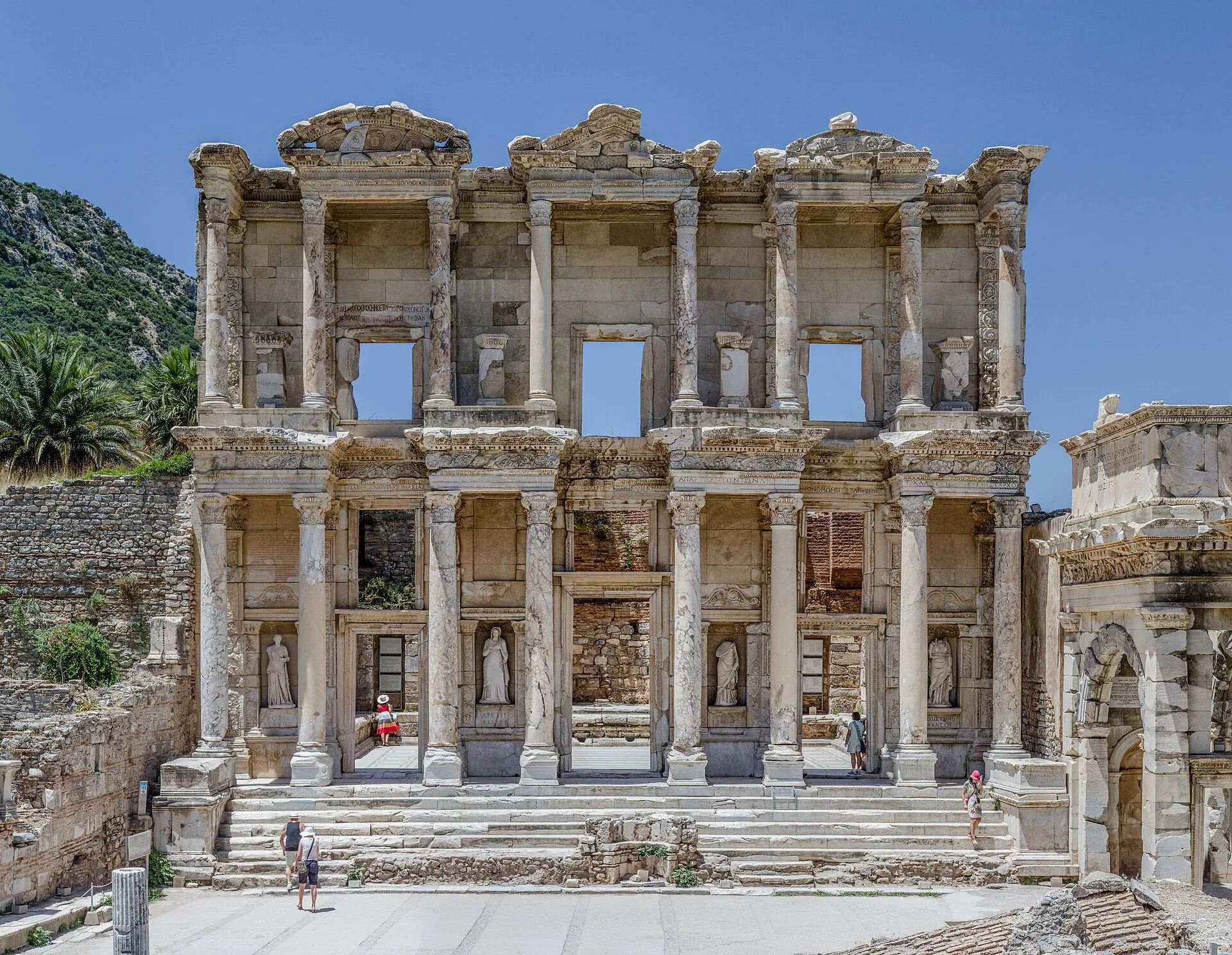
Here's what most visitors miss entirely: the Library of Celsus is lying to you. Its two-storey marble front — roughly 21 meters wide and over 16 meters tall, about the height of a five-storey apartment block — uses deliberate perspective tricks borrowed from theatre design. The columns and pediments curve subtly inward and upward toward the center axis, making the whole composition look broader and grander than its actual footprint. Stand at the base of the nine wide steps and you'd swear you were facing something the size of a palace. You're not.
The four female figures in the lower niches represent Sophia (Wisdom), Arete (Virtue), Ennoia (Intelligence), and Episteme (Knowledge) — though the ones you're looking at are casts. The originals were shipped to Vienna's Ephesus Museum during the Austrian excavations of 1903–1904. Between the paired Corinthian columns, look up at the carved soffit work and the window openings on the upper storey rather than just backing away for the wide shot everyone else takes. The detail rewards closeness more than distance.
The Tomb Beneath the Reading Room
This is the building's strangest fact, and most people walk right over it. The Library of Celsus is also a mausoleum. Beneath the central apse — the curved recess at the back of the interior — a diagonal corridor once led down to a vaulted crypt holding the white marble sarcophagus of Tiberius Julius Celsus Polemaeanus, a Greek-born Roman senator and proconsul of Asia around 105–107 CE. Burial inside a Roman city's boundaries was almost unheard of. Celsus got it anyway.
His son, Tiberius Julius Aquila, commissioned the whole building sometime in the 110s CE as both a public library and a heroön — a hero-shrine — for his father. The interior you step into today is a roofless shell of about 178 square meters, stripped bare by a fire scholars attribute to the Gothic raids of around 262 CE. But the wall niches that once held roughly 12,000 scrolls are still legible, and you can see the gap between the inner and outer walls — a double-skin design meant to buffer papyrus against Aegean humidity. Ancient climate control, hiding in plain sight.
The Full Approach: Curetes Street to the Agora Gate
Don't start at the library. Start at the top of Curetes Street and walk downhill, because the Romans designed this reveal and it still works. The marble-paved processional road — lined with mismatched columns recycled after successive earthquakes, giving it a patched, time-layered texture if you slow down enough to notice — funnels your eye toward the façade for a solid two-minute walk before you arrive. That long frontal staging is the intended experience.
Once you've spent time at the library itself, turn right to the Gate of Mazeus and Mithridates, the triple-arched entrance to the commercial agora built by two freed slaves of Emperor Augustus. On the library side, the gate is faced in dark marble; on the agora side, white. Most visitors register it as background scenery, but that colour shift is deliberate and easy to miss. Before you leave, look down at the library steps: a menorah carved into the stone — likely graffiti from a later period — has a small plaque, but you'll walk past it unless you know to look. Morning is the best time for all of this. The library faces east, and early light hits the façade cleanly before the marble starts throwing glare and heat back at you by midday.
Plan your visit
Getting There
The Library of Celsus sits inside the Ephesus archaeological site, about 4 km from Selçuk town center. From Selçuk bus station, dolmuş minibuses run to the lower gate every 20–30 minutes in summer (about 10 minutes, a few lira). A taxi from Selçuk station takes 5 minutes. From İzmir, take İZBAN rail to Tepeköy, transfer to the Selçuk train, then taxi or dolmuş to the site. From Kuşadası, frequent dolmuş services head toward Selçuk — ask the driver for the Efes lower gate.
Opening Hours
As of 2026, Ephesus opens daily at 08:00 with closing around 18:00 (box office stops at 17:30). Winter hours may shorten to 08:30–17:00 from November through March — confirm on muze.gov.tr before you go. Night museum visits have been offered in recent summers (roughly June–November, Wednesday–Saturday, 19:00–22:30, lower gate only), but dates change annually, so check the Ministry's current schedule.
Time Needed
If you enter from the lower gate and beeline for the Library of Celsus, you can reach the façade in under 10 minutes and spend a satisfying 20–40 minutes photographing it and the surrounding Marble Street. For the library plus the theatre zone and Curetes Street, budget 60–90 minutes. A thorough walk through the full Ephesus site, including the Terrace Houses, takes 3–4 hours.
Accessibility
The lower gate is the better entrance for wheelchair users and anyone with limited mobility — a hard gravel path reaches the Library of Celsus exterior from that side. Expect cobblestones, uneven marble, steep slopes, and slippery surfaces throughout the site; a companion is realistically necessary for most wheelchair users. Accessible toilets are reported at both gates. The Terrace Houses are not wheelchair accessible due to extensive stairs.
Tickets & Cost
As of 2026, the Ephesus main site ticket is €40 (foreign visitors); the Terrace Houses require a separate €15 ticket. Children under 8 enter free with passport proof, and disabled visitors plus one companion also enter free. Buy tickets online at muze.gov.tr/ETicket or pay by card at the gate — foreign cash is not accepted. The MuseumPass Aegean (€95, 7 days) covers Ephesus and other regional sites but is not valid for night visits after 19:00.
Photo Gallery
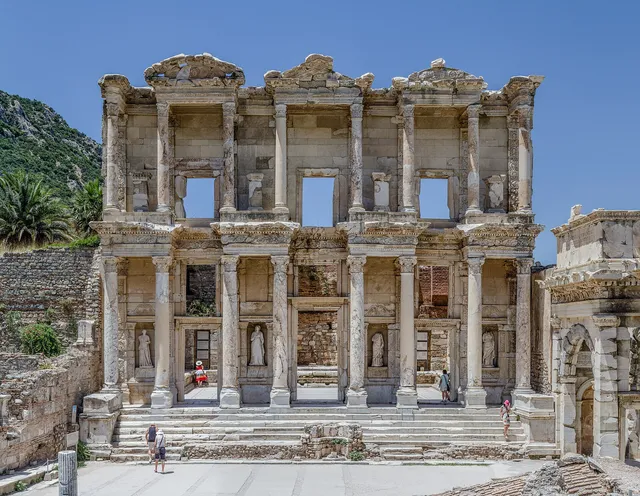
The Library of Celsus stands in Ephesus with its carved marble facade, two tiers of columns, and statues set into the lower niches. Visitors gather on the sunlit steps beneath a clear Aegean sky. · MizginoClose-up view of the Library of Celsus in ancient Ephesus, where carved marble columns and layered Roman ornament catch the bright Turkish sun. · Tolga AlanThe Library of Celsus rises above the stone ruins of ancient Ephesus, its restored two-story facade still commanding the site. Visitors gather below the columns under a pale, overcast sky. · ShettaThe Library of Celsus stands in golden evening light at Ephesus, with its carved Roman facade facing an empty stone courtyard. Arches and ruins frame the landmark beneath a streaked blue sky. · Emilio rodriguez oteroThe Library of Celsus rises above the ruins of ancient Ephesus, its restored Roman facade still theatrical in the Turkish sun. Visitors on the stone steps show the scale of the columns and carved upper stories. · Murat BeşbudakThe Library of Celsus stands among the ruins of ancient Ephesus, its marble columns and statues catching the clear daylight. Mountains rise behind the facade, with visitors giving scale to the Roman monument. · Robert HelvieThe Library of Celsus stands among the ruins of ancient Ephesus, its restored marble facade rising in sharp sunlight. Visitors gather on the steps beneath carved columns and empty window frames. · Carlos Delgado
History
A Son's Monument, a Senator's Tomb
Ephesus in the early second century CE was the de facto capital of Roman Asia — a port city of perhaps 250,000 people, rich on trade and imperial patronage. The library rose at the intersection of Curetes Street and the Marble Road, facing the commercial agora, in the most prestigious real estate the eastern Mediterranean could offer. Its construction, beginning around 117 CE, was not a civic project. It was personal.
The man who commissioned it, Tiberius Julius Aquila Polemaeanus — a Roman consul — wanted to honor his recently dead father. He chose to do so with a building that broke the law.
The turning point
The Greek Who Conquered the Senate
Tiberius Julius Celsus Polemaeanus was born around 45 CE in Sardis, a Greek city in western Anatolia. In an era when the Roman Senate was overwhelmingly Italian, he climbed every rung: equestrian officer, legionary tribune in Egypt under Vespasian, praetor, consul suffectus in 92 CE, governor of Cappadocia and Pontus, and finally proconsul of Asia — the most prestigious senatorial province in the empire — from 105 to 107 CE. Records show he was among the very first Greek-born easterners to reach the consulship. What was at stake was not just a career but the legitimacy of an entire provincial elite.
When Celsus died around 114 CE, his son Aquila faced a choice. A conventional memorial — a statue, an inscription — would fade into the background noise of a city already thick with marble honors. Instead, Aquila commissioned a full public library and placed his father's lead-lined coffin in a vaulted crypt directly beneath the reading-room floor. Roman law explicitly forbade burial within a city's sacred boundary. The special dispensation Celsus received was an honor normally reserved for emperors and founder-heroes. The library was both a gift to the city and a declaration: this Greek family had become Roman aristocracy, and the proof was literally set in stone.
Aquila himself died before the building was finished. His heirs completed it, scholars believe around 135 CE, using a 25,000-denarii endowment from Celsus's estate to purchase the scrolls. The four statues placed in the façade niches — Sophia (wisdom), Episteme (knowledge), Ennoia (intelligence), Arete (excellence) — were not generic decorations. They were Greek funerary epithets, praise-words for the dead man, dressed up as architecture. Every reader who entered the library walked over Celsus's body and under his virtues. The building was a tomb that made you smarter.
Fire, Goths, and Seven Hundred Years of Standing
In 262 CE, the interior burned. Whether the fire was set by Gothic raiders who sacked Ephesus that year or triggered by an earthquake remains an open scholarly question — both agents may have contributed. The 12,000 scrolls were lost. But the façade, scorched and emptied, refused to fall. It stood for roughly another seven centuries until a later earthquake, commonly dated to the 10th or 11th century, finally brought it down. In the 4th century, while it still stood, a fountain was built against its front using reused reliefs from a Trajanic monument — the library's face became a public water feature, its original purpose half-forgotten.
The Austrian Reconstruction
Austrian archaeologists first excavated the site between 1903 and 1906, uncovering the crypt and sarcophagus beneath the rubble. The four virtue statues were shipped to Vienna by 1910, where they remain in the Ephesus Museum at the Hofburg. Then, beginning in the late 1960s, the Austrian Archaeological Institute — led by Friedmund Hueber and Volker Michael Strocka — undertook a painstaking anastylosis, reassembling the façade from original fragments mixed with new stone. The work was completed in 1978. They deliberately stopped at the façade; the interior was never rebuilt. What visitors see today is a front without a room behind it — a monument to both Roman ambition and the limits of modern restoration.
Tips for visitors
Enter From Below
Use the lower gate for the fastest route to the Library of Celsus — you'll be standing at the façade within minutes instead of walking the full site downhill from the upper gate. Morning light hits the two-story columns beautifully before 10:00, and the crowds from Kuşadası cruise-ship buses typically peak between 10:30 and 14:00.
Photography Limits Apply
Handheld personal photography is fine, but tripods attract staff attention and may be confiscated — they look commercial under Ministry rules. Drones are effectively banned without explicit permits from both Turkish civil aviation and heritage authorities, and the penalties are real.
Skip The Carpet Stop
If you're on a group tour, expect a "cultural visit" to a carpet, leather, or silk shop — this is a kickback arrangement, not a local tradition. Politely decline or set a timer on your phone. Also avoid buying "ancient" coins near the ruins; they're either fake or legally dangerous to export under Turkish heritage law.
Eat In Selçuk Town
Skip the tour-bus buffet restaurants near the gates and eat in Selçuk center instead. Mehmet and Ali Baba Kebab House near the museum is a reliable budget grill; Selçuk Pidecisi does excellent pide for a few euros; and Petek Çöp Şiş serves the regional specialty — tiny lamb skewers charred over coals — that locals actually eat.
Pair With Ayasuluk Hill
The Library of Celsus is Roman, but Selçuk's story doesn't stop there. Walk 15 minutes from the Ephesus Museum to Ayasuluk Hill for the Basilica of St. John and İsa Bey Mosque — Seljuk and Byzantine layers that most tour groups skip entirely. Cover your shoulders for the mosque.
Try The Night Visit
If summer night museum hours are running (check muze.gov.tr closer to your date), the illuminated Celsus façade after dark is a completely different experience — warm floodlights, a fraction of daytime crowds, and the Izmir State Symphony Orchestra has performed here on select evenings. Night entry uses the lower gate only and requires a separate ticket; MuseumPass doesn't cover it.
Traditional Turkish Village Breakfast & Gözleme€€star5.0(499)
Order: The gözleme (Turkish stuffed flatbread) with potato and cheese, and the full village breakfast spread with fresh veggies, olives, and homemade fries.
A hidden gem in Şirince where Nona rolls out dough right in front of you, a wood-fired stove crackles, and the valley views are pure peace — this is the breakfast you'll measure all others against.
Order: Lamb chops (juicy and tender), mixed grill, saksuka, and a glass of the surprisingly good house wine.
Dine under grapefruit trees in a family garden where every dish — from succulent lamb to fresh Aegean fish — feels crafted with care, and the warm welcome makes you an instant regular.
Traditional Turkish & Village Pizzas€€star4.8(275)
Order: Manti (Turkish dumplings) from the village menu, brick-oven pizza, and a glass of their excellent local wine.
An atmospheric escape in Şirince where every corner tells a story, the gözleme and manti are made with real village soul, and the terrace view makes you want to linger for hours.
International Fusion & Turkish Bistro€€star4.7(151)
Order: Amazonian chicken (crispy potato with impossibly flavourful chicken) and the shepherd’s pie — a brilliant detour from the standard kebab trail.
The owner-chef cooks with heart in a cosy, art-filled space; this is where locals go for the best filtered coffee in town and dishes that feel like a delicious surprise.
checkCheck the bill for a service charge; if none is added, tipping 5–10% in Turkish lira is appreciated.
checkMany Selçuk restaurants stay open continuously from morning into late evening — still, check individual hours as patterns vary.
checkThe Selçuk Saturday Farmers' Market (downtown, roughly 8am–sunset) is the place for fresh produce, gözleme, and local cheeses.
checkCash in lira is king for tips and market shopping; cards are widely accepted in restaurants.
Food districts:Selçuk town centre (Atatürk district)Şirince village
Restaurant data powered by Google
Watch & Explore Library of Celsus.
Explore Selçuk
Ephesus, Sirince & Selçuk | Best Places near Kusadasi | Turkey Travel Guide
Reigne Or Shine20 min12K
Explore Selçuk
Is Selçuk Turkey's most underrated town? T K
OUTBOUND WITH RON11 min11K
Frequently asked
Is the Library of Celsus worth visiting?
Absolutely — it's the single most photographed monument in Turkey's Aegean region and the emotional climax of any walk through Ephesus. The two-storey marble facade stands 16 meters high with deliberate perspective tricks that make it look even grander, and beneath the reading-room floor lies the sealed sarcophagus of a Roman senator. You're standing on a tomb, inside a library, looking at an optical illusion — all at once.
How long do you need at the Library of Celsus?
Budget 20–40 minutes for the facade, stair inscriptions, and adjacent Gate of Mazeus and Mithridates. If you want to explore the surrounding streets and theatre zone, allow 60–90 minutes. Most visitors combine it with a full Ephesus walk of 2–3 hours, entering from the upper gate and descending Curetes Street so the library lands as a dramatic endpoint.
How do I get to the Library of Celsus from Selçuk?
The library sits inside the Ephesus archaeological site, about 4 km from Selçuk town center. Take a dolmus (shared minibus) from Selçuk bus station toward Pamucak Beach — it stops near the lower gate in roughly 10 minutes, and runs every 20–30 minutes in summer. A taxi takes 5 minutes. The lower gate gives you the quickest walk to the library itself.
What is the best time to visit the Library of Celsus?
Early morning in spring or autumn gives you the best combination of soft light, tolerable heat, and thinner crowds. The facade faces east, so morning sun illuminates it directly — by afternoon you're shooting into shadow and fighting reflected heat off white marble. Night visits (available on selected summer evenings from June onward) transform the experience entirely, with dramatic lighting and far fewer people.
Can you visit the Library of Celsus for free?
No — you need an Ephesus Archaeological Site ticket, currently priced at 40 euros for foreign visitors. Children under 8 enter free with ID, and disabled visitors plus one companion are also admitted free. There is no general free-entry day for international tourists. The MuseumPass Aegean (95 euros, 7 days) or MuseumPass Turkiye (165 euros, 15 days) cover entry if you're visiting multiple Turkish sites.
What should I not miss at the Library of Celsus?
Three things most visitors walk past: First, a menorah carved into one of the entrance steps — a later graffiti with a small plaque that's easy to miss unless you look down. Second, the double-wall air gap behind the scroll niches, visible from the rear of the structure — the world's earliest known purpose-built archival climate control. Third, the deliberate perspective distortion of the facade, where outer columns are shorter and the central bay wider to inflate the building's apparent size from a distance.
What are the opening hours for Ephesus and the Library of Celsus?
The Ephesus site is open daily, generally from 08:00 to 18:00, with the box office closing at 17:30. Winter hours (roughly November through March) may shorten to 08:30–17:00. Night museum visits have been offered on Wednesday through Saturday evenings in summer (19:00–22:30, lower gate only), though exact 2026 dates should be confirmed on the official Ministry of Culture site before you go.
Are the statues on the Library of Celsus facade original?
No — all four virtue statues (Sophia, Episteme, Ennoia, Arete) on the facade today are replicas. The originals were removed around 1910 during Austrian excavations and remain in the Ephesus Museum at the Hofburg in Vienna. Turkey has periodically requested their return, but as of now no repatriation agreement exists.
Sources & attribution36
Researched and written by the Audiala editorial team from historical records, architectural archives, and local expertise. Last updated April 2026.
Strictly necessary cookies keep the site working. Analytics (PostHog, Google Analytics) measures how each visitor uses our pages. Marketing loads YouTube videos and walking-route maps without a tap and lets Google Analytics set advertising cookies. We never sell your data. You can change this any time from the footer.
Analytics and marketing cookies are optional and only load if you agree. Details under Customize.
Privacy
Cookie preferences
Pick what you're okay with. You can change this any time from the footer.
Strictly necessary
Always on
Sign-in, language, navigation. Always on.
Product analytics
PostHog (EU) and Google Analytics record which pages you view and how you use them, under a random identifier stored in your browser. Helps us see which pages work and which need fixing. Google's ad personalisation stays off. No selling.
Marketing
Loads YouTube videos and the walking-route maps (OpenFreeMap) without a tap; without it, they load only when you tap them. If analytics is also on, Google Analytics may set advertising cookies. Ad personalisation stays off.