€40 adults (+ €15 Terrace Houses); House of the Virgin Mary €13.50
Access
Main marble street is uneven; limited wheelchair access on ancient paving
Best season
Spring (April–May) or Autumn (Sept–Oct)
The most famous library facade in the world is actually a tombstone — and the city around it has been dead for longer than it was alive. Ephesus Ancient City, outside the small town of Selçuk in western Turkey, sprawls across a valley that was once a busy harbor and is now eight kilometers from the sea. That slow retreat of the coastline is the real story here: a city that kept reinventing itself for nearly nine thousand years, chasing water that kept leaving.
What you walk through today is mostly the Roman-era build-out of a city first replanned around 300 BCE, but the ground beneath holds layers reaching back to the seventh millennium BCE. Neolithic tools at Çukuriçi Höyük, Bronze Age Hittite records calling this place Apasa, Greek colonial ambition, Persian occupation, Macedonian urban engineering, Roman imperial swagger, early Christian theology, Gothic destruction, Byzantine reinvention, Seljuq and Ottoman adaptation — it's all here, compressed into a few square kilometers of marble, dust, and wildflowers.
Ephesus once held around 200,000 people, making it one of the largest cities in the Roman Mediterranean — roughly the size of modern Selçuk multiplied by six. It served as the capital of the Roman province of Asia, a pilgrimage magnet for worshippers of Artemis, a setting for one of the most consequential church councils in Christian history, and eventually a silting backwater that medieval travelers barely mentioned. UNESCO inscribed it in 2015.
Come early in the morning if you can. The light hits the Library of Celsus facade around 8 a.m. in a way that makes the stone glow warm gold, and the marble street of the Curetes Way still holds the night's coolness under your feet. By midday in summer, the site bakes above 40°C and the tour groups stack up like Roman legions. The ruins reward patience and a willingness to look past the postcard.
Researched by the Audiala editorial team from historical records, architectural archives, and local expertise.
What to see
Library of Celsus
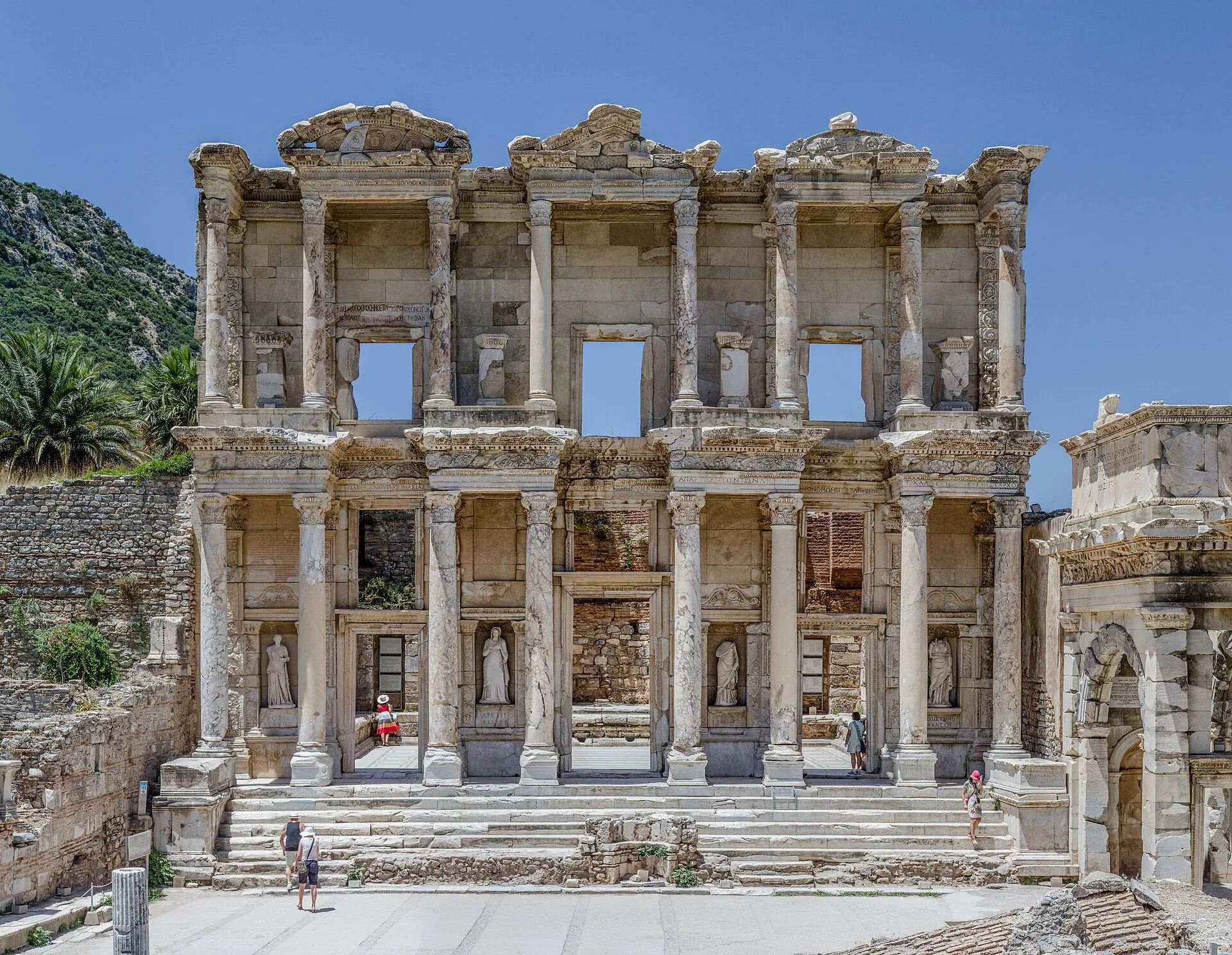
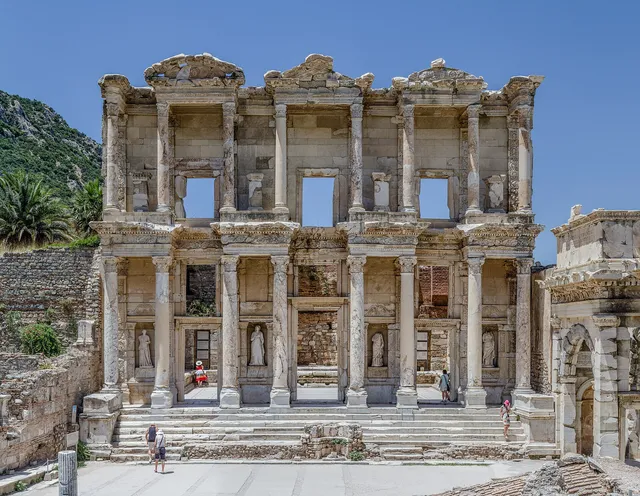
The two-storey façade you're staring at is a trick. Austrian archaeologists Volker Michael Strocka and Friedmund Hueber rebuilt it in the 1970s from thousands of scattered marble fragments, but the original Roman architects — working around 117 CE — designed deliberate optical illusions into the structure: outer columns are shorter than inner ones, plinths bow gently outward, and the whole composition fools your eye into seeing something grander than its 17-metre width. Four statue niches once held personifications of Sophia, Episteme, Ennoia, and Arete — Wisdom, Knowledge, Thought, and Virtue. The originals sit in Vienna's Ephesus Museum. The copies remain here, bleached by Aegean sun.
Beneath the reading hall, a sealed crypt still holds the marble sarcophagus of Tiberius Julius Celsus Polemaeanus, the Roman senator and governor of Asia whose son commissioned the library in his honour. Arrive at the 8 a.m. opening or after 5 p.m. and you'll have the façade to yourself — late afternoon light turns the marble from clinical white to warm honey, and the Greek dedication inscription above the central doorway becomes legible in the raking shadows. During cruise-ship hours, roughly 10 a.m. to 3 p.m., the photo line stacks three groups deep.
Terrace Houses
Pay the separate ticket. Everyone debates whether it's worth the extra cost, and the answer is immediate once you step inside: the temperature drops ten degrees, the crowd noise vanishes, and you're walking on glass catwalks suspended directly above the private dining rooms of 2nd-century Roman elites. Seven residences climb the hillside in terraces — each with hypocaust underfloor heating, marble-panelled walls, and polychrome mosaic floors depicting lions, dolphins, geometric labyrinths. The frescoes are the real shock. Garden scenes, mythological panels, a Muse playing a lyre — pigments still holding reds and blues that feel almost indecent after the bleached marble outside.
Look closer and the walls talk back. Greek graffiti scratched by residents or visitors, gladiator figures etched into plaster, even a game board carved into a marble step. These weren't temples or public monuments — they were homes, and the intimacy is palpable. The covered modern roof keeps the interiors dim and cool, a sensory jolt after the glaring heat of Curetes Street. Budget at least 40 minutes here; most guided tours rush through in 15.
The Great Theatre
A 25,000-seat semicircle carved into the western slope of Mount Pion — roughly the capacity of Madison Square Garden, open to the sky. Roman engineers expanded an earlier Hellenistic theatre in the 1st century CE, and the acoustics still perform: stand on the orchestra's centre stone and clap once. It returns to you from the upper tiers, clean and sharp. This is where, according to Acts 19, a crowd of silversmiths shouted "Great is Artemis of the Ephesians!" for two solid hours after Paul threatened their idol-making trade. The anger was economic as much as religious.
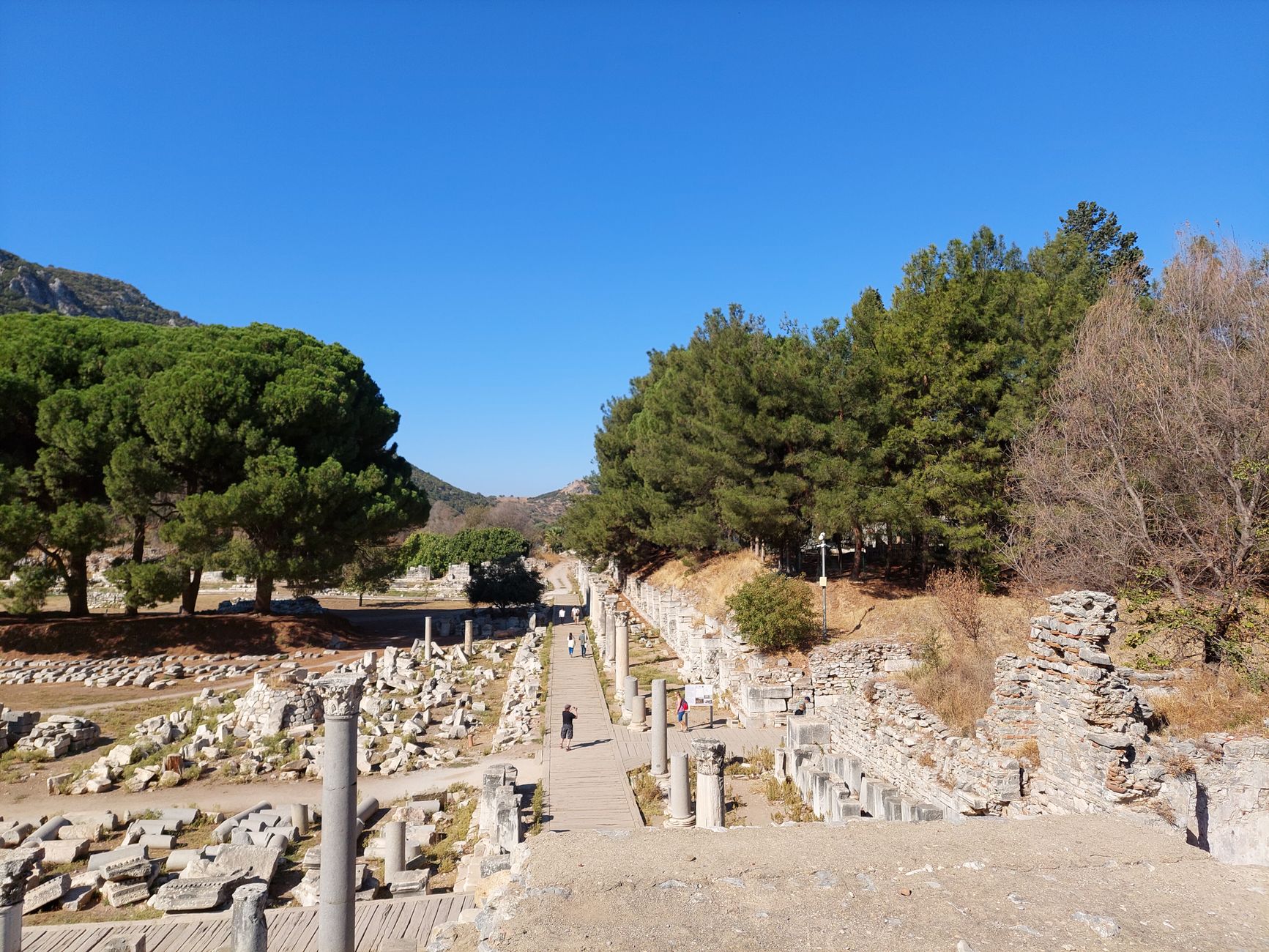
Climb to the top row. It's steep — 30 metres of elevation gain on ancient stone — but the view is the single best composition in Ephesus. Harbour Street, the 500-metre colonnaded avenue that once had nighttime street lighting (one of the few in the ancient world), runs ruler-straight from the theatre toward what used to be the port. The harbour silted up centuries ago; now it's a marshy plain edged with reeds. That shift — grand boulevard ending in wetland — tells the whole story of why Ephesus died. You don't need a placard. You can see it.
Curetes Street: A Walk Through 2,000 Years of Wear
Enter from the upper Magnesia Gate and let gravity do the work — the marble-paved street descends steadily past the Odeon, the Temple of Hadrian, the Scholastica Baths, and the public latrines before delivering you to the Library of Celsus. But slow down. The real story is underfoot. Cart-wheel ruts cut 2 to 4 centimetres deep into marble slabs, worn to a glassy polish by centuries of commerce — you can place your foot inside one and feel the exact axle width of a Roman wagon. At the Hadrian Temple, the keystone figure most people call Medusa is actually Tyche, the city's guardian goddess, her face framed by acanthus leaves. The frieze panels on display are casts; originals live in Selçuk's museum.
Don't skip the public latrines near the Scholastica Baths — rows of marble seats over a water channel, worn satin-smooth, still intact. Sit down. The cold stone is startlingly real. Further along the Marble Road toward the harbour, look for the small carved paving slab: a left footprint, a woman's head, a heart, and coins. Traditionally called an advertisement for the brothel, scholars now think it may be a votive offering. Either way, it's one of Ephesus's most human details, easy to walk past if you don't know to look down. The whole descent takes 90 minutes if you actually stop, 20 if you follow a tour flag. Stop.
Plan your visit
Getting There
From Selçuk, dolmuş minibuses run every 30 minutes from the otogar to the lower gate — 5 minutes, dirt cheap. From İzmir, take the train from Basmane station (it stops at Adnan Menderes Airport en route) directly to Selçuk. Kuşadası cruise passengers can grab the half-hourly dolmuş to Selçuk, which drops you near the lower gate — skip the overpriced taxi.
Opening Hours
As of 2026, Ephesus opens daily 08:00–19:00 from April through October, and 08:00–17:00 from November through March. The site operates year-round with no major closure days. Arrive right at 08:00 — by 10am the Kuşadası cruise coaches roll in and the marble streets feel like rush hour.
Time Needed
A focused walk from upper to lower gate along the main 3 km path takes about 2 hours, but you'll want 3–4 hours to actually absorb what you're seeing — especially if you add the Terrace Houses. Pair Ephesus with the Basilica of St. John, the Ephesus Museum, and Şirince village and you've got a full day.
Accessibility
This is a tough site for mobility-limited visitors — polished marble streets are slippery, inclines are steep, and there are no elevators or ramps. The lower gate offers the flattest access to the Library of Celsus area, which is the best option for wheelchair users. An accessible toilet sits at the lower gate car park.
Tickets & Cost
As of 2026, the standard entry ticket costs €40 per person (ages 8+), which bundles the Digital Ephesus & Artemis Museum whether you want it or not. The Terrace Houses are an extra €15 — pay it, they're the best part. A combo pass covering Ephesus, Terrace Houses, Basilica of St. John, Selçuk Castle, and the Ephesus Museum runs about €65 and is genuinely worthwhile.
Photo Gallery
Marble columns and scattered stone blocks line the ancient streets of Ephesus, with visitors moving through the ruins beneath the hills of Selçuk. · Tugay Kocatürk on PexelsIntricate Roman stonework frames the sky at Ephesus Ancient City near Selçuk. The surviving arch shows the precision and ornament that once shaped this ancient city. · Büşra Güney on PexelsMarble columns and broken stonework line the ancient streets of Ephesus, with pine-covered hills rising behind the ruins. Visitors move through the archaeological site under clear Turkish light. · Selin Karaman on PexelsCarved marble arches and columns stand among the ruins of Ephesus Ancient City near Selçuk. Bright sunlight brings out the stone detail against the hillside and blue sky. · Mehmet Turgut Kirkgoz on PexelsCarved marble arches and columns rise against a clear blue sky at Ephesus Ancient City in Selçuk. The ruins show the precision and theatrical confidence of Roman architecture. · Ayşegül Delice on PexelsWeathered columns and carved stone fragments catch the low sun at Ephesus Ancient City. The hillside setting gives the ruins a dry, golden stillness. · dilan archive on PexelsThe Library of Celsus rises above the ruins of Ephesus Ancient City, with carved stone columns and inscriptions catching the afternoon light. Visitors gather among the ancient marble streets of Selçuk, Turkey. · Barış Aktaş on Pexels
History
A City That Kept Moving to Stay Alive
Ephesus is not one city frozen in amber. It is a chain of settlements that shifted west across the same valley as the Aegean shoreline retreated, century by century, under loads of river silt. The Kaystros River — modern Küçük Menderes — deposited so much sediment that the harbor that once made Ephesus rich eventually made it irrelevant. Every major reinvention of the city was, at root, an argument with mud.
The oldest traces date to the seventh millennium BCE at nearby Çukuriçi Höyük, according to UNESCO's synthesis. By the second millennium BCE, Hittite cuneiform texts record the name Apasa, likely cognate with Ephesus, as the capital of the kingdom of Arzawa. Greek colonists arrived around the tenth century BCE. Then came Persians, Athenians, Spartans, Alexander, Rome, Christianity, Goths, Byzantines, Seljuqs, and Ottomans — each rewriting the city without quite erasing what came before.
The turning point
The King Who Flooded His Own People Into a New City
Around 300 BCE — the exact year remains disputed among scholars — the Macedonian successor king Lysimachus faced a problem. He controlled western Asia Minor after Alexander the Great's death, and Ephesus was one of his most valuable possessions. But the old city near the Temple of Artemis was losing its harbor to silt, breeding malaria in stagnant marshes, and slowly dying. Lysimachus decided not to fix the city. He decided to move it entirely, relocating it to a new site between Mount Pion and Mount Coressus, where the ruins visitors walk today still stand.
The inhabitants refused to go. According to the geographer Strabo, Lysimachus solved this by blocking the city's drainage channels during a heavy rainstorm, flooding the streets until the population had no choice but to abandon their homes. It was urban planning by coercion — a king literally drowning a city to save it. He laid out new walls stretching six kilometers, imposed a Hippodamian grid of streets, and tried to rename the place Arsinoe after his wife. The Ephesians accepted the new location. They rejected the new name.
What Lysimachus staked was enormous. If the relocation failed, he lost the tax revenue and strategic harbor of one of the richest nodes in the eastern Mediterranean. If it worked, he gained a defensible royal city with a functioning port, fresh infrastructure, and a population that owed its survival to his authority. It worked — for a while. Lysimachus died in battle in 281 BCE, but his city outlived him by centuries. The marble streets, the terraced houses, the great theater: all of it sits on the site he chose, built over the drainage he imposed. Every tourist photograph of Ephesus is, in a sense, a photograph of his gamble.
The Night a Nobody Burned a Wonder of the World
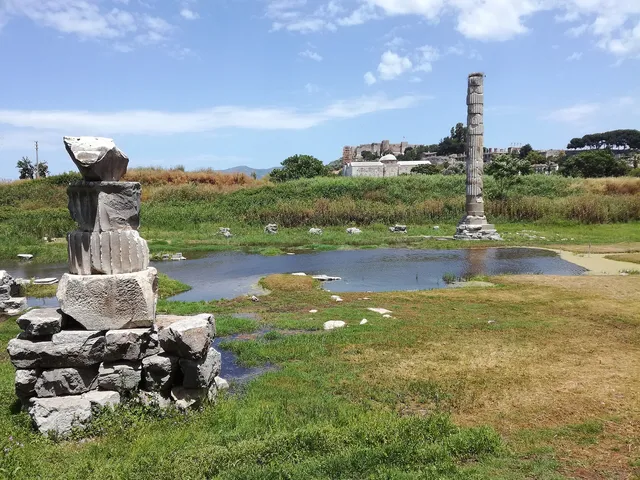
On a night in 356 BCE that later tradition linked to Alexander the Great's birth, a man named Herostratus set fire to the Temple of Artemis at Ephesus — one of the Seven Wonders of the Ancient World, bankrolled a generation earlier by King Croesus of Lydia. Herostratus had no political motive and no grievance. He wanted to be remembered. The Ephesian authorities executed him and passed a decree forbidding anyone to speak his name, a punishment called damnatio memoriae. It failed spectacularly: ancient writers recorded the name anyway, and 2,400 years later we still know it. The Ephesians rebuilt the temple even grander than before, but the Goths destroyed it again in 262 CE, and today only a single reconstructed column marks the site.
Silversmith Economics and a Riot for Artemis
Around 57 CE, the apostle Paul's preaching in Ephesus triggered a city-wide crisis recorded in Acts 19. A silversmith named Demetrius, who made miniature shrines of Artemis for pilgrims, rallied his fellow craftsmen with a blunt argument: if people stopped worshipping Artemis, they'd stop buying silver shrines, and the trade would collapse. The crowd surged into the great theater — which seated an estimated 25,000, roughly the capacity of Madison Square Garden — chanting "Great is Artemis of the Ephesians" for two hours. A city clerk eventually talked them down by warning that Rome might punish Ephesus for the disorder. It's a scene where religion, commerce, and imperial politics collide in a single afternoon, and you can stand in that same theater today and feel the acoustics that carried the shouting.
Tips for visitors
Enter From Above
Start at the upper (Magnesia) gate and walk downhill — you'll cover the full site with gravity on your side while most tour groups slog uphill from the lower gate. You exit near dolmuş stops and cafés at the bottom.
Drone Ban Is Real
Drones are prohibited at all Turkish archaeological sites without explicit Ministry of Culture and civil aviation permits — flying one at Ephesus means confiscation and a fine. Tripods technically require a permit too, though casual use off-peak is usually tolerated.
Beat The Heat
The site is open marble with zero shade — in summer, surface temperatures can be brutal by 11am. Arrive at 08:00 opening or after 3pm, bring 2 liters of water, and wear a hat; there's no food or drink sold inside the site itself.
Eat In Selçuk
Mekan Efes in Selçuk centre draws locals and visitors alike (mid-range, 4.8 stars on TripAdvisor). For something special, head 8 km uphill to Şirince village for fruit wine tastings and panoramic dinners at Artemis Restaurant — go late afternoon for the sunset light.
Skip Fake Guides
Unlicensed "guides" loiter near both gates offering cheap tours — licensed Turkish guides carry a Ministry of Culture badge, so ask to see it. Also buy tickets only at the official booth or online; hawkers near the entrance sometimes sell inflated fakes.
Terrace Houses Are Essential
Most visitors skip the Terrace Houses to save €15 and miss the single best thing at Ephesus — 2nd-century AD frescoes and mosaics still being excavated under a protective roof by the Austrian Archaeological Institute. These were the homes of Ephesus's wealthy; the colors on the walls are startling.
Where to Eat
local_dining
Don't Leave Without Trying
Köfte (spiced grilled meatballs)Çöp şiş (marinated lamb or chicken skewers)Zeytinyağlılar (olive oil-braised seasonal vegetables)Gözleme (savory hand-rolled flatbreads)Kuzu tandır (slow-cooked lamb)Aegean fish: grilled sea bass and sea breamPide (Turkish flatbread/pizza)Mezzes like şakşuka (fried vegetables in spiced tomato sauce)Village breakfast (köy kahvaltısı)Şirince fruit wines
Ri Minos Cafe Restaurant
cafe
Turkish Village Breakfast & Gözleme€€star5.0(499)
Order: The village breakfast spread with fresh gözleme (savory stuffed flatbread) — Nona's cooking is unforgettable.
A hidden gem in Şirince hills with a wood-fired stove, family-run warmth, and stunning valley views. This is where you come for a slow, peaceful breakfast that lingers for hours.
Order: Musakka (minced beef with eggplant) or the chicken soup are standouts; the rice pudding is a must.
A beloved local lunch spot hidden in a market square, serving homestyle Turkish comfort food to a loyal crowd. It feels like you're eating in a family kitchen, with recipes that change daily.
Order: Lamb chops — tender, juicy, perfectly cooked; the mixed grill and saksuka (fried vegetables with spices) are also stellar.
Dine under grapefruit trees in a charming courtyard that feels like a secret garden. The attentive staff and house wine make every meal a celebration — it's the kind of place you'll return to daily.
Order: Choose from decadent house-made desserts — the pastry chef’s creations change daily, but the baklava and specialty cakes earn rave reviews. Pair with a well-crafted Turkish coffee.
A cozy retreat decked out with vintage Turkish film posters, Münire feels like a friend's living room. It's the perfect spot to unwind over coffee and something sweet after a day of ruins.
checkTipping: 10–15% is standard at sit-down restaurants, always tip in cash (Turkish Lira) and hand it directly to the server — never add a tip to a credit card payment as it often doesn't reach staff.
checkCarry cash when dining: many family-run spots prefer it, and small bills are useful for markets and taxis.
checkVisit the Selçuk Saturday Market (Cumartesi Pazarı) for fresh produce, cheeses, and local delicacies — a great place to graze or assemble a picnic.
checkSome local restaurants (especially esnaf lokantası) serve only lunch, closing by late afternoon — check opening hours before heading out.
checkTry the local Şirince wines with your meal; the village is a short drive from Selçuk and many restaurants serve them.
Food districts:Cengiz Topel Caddesi (downtown Selçuk's restaurant street)Şirince village for hillside cafes and wine-tasting
Restaurant data powered by Google
Watch & Explore Ephesus Ancient City.
Ephesus Travel Tips in 5 Mins | Do Not Miss!
SheTravelsTurkiye5 min10K
Explore Selçuk
Ephesus, Sirince & Selçuk | Best Places near Kusadasi | Turkey Travel Guide
Reigne Or Shine20 min12K
Explore Selçuk
Is Selçuk Turkey's most underrated town? T K
OUTBOUND WITH RON11 min11K
Frequently asked
Is Ephesus Ancient City worth visiting?
Absolutely — Ephesus is the best-preserved classical city on the Mediterranean's eastern coast, and a UNESCO World Heritage Site since 2015. The reconstructed Library of Celsus alone justifies the trip, but the Terrace Houses with their intact 2nd-century frescoes and mosaics are what most visitors remember longest. Budget at least half a day, and pair it with the Basilica of St. John and Şirince village for a full experience.
How long do you need at Ephesus?
Plan for 3–4 hours to walk the main site comfortably from upper gate to lower gate, including the Terrace Houses. If you rush, 2 hours covers the highlights, but you'll miss the latrines, the Odeon, and the Church of Mary. Add another 2–3 hours if you want the Ephesus Museum in Selçuk, the Basilica of St. John, and the lone re-erected column of the Temple of Artemis.
How do I get to Ephesus from İzmir?
The easiest route is a train from İzmir Basmane station to Selçuk — about 80 minutes, cheap, and it stops at İzmir Adnan Menderes Airport on the way so you can board there without entering the city. From Selçuk, a dolmuş minibus runs every 30 minutes to the Ephesus lower gate (5–10 minutes). Alternatively, Kamil Koç buses depart İzmir's bus station for Selçuk roughly every 3 hours, taking about 45 minutes.
What is the best time to visit Ephesus?
April–May and September–October give you mild temperatures, wildflowers on the hillsides, and far fewer crowds than summer. In July and August, marble streets reflect heat up to 40°C with almost zero shade — arrive at the 8am opening if you must visit then. Winter is quiet and moody, but the site closes at 17:00 and rain makes the polished marble dangerously slick.
Can you visit Ephesus for free?
No — as of 2025/2026, the standard entry ticket costs €40 per person for foreign visitors (ages 8+), which includes the Digital Ephesus & Artemis Museum. The Terrace Houses require an additional €15 ticket, and a combo pass covering Ephesus, Terrace Houses, Basilica of St. John, Selçuk Castle, and the Ephesus Museum runs about €65. No regular free-entry days have been confirmed for foreign visitors.
What should I not miss at Ephesus?
Pay the extra €15 for the Terrace Houses — they contain polychrome frescoes, mosaic floors, and graffiti scratched by ancient residents, all under a cool protective roof that's a relief from the blazing marble outside. At the Great Theatre, climb to the top tier for a ruler-straight view down Harbour Street to where the ancient port once stood. And don't walk past the cart-wheel ruts on Curetes Street without kneeling to run your hand along them — they're glassy-smooth grooves worn by 2,000 years of commerce.
What is the Library of Celsus at Ephesus?
The Library of Celsus is a two-storey Roman facade rebuilt in the 1970s by Austrian archaeologists using mostly original stones — it's an anastylosis, not an untouched ruin. What most visitors don't realize is that the building doubles as a tomb: Tiberius Julius Celsus Polemaeanus, a Roman consul and governor of Asia, lies buried in a crypt directly beneath the reading room, an honor almost unheard of inside Roman city walls. The facade uses a clever optical trick — outer columns are shorter than inner ones and the base curves outward — making it appear larger than it actually is.
Did the Apostle Paul visit Ephesus?
Yes — around 57 CE, Paul spent roughly two years in Ephesus and triggered a city-wide riot described in Acts 19 of the New Testament. The silversmith Demetrius, whose workshop produced miniature Artemis shrines, rallied craftsmen who feared Paul's preaching would destroy their trade, and a mob of thousands packed the 25,000-seat Great Theatre chanting 'Great is Artemis of the Ephesians.' You can still stand in that same theatre today and test its acoustics yourself.
Sources & attribution41
Researched and written by the Audiala editorial team from historical records, architectural archives, and local expertise. Last updated April 2026.
Strictly necessary cookies keep the site working. Analytics (PostHog, Google Analytics) measures how each visitor uses our pages. Marketing loads YouTube videos and walking-route maps without a tap and lets Google Analytics set advertising cookies. We never sell your data. You can change this any time from the footer.
Analytics and marketing cookies are optional and only load if you agree. Details under Customize.
Privacy
Cookie preferences
Pick what you're okay with. You can change this any time from the footer.
Strictly necessary
Always on
Sign-in, language, navigation. Always on.
Product analytics
PostHog (EU) and Google Analytics record which pages you view and how you use them, under a random identifier stored in your browser. Helps us see which pages work and which need fixing. Google's ad personalisation stays off. No selling.
Marketing
Loads YouTube videos and the walking-route maps (OpenFreeMap) without a tap; without it, they load only when you tap them. If analytics is also on, Google Analytics may set advertising cookies. Ad personalisation stays off.