Type 2+ letters to search all countries, cities, and places
/Ctrl KEsc
travel_explore
Type 2+ letters to search all countries, cities, and places
Press Enter to open the top result
Pamukkale Travertines
Pamukkale·Turkey·37° N · 29° E·Updated Apr 2026
Nearly 200 meters above the plain, Pamukkale's white terraces spill from hot springs beside an ancient spa city where Romans bathed and wool was washed.
Why does a place that looks like spilled snow carry the memory of healing baths, toxic vapors, and a gate to the underworld? The Pamukkale Travertines in Pamukkale, Turkey, answer that question the moment you arrive: white calcite basins step down a 200-meter cliff above the plain, bright as salt in hard sun, while warm mineral water slides over the stone and turns your bare feet slick. Visit because this is not just a natural wonder in Turkey; it is one of those rare places where geology, faith, and human ambition are still visible in the same glance.
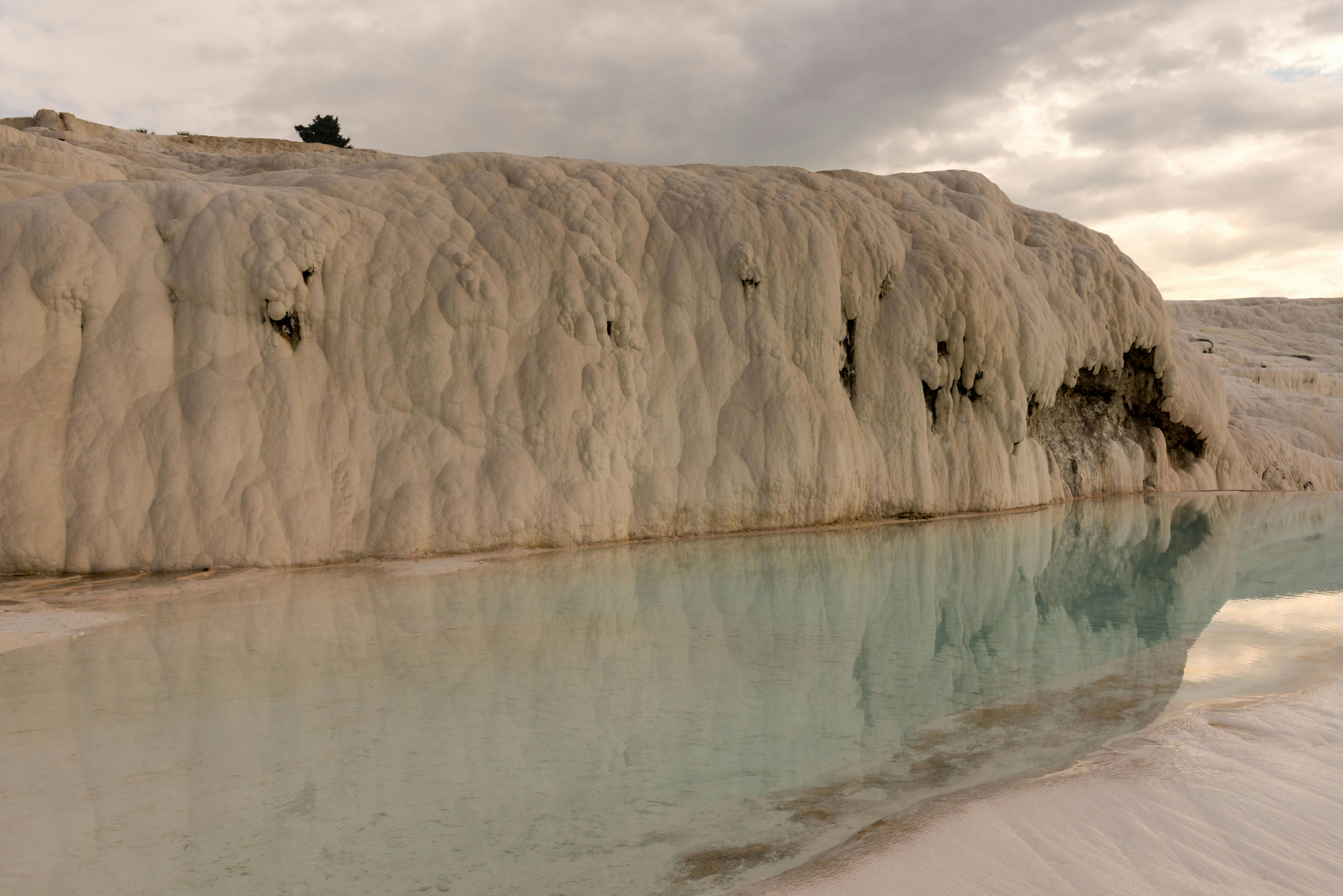
Most visitors come for the white terraces, and fair enough. They glow at dusk like porcelain set on fire, and the shallow pools mirror the sky so cleanly that the edge between water and light starts to blur.
But the real shock sits just uphill in Hierapolis. UNESCO records that the same springs feeding the terraces also powered baths, helped scour and dry wool, and drew pilgrims who believed this fault-ridden slope could heal the body or open a path to the dead.
That double identity is what makes Pamukkale worth your time. You are looking at a landscape shaped over millennia by calcium-rich water, then shaped again by priests, emperors, archaeologists, hotel developers, and conservationists who all wanted something different from the same hot springs.
Researched by the Audiala editorial team from historical records, architectural archives, and local expertise.
What to see
The Travertine Terraces
Pamukkale makes its first argument in white: calcite shelves spilled down a cliff almost 200 meters high, roughly the height of a 60-storey tower, with shallow basins that catch the sky and turn it milk-blue. Walk barefoot where visitors are allowed and you feel the place with your soles before your eyes catch up, the stone shifting from satin-smooth to pitted and warm, water slipping over the rims with a soft trickle that sounds almost domestic until you look up and realize the whole slope was built by hot springs over millennia.
The Theatre and the Ruins of [Hierapolis](https://audiala.com/en/turkey/pamukkale/hierapolis)
Most people come for the white pools and nearly miss the better surprise above them: a full Roman spa city stretched across the plateau, with a colonnaded main street about 1 kilometer long and a theatre tied by UNESCO to the age of Septimius Severus in the early 3rd century AD. Sit high in the seats for a minute; wind moves through the stone, the plain opens below like a map, and the bright terraces stop looking like a postcard trick and start reading as the reason this city existed at all.
A Slow Route: North Necropolis to the Plutonium and Back at Dusk
Start at the north approach if you can, because the necropolis does a better job than any signboard of explaining what this place meant: tombs lining the road, silence underfoot, then the living city opening ahead. End near the Plutonium and Temple of Apollo zone, where ancient builders placed a sanctuary over a fault that still exhales dangerous gas; the grate feels modern, the fear is ancient, and dusk on the white slope below gives the whole site a faint unreal glow.
Plan your visit
Getting There
Denizli is the real transport hub. From Denizli Otogar, take the Pamukkale or Karahayıt dolmuş from lower-level Gate 76; minibuses run about every 15 to 20 minutes and usually reach Pamukkale village in 20 to 30 minutes, about the length of a short airport transfer. From the village center, the lower pedestrian gate is a 10 to 15 minute walk, while the South Gate sits roughly 2 kilometers uphill and makes more sense by taxi or car; drivers usually prefer that entrance because its parking area is the largest.
Opening Hours
As of 2026, the Hierapolis Pamukkale Travertine Archaeological Site opens daily. The pedestrian lower gate runs 08:00-18:00, the North Gate 08:00-21:00, and the South Gate 06:30-21:00; north and south ticket offices close at 18:50, and night visits run 19:00-23:00 through the north and south gates only. On the first day of religious holidays, Turkish museum sites usually open after 13:00 unless a site posts an exception.
Time Needed
Give it 1.5 to 2.5 hours only if you're here for the barefoot walk across the white terraces and a few quick viewpoints. Most visitors need 3 to 5 hours for the travertines plus the main Hierapolis ruins, and 6 to 8 hours feels right if you want the theater, necropolis, museum, slow photography, and time to follow the site at a human pace instead of racing it.
Accessibility
The South Gate is the least punishing entry for visitors with limited mobility because it avoids the steep barefoot climb from town. The travertine pools themselves are not wheelchair accessible, and the walking surface can be wet and slick like polished soap; some boardwalk viewpoints, the museum, and parts of Hierapolis are more manageable, and accessible toilets are reported at multiple restroom blocks.
Cost & Tickets
As of 2026, the official site ticket is €30 and covers the Pamukkale travertines, Hierapolis, and the archaeology museum. MuseumPass Türkiye (€165 for 15 days) and MuseumPass The Aegean (€95 for 7 days) can make sense if Pamukkale is one stop on a longer western Turkey trip, but passes do not cover Night Museology, and the Antique Pool is extra and currently needs same-day status checking because its closure history has shifted.
History
The Water Never Stopped Working
Pamukkale's continuity is not architectural. Earthquakes broke the city more than once, hotels scarred the terraces in the 20th century, and whole belief systems rose and fell on this slope. The enduring thing is simpler: people kept coming for the water.
Records show the late 2nd-century BCE spa city of Hierapolis grew around these springs, and the logic barely changed. The water healed, earned money, carried religious meaning, and demanded management then, just as it does now when flow is rationed across the terraces to keep them white.
The turning point
From Miracle Water to Managed Water
At first glance, Pamukkale seems like pure nature with a side order of ruins. That is the surface story: white pools formed by hot springs, then a few Romans arrived, bathed, and left their columns behind.
But odd details start to spoil that version. Why did a sanctuary to Apollo sit directly over a fault vent releasing lethal gas, and why do channels and basins around the slope look less accidental than tourists expect? UNESCO records that the hot water was used for bathing and for scouring and drying wool, which means this was also a working hydraulic system, not a pretty accident.
The revelation came back into focus in 2013, when archaeologist Francesco D'Andria identified the Ploutonion, the ancient 'Gate to Hell,' by matching texts, masonry, and the path of the thermal spring itself. His reputation was on the line: if he was right, the old stories were not pious exaggeration but a precise description of a cult built around dangerous geology; if he was wrong, Hierapolis stayed a blur of legends and scenic ruin.
That turning point changes the way you read the place now. The barefoot channels on the terraces, the controlled flow of water, and the ruins above are all part of the same long habit: people have been trying to direct these springs toward healing, profit, awe, and survival for more than 2,000 years.
What Changed
The setting changed its costume again and again. Attalid rulers founded the spa city in the late 2nd century BCE; Rome rebuilt after the earthquake of 60 A.D.; Christians turned Hierapolis into a pilgrimage center linked by tradition to the martyrdom of St. Philip; and modern tourism nearly damaged the terraces so badly that UNESCO-backed protection led to the demolition of the last on-site hotels in 2001. Each age claimed the slope for a different purpose.
What Endured
The springs kept their authority. Ancient visitors came for hydrotherapy and ritual, local tradition still treats the waters as transformative, and modern travelers still wade into designated pools for the same basic reason: they want the water to do something to them. Even the argument today is ancient in spirit, because Pamukkale still balances use against reverence.
Tips for visitors
Choose Your Gate
Start at the South Gate if you want the least awkward entry. The lower gate gives you the classic climb up the terraces, but that means 20 to 30 minutes of barefoot uphill walking on wet calcite, which sounds romantic until your balance disagrees.
Beat The Glare
Early morning and late afternoon are the kindest hours. Midday sun bounces off the white terraces so hard that the whole slope can feel like a giant reflector dish, and heat is a bigger enemy here than crime.
Photos Need Restraint
Casual handheld photography is normal, but professional shoots, larger rigs, and drone work need advance permission under Turkish heritage rules. Drone pilots should not improvise here; protected airspace and registration rules turn a quick flight into paperwork fast.
Barefoot Rule
Shoes come off on the travertines, full stop. Wear sandals or slip-ons you can remove quickly, and carry a small bag for them unless you enjoy clutching dusty sneakers while stepping through shallow thermal water.
Eat Smart Nearby
For a quick meal in Pamukkale village, Hiera Restaurant Coffee & Tea House and Traverten Pide are reliable budget stops, while Kayaç Wine House Restaurant Bar works for a slower mid-range dinner. If food matters more than convenience, leave the tourist strip and go into Denizli for kebab; Çamlık Denizli Kebapcısı is the move.
Skip Ticket Theater
Buy only from official ticket offices and be wary of anyone hovering outside with 'help' or audio-guide pressure. MuseumPass can save real money if you're also visiting western Turkey sites, but don't count on it for night entry or the Antique Pool.
Hiera Restaurant Coffee & Tea House ( Reservation Only ) 히에라 레스토랑 커피 & 티 하우스
local favorite
Traditional Turkish Family Restaurant€€star4.9(2704)
Order: The diverse range of house-made sauces and hearty portioned traditional dishes.
This is a quintessential family-run gem where the warmth of the service matches the high quality of the food. It’s an essential, intimate experience that requires a reservation, but it is widely considered the best dining experience in the area.
Order: The grilled chicken kebabs paired with their unique tang-filled garlicky yogurt sauce and sweet flatbread.
Run by a welcoming husband-wife duo, this spot offers excellent value and authentic grilled flavors. It stands out for its genuine hospitality and the owners' willingness to share local tips with travelers.
Order: The mixed donair plate or stuffed vine leaves, followed by a glass of wine on the terrace.
With a terrace offering a stunning, peaceful view of the travertines, this spot balances traditional Turkish flavors with a relaxed pub atmosphere. It is the perfect place to recharge after a long day of exploring.
Order: The lamb skewers, meat stew, or the traditional kunefe dessert.
Located just a five-minute walk from the site, this is where you go for honest, chef-prepared food. It’s a no-frills, highly authentic spot where you can enjoy comforting meals in a setting that feels like a local neighborhood staple.
checkBreakfast is considered the most important meal; for the best experience, arrive between 8:00 AM and 9:00 AM.
checkExpect meals to be social, lingering affairs; allow 1–2 hours for a proper dining experience.
checkA standard tip in restaurants is 10–15% of the bill.
checkThe local Pamukkale market is held on Wednesdays at Pamukkale Mah. Fatih Cad.
checkLocals in Denizli prefer lighter, easily digestible meals in the evening after a heavy breakfast.
Restaurant data powered by Google
Frequently asked
Is Pamukkale Travertines worth visiting?
Yes, if you treat it as one layered site rather than a quick barefoot photo stop. The white terraces rise from thermal water spilling over a cliff almost 200 meters high, about the height of a 60-story tower, and the ruins of Hierapolis turn the visit into geology, religion, and Roman urban life in one walk. The surprise is upstairs: after the glare of white calcite and shallow water, you step into honey-colored stone, a theater, tomb roads, and a fault-line sanctuary once feared as a gate to the underworld.
How long do you need at Pamukkale Travertines?
Plan on 3 to 5 hours for a visit that does the place justice. That gives you time for the travertine route, the main parts of Hierapolis, and the museum without rushing over wet stone or baking yourself at noon. If you want the north necropolis, the theater, the St. Philip area, and a slower photography stop, 6 hours disappears fast.
How do I get to Pamukkale Travertines from Pamukkale?
From Pamukkale village, you can walk to the lower pedestrian entrance in about 10 to 15 minutes. The village is compact, so the real choice is which gate suits your legs: the lower entrance means an uphill barefoot climb on wet calcite, while the South Gate is easier if you take a short taxi or drive. From Denizli, the practical public route is the Pamukkale or Karahayit dolmus from Denizli Otogar, lower level, Gate 76, with a ride of roughly 20 to 30 minutes.
What is the best time to visit Pamukkale Travertines?
Early morning or late afternoon is the sweet spot. The white terraces reflect light hard enough to feel like walking through a mirror, and in summer the stone heats quickly, so the softer hours are kinder on your feet and better for photographs. Spring and autumn usually give the best balance of temperature, crowd levels, and clear views across the plain.
Can you visit Pamukkale Travertines for free?
Most visitors need to pay, and the official 2026 site ticket is 30 euros. Free entry is limited to specific categories such as disabled visitors with one companion, UNESCO or ICOM or ICOMOS card holders, and foreign children aged 8 and under. Cleopatra's Antique Pool is a separate matter anyway, with extra access rules and closure status that should be checked on the day.
What should I not miss at Pamukkale Travertines?
Do not stop at the white pools and leave. The theater in Hierapolis gives the best sense of scale, the Plutonium and Temple of Apollo area reveals that the city was built around a living fault, and the long necropolis road shows how large this spa city really was. If you have energy left, the St. Philip precinct changes the mood completely: less splash and chatter, more wind, stone, and the feeling that pilgrims once climbed the same hill for a reason.
Sources & attribution8
Researched and written by the Audiala editorial team from historical records, architectural archives, and local expertise. Last updated April 2026.
UNESCO World Heritage Centre — Core history and significance of Hierapolis-Pamukkale, including the travertines, the Roman city, St. Philip tradition, restricted bathing areas, and the geological setting above the plain.
Turkey Travel Planner — Transport guidance for reaching Pamukkale from Denizli, including the dolmus route from Denizli Otogar.
Denizli Hotel Travel Guide — Recent practical details on dolmus frequency and approximate travel time between Denizli and Pamukkale.
MachuPicchu.org Pamukkale Travel Guide 2026 — Walking logistics from Pamukkale village, lower entrance access, and the scale of the north approach through the archaeological zone.
Wander Turkey — Useful current planning estimate for how much time most visitors need on site.
KTB Where to Visit: Hierapolis — What to see on site, including the theater, the Plutonium and Temple of Apollo zone, and the broader Hierapolis layout.
Turkish Ministry Directive PDF — Official rules on free-entry categories and holiday opening exceptions that affect museum and archaeological-site access.
Strictly necessary cookies keep the site working. Analytics (PostHog, Google Analytics) measures how each visitor uses our pages. Marketing loads YouTube videos and walking-route maps without a tap and lets Google Analytics set advertising cookies. We never sell your data. You can change this any time from the footer.
Analytics and marketing cookies are optional and only load if you agree. Details under Customize.
Privacy
Cookie preferences
Pick what you're okay with. You can change this any time from the footer.
Strictly necessary
Always on
Sign-in, language, navigation. Always on.
Product analytics
PostHog (EU) and Google Analytics record which pages you view and how you use them, under a random identifier stored in your browser. Helps us see which pages work and which need fixing. Google's ad personalisation stays off. No selling.
Marketing
Loads YouTube videos and the walking-route maps (OpenFreeMap) without a tap; without it, they load only when you tap them. If analytics is also on, Google Analytics may set advertising cookies. Ad personalisation stays off.