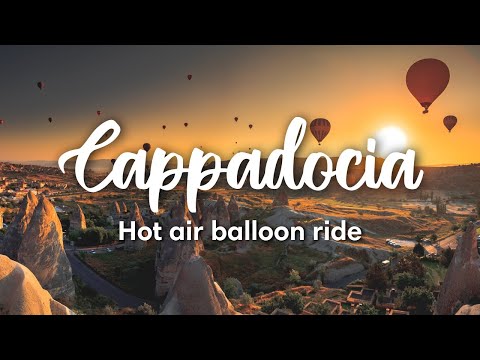
Cappadocia Hot Air Balloons
CappadociaTurkey Updated Apr 2026
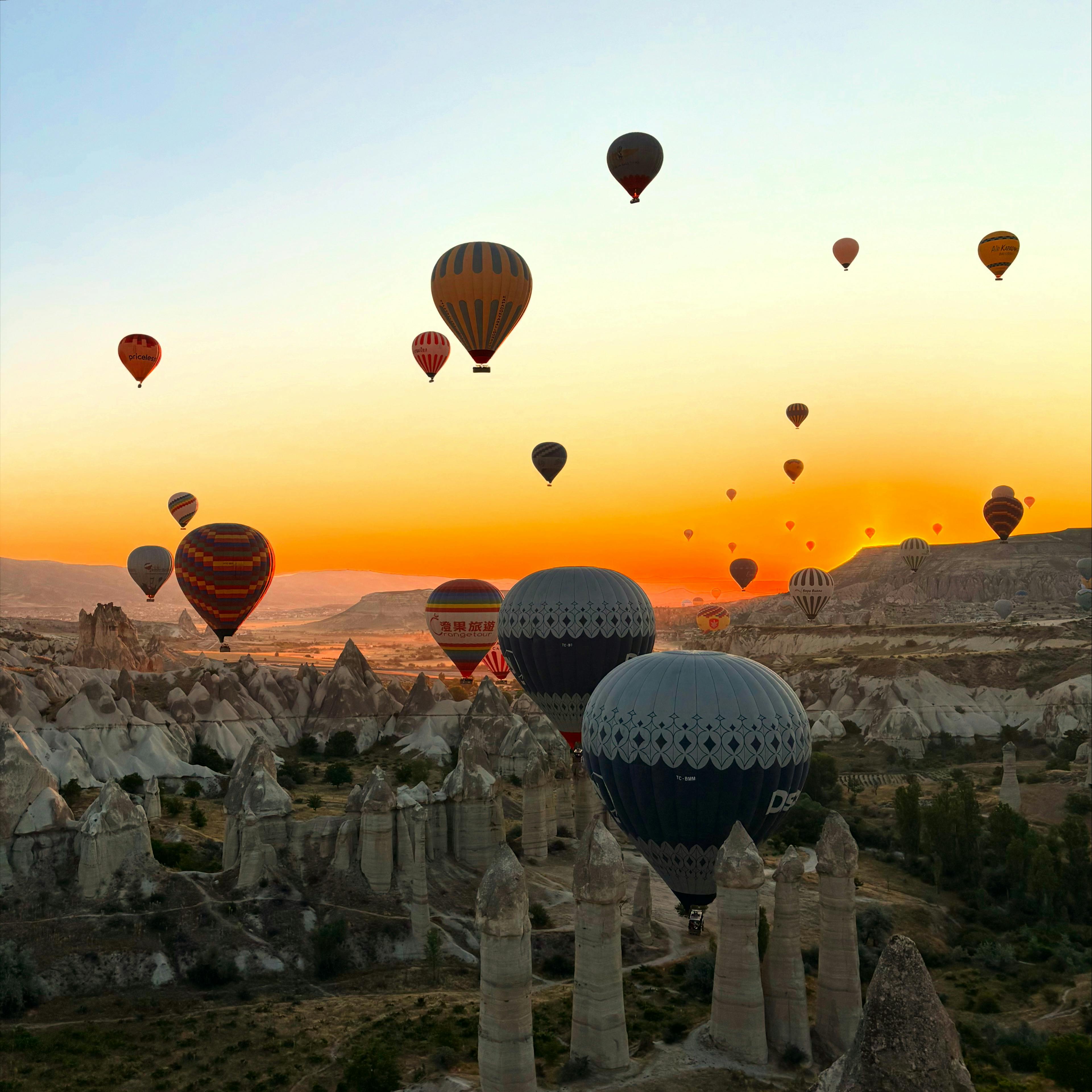
Up to 165 balloons lift off simultaneously at sunrise over Cappadocia's fairy chimneys — one of the densest balloon skies on Earth, flying ~250 days a year.
- Time needed
- Half day (4 AM pickup to ~9 AM return)
- Entry
- €150–180 off-peak / €250–300 peak season
- Access
- Not wheelchair accessible — requires climbing into basket
- Best season
- Autumn (October)
How did a place whose most famous image — a hundred silk orbs drifting over ancient stone — have no balloons in its sky until 1991, six years after UNESCO already declared the ground beneath them a World Heritage Site? Cappadocia's hot air balloons, rising each dawn above the fairy chimneys of Göreme in central Turkey, are the single most photographed scene in Turkish tourism, and yet the entire practice is younger than most of the tourists clutching their cameras in the basket.
What you see today: a pre-dawn convoy of minibuses delivering sleep-dazed passengers to open fields outside Göreme. Propane burners roar in the dark, filling envelopes that bloom like enormous paper lanterns laid on their sides. Then silence. One by one, up to 165 balloons — the daily cap enforced by Turkey's civil aviation authority — lift off into a sky turning from indigo to apricot. Below, the tuff pillars and rock-cut churches of a Byzantine monastic world pass in miniature, close enough to read the erosion lines.
The scale is staggering. Nearly 770,000 passengers flew in 2024 alone, carried by roughly 25 licensed companies operating about 250 registered balloons. According to one industry estimate, around 40 percent of all commercial balloon rides on Earth happen in this single valley system. The flight lasts roughly an hour, covers no fixed route — wind decides — and ends with a champagne toast on whatever patch of vineyard or stubble field the pilot can thread the basket onto.
Come for the photograph. Stay for the vertigo of realizing that the monks who carved those churches a thousand years below you never saw anything like this — and that the entire spectacle was invented within living memory.
What to see
-
The Inflation Field at Pre-Dawn
You will not expect the ground to be the best part. But at 04:15, standing on cold tuff gravel in near-total darkness, you watch 100-plus balloon envelopes laid flat like enormous deflated jellyfish — each one roughly 25 metres tall when upright, taller than a seven-storey building. Cold-pack fans scream first, filling the nylon with ambient air until the fabric twitches and billows. Then the burners ignite. That first whoosh — a four-second roar like a giant gas hob lighting in a cathedral — bounces off the volcanic ridges and comes back doubled. Multiply it across the entire field and you get a staggered chorus of flame-roars echoing through the dark, each burst painting the inside of an envelope in sudden orange.
The temperature contrast is physical and strange: your face warm from the propane heat, your back freezing in the Cappadocian pre-dawn cold. The air smells of sweet propane gas and damp volcanic dust. Around you, ground crews shout in Turkish, wicker baskets creak as they're tipped upright, and the envelopes slowly rise from horizontal to vertical like creatures waking up. This 30-minute inflation ritual — assembled and dismantled every single morning across rotating fields near Göreme — is a logistical performance as impressive as the flight itself. Most passengers are too sleepy to notice. Don't be.
-
The Sunrise Flight Over Fairy Chimneys
Here is the thing nobody tells you about riding a hot air balloon: there is no wind. Because the basket moves with the air mass, the atmosphere around you is perfectly still — no breeze on your face, no flapping hair. You rise so smoothly that the only way to know you've left the ground is to look down and see Göreme shrinking beneath you. Then silence. Absolute silence, broken every 40 seconds by the pilot's burner blast overhead, a roar that heats the crown of your skull and then stops, leaving you in a stillness where you can hear roosters crowing 600 metres below and the muezzin's dawn call drifting up from Uçhisar.
The visual choreography is staggering. Up to 165 balloons fly simultaneously — a regulatory cap set by Turkey's civil aviation authority — stacked at different altitudes because pilots can only steer vertically, riding different wind layers. You'll see balloons 300 metres above you and others skimming the tops of fairy chimneys at your feet. The real show, though, is the light. First sun hits the eastern faces of the tuff formations while western valleys stay in deep blue shadow, and that dividing line advances visibly across the rock over eight or ten minutes. Each chimney casts a long indigo shadow westward — from altitude, these shadows form an inverted forest of spires that most passengers miss entirely because they're photographing the balloons instead. Look down.
-
The Valley Dip and the Champagne Landing
The best pilots don't just float — they perform. Ask beforehand about the "tuff kiss": a deliberate manoeuvre where the pilot descends into Love Valley or Red Valley and brushes the wicker basket against the top of a fairy chimney, close enough for passengers to reach out and touch 10-million-year-old volcanic rock. When the balloon dips into a narrow valley, the burner roar bounces off both canyon walls and returns as a strange doubled echo one to two seconds later — a sound you won't hear anywhere else on earth.
After landing — sometimes directly onto the transport trailer in a feat of precision that earns genuine applause — the ground crew unfolds a small table on whatever random field the wind chose. The champagne toast is a tradition borrowed from 18th-century French ballooning: according to the old story, Montgolfier-era aeronauts carried bottles to appease farmers whose crops they'd crashed into. Today it's sparkling wine, a hand-signed flight certificate, and 15 minutes standing on tuff soil watching the enormous envelope collapse into a soft, colourful puddle behind you. That quiet deflation — a long, slow hiss — is somehow the most moving sound of the whole morning.
Plan your visit
- Getting There
- Fly into Nevşehir Kapadokya Airport (NAV), 40 km from Göreme, or Kayseri Erkilet (ASR), 75 km out — both have shuttle transfers to town. You won't navigate to the launch site yourself: every ticket includes hotel pickup around 04:30–05:00 AM, with the operator's minibus delivering you to whichever field the wind chose that morning. Long-distance buses reach Nevşehir's otogar, then a local dolmuş covers the last stretch to Göreme for a few lira.
- Opening Hours
- As of 2026, flights launch exclusively at sunrise — typically 06:00–06:30 AM depending on the month — with Turkish Civil Aviation officials making the go/no-go call around 04:00 AM each day. There are no afternoon or evening flights; the physics of cold morning air is the whole point. Roughly 220 days per year are flyable, with the highest cancellation rates in December through March due to snow, fog, and high winds.
- Time Needed
- The airborne portion runs 45–60 minutes, but the full experience — hotel pickup, watching the envelopes inflate in the dark, the flight itself, the champagne toast and certificate ceremony, and the drive back — takes 3 to 4 hours. You'll be back at your hotel by 09:00–10:00 AM, leaving the rest of the day wide open. Budget at least 3 sunrise mornings in Cappadocia so weather cancellations don't ruin your only shot.
- Accessibility
- This is not wheelchair accessible. Passengers must climb unaided into a chest-high wicker basket, stand for the entire flight, and brace in a bent-knee position for landing on rough, uneven dirt fields. Guide dogs are permitted by most operators, but pregnant travelers are generally refused due to hard landings, and passengers over 120 kg may need to book a private basket for weight balance.
- Cost & Tickets
- As of 2026, standard flights (baskets of 20–28 passengers) run €85–€120 per person; deluxe smaller-basket options cost €180–€250; private flights start around €300 and climb past €500. Every ticket includes hotel transfers, a light pre-flight breakfast, insurance, champagne toast, and a flight certificate. Book 30+ days ahead in April–November peak season, ideally direct with licensed operators like Royal Balloon, Butterfly, or Voyager — hotel concierge bookings often carry steep markups.
History
Thirty-Four Years in a Sixty-Million-Year-Old Sky
The volcanic tuff formations of Cappadocia took roughly 60 million years to sculpt. The Byzantine monks who hollowed them into churches and refuges worked across a millennium. Commercial ballooning over the same terrain has existed for barely a generation — and yet it has become the defining image of the region, eclipsing the rock-cut frescoes, the underground cities, and even the UNESCO listing itself.
Understanding how that happened means tracking a surprisingly compressed history: a single foreign-born company, a regulatory freeze that turned two dozen operators into a closed guild, and an annual festival now backed by Turkey's Ministry of Culture as a national cultural event.
The turning point
The Monopoly That Made the Sky Famous
The surface story is simple: balloons appeared over Cappadocia because the landscape is beautiful. Tourists came, operators multiplied, and now it's an icon. But the timeline doesn't quite support that tidy arc. According to industry sources, the first commercial flight launched in 1991 — organized, tradition holds, by Swedish balloonists Kaili and Lars-Eric Moré, who founded Kapadokya Balloons after an international gathering of pilots in the region. For years, possibly a decade or more, they were the only operator. One company. One balloon. A sky that today holds 165 at once was, for its founding era, essentially private.
What changed was demand — and then regulation. As competitors entered through the 2000s, passenger numbers climbed past the tens of thousands, then the hundreds of thousands. Turkey's Directorate General of Civil Aviation (SHGM) responded by capping the daily fleet at 165 balloons and, critically, freezing new operator licenses for Cappadocia airspace entirely. No new companies may register. The 25 that hold licenses now hold them like guild charters — inheritable, finite, enormously valuable. The sky over Göreme is, in regulatory terms, a closed shop.
Knowing this changes what you see at dawn. Those 165 balloons aren't a spontaneous flock; they're the maximum permitted output of a tightly controlled industry younger than the iPhone. The Morés' single balloon became a fleet, the fleet became a cap, and the cap became a kind of artificial scarcity that keeps the experience both spectacular and — at €150–300 per seat — highly profitable. The fairy chimneys below are ancient. The business model floating above them is ruthlessly modern.
The Solo Era (1991–early 2000s)
According to the industry's own telling, Kapadokya Balloons operated as a monopoly for years after its 1991 founding. Passenger counts were tiny — a few dozen per week at most. The experience was niche, expensive, and almost unknown outside specialist travel circles. The 1997 First World Air Games, reportedly held partly in the region, may have been the first event to broadcast the Cappadocia-balloon image internationally, though this claim rests on a single source and remains unconfirmed.
The Boom and the Cap (2000s–present)
Competitor companies entered through the 2000s, and by the 2010s the fleet had swelled to roughly 250 registered balloons across 25 operators. The DGCA's 165-balloon daily cap and operator freeze formalized the industry's limits. In 2019, the first Cappadocia International Hot Air Balloon Festival (Balonfest Kapadokya) launched — now a state-backed annual event featuring special-shape balloons from dozens of countries, night-glow fire spectacles, and folk performances. The 2025 edition runs August 7–10 with 38 special-shape balloons from 27 nations. What began as one Swede's side project is now a ministry-level cultural program.
Tips for visitors
October Beats Summer
Locals quietly recommend October over July: more stable weather, fewer cancellations, gentler crowds, and prices drop to €150–180 from the summer peak of €250–300. The light is warmer, the valleys turn gold, and you won't share your basket with 27 strangers.Drones Are Banned
Turkish Civil Aviation prohibits unauthorized drones in Cappadocia airspace during flight hours, and Göreme National Park requires a permit year-round — tourists are routinely fined. In-basket photography is encouraged, but use a wrist strap or neck lanyard for your phone; a drop from 300 meters is unrecoverable.Pick Your Basket Side
Here's something no guidebook prints: ask the pilot before boarding which compartment of the basket faces the best valley views that morning. Flight paths and wind direction change daily, so the prime position rotates — a 10-second question can transform your entire hour aloft.Eat After, Not Before
The pre-flight breakfast is tea and biscuits — functional, not memorable. Save your appetite for Dibek in Göreme, a restaurant inside a 475-year-old stone building where the testi kebabı (clay-pot stew cracked open tableside) is Cappadocia's signature dish, around €15–20 per person. For budget pide and lahmacun, Fırın Express does the job for under €10.Dress For Two Climates
Pre-dawn ground temperatures are genuinely cold even in August, but the burner roaring above your head at altitude is furnace-hot. Wear removable layers, a windproof jacket, and closed-toe shoes with grip — the landing fields are rocky dirt, and the basket can tip sideways in wind. Leave scarves and loose accessories at the hotel; they're a fire hazard near the burner.Tip The Ground Crew
The chase team hauling 500 kg of nylon in the dark at 3 AM earns modest wages. A tip of 50–100 Turkish lira per person isn't expected but is deeply appreciated — hand it directly to the crew after landing, not to the pilot or the company.
Watch & Explore Cappadocia Hot Air Balloons.

Frequently asked
Is a Cappadocia hot air balloon ride worth it?
Yes — floating over fairy chimneys at sunrise with up to 150 other balloons in the sky is one of the most visually extraordinary things you can do in Turkey. The flight itself lasts about an hour, but the full experience runs 3–4 hours from your 4:30 AM hotel pickup through inflation-watching, the flight, and a champagne toast on landing. What surprises most people is the silence: because you move with the wind, there's no breeze on your face, and between burner blasts you can hear roosters crowing in Göreme village 600 meters below.
How much does a hot air balloon ride cost in Cappadocia?
Standard flights start at €85–€120 per person as of 2026, rising to €250–€300 in peak summer months. That base price includes hotel transfers, a light pre-flight breakfast, the 45–60 minute flight, champagne toast, flight certificate, and insurance. Smaller-basket "comfort" flights (16–20 passengers instead of the standard 24–28) run €180–€250, while private or premium flights can hit €500. Book directly with licensed operators rather than through hotel concierges, who often mark up significantly.
What is the best time to visit Cappadocia for hot air balloons?
October is the sweet spot — stable weather, far fewer cancellations than summer, gentler crowds, and prices roughly half the July peak. The official flying season runs April through November, with balloons going up around 250 days per year. Winter flights (December–February) offer snow-dusted fairy chimneys and a dramatic monochrome palette, but cancellation rates climb sharply. Whatever the season, build at least three sunrise mornings into your itinerary to absorb weather cancellations — the Turkish Civil Aviation Authority makes a go/no-go call each morning, and roughly a third of scheduled flights get scrubbed.
How long do you need in Cappadocia for hot air balloons?
Plan a minimum of three nights, ideally four. The balloon experience itself takes one morning (back at your hotel by 9–10 AM), but weather cancellations are common enough that you need buffer days. Those extra mornings aren't wasted — Cappadocia's underground cities at Derinkuyu, the Byzantine frescoed churches of the Göreme Open-Air Museum, and the Ihlara Valley gorge hike each deserve a half-day.
How do I get to Cappadocia from Istanbul?
The fastest route is a 1-hour 15-minute flight to either Nevşehir Kapadokya Airport (NAV, about 40 km from Göreme) or Kayseri Erkilet Airport (ASR, about 75 km out). From either airport, most hotels arrange shuttle transfers, or you can book a private car. Long-distance buses from Istanbul run overnight (10–12 hours) to Nevşehir's otogar, where you transfer to a local dolmuş minibus into Göreme — cheaper but brutal on sleep when your balloon pickup is at 4:30 AM.
Are Cappadocia hot air balloons safe?
The industry has a generally strong safety record, but it is not risk-free — a DergiPark academic study identifies Cappadocia as one of Turkey's most intensive balloon-incident regions, and hard-landing injuries have occurred. Turkish Civil Aviation caps flights at 165 balloons per day, freezes new operator licenses, and makes the daily weather-clearance decision centrally. Your best protection is booking with one of the established licensed operators (Royal Balloon, Kapadokya Balloons, Butterfly Balloons, Voyager) and confirming their DGCA license — only about 25 companies are authorized for Cappadocia airspace.
What should I wear on a Cappadocia balloon ride?
Layers and closed-toe flat shoes — no exceptions. Pre-dawn temperatures drop near freezing even in summer, and at 300 meters altitude it's colder still, though the propane burner directly above your head throws serious heat downward. Avoid loose scarves (fire risk from the burner), skip heels and sandals (landing fields are rough volcanic dirt), and secure your phone with a wrist strap or lanyard — drops from altitude are unrecoverable. A snug beanie protects against both cold and the occasional singed-hair surprise from the burner's pilot light.
Can you watch Cappadocia balloons without flying?
Absolutely, and it's free. The best ground-level viewpoint is Sunset Point (also called Lover's Hill) in Göreme, where around 150 people gather at dawn — arrive 30 minutes before sunrise for a good spot. Cave hotel rooftops across Göreme offer the classic "carpet and coffee with balloons" view; Sultan Cave Suites and Kelebek are the most photographed. For a quieter alternative, the ridge trail above Red Valley or the top of Uçhisar Castle puts you high enough that balloons actually float below your eye-line.
Sources & attribution 29
- Fly Cappadocia Balloon — History of Cappadocia Hot Air Ballooning — Industry-told origin narrative (1991 founding), daily balloon cap of 165, ~25 licensed companies, operator license freeze, annual passenger estimates
- DergiPark — Hot Air Balloon Accidents in Turkish Airspace (academic study) — Academic study identifying Cappadocia as an intensive balloon-incident research zone
- UNESCO World Heritage Centre — 36th Committee Decisions (Göreme inscription) — Confirms UNESCO inscription of Göreme National Park and Rock Sites of Cappadocia (1985)
- Kings World Travel — Cappadocia Guide — General Cappadocia tourism overview including multiple launch points (Göreme, Uçhisar, Nevşehir, Avanos)
- Adventus Travel — Cappadocia Hot Air Balloon Experience — Seasonality, ~220 flyable days/year, ~3,000 daily passenger capacity, cancellation policies, booking lead times
- Hot Air Balloons Cappadocia — 2026 pricing (€85 standard), accessibility info, guide dog policy, mobility limitations
- Una Cappadocia — Hot Air Balloon Tour — 2026 pricing confirmation (from €100)
- Book From Locals — Hot Air Balloon in Cappadocia — 2026 pricing (€120 until Feb 2026)
- Tourla Cappadocia — Balloon History — Night flights not operated, sunrise-only regulation, plan 3–4 mornings advice
- Tourla Cappadocia — Everything You Need to Know — Layering and clothing advice, pre-dawn temperature warnings, total experience duration
- Memories Cappadocia — History of Hot Air Balloons — Kapadokya Balloon founding claim (1990, Lars-Eric Möre), 1997 World Air Games reference
- Feliz Turismo — Cappadocia Transportation Guide — Long-distance bus and dolmuş minibus transport options to/within Cappadocia
- Turkey Travel Planner — Cappadocia Transport — Airport distances: Nevşehir (NAV) ~40 km, Kayseri (ASR) ~75 km from Göreme
- Lonely Planet — Getting Around Cappadocia — Dolmuş shared minibus routes between Göreme, Ürgüp, Avanos, Uçhisar
- GetYourGuide — Cappadocia Balloon Tours — Booking platform for balloon tours, operator listings
- Go Türkiye — Cappadocia Hot Air Balloons Things to Know — Official Turkish tourism board balloon guidance
- Lemon8 / @77shome — Cappadocia Balloon Trip Report — First-person sensory details: pre-dawn pickup, inflation field sounds, sunrise light progression
- Lemon8 / @mentaik.o — Cappadocia Experience — Summer pricing, cancellation frequency, half-day time commitment
- Trip.com — Love Valley Cappadocia Guide — Launch field locations including Love Valley
- TripAdvisor — Cappadocia Balloon Attractions — 2026 pilot reviews (Burak/Royal, Ibrahim/Discovery), trailer-landing precision, champagne toast details
- TikTok / @catchagypsea — Cappadocia Balloons — Sunrise viewpoint at Sunset Point/Lover's Hill, ~250 flying days/year claim
- Trip.com — Love Valley Cappadocia Guides (SG edition) — Valley names, local vocabulary (peribacaları), October recommendation, basket compartment tip, drone rules, photography advice
- Lemon8 / @jonathanfraga — Cappadocia Insider Review — Local attitudes toward tourists, Instagram tourism resentment, horse-tour animal welfare concerns, small pension vs. big hotel comparison
- Toursce — Hot Air Balloon Festival 2026 Cappadocia — BalonFest Kapadokya details: 2019 founding, 2025 dates (Aug 7–10), special-shape balloons, Night Glow, festival food
- Lemon8 / @davekoh62 — Cappadocia Tips — Proposal/engagement sub-economy, currency exchange advice
- The World or Bust — Turkey Hot Air Balloon Festival — 2024 passenger count (769,814), 40% global balloon-ride market share claim, festival 2025 details
- Facebook — Balonfest Kapadokya Pilot Pre-Registration — 2026 festival pilot pre-registration confirmation
- Go Türkiye — Mevlevi Ceremonies — Adjacent Anatolian living heritage context (whirling dervish traditions in broader Cappadocia region)
- UNESCO World Heritage Centre — Göreme Documents — Additional UNESCO documentation on Göreme National Park heritage site
Built from cited sources · see the method · How we make our guides →
Pick up where you left off
Saved and recently read places — kept on this device only.