A football stadium in Antalya, Turkey, makes its first impression with sunlight and solar panels, then tells you a story about grass that refused to cooperate. New Antalya Stadium, now branded Corendon Airlines Park, is worth visiting because it shows a different side of the city: not Roman gates or minarets, but a modern civic stage where ambition, politics, and supporter culture meet under a Mediterranean roof. Come for the matchday noise if Antalyaspor are home. Stay for the strange, very Turkish mix of glossy spectacle and stubborn reality.
Most visitors meet Antalya through Hadrian'S Gate, the old harbor, or the spray at Düden Waterfalls. This stadium sits in a different register. Records show it rose in Muratpaşa on the long-disputed 100. Yıl sports-complex site, west of the old center, as part of Turkey's early-2010s rush to build new arenas.
The building's best detail hangs over your head. Part of the roof was designed to stay transparent so sunlight could reach the pitch, while the rest carried a solar installation large enough for the stadium to generate electricity and feed power back into the grid. Elegant idea. Then the turf failed within weeks of the 26 October 2015 opening, and Antalyaspor had to retreat to the smaller ground at Akdeniz University.
That tension is why the place matters. New Antalya Stadium is not old enough for legends, but it is new enough that the motives behind it still feel warm to the touch: a club chasing a bigger profile, a city trying to look beyond beaches and package holidays, and officials betting that a 33,000-seat bowl could remake the civic mood.
Researched by the Audiala editorial team from historical records, architectural archives, and local expertise.
What to see
The Solar Roof and Circular Exterior
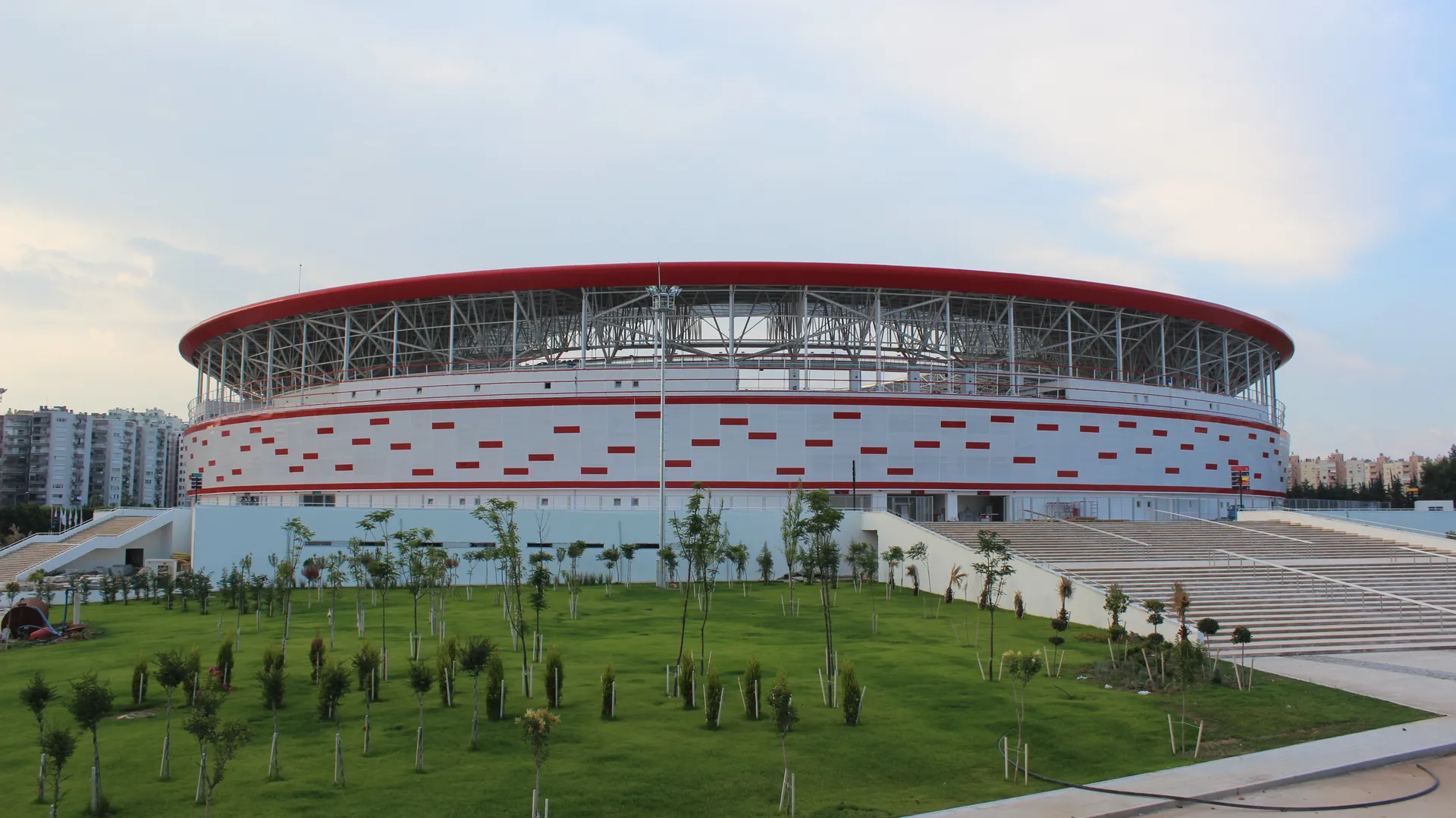
The first surprise comes before you reach the turnstiles: from outside, Antalya Stadyumu reads less like a football ground than a giant red-and-white drum set on a high concrete plinth, its round shell wrapping a rectangular game inside. AZ Aksu designed the stadium in 2013 with 33,000 seats and 87,331 square meters of built area, and that outer circle matters because it gives the place a faint echo of the region's ancient theatres while the 22,118-square-meter roof above you carries a 1,400-kilowatt solar array large enough to feel more like an industrial field than a decorative cap.
The South Promenade and the Bowl’s Odd Geometry
Climb high on the south side and the stadium suddenly gives up its best secret: the bowl opens just enough for a glimpse of the Mediterranean and the hotel strip, a blue horizon beyond all that concrete and steel. Stay a minute, then look back at the end stands, where four stacked tiers rise behind the goals like shelves rather than a single sweep; the upper balconies are only five or six rows deep, so chants, whistles, and drumbeats feel trapped under the roof instead of drifting away into the Antalya heat.
From Undercroft to Kickoff
Start below the bowl, where the stadium shows its real character: 29 kiosks, retail units spread across 7,500 square meters, and the Antalyaspor store tucked under the structure make this place feel half match venue, half revenue machine from Turkey's early-2010s building boom. Then walk toward the upper circulation before kickoff and remember what came before, when Antalyaspor still played at Akdeniz University; the move here in October 2015 was supposed to announce a bigger club, and the patchy grass that failed within a month only makes the ambition more human.
Plan your visit
Getting There
Corendon Airlines Park stands in Meltem, Muratpaşa, on Sakıp Sabancı Bulvarı near 3802. Sokak, about 6-8 minutes on foot from Cam Piramit and 10-15 minutes from Antalya Museum. Bus is the cleanest option: stops like Meltem Blv-6, Dumlupınar Blv-9, and Adliye Sarayı sit 2-3 minutes away, while the Üni.Hastanesi2 light-rail stop is about a 13-minute walk; from Antalya Airport, bus 400 is one practical public-transport route.
Opening Hours
As of 2026, no official daily visitor hours or regular stadium-tour schedule are published by Antalyaspor. Treat this as a match-and-event venue: the exterior is visible from public streets at any time, but interior access usually means a ticket or a special arrangement confirmed with the club.
Time Needed
Give the exterior 15-30 minutes if you just want photos and a look at the solar-roofed shell, which spreads over the block like a low red-white bowl. Plan 45-75 minutes if you also want to walk the district around Cam Piramit and the museum side of town, or 2.5-4 hours for a match, with arrival 60-90 minutes before kick-off.
Accessibility
The ground opened in 2015, so the basic design is modern, and the surrounding streets are mostly flat enough for a wheelchair approach from nearby bus stops. But Antalyaspor does not publish a detailed access guide with gate-by-gate step-free routes, lift locations, or accessible seating maps, so limited-mobility visitors should confirm arrangements in advance at +90 242 237 08 81 or [email protected].
Cost & Tickets
As of 2026, prices swing wildly by match rather than following one tourist entry fee: recent league examples ran from 100 TL to 750 TL for Samsunspor, while the Fenerbahçe fixture reached 3,000 TL to 10,000 TL. Buy through Passo, Passo Mobile, or the Passolig box office at the stadium; children 7 and under do not need a ticket, and women, students, and disabled supporters get 25 percent season-ticket discounts at the box office.
Photo Gallery
The interior of New Antalya Stadium reveals its vast steel roof lattice, tiered concrete stands, and open bowl under bright Mediterranean light. A few workers on site give a sense of the stadium's scale. · The original uploader was E-92 at Turkish Wikipedia.New Antalya Stadium appears from above as a striking circular arena near Antalya's Mediterranean coast. The bright midday light highlights its modern roofline, surrounding plaza, and the city stretching toward the sea. · beIN SPORTS TürkiyeA rendering of New Antalya Stadium in Antalya, Turkey shows its sweeping roof, transparent facade, and landscaped green terraces opening into a public park. Small groups of people animate the scene under clear, soft daylight. · Dlavelle1New Antalya Stadium rises above landscaped lawns in Antalya with a bold red-and-white oval facade. Soft evening light brings out the scale of the modern arena and its open steel structure. · OnurNew Antalya Stadium opens beneath a vast steel lattice roof, with daylight pouring onto the pitch and packed stands on all sides. The scene captures the scale and energy of Antalya's modern football arena. · Dlavelle1
History
A Stadium Born Mid-Argument
New Antalya Stadium does not offer the usual heritage comforts of age, ruin, or myth. Its past is documented in tenders, court fights, ministry ceremonies, and supporter memory. Records show the site belonged to the contested 100. Yıl Spor Kompleksi area, where sports land, commercial ambition, and public anger kept colliding for years before construction finally began.
That makes the ground more interesting than its fresh concrete suggests. The old Antalya Atatürk Stadium, opened in 1965, stood elsewhere and was declared unsafe in 2010; Antalyaspor then bounced through temporary homes before reaching this new arena in 2015. What you see here is less a clean replacement than the end of a long, messy detour.
The turning point
Menderes Türel and the Price of a New Antalya
Few figures tie this story together more neatly than Menderes Türel, the Antalya politician who appears at both ends of the city's stadium upheaval. Documented reports place him in the 2007 phase of the 100. Yıl complex tender process, backing a future of flagship sports infrastructure, and then again in 2016 at the demolition of the old Atatürk Stadium, where he spoke about the memories his generation had lodged in those stands. For him, this was personal as well as political.
The turning point came on 23 June 2013, when the foundation ceremony took place during the Gezi protest summer. Records show Minister of Youth and Sports Suat Kılıç laid the groundwork with TOKI president Ahmet Haluk Karabel and football officials present, while nearby residents protested from balconies and windows, banging pots and pans. Two Antalyas stood in the same frame: one cheering a solar-powered future, one asking who the city was being built for.
Then football intruded, as it always does. The stadium entered service with Antalyaspor vs Beşiktaş on 26 October 2015, and the first official goal was scored by Beşiktaş defender Necip Uysal, which feels almost rude in its symbolism. A month later the turf problems forced a temporary retreat. Grand projects rarely fail all at once. They wobble first.
The Roof That Promised Too Much
The stadium's secret sits above the seats, not on the pitch. Official descriptions state that transparent roof sections were meant to help the grass, while the wider canopy carried solar panels in a city with more than enough sun to make the idea look obvious. Yet by 24 November 2015, documented reports show the surface was in such poor condition that Antalyaspor's next home match had to move back to Akdeniz University. The building wanted to be a postcard for clean, smart infrastructure. The grass answered like grass.
From Eto'o to the North End
New buildings do not create club memory on their own; supporters drag it with them. Antalyaspor signed Samuel Eto'o in July 2015 while still playing at the university ground, a statement of ambition delivered before the club had a settled home, and local supporter culture carried the deeper continuity. According to club and fan accounts, groups such as 07 Gençlik transferred their north-end identity from the old Atatürk Stadium to each temporary stop and then into this bowl, turning a new arena into inherited territory by force of habit, noise, and repetition.
Tips for visitors
Eat Local First
Skip the anonymous matchday fast food if you have an extra hour. Go for Antalya's tahini-rich piyaz and şiş köfte at Piyazcı Ahmet or Şişçi Ramazan, or keep it simple with Route Burger Meltem right under the stadium; 5M Migros is the reliable fallback for toilets, air-conditioning, and chain food.
Camera Rules
Phone photos are usually fine on ordinary event days, and the best exterior shots come when the late sun catches the red seating bowl through the facade gaps. Bring a professional camera, tripod, selfie stick, or drone and you are asking for trouble; drone use in Turkey needs permission, and a stadium is the wrong place to improvise.
Travel Light
Do not arrive with a large bag or suitcase. No official left-luggage policy is published for the stadium, security checks are standard at Turkish football grounds, and even nearby third-party storage should be treated as a backup rather than part of your main plan.
Pick Your Match
This place makes the most sense when Antalyaspor host a match that matters, because on a quiet day you are really visiting the outside of a stadium, not a full public attraction. Big fixtures bring noise, color, and ticket-price shock; lower-profile games cost far less and feel easier if you want the experience without the scramble.
Pair The District
The stadium sits in everyday Antalya, not the resort postcard version, which is exactly why the area is interesting. Pair it with Akdeniz University, a walk around Cam Piramit, or a stop at Antalya's museum quarter before heading toward Konyaaltı later.
Wear Neutral Colors
Dress is casual, but home sections are no place for away colors or provocative slogans. Neutral clothes are smartest if you are not an Antalyaspor supporter, and clean casual works better than beachwear if you somehow end up in a VIP or club-hosted area.
Where to Eat
local_dining
Don't Leave Without Trying
Antalya piyazı with tahini-based taratorKabak tatlısı with tahini and walnutsHibeşSerpme börekArap kadayıfYanık dondurmaŞiş köfteMediterranean seafood and olive oil dishes
Çömlekçi Restaurant
local favorite
Turkish grill house and soup kitchen€€star4.8(2563)
Order: Order the lamb cooked with tomato and eggplant, or go straight for the kelle paca with garlic sauce, vinegar, and fresh bread if you want the dish people remember.
This is the one to pick when you want something rooted in local eating habits rather than a polished view-and-cocktail setup. Reviews keep circling back to careful cooking, generous portions, and staff who make the room feel easy even when it's busy.
Modern Mediterranean restaurant with seafood and handmade pasta€€star4.7(623)
Order: Get the handmade noodles with shrimp sauce, the baked veal, or the octopus if seafood is what brought you here.
Nomades sounds like a restaurant that actually pays attention in the kitchen. Diners mention the chew of the fresh noodles, the tenderness of the veal, and service that stays warm without turning into a performance.
Cafe for breakfast, brunch, and light Turkish-international plates€€star4.8(173)
Order: Come for breakfast and order the Turkish breakfast, or take the Benedict eggs on sourdough if you want the dish regulars talk about.
This is the kind of weekday cafe people slip into and then keep returning to. Reviews describe a room with books, couches, fair prices, and healthy options that make it feel more lived-in than designed.
Mediterranean seafood and grill restaurant€€star4.7(2150)
Order: Order the seafood first: fresh fish and prawns are what reviews praise most, then finish with the Volcano Dessert.
A lot of places sell the sea view in Antalya and forget the plate. Sauvignon seems to manage both, with repeated praise for the freshness of the seafood, polished service, and a setting that earns its keep.
checkBreakfast usually runs roughly 07:00-10:00, lunch about 12:00-14:00, and dinner about 19:00-21:00.
checkIn Antalya, dinner often starts later in the evening, especially in summer, and meals tend to be social and unhurried.
checkTipping is appreciated but not mandatory; 5-10% for good service is a common range, and 10% is a standard rule of thumb.
checkCheck the bill before tipping because some places, especially in tourist-heavy areas, may already include a service charge.
checkCash is the safest way to leave a tip.
checkVisa, Mastercard, and contactless card payments are widely accepted in Antalya, but cash is still useful for weekly markets, small family-run places, and the occasional card-terminal failure.
checkDo not assume a citywide restaurant closing day; some Antalya restaurants close Monday, while others operate seven days a week, so check the listing before you go.
checkNear the stadium, the confirmed local produce markets are Wednesday at Öğretmenevleri, Thursday at Uncalı, Friday at Altınkum, Saturday at Gürsu and Hurma, Sunday at Pınarbaşı, and Tuesday at Liman.
Inside View: Pre-Season Tour, Antalya Turkiye Departure
Kedah Darul Aman FC3 min10K
Frequently asked
Is New Antalya Stadium worth visiting?
Yes, if you care about football, stadium design, or how modern Antalya tries to define itself beyond beaches and ruins. This is Turkey's solar-roof stadium in a city better known for Roman gates and resort towers, and that contrast gives the place its edge. Without a match, though, you're mostly coming for the exterior, the under-stadium commercial strip, and the story.
How long do you need at New Antalya Stadium?
You need 15 to 30 minutes for an exterior look, about an hour if you want to walk the district and look around properly. Match day changes everything. Then you should give it 2.5 to 4 hours, with 60 to 90 minutes before kickoff for security, crowds, and finding your section.
How do I get to New Antalya Stadium from Antalya city center?
The easiest way is by bus, not rail. The stadium sits in Meltem, west of the center near the Glass Pyramid, Akdeniz University, and the museum side of town, with bus stops such as Meltem Blv-6 and Adliye Sarayı only a few minutes away on foot. If you're coming from Antalya Airport, public transport usually means bus or AntRay into the city, then a short final bus ride or walk.
What is the best time to visit New Antalya Stadium?
The best time is during a match or in late afternoon when the heat eases and the light softens on the red-and-white shell. Antalya summer sun can feel hard enough to bleach the pavement, so midday exterior visits are less pleasant than they sound. If you only want photos, daylight works; if you want atmosphere, pick a home game that matters.
Can you visit New Antalya Stadium for free?
You can usually see the outside for free from the surrounding public streets, but interior access normally requires a match or event ticket. I found no reliable official evidence of a daily public tour schedule or a permanent museum route. Treat it as a working football ground, not a walk-up monument.
What should I not miss at New Antalya Stadium?
Don't miss the roof, because it tells the whole story. About 22,118 square meters of canopy spread over the bowl like roughly three football pitches, with solar panels across much of it and translucent sections meant to feed sunlight to the grass; also watch for the strange stacked end stands and, if accessible, the south-side upper promenade where the Mediterranean appears beyond the seating.
Why is New Antalya Stadium called Corendon Airlines Park?
Because Antalyaspor sold the naming rights in 2022, and the club announced the new name on August 2, 2022. Locals still mix names freely. You'll hear Corendon Airlines Park, Antalya Stadyumu, Antalya Arena, and the older 100. Yıl label depending on who is talking and how old their habit is.
When did New Antalya Stadium open?
The stadium opened for its first official match on October 26, 2015, when Antalyaspor lost 5-1 to Beşiktaş. The foundation had been laid on June 23, 2013, so the build moved quickly by stadium standards. Then reality arrived fast: less than a month after the opener, turf problems forced Antalyaspor to move a home match back to the university ground.
Sources & attribution24
Researched and written by the Audiala editorial team from historical records, architectural archives, and local expertise. Last updated April 2026.
Antalyaspor Official Website — Official announcement of the 2022 naming-rights change to Corendon Airlines Park.
Antalyaspor Official Contact Page — Official address, district location in Meltem/Muratpaşa, phone number, and contact details for the stadium and club.
AZ Aksu Project Page — Architect attribution, 2013 project date, built area, and overall stadium design facts.
Igor Sporynin — Unsplash License (https://unsplash.com/license) — Source: https://images.unsplash.com/photo-1719311313619-a58925e96cb7
Yeni Antalya Stadyumu - 23.6.15 — Onur — CC BY-SA 4.0 (https://creativecommons.org/licenses/by-sa/4.0/) — Source: https://commons.wikimedia.org/wiki/File:Yeni_Antalya_Stadyumu_-_23.6.15.JPG
Antalya Arena İnşaatı - Nisan 2015 — The original uploader was E-92 at Turkish Wikipedia. — CC BY 2.5 (https://creativecommons.org/licenses/by/2.5/) — Source: https://commons.wikimedia.org/wiki/File:Antalya_Arena_İnşaatı_-_Nisan_2015.JPG
Antalya Stadyumu – Dış manzara — beIN SPORTS Türkiye — CC BY 3.0 (https://creativecommons.org/licenses/by/3.0/) — Source: https://commons.wikimedia.org/wiki/File:Antalya_Stadyumu_–_Dış_manzara.png
Concept design for Antalya stadium — Dlavelle1 — CC BY-SA 4.0 (https://creativecommons.org/licenses/by-sa/4.0/) — Source: https://commons.wikimedia.org/wiki/File:Concept_design_for_Antalya_stadium.jpg
Seating Bowl Concept for Antalya Stadium — Dlavelle1 — CC BY-SA 4.0 (https://creativecommons.org/licenses/by-sa/4.0/) — Source: https://commons.wikimedia.org/wiki/File:Seating_Bowl_Concept_for_Antalya_Stadium.jpg
Strictly necessary cookies keep the site working. Analytics (PostHog, Google Analytics) measures how each visitor uses our pages. Marketing loads YouTube videos and walking-route maps without a tap and lets Google Analytics set advertising cookies. We never sell your data. You can change this any time from the footer.
Privacy
Cookie preferences
Pick what you're okay with. You can change this any time from the footer.
Strictly necessary
Always on
Sign-in, language, navigation. Always on.
Product analytics
PostHog (EU) and Google Analytics record which pages you view and how you use them, under a random identifier stored in your browser. Helps us see which pages work and which need fixing. Google's ad personalisation stays off. No selling.
Marketing
Loads YouTube videos and the walking-route maps (OpenFreeMap) without a tap; without it, they load only when you tap them. If analytics is also on, Google Analytics may set advertising cookies. Ad personalisation stays off.