Type 2+ letters to search all countries, cities, and places
/Ctrl KEsc
travel_explore
Type 2+ letters to search all countries, cities, and places
Press Enter to open the top result
Hadrian'S Gate
Antalya·Turkey·36° N · 30° E·Updated Apr 2026
Buried inside Antalya's walls for centuries, Hadrian's Gate kept its Roman ceiling intact; today it marks the step from traffic into old Kaleiçi streets.
How does a Roman triumphal arch survive because later rulers buried it alive? Hadrian's Gate in Antalya, Turkey, answers that question in marble: three arches, blackened grooves cut by cart wheels, and a coffered ceiling that still catches the light as people stream into Kaleiçi. Visit because this is not a dead monument behind a fence; it is a 1,900-year-old city threshold still doing its job.
Most visitors arrive expecting a victory arch for Emperor Hadrian and leave with something stranger. The gate was built to flatter a passing ruler in 130 CE or soon after, then spent centuries trapped inside later fortifications, which protected details that open weather would have rubbed away. Burial saved it.
Stand here for five minutes and the place makes its case. Scooter engines fade behind you, footsteps click on stone, the air shifts as the old town narrows ahead, and the Roman arch frames the route toward Hidirlik Tower and the harbor like a piece of urban stagecraft that never stopped performing.
And the setting matters. Hadrian's Gate is the cleanest hinge between modern Antalya and the older city around Antalya Mosque, where Seljuk, Ottoman, and Roman layers sit almost shoulder to shoulder, close enough to read in one slow walk.
Researched by the Audiala editorial team from historical records, architectural archives, and local expertise.
What to see
The Triple Arch and the Roman Road
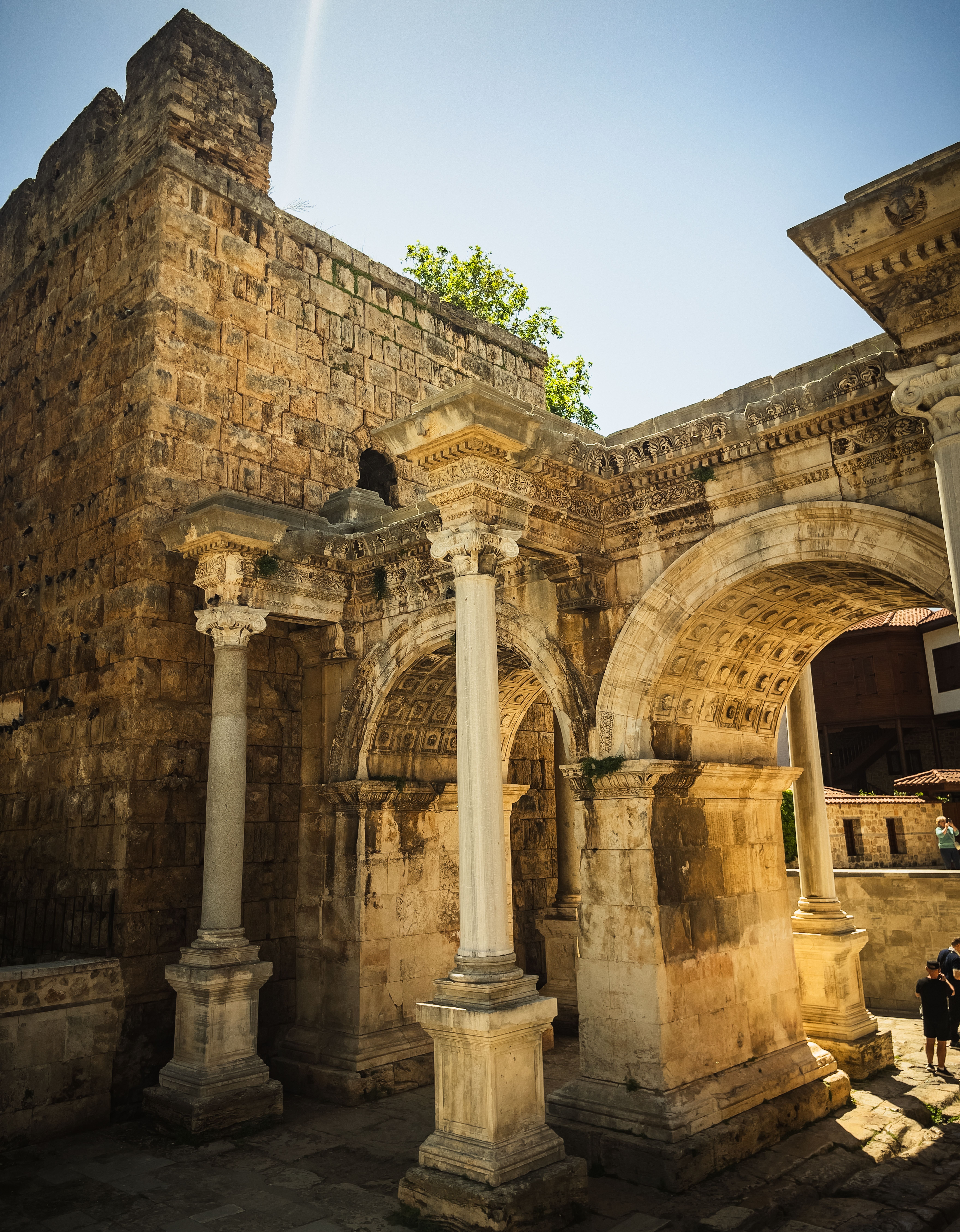
Hadrian's Gate looks almost too refined for a city entrance, all white marble and granite columns, until you step under the middle arch and see the road worn into deep wheel ruts. Those grooves matter more than the emperor, honestly: they turn a monument from imperial propaganda into a working street, and the glass panel lets you read 1,900 years of traffic the way you read a scar on stone. Look up before you leave. The coffered ceilings, studded with rosettes and floral carving, survived because later walls swallowed the gate for centuries and protected what weather would have ruined.
The Two Towers, Roman Below and Seljuk Above
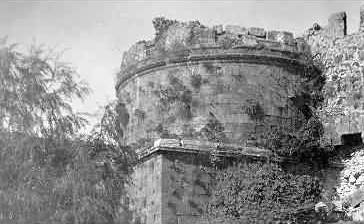
Most visitors photograph the arches and miss the argument happening at the edges. The south tower, known as Julia Sancta, keeps its Roman character; the north tower changes mid-story, with a Roman base and an upper section rebuilt in the early 13th century under Seljuk Sultan Alaeddin Keykubat I, so you can watch one city become another in a single vertical glance. Stand a little off-center from Atatürk Caddesi and the seam reads clearly. Blank stone also tells a story here: the gate once carried gilded bronze letters for Hadrian, and their absence leaves the facade oddly hushed, like a stage after the actors have gone home.
Cross Into Kaleiçi and Walk to Hıdırlık
The best way to see the gate is not to stop at it. Cross from the traffic noise of Atatürk Caddesi into Kaleiçi, pause once to look back through the arches at modern Antalya, then keep walking downhill through the old quarter toward Hidirlik Tower, where the stone changes again and the sea air starts cutting through the smell of coffee and warm dust. That short stretch explains the city better than any panel could. Rome built the ceremonial threshold, Seljuk and Ottoman Antalya folded around it, and present-day Antalya still passes through the same opening on its way to dinner, the harbor, or a detour toward the Antalya Mosque.
Plan your visit
Getting There
Hadrian's Gate sits on Atatürk Caddesi at the eastern edge of Kaleiçi, about a 5-minute walk east from Kalekapısı and the Clock Tower. The nostalgic tram is the cleanest option: ride toward the Hadrian stop or get off at Kalekapısı and walk; from Antalya Airport, take the tram toward the center, change as needed toward Kaleiçi, or expect a 20-30 minute taxi ride depending on traffic.
Opening Hours
As of 2026, the gate is open 24 hours a day, every day of the year, because it stands on a public street rather than inside a ticketed archaeological park. No seasonal closure pattern is reported, and evening visits work well because the arch is lit after dark.
Time Needed
Give it 15-30 minutes if you want a quick look and photos, especially from the Atatürk Caddesi side. Stay 45-60 minutes if you want to study the coffered ceiling, the three arches, and the mismatched towers, then allow 2-4 hours if you continue through the gate into Kaleiçi and down toward the harbor or Hidirlik Tower.
Accessibility
The passage through the gate itself is relatively flat, but the surrounding streets in Kaleiçi are paved with uneven cobblestones that can feel like rolling over a bag of stones. Wheelchair users can reach and pass through the arch, though exploring deeper into the old quarter gets harder; nearby restaurants such as Vanilla and Arma are better bets for accessible seating than many small laneside cafes.
Cost & Tickets
As of 2026, entry is free and no ticket, reservation, or timed slot applies. Save your money for the places beyond the arch: a tea by the harbor, or better, a plate of Antalya piyaz with sis kofte in Kaleiçi.
Photo Gallery
Hadrian'S Gate rises in rough stone and carved marble at the edge of Antalya's old quarter. The overcast light brings out the texture of the Roman arch and medieval tower. · Ray Swi-hymn from Sijhih-Taipei, TaiwanHadrian'S Gate stands between massive stone walls in Antalya, its Roman arches and columns gleaming after rain. Umbrella-carrying visitors and soft gray light give the scene a quiet, historic mood. · Ray Swi-hymn from Sijhih-Taipei, TaiwanHadrian'S Gate in Antalya appears here beside its weathered stone tower and ornate Roman arches, framed by trees on a rainy day. The soft light and wet ground give the historic site a quiet, lived-in atmosphere. · Ray Swi-hymn from Sijhih-Taipei, TaiwanHadrian'S Gate in Antalya pairs a massive weathered stone tower with ornate Roman arches. Soft overcast light brings out the texture of the ancient masonry. · Ray Swi-hymn from Sijhih-Taipei, TaiwanHadrian'S Gate rises in Antalya with its weathered Roman arch, marble columns and massive stone tower. Soft overcast light brings out the texture of the ancient masonry. · Ray Swi-hymn from Sijhih-Taipei, TaiwanHadrian'S Gate stands in Antalya with its Roman arches, carved stonework, and tall columns still sharply defined. Wet paving and soft daylight give the old gateway a quiet, weathered presence. · Ray Swi-hymn from Sijhih-Taipei, TaiwanHadrian'S Gate stands in Antalya with its weathered stone tower and elegant Roman arches reflected by the water below. The overcast light brings out the texture of the old masonry. · Ray Swi-hymn from Sijhih-Taipei, Taiwan
History
Buried, Looted, Reused, Still Standing
Records show that Attaleia, the Roman city beneath modern Antalya, raised this arch to honor Emperor Hadrian during his eastern tour of 130 CE or very soon after. The date sounds tidy. The stone does not.
Look closely and the monument refuses the simple version. Roman marble carries a dedication to Hadrian, a Seljuk tower rises on one side, missing bronze letters leave their pinholes behind, and the road under your feet still bears wheel ruts worn over centuries of daily use.
The turning point
The Gate That Survived by Disappearing
At first glance, Hadrian's Gate looks like a Roman monument that somehow stayed intact from 130 CE to now. That surface story is comforting: emperor visits city, city builds arch, centuries pass, tourists take photos.
Then doubts creep in. Francis Beaufort, the Irish naval surveyor who described the gate after visiting Attaleia in 1811 or 1812, recorded a taller structure with an upper story that no longer exists. Karol Lanckoroński, the Polish aristocrat who paid for a scientific expedition from his own fortune in 1884, reached Antalya with architect George Niemann and found that upper level almost entirely gone. For Lanckoroński, the stakes were personal as well as scholarly: if his team did not document what remained, one of Pamphylia's finest Roman monuments would keep vanishing piece by piece.
The revelation is less romantic and more interesting. This gate survived the long centuries not because people left it alone, but because later city walls enclosed it so tightly that they shielded its carved ceiling from rain and salt air; by the time those walls fell away in the 1959-1962 restoration period, the arch emerged like something uncorked from the dark. Once you know that, you stop seeing a pristine Roman relic and start seeing a survivor shaped by Romans, Seljuks, Ottoman reuse, European collectors, and modern conservators all at once.
Roman Favor and Civic Theater (150 BCE-4th century CE)
Attaleia, founded by Attalos II around 150 BCE, spent nearly 280 years growing into a port important enough to court imperial attention. Scholars date the gate to 130 CE or just after, and the inscription's use of Hadrian's title Olympios points to a post-129 CE carving; in plain terms, the city built a ceremonial welcome arch for a ruler whose visit could raise local prestige and trade.
Seljuk Walls, Borrowed Survival (13th century-19th century)
The northern tower changed when Seljuk Sultan Alaeddin Keykubat I, who ruled from 1220 to 1237, rebuilt its upper section and left an inscription in Arabic script. That mattered because the gate ceased to be only a Roman showpiece and became part of a defended medieval city, sealed inside walls for centuries, while daily traffic kept grinding grooves into the paving stones below.
Rediscovery, Loss, and Restoration (1811-1962)
Beaufort's early 19th-century description suggests the gate still carried much more of its upper story, while Lanckoroński's 1884 expedition documented how much had disappeared by then. Records also show that European collectors removed gilded bronze letters from the dedicatory inscription, scattering them across museums in Vienna, Berlin, Oxford, and London, and modern restoration between 1959 and 1962 finally exposed the arch fully after the surrounding walls came down.
Tips for visitors
Best Light
Go early, around 7-9 AM, if you want soft light and a street that still belongs to locals. Golden hour also flatters the stone, but midday heat in summer turns the marble and pavement into a griddle.
Look Up
Most people photograph the arches and miss the ceiling. Step into the central passage, tilt your head back, and catch the coffered panels that survived because later walls sealed them up like a time capsule.
Skip The Drone
Personal photography is fine, and tripods in a public street usually draw no fuss. Drones are another matter: Kaleiçi is a historic urban zone, and flying without permits is a bad idea in Turkey.
Check The Bill
The gate itself is easygoing; the tourist traps start once menus appear. In Kaleiçi, ask for a written menu with prices before you order, and if a taxi drops you nearby, insist on the meter before the car moves.
Order Piyaz
Don't settle for generic kebab near the arch. Go for Antalya's local pairing of tahini-rich piyaz and sis kofte; Topcu Kebap is the name locals and repeat visitors bring up for the real thing.
Go Through It
The common mistake is treating the gate as the destination. Walk through it, keep going toward the harbor, then loop back past Antalya Mosque or onward to Hidirlik Tower; the arch makes more sense once you feel how it still divides modern Antalya from the old walled quarter.
Where to Eat
local_dining
Don't Leave Without Trying
Antalya piyazı with tahini-based tarator sauceŞiş köfteHibeşKabak tatlısı with tahini or walnutsSerpme börekYanık dondurma
Hare Restaurant
local favorite
Traditional Turkish regional cuisine€€star4.8(485)
Order: Order the Hare Special if you want the table to do the work for you: reviewers call it a filling sampler of classic Turkish dishes, with bulgur rice that stands out.
This is the rare Kaleiçi restaurant that feels tuned to visitors without flattening the food into generic old-town fare. Reviews keep coming back to the terrace, the thoughtful service, and a menu built around recognizable Turkish dishes from different regions rather than tourist filler.
Turkish grill house and soup restaurant€€star4.8(2563)
Order: Go straight for the lamb shish or Urfa kebab, and if you want something more old-school, reviewers rave about the kelle paca lamb head soup with garlic sauce, vinegar, and fresh bread.
This one reads like a place people return to for substance, not just atmosphere. The menu runs from grills to soup-house classics, portions are generous, and the ayran, lentil soup, and slow-cooked lamb dishes give it the feel of a proper city restaurant rather than a polished old-town stage set.
Order: Breakfast is the point here: reviewers single out the eggs and sausage dish, served with traditional Turkish sides, and one guest mentions a special vegan menemen made with fresh vegetables.
Around Hadrian's Gate, breakfast can be better than dinner if you pick the right place. This one sounds warm rather than performative, with homemade sausage, a patio shaded by pomegranate trees, and the kind of welcome that makes people start planning a second visit before they finish tea.
Contemporary Turkish-Mediterranean bistro with cocktails€€star4.8(264)
Order: Order the eggplant and the ceviche; both come up in reviews as the dishes that justify the higher bill.
Hadrian's Gate has no shortage of lazy kebab-and-pizza menus. Mandjie goes the other way: sharp cocktails, a more ambitious kitchen, and a dinner crowd that seems to come for the cooking rather than the postcard setting.
checkNear Hadrian's Gate, expect the overlap of Kaleiçi tourist dining and everyday Muratpaşa eating, with breakfast spreads, grills, meyhane-style dinners, sweets, and snack foods all in the mix.
checkBreakfast usually runs about 07:00-10:00, though weekend kahvaltı often stretches later.
checkLunch is typically 12:00-14:00.
checkDinner is typically 19:00-21:00, often later in summer and in tourist-heavy Kaleiçi.
checkA full Turkish breakfast is usually a spread of cheeses, olives, eggs, tomatoes, cucumbers, bread, jams, honey, and tea rather than a quick coffee-and-pastry stop.
checkTipping is appreciated but not mandatory; 5% to 10% is a practical norm for good service, while rounding up or leaving small change works in simpler daytime places.
checkCards are widely accepted in Antalya restaurant districts, but cash is still smart to carry for tips, markets, snack stalls, and smaller lokantas.
checkIf you are visiting a market, go early for the best produce; later in the day can mean better bargaining or end-of-day markdowns.
Food districts:Kaleiçi around Hadrian's Gate for evening dining, breakfast spreads, sweets, and tourist-heavy old-town restaurantsCentral Muratpaşa north of the gate for more local, lunch-oriented spotsElmalı for more everyday city eating beyond the old-town core
Restaurant data powered by Google
Frequently asked
Is Hadrian's Gate worth visiting?
Yes, especially if you want one place that explains Antalya in a few steps. The gate itself takes 15 to 30 minutes, but the real payoff comes from crossing through it into Kaleiçi, where Roman marble gives way to Ottoman lanes, cafés, cats, and the old harbor route.
How long do you need at Hadrian's Gate?
Most people need 15 to 30 minutes for the gate alone. Give it closer to 45 minutes if you want to study the coffered ceilings, look down at the Roman wheel ruts under the central arch, and compare the Roman south tower with the Seljuk-rebuilt north tower.
How do I get to Hadrian's Gate from Antalya?
If you're already in central Antalya, walk or take the nostalgic tram to the Hadrian or Kalekapısı stop. From Antalya Airport, the usual route is bus or tram into the city center, then a short transfer or walk toward Atatürk Caddesi, where the gate marks the entrance to Kaleiçi.
What is the best time to visit Hadrian's Gate?
Early morning and the last hour before sunset are best. Morning gives you softer light and fewer people, while evening warms the marble and makes the threshold between the boulevard and old town feel sharper; summer midday can feel like standing on a griddle.
Can you visit Hadrian's Gate for free?
Yes, Hadrian's Gate is free and open at all hours because it still functions as a public passageway. You don't need a ticket or reservation, and that everyday use is part of its charm: locals pass through the same arches tourists stop to photograph.
What should I not miss at Hadrian's Gate?
Don't miss four things: the wheel grooves under the central arch, the carved rosettes in the coffered ceilings, the seam between Roman and Seljuk masonry on the north tower, and the blank stone where bronze letters once gleamed. Most visitors photograph the facade and keep moving; the better experience starts when you look down, then up.
Sources & attribution53
Researched and written by the Audiala editorial team from historical records, architectural archives, and local expertise. Last updated April 2026.
Wikipedia — Hadrian's Gate — Basic chronology, architecture, tower history, inscription details, and restoration-date conflict.
Strictly necessary cookies keep the site working. Analytics (PostHog, Google Analytics) measures how each visitor uses our pages. Marketing loads YouTube videos and walking-route maps without a tap and lets Google Analytics set advertising cookies. We never sell your data. You can change this any time from the footer.
Privacy
Cookie preferences
Pick what you're okay with. You can change this any time from the footer.
Strictly necessary
Always on
Sign-in, language, navigation. Always on.
Product analytics
PostHog (EU) and Google Analytics record which pages you view and how you use them, under a random identifier stored in your browser. Helps us see which pages work and which need fixing. Google's ad personalisation stays off. No selling.
Marketing
Loads YouTube videos and the walking-route maps (OpenFreeMap) without a tap; without it, they load only when you tap them. If analytics is also on, Google Analytics may set advertising cookies. Ad personalisation stays off.