Type 2+ letters to search all countries, cities, and places
/Ctrl KEsc
travel_explore
Type 2+ letters to search all countries, cities, and places
Press Enter to open the top result
Bab El Bhar
La Marsa·Tunisia·36° N · 10° E·Updated Apr 2026
Bab El Bhar means Gate of the Sea, though it faced Tunis's lake and maritime side, not open water; today it marks the seam between medina and ville nouvelle.
Two city plans collide at Bab El Bhar in Tunis, Tunisia: the medina's shaded, twisting lanes on one side, the straight colonial avenues on the other. That's why you come here. This gate, also called Porte de France, lets you feel the old capital change under your feet in a matter of steps, with the smell of coffee and traffic behind you and the cool stone hush of the Medina of Tunis ahead.
Bab El Bhar means "Gate of the Sea," though the phrase needs care. The gate did not open straight onto open Mediterranean water; evidence suggests the name pointed toward the Lake of Tunis, the landing places, and the maritime edge of the city. That small correction makes the place more interesting, not less.
UNESCO treats Bab El Bhar as one of the defining urban elements of the Medina of Tunis, a World Heritage site inscribed in 1979. You feel why when you stand in Place de la Victoire and watch the city split cleanly into two temperaments: one inherited from centuries of Arabo-Muslim urban life, the other laid out with colonial confidence and a ruler's edge.
Most visitors use the gate as a threshold and keep walking. Pause instead. The stone arch is less a monument on its own than a hinge, and hinges tell you how power moved, how trade arrived, and how Tunis learned to face inland and outward at the same time.
Researched by the Audiala editorial team from historical records, architectural archives, and local expertise.
What to see
The Gate on Place de la Victoire
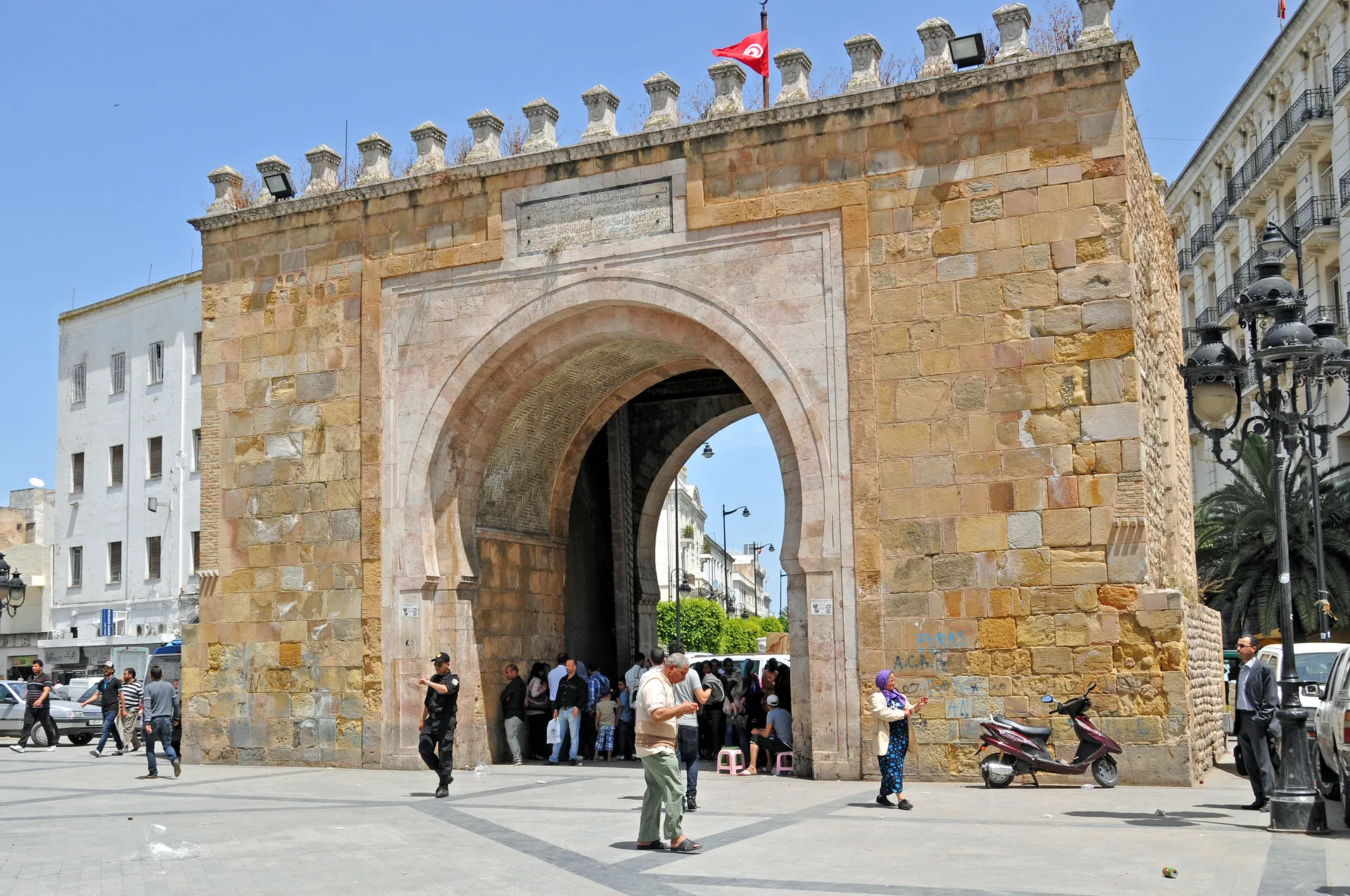
Bab El Bhar surprises by refusing to be grand. The present gate is generally treated as a mid-19th-century rebuilding, yet its real power comes from placement: stand a few paces back on Place de la Victoire and you feel Tunis split in two, with the open square, traffic and cafe chairs on one side, and the shaded mouth of the medina on the other. Walk under the arch slowly. In three seconds, the light changes, the air cools, and the city stops behaving like a boulevard city and starts sounding like trade, footsteps, shutters and low voices.
The Inscription Above the Arch
Most people photograph the arch and miss the sentence written over their heads. Look up, because this is where the gate stops being a backdrop and becomes an argument about memory: Bab El Bhar, Porte de France, an opening with two names and a long afterlife shaped by Ottoman Tunis, beylical reform and the colonial city that pressed itself against the walls. The stonework is restrained, almost blunt. That helps. Your eye lands on the inscription, the crenellations, the worn surface, and you start reading the gate the way Tunis reads it: as a border that never stayed still.
Cross the Threshold into the Medina
Use Bab El Bhar as a short walking experience, not a photo stop. Begin on the square, where the sky feels wide and the city breathes in long lines, then pass under the arch toward the souks and keep going until the streets tighten around you like a jacket pulled closed, with spice, perfume, dust and frying oil mixing in the air; the distance is only a few steps, shorter than a tennis court, but the shift feels larger than crossing between two neighborhoods. Go early if you want to read the architecture. Go late afternoon if you want the gate doing what it does best, turning a simple passage into street theater.
Plan your visit
Getting There
Bab El Bhar stands on Place de la Victoire, where Avenue de France runs into the medina. From Place de Barcelone, expect a central-city walk of roughly 1.2 km, about the length of 12 football fields; from Tunis Marine, about 1.5 km, closer to 15 football fields. From Tunis-Carthage Airport, Rome2Rio currently shows bus 635 to Tunis Marine in about 19 minutes, or a taxi ride of about 8 km, roughly the length of a short runway.
Opening Hours
As of 2026, Bab El Bhar functions as a public city gate in open street space, so current travel sources treat it as accessible 24/7. I found no official municipal timetable and no evidence of seasonal closure for the gate itself, though Ramadan evenings bring heavier foot traffic and transit schedules can shift.
Time Needed
Give the gate itself 5 to 10 minutes if you want a quick look and a photo. Allow 20 to 30 minutes if you want to stand in Place de la Victoire, get your bearings, and watch the city change character under the arch; use 1 to 2 hours if this is your doorway into a full medina walk.
Accessibility
The arch and square make an easy exterior stop compared with the medina behind it, and one current travel listing marks the site wheelchair accessible. The trouble starts after the photo: narrow lanes, uneven paving, curb breaks, and market congestion can turn the first few hundred meters into a test, and I found no official step-free route or adapted facilities.
Cost & Tickets
As of 2026, Bab El Bhar is free and unticketed. No booking system, audio guide, or skip-the-line option appears for the gate itself; any paid product you see online is really a guided Tunis or medina tour, not priority access to the monument.
Photo Gallery
The historic Bab El Bhar gate stands proudly in Tunis, Tunisia, framed by Tunisian flags and a refreshing fountain in the city square. · WildtunisHistorical information plaques mounted on the stone wall of the Bab El Bhar gate, a significant landmark in the Medina of Tunis, Tunisia. · Noomen9The historic Bab El Bhar, also known as the Sea Gate, stands as a prominent architectural landmark in the heart of Tunis, Tunisia. · IssamBarhoumiBab El Bhar, also known as the Sea Gate, stands as a historic entrance to the Medina of Tunis, showcasing traditional North African stone architecture. · Sami MlouhiThe iconic Bab El Bhar gate stands as a historic gateway between the old medina and the modern city of Tunis, Tunisia. · Noomen DaoudThe iconic Bab El Bhar, also known as the Sea Gate, stands as a historic landmark in the heart of Tunis, Tunisia, surrounded by a vibrant public square. · Credits to Mourad Ben Abdallah / Wikimedia CommonsThe iconic Bab El Bhar, also known as the Sea Gate, stands as a historic entrance to the Medina of Tunis, Tunisia. · Sami Mlouhi
History
The Gate Where Tunis Changed Direction
Records show that Tunis emerged in 698 CE as one of the first Arabo-Muslim towns in the Maghreb, and the medina later reached its high point between the 12th and 16th centuries under the Almohads and Hafsids. Bab El Bhar mattered because it marked the city's eastern opening, the point where merchants, officials, and strangers crossed between the enclosed medina and the watery approaches beyond.
The gate you see today belongs to a later chapter. Secondary-source consensus places its rebuilding in the mid-19th century, when Tunis was remaking its edge and turning toward a new urban future beyond the walls. One arch, two worlds.
The turning point
Ahmed Bey and the Gate That Faced a New Century
Attributed accounts say Ahmed Bey ordered the older gate demolished after returning from Paris in 1848, where he had seen a different style of capital city and a different performance of power. For him, this was personal as much as urban: a ruler under pressure to modernize without surrendering authority, trying to prove that Tunis could look outward and still remain Tunis.
Most scholars accept that the present Bab El Bhar took shape around 1860, aligned with what became Avenue de France, though the exact documentary trail remains thinner than a historian would like. That was the turning point. The gate stopped serving only as a defensive threshold and became a stage set for a city stepping into its colonial-century geometry.
Stand under the arch now and you can still read that decision in stone. Behind you, the medina closes in with narrow shade, shop signs, and the scrape of carts over paving worn smooth by centuries; ahead, the air opens, traffic noise rises, and the street runs straight as if someone had taken a ruler to history.
A Sea Gate Without the Sea
The name Bab El Bhar means "Gate of the Sea," but local historians and recent press accounts warn against taking that too literally. Evidence suggests the "sea" here referred to the Lake of Tunis and the maritime side of the city rather than waves breaking at the threshold. That matters because it shifts the story from postcard myth to trade geography: this was a gate tuned to movement, cargo, and arrival.
From Medina Wall to Colonial Edge
UNESCO's urban history of Tunis makes the larger pattern clear: the medina developed over centuries, then found itself pressed against a newer city outside its walls. Bab El Bhar became the seam. By the 19th century, the gate no longer marked the end of Tunis but the meeting point between two street logics, two political eras, and two ideas of what a capital should look like.
Tips for visitors
Go Early
Morning gives you the cleanest look at the gate before the square fills and the medina starts humming. Ramadan evenings are atmospheric, with the city sounding fuller and sharper, but that comes with denser crowds and slower transit.
Photograph People Carefully
The gate itself is a normal exterior photo stop, and architectural shots are generally fine. Trouble starts when lenses turn toward vendors or close portraits in the souks, so ask first and keep your camera manners better than your zoom.
Pack Light
Bab El Bhar has no confirmed public luggage room, and the medina is a poor place to drag a roller bag over broken paving. Leave bags with your hotel if you can; nearby properties such as Royal Victoria Hotel and Dar El Medina advertise luggage storage.
Eat With Intent
For a quick stop near the gate, Bab Tounes is the handy option around Place de la Victoire, in the budget-to-mid-range bracket. Fondouk El Attarine at 9 Bis Souk El Attarine works well for a mid-range lunch, while Dar El Jeld on Rue Dar El Jeld is the splurge address when you want the meal to feel like part of the story.
Pair The Walk
Use the gate as a hinge, not a destination on its own. Start on Avenue Habib Bourguiba, walk west until the colonial grid tightens into the medina, then pass under Bab El Bhar and let the city switch languages under your feet.
Skip The Car
Driving here sounds easier than it is. Recent traveler material points to dense traffic and street parking only, so metro links through Place de Barcelone or Tunis Marine save you the slow hunt for a space in streets that were not built with patient drivers in mind.
Where to Eat
local_dining
Don't Leave Without Trying
Méchouia — grilled onions, garlic, tomatoes, and hot peppers, often eaten as a salad or sandwich fillingChorba — spiced meat soup with vegetables and frikCouscous with fish or lamb — the Tunis version often features fish from the coastBrik — thin pastry filled with tuna, egg, potato, and parsleyLablebi — chickpea-and-bread broth bowl with harissa, olive oil, and a poached eggNwasser — small square pasta sheets with chickpeas and chickenMalfouf and chapati sandwiches — Tunisian street sandwiches with tuna, egg, chicken, méchouia, and harissaBouza — traditional dessert of hazelnuts and cream
Bab Tounès
local favorite
Tunisian Restaurant€€star4.8(424)directions_walkWalking distance from Bab El Bhar
Order: Fish couscous or lamb tajine — the daily specials rotate, which signals a kitchen that sources fresh and cooks to season rather than a frozen tourist menu.
With 424 reviews and a 4.8 rating, this is where locals actually eat near Bab El Bhar. The name itself means 'Gate of Tunisia,' and it sits steps from the old customs house—the real medina, not the postcard version.
Tunisian Restaurant€€star4.8(80)directions_walkOn Rue Jamaa Ezzitouna, a few minutes from Bab El Bhar
Order: Slow-cooked lamb with couscous or fish stew with olives — order whatever the kitchen recommends that day, as mains change based on the market.
Sits on the medina's most atmospheric street, near the Zitouna Mosque. Eighty solid reviews suggest it's a place where the setting (restored courtyard) and the food work together without either one overshadowing the other.
Tunisian Restaurant€€star5.0(3)directions_walkAvenue de France, a short walk from Bab El Bhar toward downtown
Order: Ask the owner what came in fresh that morning — this is the kind of place where the menu is what the kitchen has, not what the printer made last year.
A perfect 5.0 rating with a small but devoted review count tells you this is a neighborhood spot that doesn't chase tourists. It sits on the boundary between the medina and modern Tunis, so it captures both worlds.
Cafe & Light Meals€€star5.0(6)directions_walkOn Rue Jamaa Ezzitouna, heart of the medina
Order: Tunisian coffee with a brik or méchouia sandwich — this is the spot to sit, watch the medina move past, and eat like you belong there.
A perfect 5.0 rating in a cafe-restaurant setting means the owner cares about consistency and knows their regulars by name. Open until 11 PM, so it's your best bet for a late casual meal near Bab El Bhar.
checkThe medina around Bab El Bhar is best explored on foot — most restaurants are within 5–15 minutes' walk, and the streets themselves are part of the experience.
checkLunch is the main meal in Tunisia; many restaurants listed here serve lunch from noon and close or reduce service in the afternoon before reopening for dinner.
checkHarissa (hot red pepper paste) is standard at the table — ask for it on the side if you're unsure about heat levels.
checkCash is preferred at smaller local spots; larger restaurants may take cards, but confirm beforehand.
checkMarché Central de Tunis is walkable from Bab El Bhar and worth a quick visit to see what's in season and how locals shop for food.
Food districts:Rue Jamaa Ezzitouna — the medina's main artery, lined with cafes, restaurants, and food stalls; the most atmospheric eating street near Bab El BharRue de l'Ancienne Douane — quieter side street with established local restaurants, steps from Bab El BharAvenue de France — the seam between medina and downtown; where neighborhood spots serve both locals and travelers who wander off the main path
Restaurant data powered by Google
Watch & Explore Bab El Bhar.
Explore Tunis Governorate
Tunis, the capital of Tunisia | Best Places to Visit in Tunis, Tunisia
Very Nice Travel8 min213K
Explore Tunis Governorate
The Tunis Governorate Delegations and Municipalities Song! - Hindanger
Hindanger3 min7K
Frequently asked
Is Bab El Bhar worth visiting?
Yes, Bab El Bhar is worth visiting because it changes the feel of Tunis in a few steps. You pass from Place de la Victoire and the broad colonial-era streets into the shaded, tighter pulse of the medina almost instantly. The gate itself is modest, but the contrast it stages is the real reason to stop.
How long do you need at Bab El Bhar?
You only need 5 to 10 minutes for the gate itself, and 20 to 30 minutes if you want to linger on Place de la Victoire. Give it 1 to 2 hours if Bab El Bhar is your starting point for the medina. Think of the gate as a hinge, not a full monument circuit.
How do I get to Bab El Bhar from Tunis?
The easiest way is to head for Place de la Victoire from central Tunis, usually on foot, by metro to Place de Barcelone, or via Tunis Marine if you are coming from the TGM or airport bus 635. From Tunis Marine, the walk is about 1.5 kilometers, roughly the length of 15 city blocks, and from Avenue Habib Bourguiba you simply keep walking toward the medina until the arch appears. Taxis from Tunis-Carthage Airport are quick too, around 8 kilometers, about the length of a short cross-town ride.
What is the best time to visit Bab El Bhar?
Late afternoon is the best time to visit Bab El Bhar if you want the gate with people, sound, and a little theater. Early morning is better for cleaner photos and for feeling the shift from open square to cooler medina air before the crowds build. During Ramadan evenings, the whole threshold tends to feel more charged as the medina fills with events and night traffic.
Can you visit Bab El Bhar for free?
Yes, Bab El Bhar is free to visit. It is a public city gate on an open square, not a ticketed monument with a box office or timed entry. That means no queue, no booking, and no special free-entry day because every day is already free.
What should I not miss at Bab El Bhar?
Don't miss the moment of standing under the arch and turning to look both ways. One side opens onto Place de la Victoire and the modern city; the other tightens into the medina's shaded lanes, and that contrast is the whole confession of the place. Look up at the inscription too, because many people photograph the gate and never actually read it.
Sources & attribution55
Researched and written by the Audiala editorial team from historical records, architectural archives, and local expertise. Last updated April 2026.
UNESCO World Heritage Centre — Confirmed the historical importance of the Medina of Tunis, the 698 CE foundation context, the 12th to 16th century peak, and the 1979 World Heritage inscription.
UNESCO Urban Heritage Atlas — Provided the urban context of Bab El Bhar as part of the Medina of Tunis and described the medina's street pattern, summer shade, and Ramadan cultural activity.
Lonely Planet — Used for location, orientation, and practical visitor framing for Bab El Bhar.
Webdo — Explained the two names, Bab El Bhar and Porte de France, and the meaning of 'Gate of the Sea' as tied to the lake and maritime side of Tunis.
La Presse Tunisie — Used for naming history and secondary-source discussion of the gate's 19th-century rebuilding chronology.
Wikipedia — Supplied secondary-source background on the gate's names, dates, and later urban changes.
Museum With No Frontiers — Referenced for the reported 1848 demolition and rebuilding under Ahmed Bey.
Audiala — Used for practical visitor framing, including open-air access and free entry.
Trip.com Moments — Used for current traveler-facing notes on access, atmosphere, and the square around the gate.
Bazar Travels — Provided practical visitor notes, route orientation, and approximate visit duration.
Transtu — Used for current Ramadan timetable context affecting nearby transport hubs.
Transtu — Provided seasonal timetable context for nearby public transport.
Tripomatic — Used for free-entry and orientation details for the Sea Gate.
Tripadvisor — Used to distinguish between Bab El Bhar itself and paid guided or self-guided tour products.
Wikipedia — Provided place context for Place de la Victoire and its link to Bab El Bhar.
Transtu — Used for network and station context, especially Place de Barcelone and Tunis Marine.
Rome2Rio — Provided airport route timing and transfer context from Bab El Bhar to Tunis Airport.
Transtu — Used for current transit network lines relevant to Place de Barcelone and Tunis Marine.
Bab El Bhar, Tunis — Dennis G. Jarvis — CC BY-SA 2.0 (https://creativecommons.org/licenses/by-sa/2.0/) — Source: https://commons.wikimedia.org/wiki/File:Bab_El_Bhar,_Tunis.jpg
Bab Bahr- Vue depuis la place de la victoire — Wildtunis — CC BY-SA 4.0 (https://creativecommons.org/licenses/by-sa/4.0/) — Source: https://commons.wikimedia.org/wiki/File:Bab_Bahr-_Vue_depuis_la_place_de_la_victoire.jpg
Bab bhar 3 — Noomen9 — CC BY-SA 4.0 (https://creativecommons.org/licenses/by-sa/4.0/) — Source: https://commons.wikimedia.org/wiki/File:Bab_bhar_3.JPG
Bab Bhar — IssamBarhoumi — CC BY-SA 3.0 (https://creativecommons.org/licenses/by-sa/3.0/) — Source: https://commons.wikimedia.org/wiki/File:Bab_Bhar.JPG
Bab Bhar photo 2 باب البحر — Sami Mlouhi — CC BY-SA 4.0 (https://creativecommons.org/licenses/by-sa/4.0/) — Source: https://commons.wikimedia.org/wiki/File:Bab_Bhar_photo_2_باب_البحر.jpg
Bab Bhar .. — Noomen Daoud — CC BY-SA 3.0 (https://creativecommons.org/licenses/by-sa/3.0/) — Source: https://commons.wikimedia.org/wiki/File:Bab_Bhar_...JPG
Bab Bhar photo 1 باب البحر — Sami Mlouhi — CC BY-SA 4.0 (https://creativecommons.org/licenses/by-sa/4.0/) — Source: https://commons.wikimedia.org/wiki/File:Bab_Bhar_photo_1_باب_البحر.jpg
Bab bhar 5 — Noomen9 — CC BY-SA 4.0 (https://creativecommons.org/licenses/by-sa/4.0/) — Source: https://commons.wikimedia.org/wiki/File:Bab_bhar_5.JPG
Bab bhar 4 — Noomen9 — CC BY-SA 4.0 (https://creativecommons.org/licenses/by-sa/4.0/) — Source: https://commons.wikimedia.org/wiki/File:Bab_bhar_4.JPG
Bab bhar 7 — Noomen9 — CC BY-SA 4.0 (https://creativecommons.org/licenses/by-sa/4.0/) — Source: https://commons.wikimedia.org/wiki/File:Bab_bhar_7.JPG
Bab bhar 8 — Noomen9 — CC BY-SA 4.0 (https://creativecommons.org/licenses/by-sa/4.0/) — Source: https://commons.wikimedia.org/wiki/File:Bab_bhar_8.JPG
Strictly necessary cookies keep the site working. Analytics (PostHog, Google Analytics) measures how each visitor uses our pages. Marketing loads YouTube videos and walking-route maps without a tap and lets Google Analytics set advertising cookies. We never sell your data. You can change this any time from the footer.
Privacy
Cookie preferences
Pick what you're okay with. You can change this any time from the footer.
Strictly necessary
Always on
Sign-in, language, navigation. Always on.
Product analytics
PostHog (EU) and Google Analytics record which pages you view and how you use them, under a random identifier stored in your browser. Helps us see which pages work and which need fixing. Google's ad personalisation stays off. No selling.
Marketing
Loads YouTube videos and the walking-route maps (OpenFreeMap) without a tap; without it, they load only when you tap them. If analytics is also on, Google Analytics may set advertising cookies. Ad personalisation stays off.