An introduction.
Researched by the Audiala editorial team from historical records, architectural archives, and local expertise.
TThe royal temple that kept Phuket’s civic rituals in order sits a few steps from souvenir stalls and camera-wielding crowds. Wat Mongkhon Nimit in Phuket, Thailand, rewards a visit because it shows you the old town’s inner life, not just its painted shopfronts: monks’ quarters in Sino-Portuguese style, a gold Buddha once hidden under plaster, and a courtyard that still feels cooler and quieter than the streets outside. Most visitors notice the roofline and keep walking. That’s their mistake.
Locals still call it Wat Klang, the middle temple, and that older name tells you exactly how the place works. It stands near Thalang Road, Soi Romanee, Dibuk Road, and Thepkasattri Road, right where the old grid tightens into the historic core shaped by tin wealth and the Ancient buildings in Sino-European style that made Phuket Town famous.
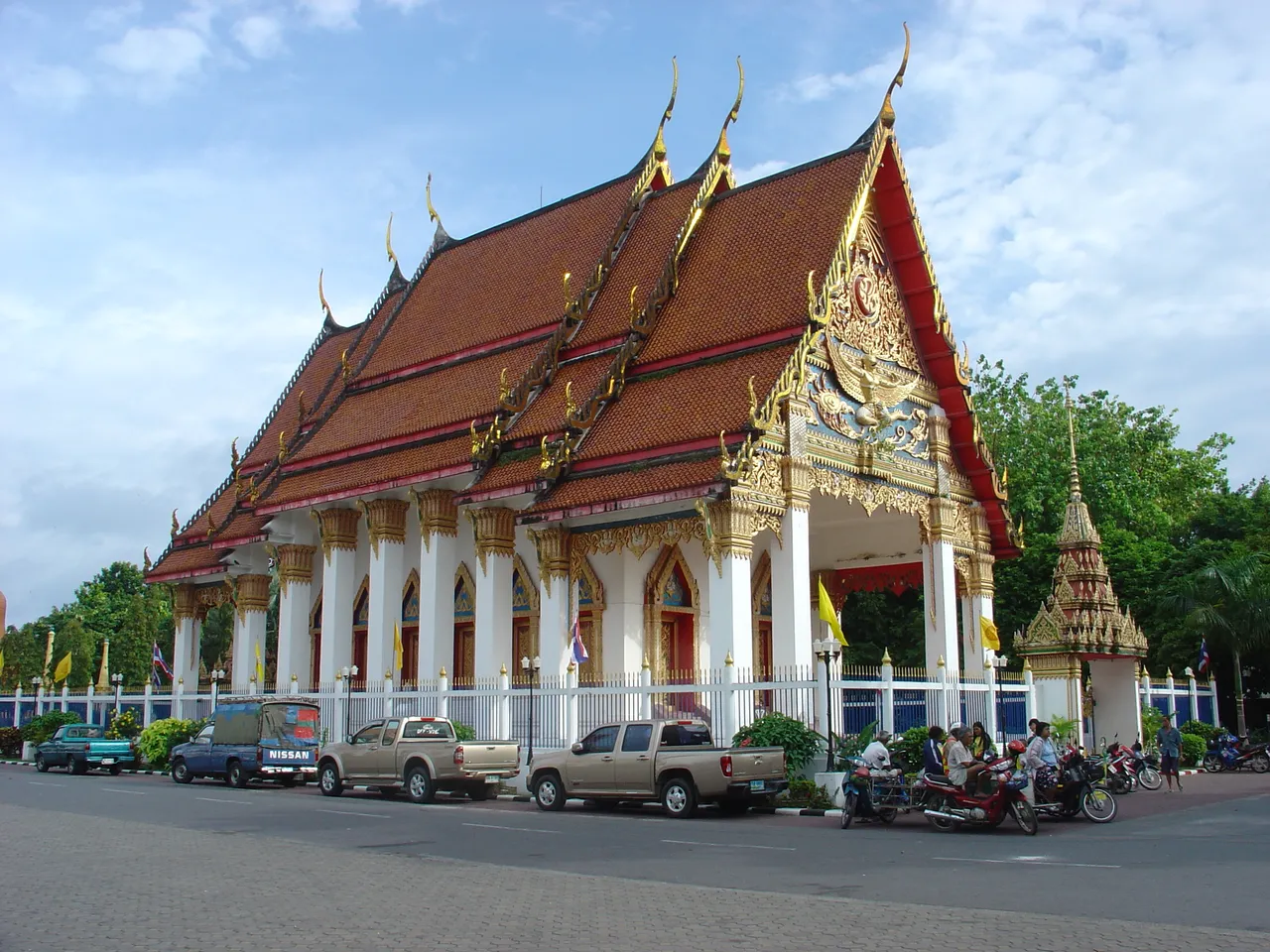
The first impression is architectural, then sensory. Red-and-gold roofs rise above the street noise, incense hangs in the air, and the white daylight of Phuket turns soft under the eaves; then you notice that some monastic buildings look less like a forest monastery and more like townhouses adapted to religious life.
If you have already ticked off The Big Buddha, Phuket, come here for the opposite scale. This temple is less about panorama and more about texture: the sound of sandals on tile, the disciplined calm of an active compound, and the feeling that Phuket’s public life once passed through this gate before it spilled out into the rest of Phuket.
01 What to see.
The Ubosot and Luang Pho Khao
The Eleven Chedis and the Old Library Hall
A Short Walk Through Phuket’s Split Personality
02 In pictures.


Plan and listen to Wat Mongkhon Nimit with Audiala.
Audio guide in your pocket, itinerary in your browser. Built for the way you actually visit.
03 Visitor logistics.
The practical scaffolding for a good visit — kept short.
Getting There
Wat Mongkhon Nimit sits on Dibuk Road opposite Soi Romanee, right at the edge of Phuket Old Town. From Bus Terminal 1, walk about 950 metres in 12-15 minutes, or use the Old Town Dragon Line shuttle, which stops at "Mongkol Nimit Temple"; from Phuket Airport, Route 8411 airport bus runs to Bus Terminal 1 for 100 THB, and from Patong, Smart Bus Route 2 reaches the same terminal before the short final walk.
Opening Hours
As of 2026, the safest planning window is daily 08:00-17:00. Current listings split between 07:00-17:30 and 08:00-17:30, with no reliable evidence of seasonal hours or a weekly closing day, but this is a working temple, so halls can be quieter or partially restricted during ceremonies.
Time Needed
Give it 15-25 minutes if you're stepping in from Soi Romanee for a quick look, 30-45 minutes for a normal visit around the main hall and grounds, and 60-90 minutes if you want to move slowly and find the chedi at the back. Many people underestimate the site because they only notice the roofline from the street. Then they leave too soon.
Accessibility
The surrounding Old Town streets are mostly flat, so reaching the grounds is easier than entering every building. Full wheelchair access inside the ordination hall is unconfirmed as of 2026, and you should expect possible steps or raised thresholds, plus shoes-off entry into shrine spaces.
Cost/Tickets
As of 2026, entry appears to be free, with no ticket desk, no online booking, and no skip-the-line system. Donations are welcome, but I found no fixed suggested amount, and no separate paid audio guide for this temple.
04 Tips for visitors.
Small things that change the day.
Temple Clothes
Cover shoulders and knees, skip sleeveless tops and short bottoms, and remove your shoes before entering the shrine hall. This is Wat Klang to locals, a working town temple, so quiet behavior matters more here than at a photo-stop temple built for visitors.
Shoot Softly
Photos on the grounds are generally fine, but inside halls or during prayers, funerals, and candle processions, ask first and keep the camera discreet. Avoid flash, and don't arrive with a tripod or drone unless you already have clear permission.
Go Early
Aim for a weekday morning between 08:00 and 10:00 if you want calm air, softer light on the red-and-gold roofs, and fewer people drifting over from Soi Romanee. Sunday evening feels different: more street energy outside, less stillness inside.
Eat Nearby
For a proper post-temple stop, walk to One Chun on Thep Krasatti Road for mid-range Phuket cooking, Torry's Ice Cream on Soi Romanee for dessert with local flavors, or Khao Tom Dibuk on Phang Nga Road for a budget bowl. Don't look for temple snacks here; the surrounding lanes are the pantry.
Pair The Walk
This visit works best folded into a slow circuit of Ancient buildings in Sino-European style around Old Town, because the temple shows the Buddhist side of a district usually sold through shophouses and cafe facades. Start on Thalang Road, cut down Soi Romanee, then cross Dibuk Road into the temple grounds before the crowds stack up.
Transport Friction
The area feels safer than Phuket's beach-party zones, but Dibuk Road can clog with tour vehicles and informal transport. If you're not walking, check the Dragon Line fare on the day because 2026 reporting conflicts between free rides and 20 THB, and use licensed transport if a driver starts inventing prices.
Where to Eat
Don't Leave Without Trying
Krua Talad Yai Restaurant
local favoriteOrder: Go in the morning for the breakfast buffet, especially the live egg and omelette counter, fruit, salads, and the mix of Western and Asian dishes that reviewers consistently praise.
This one makes sense if you want a calm, reliable breakfast near Phuket Old Town without gambling on a tiny shop being sold out by late morning. Reviewers keep coming back to the range, the polished service, and the value, which matters in an area where breakfast can otherwise be hit or miss.
Cafe Delight Phuket Old Town
cafeOrder: Order the breakfast sandwich with sriracha mayo, or the avocado toast if you want something lighter; reviewers also call out the coffee, hot chocolate, smoothie bowl, and salad.
A good Old Town breakfast stop should be quick, friendly, and genuinely worth the detour before the heat builds. This place gets that right, with fast service, big enough portions, and a menu broad enough for both coffee-and-toast people and full-brunch people.
TAPAS Cafe & Restaurant - Phuket Old Town
local favoriteOrder: Start with the garlic bread and fish croquettes, then add the nachos with pulled beef; if you want something less obvious, reviewers rave about the duck breast with deep fried burrata.
This is not the place for classic Phuket cooking, but it is one of the strongest polished meals in the Wat Mongkhon Nimit orbit. People mention the balance of flavors, careful service, and a room that feels comfortable even on a brutal hot afternoon, which counts for a lot in Old Town.
The Garden Phuket
local favoriteOrder: Try their version of khao soi if you want a Thai-leaning dish, or go for the mini burgers, pancakes, and chicken schnitzel, all singled out by reviewers.
This is the outlier on the list: not in Old Town, but worth knowing if you are moving beyond the temple area and want a comfortable all-day place with range. Reviews point to warm hospitality, a broad menu, and the kind of crowd-pleasing cooking that works for families or mixed appetites.
Dining Tips
- check Phuket Town food is shaped by Thai, Chinese or Hokkien, Malay, and Muslim influences, so look for Peranakan or Baba-style dishes rather than generic pad thai lists.
- check Breakfast starts early around Phuket Town, and local morning places often focus on roti, steamed buns, dim sum-style breakfasts, kopi, and noodle dishes.
- check Some breakfast and lunch specialists close before noon or shut once they sell out, so late arrivals can miss the best local spots.
- check Lunch is the main rush for many local places, roughly 11:30 am to 1:00 pm.
- check Locals often eat dinner earlier than visitors expect, around 6:00 pm to 8:00 pm.
- check Southern Thai food in Phuket tends to run hotter and sharper than central Thai food, so take spice warnings seriously.
- check Many Phuket businesses keep one weekly rest day, but the closed day varies by place, so do not assume a town-wide pattern.
- check Night markets often double as early dinner: Phuket Indy Market runs Wednesday through Friday from about 4:00 pm to 10:00 pm, Sunday Walking Street Market on Thalang Road starts around 4:00 pm on Sundays, Chillva Market runs Monday to Saturday 5:00 pm to 11:00 pm, and Naka Weekend Market runs Saturday and Sunday 4:00 pm to 11:00 pm.
Restaurant data powered by Google
05 Where Phuket Kept Its Ritual Center
Wat Mongkhon Nimit has changed names, buildings, and status, but its public function has held remarkably steady. Documented records show a formal temple establishment in 1880, a royal boundary charter for the ordination hall in 1885, and elevation to third-class royal temple status in 1953; across those shifts, the compound kept serving as Phuket Town’s ceremonial heart.
That continuity matters more than postcard beauty. Official summaries from Phuket’s Office of National Buddhism describe oath-taking ceremonies for officials and consecrated coronation-water rites here, which means this was not just a neighborhood temple where people came to make merit, but a place where the Siamese state made itself visible on an island built on trade, migration, and tin.
Governor Kaew’s Bet on a New Town
According to a Fine Arts Department history reproduced in Phuket, Wat Mongkhon Nimit may date back earlier than the documented 1880 establishment and may have been built in the reign of King Rama III by Governor Phra Phuket (Kaew), the man tied to the rise of the new Phuket Town. If that attribution holds, Kaew was not funding a pious ornament. He was staking his own authority on a new urban center that had to look governed, not improvised.
The turning point came when Phuket’s center of gravity shifted toward the town that tin wealth was building. A temple at its middle gave that shift ritual weight: monks, officials, and townspeople could gather in one sanctioned place, and civic order suddenly had walls, roofs, bells, and a Buddha image to face.
The evidence remains uneven. Documented sources support 1880, 1885, and 1953 with confidence, while the earlier 1840s origin is best treated as a plausible but unresolved claim until the 19 June 1881 report cited by the Fine Arts text is checked directly; still, the persistence of the story tells you how deeply locals connect this temple to the making of Phuket Town itself.
What Endured
What Changed
Listen to the full story in the app
The whole Wat Mongkhon Nimit,
told well.
Audio guides for 1,100+ cities across 96 countries. History, stories, and local insight — offline ready.
06 Frequently asked.
The questions travellers send us most about Wat Mongkhon Nimit.
Is Wat Mongkhon Nimit worth visiting?
Yes, especially if you're already walking Phuket Old Town. Wat Mongkhon Nimit feels calmer and more local than the better-known temple circuit, with a gold-and-blue ordination hall, Sino-Portuguese monk quarters, and a courtyard that still works as a civic-religious center rather than a stage set for visitors.
How long do you need at Wat Mongkhon Nimit?
Most visitors need 30 to 45 minutes. Give it 15 to 25 minutes for a quick look from the Soi Romanee side, or up to 60 to 90 minutes if you want to see the rear chedi, read the tree plaques, sit quietly in the grounds, and fold it into a longer Old Town walk.
How do I get to Wat Mongkhon Nimit from Phuket?
If you're already in Phuket Town, walk from Soi Romanee or Thalang Road because the temple sits right on the edge of the Old Town grid. From Phuket Airport, the Airport Bus to Bus Terminal 1 costs about 100 THB, then the temple is roughly 950 meters away on foot; from Patong, Smart Bus Route 2 to Bus Terminal 1 is the simplest public-transport option.
What is the best time to visit Wat Mongkhon Nimit?
Early morning is the best time to visit Wat Mongkhon Nimit. Plan for the safest public visiting window of 08:00 to 17:00, when the light is softer, the heat is less punishing, and the temple feels more like a working neighborhood sanctuary than a stop between coffee shops and photo corners.
Can you visit Wat Mongkhon Nimit for free?
Yes, entry appears to be free. I found no ticket desk, no booking system, and no skip-the-line product, though a small donation is customary and modest dress still matters because this is an active temple, not a museum.
What should I not miss at Wat Mongkhon Nimit?
Don't miss the 11-chedi cluster, the tree plaques with Buddhist sayings, and the Sino-Portuguese monk buildings that tie the temple to Phuket Town's tin-era streetscape. Most people photograph the roofline from Soi Romanee and leave, which means they miss the part that actually explains why this place matters.
Verified, and shown.
Researched and written by the Audiala editorial team from historical records, architectural archives, and local expertise.
Checked Thailand's World Heritage listings to confirm Wat Mongkhon Nimit is not a UNESCO World Heritage site.
Checked Thailand's Tentative List to confirm Phuket Old Town and Wat Mongkhon Nimit are not on it.
Used to clarify that Phuket appears in UNESCO records through a natural tentative-list nomination, not through this temple.
Provided establishment date, opening hours, suggested visit duration, local name Wat Klang, and practical visitor details including toilets.
Main chronology source for foundation, royal charter, ubosot dates, royal temple status, Luang Pho Khao, chedi cluster, and architectural details.
Used for current site description, free entry, dress expectations, hidden details, rear chedi, and the temple's relationship to Soi Romanee.
Confirmed royal-temple status, ceremonial role, local significance, and 1959 royal visit.
Corroborated 1907 ubosot construction, 1949 restoration, and general temple history.
Used for the earlier-origin claim linking the temple to Governor Phra Phuket (Kaew) and the founding of new Phuket Town.
Indexed official-style text supporting the claim that the temple may date to the reign of Rama III and the founding of Phuket Town.
Used for historic-site registration dates and secondary corroboration of temple chronology.
Provided the specific date of King Bhumibol Adulyadej's visit to the temple on March 11, 1959.
Used for background on the Rattanadilok na Phuket family and Governor Phra Phuket (Kaew).
Referenced for the historical image of Luang Pho Khai with Luang Pho Chaem.
Supplemented the historical image attribution for Luang Pho Khai and Luang Pho Chaem.
Used to identify and correct a common chronology error linking an 1880 date to the reign of Rama III.
Used cautiously for a preservation-related note about Sala Mae Plong.
Provided current listing details including address and longer opening-hours range.
Used for current hours, visitor impressions, and general practical corroboration.
Provided current visitor guidance on hours, free entry, dress code, and walking distance from Bus Terminal 1.
Used for the March 2026 temple fair and event-based access context.
Provided plus code and a looser 1 to 2 hour visit estimate.
Used for Dragon Line routing, service pattern, and local bus connections near the temple.
Used for current reporting on Dragon Line fares and hours.
Used for Dragon Line launch details, frequency, and service area.
Supplemented Dragon Line operating-hour reporting.
Used for the airport-to-town bus connection and ticket price.
Used for timetable details between Phuket Airport and Bus Terminal 1.
Used for Phuket Smart Bus route and fare context from Patong to Phuket Town.
Used for the simplest walking approach to the temple from Old Town landmarks.
Used for parking information and one older local listing of temple facilities.
Used for accessibility information on buses serving Phuket.
Used as a nearby coffee-stop reference close to the temple.
Provided location and opening-hour reference for Torry's Ice Cream near the temple.
Used for a nearby restaurant recommendation and current opening hours.
Used for nearby air-conditioned rest-stop and mall information.
Corroborated Limelight Phuket location and hours.
Used for nearby luggage storage options in Old Town.
Provided a second nearby luggage storage listing and hours.
Used for airport luggage-storage pricing through AIRPORTELs.
Used for on-the-ground impressions, roofline views, and the tree-plaque detail.
Used for English-language details of the March 2026 temple fair and special access to the ubosot.
Provided descriptive architectural details and visitor-facing summary material.
Used for supplementary experiential descriptions of the temple atmosphere.
Provided Phuket's seasonal climate frame for assessing visit timing.
Alternate Dhammathai URL referenced in research for chronology and temple features.
Used for the relationship between the temple and Soi Romanee's photographed streetscape.
Supplemented official local framing of the temple's civic and ceremonial role.
Used for local perspective, including everyday use of the temple and a parking-related anecdote.
Used for broader Phuket Old Town cultural framing around the temple.
Used for broader official tourism framing of Phuket and Old Town context.
Supplemented local views of the temple as a place for merit-making.
Used for local traffic and transport pressure around the temple frontage.
Used for recent street disruption on Dibuk Road outside the temple.
Used as a nearby cafe reference close to Soi Romanee and the temple.
Used to show the temple's continuing role in major Buddhist observances.
Used for the temple's place in provincial religious ceremonies and official attendance.
Used for Buddhist Lent and related ceremonial activity at the temple.
Used for youth religious competitions and temple-based civic events.
Used for local reporting on temple-related religious and community activity.
Used for reporting on the March 2026 Old Town temple fair.
Supplemented reporting on the March 2026 temple fair and cultural programming.
Used for neighborhood context around the temple in Phuket Old Town.
Used for the temple's setting within the wider Old Town grid.
Used for route context linking the temple to nearby Old Town attractions.
Used for surrounding cafes, shops, and district character near the temple.
Supplemented neighborhood atmosphere and visitor-flow context in Old Town.
Used for crowding context on Sunday evenings in the surrounding area.
Used for transport friction and enforcement context around Phuket Town.
Used for cautionary context about licensed guides in Old Town.
Supplemented caution about unlicensed guiding around Phuket Town.
Used for local food context around the temple and Old Town.
Used for broader Old Town walking context and local food references.
Used for nearby food-hall context and local dish suggestions.
Used for general sacred-site etiquette including dress and behavior.
Used for etiquette around photography during ceremonies and Buddhist holy-day context.
Supplemented holy-day etiquette and photography caution during worship.
Used for Thailand drone-registration rules relevant to temple photography.
Supplemented general drone-rule context in Thailand.
Used for formal legal context around drone use near sensitive sites.
Used as a nearby budget food recommendation in Phuket Town.
Used as a nearby mid-range dining recommendation on Dibuk Road.
Used as a nearby higher-end dining reference in Phuket Town.
Used as a nearby dessert stop reference close to Soi Romanee and the temple.
Researched from Wikidata, Wikipedia & official sources · fact-checked · How we make our guides →