Why does Phuket's most famous Buddha feel older than it is, and more fragile than a monument this size should ever seem? The Big Buddha, Phuket rises above Phuket, Thailand, in white marble that catches the island light like a sail turned to stone, and you come for that high, wind-bright view over Chalong Bay, Kata, and the green folds of Nakkerd Hill. But the visit stays with you because this is not a sleepy relic from some distant kingdom; it is a modern sacred place still marked by faith, argument, and grief.
From the terrace, you see the Andaman Sea flashing beyond rooftops and rubbery hills, hear bells clicking in the wind, and smell incense mixed with hot concrete after rain. Monks chant below the lookout, tour vans idle in the parking area, and the giant seated figure above it all keeps the calm expression of a monument that has already outgrown the story told about it.
Most visitors arrive expecting a simple postcard stop: a 45-meter Buddha, about as tall as a 15-story building, with good photos at the top. What they find instead is a place where worship and tourism share the same steps, where donor names are built into the stone, and where the hill itself became part of Phuket's hardest recent argument about safety, responsibility, and what devotion can justify.
Researched by the Audiala editorial team from historical records, architectural archives, and local expertise.
What to see
The Marble Buddha and Upper Terrace
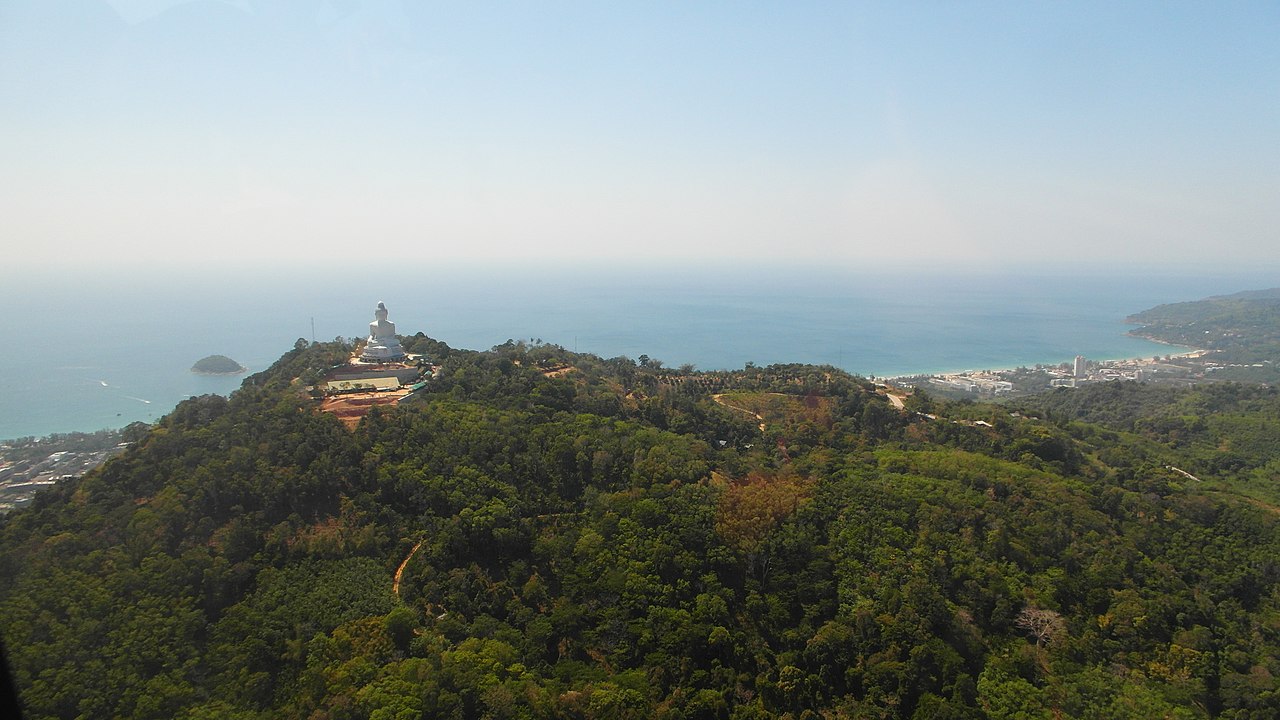
The surprise up here is texture: from the beaches below, the Buddha reads as one clean white shape, but at the summit you see 45 metres of hand-laid Burmese marble tiles, fitted piece by piece over reinforced concrete like a mountain-sized skin. Stand at the base after climbing the 94 naga-flanked steps and the scale finally lands: the figure is as tall as a 15-storey building, the wind keeps moving across the terrace, and the white surface shifts from chalky to luminous as clouds pass over Nakkerd Hill.
The Rear Terrace and the Quieter Side of the Hill
Most people take the front-facing photo and leave, which is their mistake. Walk behind the statue and the place changes character: bells tick in the wind, the crowds thin out, and the views open toward Kata Noi and the southern headlands, so the monument stops feeling like a checklist stop and starts acting like what it is under Wat Kittisangharam's care, a working place of devotion with one of the best perches on the island.
Do the Full Hilltop Sequence
Start below the main platform in the prayer zone, where monks give blessings, the weekday Buddhas wait in a neat row, and brass bells carry that thin metallic sound you only get on exposed hilltops. Then climb the 94 steps between the naga balustrades, circle the base instead of stopping at the front, and finish in the small construction-history room; five minutes there changes the whole visit, because this isn't an ancient relic polished for tourists but a donation-built project whose 2002 foundation ceremonies and later build phases are still visible in the marble, the inscriptions, and the unfinished edges.
Plan your visit
Getting There
Most people drive or ride up via Soi Yot Sane 1 off West Chaofa Road (4021), then climb the last 5.4 km of steep hill road to Nakkerd Hill. As of 2026, no public bus goes to the top, so the practical transit move is Phuket Smart Bus Route 1 to Karon Circle, Kata Palm, or Chalong Circle, then a Bolt, Grab, or taxi for the final climb; strong walkers can hike 2.3-2.6 km uphill from Patak Road in Karon in about 1 hour.
Opening Hours
As of 2026, the latest confirmed public hours are 9:00 AM-6:00 PM daily after the March 3, 2026 reopening under Wat Kittisangharam (Wat Kata). Older pages still show 6:30 AM-6:30 PM, but those appear outdated, and because the site reopened after the August 23, 2024 landslide with 25 safety conditions, a same-day status check is smart in wet weather.
Time Needed
Give it 45-60 minutes if you drive up, take in the terraces, and leave after the views. A slower visit runs 60-90 minutes, and if you hike up from Karon, expect at least 2.5 hours round trip once you add the climb, photo stops, and time on the hill.
Accessibility
Access is partial, not full. A car can reach the hilltop parking and lower terrace, but the final approach to the main statue platform includes 94 steps, and I found no verified elevator; the road is steep, and the Karon trail is rough dirt with one rope-assisted stretch.
Cost & Tickets
Entry is free as of 2026, with no official booking system, no timed tickets, and no real skip-the-line option because this is a donation-funded religious site rather than a ticketed monument. Donations for incense, flowers, candles, or marble tiles are optional, and parking appears to be standard rather than separately ticketed.
Tickets & tours.
These are guided options from our partners — same price as booking direct.
Prices are indicative — final pricing and availability are confirmed at checkout. Audiala may earn a commission from bookings made through these links.
Also on GetYourGuide
More tours for The Big Buddha, Phuket
Curated from GetYourGuide. Same price as official, free cancellation on most.
Prices shown are indicative — final pricing and availability are confirmed at checkout. Audiala may receive a commission from bookings made via these links.
Photo Gallery
The Big Buddha, Phuket rises above dense green hills with sweeping views of the Andaman Sea. This elevated view captures the monument’s hilltop setting and the bright coastal light of southern Thailand. · Roma NeusThe Big Buddha rises above Phuket's green hills in a dramatic hilltop setting overlooking the Andaman coast. Clear daylight reveals the statue, temple grounds, and sweeping shoreline below. · Roma NeusA view of The Big Buddha, Phuket, Phuket, Thailand. · CEphoto, Uwe AranasThe Big Buddha rises above Phuket's green hills in a sweeping aerial view that stretches to the shoreline and bay beyond. Bright midday light reveals the scale of the monument and its hilltop setting. · Roma NeusThe Big Buddha sits high above Phuket's green hills, its white marble form standing out through the haze. Soft overcast light gives the mountain view a quiet, distant feel. · Christophe95
History
A Sacred Giant With Fresh Cement Under Its Feet
The first surprise is simple: this is not an ancient temple crowned by an old miracle image. Records show the project took shape in the early 2000s on Nakkerd Hill under the orbit of Wat Kittisangharam, with a foundation stone laid on 26 May 2002 and the giant visible build phase gathering force a little later, which is why so many summaries jump to 2004.
That confusion matters. The Big Buddha looks timeless from below, yet its history belongs to Phuket's tourism age, to donation campaigns, royal symbolism, and then to the August 23, 2024 landslide that turned a hilltop landmark into a site of evidence, lawsuits, and public grief.
The turning point
The Monument That Pretended To Be Older Than Its Paperwork
At first glance, the story seems tidy: a serene white Buddha built for royal merit, finished long ago, now watching over south Phuket like it has always been here. That version flatters everyone. It gives tourists a clean symbol, donors a noble cause, and local power brokers a monument that feels above politics.
Then the dates start misbehaving. Records show ceremonies and foundation work in 2002, while later summaries say construction began in 2004; the project was still visibly unfinished years after that, and Suporn Wanichakul, the foundation president who became its public face, had his own reputation tied to making the hilltop dream real because this was merit, prestige, and public legacy in one body of white marble.
The turning point came on 23 August 2024, when heavy rain sent part of Nakkerd Hill downslope and the monument's story changed in an instant. Suporn was no longer only the man behind a donation-built icon; by October 2024 he faced criminal charges tied to alleged forest encroachment and unauthorized construction, with donor trust, legal exposure, and the future of the site at stake for him personally. Once you know that, the Buddha no longer reads as a finished symbol of calm. You look up and see a sacred place still being argued over by monks, officials, residents, and the hill itself.
The Two Buddhas Most People Miss
Most cameras stop at the giant white figure clad in Burmese marble, but the site tells a more coded story. Project material describes the main white Buddha as built for the father and the smaller brass Buddha beside it as built for the mother, a royal shorthand pointing toward King Bhumibol Adulyadej and Queen Sirikit; what looks like one statue is really a paired statement about Buddhism, monarchy, and Phuket's place inside that national script.
A Living Shrine, Not A Sculpture Park
The Big Buddha still works as a religious site, which changes the mood of the visit if you slow down enough to notice. Recent reporting documents its reopening on 3 March 2026 under Wat Kittisangharam with monks stationed on the hill, while foundation archives record chanting at year-end, Kathin ceremonies, ordinations, meditation, blessings, and offerings from Thai devotees and migrant Buddhist communities alike; the bells, prayer spaces, and donation tiles are not decoration, they are the machinery of ongoing merit-making.
Tips for visitors
Temple Clothes
Shoulders and knees need covering here. No sleeveless tops, no short skirts, and no shorts above the knee; free sarongs are usually available at the entrance, but relying on them means starting your visit by borrowing temple laundry.
Photo Respect
Regular photography is fine, but treat blessings, chanting, and prayer areas as real religious moments, not stage sets. Drone flying is a bad gamble unless you already meet Thailand's registration rules and get clear on-site permission.
Rainy Season Caution
The real risk here isn't theft. It is the steep road, slick downhill curves on a motorbike, and the hill's landslide history after heavy rain, so check conditions the morning you go and skip the climb if the weather feels wrong.
Eat Off Hill
The road up has decent view cafes, but Phuket's better meals wait below. For a budget stop on the slope, Nak-Kerd Seaview Cafe does simple Thai dishes in the 100-250 baht range; for a proper post-visit meal, head to Chalong for Mor Mu Dong or Bucha, both far more revealing than another hilltop fried rice.
Go Early
Early morning gives you softer light, less heat on the exposed terraces, and a quieter mood before the hill turns into a photo stop. Late afternoon looks good too, but clouds can build fast, and after rain the whole place feels less serene than cautious.
Pair It Well
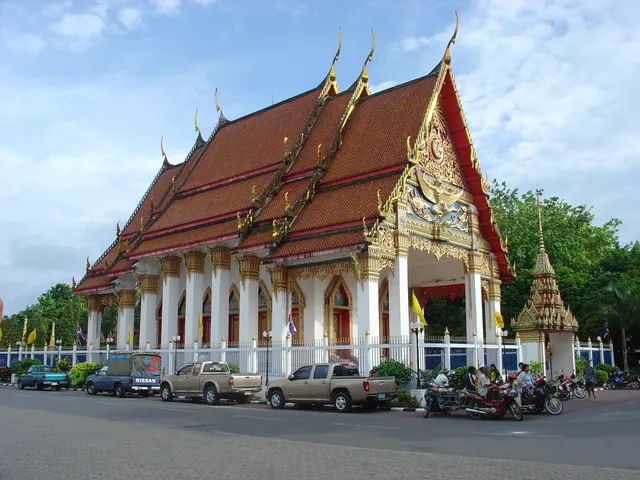
Big Buddha makes more sense when you pair it with Wat Chalong rather than another selfie stop. Do the hill for the wind, the bells, and the island-wide view, then drop into Chalong or Phuket Town for the part Phuket does better than almost anywhere: food with a memory.
Where to Eat
local_dining
Don't Leave Without Trying
moo hongmee hokkieno taolo baoh aewrotikanom jeen
Khao Suan Pho Restaurant
local favorite
Thai hillside restaurant€€star4.8(243)
Order: Order a spread of Thai dishes and eat on the terrace. Reviews keep coming back to the very good Thai food, fair prices, and the jungle-and-sea view with the Big Buddha in sight.
This is the one that feels least engineered for tourists and most worth the uphill detour. You get quiet, trees, ocean glimpses, and a setting that feels far from busy Kata and Karon.
All-day cafe restaurant with Thai and Western comfort food€€star4.8(396)
Order: Go for the house khao soi if you want something Thai, or the chicken schnitzel, mini burgers, and pancakes if you're after a generous brunch-style meal. Regulars specifically single those out.
The menu sounds broad, but reviews suggest this place actually pulls it off. It is a reliable Chalong stop when your group wants different things and nobody wants to settle for bad coffee.
Order: The avocado and salmon toast, yogurt bowl, and blueberry pancake are the dishes that keep getting named in reviews. Add coffee and take your time.
This is the calm breakfast-or-late-brunch answer when you need a break from beach-road noise. The room sounds thoughtfully done rather than trend-chasing, and the food gets praise for being fresh, balanced, and actually satisfying.
Rooftop lounge restaurant with cocktails€€star4.9(780)
Order: Order dinner with cocktails and settle in for the evening. Reviews are light on dish names but consistently praise the food's flavor and the drinks.
Pick this one when you want a polished night out after the temple and viewpoints. The mood matters here: stylish but relaxed, with service that makes birthdays and small celebrations feel properly looked after.
checkBreakfast matters in Phuket. Dim sum, kanom jeen, and roti are classic morning eats, and some breakfast places sell out early.
checkLunch tends to peak around 12:00-1:00 PM, and dinner around 6:00-8:00 PM.
checkNight markets usually get going from late afternoon, with many starting around 4:00-5:00 PM.
checkCarry cash. Most local restaurants are cash only, and many market stalls are cash only too.
checkCard acceptance is better at midrange, upscale, and tourist-facing venues, but not guaranteed everywhere.
checkCheck whether a service charge is already on the bill before tipping. If it is not, rounding up or leaving around 10% for very good sit-down service is normal.
checkMonday and Tuesday are the two days most worth double-checking for restaurant closures or limited operations.
checkIf you want the most predictable eating options, build an evening around scheduled markets such as Karon Temple Market, Kata Night Market, Naka Weekend Night Market, or Sunday Old Town Walking Street.
Food districts:Karon and Kata for market evenings near the Big Buddha side of south PhuketChalong for casual all-day diningRawai for cafes and evening rooftop spotsOld Phuket Town for breakfast culture and Sunday Walking Street food stallsNaka Market area for daily street-food grazing at Naka Food Center and weekend market eating
Restaurant data powered by Google
Watch & Explore The Big Buddha, Phuket.
Explore Phuket
Best Things To Do Phuket Thailand 4K
Island Hopper TV27 min607K
Explore Phuket
Visiting Big Buddha Phuket | Ultimate Travel Guide & Best Views
A Festival Called Life3 min7K
Frequently asked
Is The Big Buddha, Phuket worth visiting?
Yes, if you want more than a viewpoint. The 45-meter white marble Buddha sits on Nakkerd Hill like a six-story building set above the island, and the mix of wind, bell chimes, monk blessings, and wide views over Chalong Bay and the Kata-Karon side gives it real presence. Go knowing this is also a working religious site that reopened on March 3, 2026 after the August 23, 2024 landslide, so the place carries more weight than the average photo stop.
How long do you need at The Big Buddha, Phuket?
Most visitors need 60 to 90 minutes. That gives you time for the lower terrace, the 94-step naga stair, the main platform, the quieter rear terrace, and a slow look at the temple area below. If you hike up from Karon instead of driving, plan at least 2.5 hours round trip.
How do I get to The Big Buddha, Phuket from Phuket Town?
From Phuket Town, the simplest route is by car, taxi, or Bolt via West Chaofa Road (Route 4021) to Soi Yot Sane 1, then up the hill road for about 5.4 kilometers. Public buses do not go to the top, so the practical budget option is to take the Phuket Smart Bus south and switch to a taxi or ride-hailing car for the final climb. If you want the uphill walk, the best-known trail starts on the Karon side and takes about an hour.
What is the best time to visit The Big Buddha, Phuket?
Early morning is best, ideally before 10:00 AM. The light is cleaner, the heat is less punishing, and the east-facing white marble catches the sun instead of flattening into glare. Dry-season months from December to February usually give the clearest long views, while rainy periods can bring dramatic cloud and real safety concerns on the hill.
Can you visit The Big Buddha, Phuket for free?
Yes, admission is free. You do not need a ticket or advance booking, though donation boxes, flowers, incense, and optional sponsored tiles remain part of the site's culture. As of the latest confirmed reporting in March and April 2026, the reopened site was operating daily from 9:00 AM to 6:00 PM, but same-day checks are wise because conditions can still change.
What should I not miss at The Big Buddha, Phuket?
Do not stop at the front photo platform and leave. Walk the full way around the base to the rear terrace, where the crowds thin out and the island opens below you, and pay attention to the hand-fitted marble tiles, the smaller golden brass Buddha, the Seven Buddhas of the Week, and the rows of bells that keep sounding in the wind. The lower prayer area matters too; that is where the site feels less like an icon and more like a living place of worship.
Sources & attribution80
Researched and written by the Audiala editorial team from historical records, architectural archives, and local expertise. Last updated April 2026.
The Phuket News — Reported the March 3, 2026 reopening, current 9:00 AM-6:00 PM hours, and transfer to Wat Kittisangharam management.
The Phuket News — Detailed the 25 reopening conditions, current operations, and ongoing legal and safety limits after the landslide.
Phuket 101 — Provided current visitor guidance, dress code, access details, site highlights, and practical timing.
Mingmongkol Phuket — Official project site with formal name, project framing, and older public-facing site information.
Phuket Provincial Government — Supplied official background, site identity, access directions, and the place's role as both viewpoint and worship site.
abdullah ali — Unsplash License (https://unsplash.com/license) — Source: https://images.unsplash.com/photo-1719376341355-a67e8f4a849a
"Big Budda" Phuket 2014 february - panoramio — Roma Neus — CC BY 3.0 (https://creativecommons.org/licenses/by/3.0/) — Source: https://commons.wikimedia.org/wiki/File:"Big_Budda"_Phuket_2014_february_-_panoramio.jpg
"Big Budda" Phuket 2014 february - panoramio (2) — Roma Neus — CC BY 3.0 (https://creativecommons.org/licenses/by/3.0/) — Source: https://commons.wikimedia.org/wiki/File:"Big_Budda"_Phuket_2014_february_-_panoramio_(2).jpg
"Big Budda" Phuket 2014 february - panoramio (1) — Roma Neus — CC BY 3.0 (https://creativecommons.org/licenses/by/3.0/) — Source: https://commons.wikimedia.org/wiki/File:"Big_Budda"_Phuket_2014_february_-_panoramio_(1).jpg
Big Buddha from Windmill Viewpoint — Christophe95 — CC BY-SA 4.0 (https://creativecommons.org/licenses/by-sa/4.0/) — Source: https://commons.wikimedia.org/wiki/File:Big_Buddha_from_Windmill_Viewpoint.jpg
Strictly necessary cookies keep the site working. Analytics (PostHog, Google Analytics) measures how each visitor uses our pages. Marketing loads YouTube videos and walking-route maps without a tap and lets Google Analytics set advertising cookies. We never sell your data. You can change this any time from the footer.
Analytics and marketing cookies are optional and only load if you agree. Details under Customize.
Privacy
Cookie preferences
Pick what you're okay with. You can change this any time from the footer.
Strictly necessary
Always on
Sign-in, language, navigation. Always on.
Product analytics
PostHog (EU) and Google Analytics record which pages you view and how you use them, under a random identifier stored in your browser. Helps us see which pages work and which need fixing. Google's ad personalisation stays off. No selling.
Marketing
Loads YouTube videos and the walking-route maps (OpenFreeMap) without a tap; without it, they load only when you tap them. If analytics is also on, Google Analytics may set advertising cookies. Ad personalisation stays off.