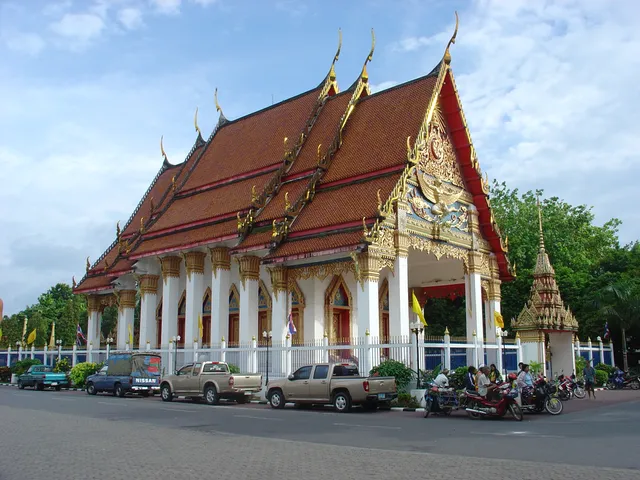
An introduction.
Researched by the Audiala editorial team from historical records, architectural archives, and local expertise.
SSalt hangs in the air at Cape Panwa before you see much of anything, then the road bends and Phuket, Thailand suddenly stops behaving like the Phuket in postcards. Come here for the quieter version of the island: steep green lanes, small bays with long-tail boats nosing the shore, a working marine-research station, and sea views that feel earned rather than staged. Cape Panwa, on Phuket's southeastern tip, suits travelers who'd rather trade beach-club noise for aquarium tunnels, wind on a lookout tower, and dinners at the end of the road where the island gives way to open water.
Cape Panwa sits roughly 10 kilometers south of Phuket Town, about the distance of a patient 20-minute drive if the curves behave. That short gap matters. You can spend the morning among the shophouses of Phuket's Ancient buildings in Sino-European style, then arrive here to find research boats, fishing piers, and resort gates sharing the same peninsula without pretending to be one coherent scene.
West-coast Phuket sells sunsets by the truckload. Cape Panwa sells texture instead: the cool dark of the Phuket Aquarium after noon heat, the dry clatter of leaves on the climb to Khao Khad Viewpoint, the softer water at Ao Yon where families still treat the beach as part of daily life rather than a stage set.
And that split personality is the reason to visit. Cape Panwa feels half local peninsula, half tucked-away resort district, with just enough friction between the two to stay interesting.
Cape Panwa Hotel, Thailand's 5-Star Luxury Resort in Phuket (4K Full Tour)
Luxury Travel Host01 What to see.
Phuket Aquarium and the PMBC Seafront
Khao Khad Viewpoint
Ao Yon and the Cape-End Hotels
02 In pictures.

Watch & Explore Cape Panwa.
Plan and listen to Cape Panwa with Audiala.
Audio guide in your pocket, itinerary in your browser. Built for the way you actually visit.
03 Visitor logistics.
The practical scaffolding for a good visit — kept short.
Getting There
Cape Panwa sits about 10 km south of Phuket Town on Sakdidej Road, and the drive usually takes 20-30 minutes depending on traffic. As of 2026, Phuket Aquarium’s official site says a local public shuttle to “Makham Bay and Aquarium” runs from town every 30 minutes; Khao Khad Viewpoint has no local bus, so you need a car, motorbike, taxi, or ride-hailing for the last climb.
Opening Hours
Cape Panwa’s roads, beaches, and viewpoints are open-air and effectively always accessible, but the main indoor stop has fixed hours. As of 2026, Phuket Aquarium is open daily from 8:30 a.m. to 4:30 p.m., with the ticket office closing at 4:00 p.m.; restaurant hours at the cape-end hotel cluster vary by venue and day.
Time Needed
Give Cape Panwa 2-3 hours if you only want Phuket Aquarium and a quick look at the cape. Plan 4-5 hours if you add Khao Khad Viewpoint, a swim or lunch at Ao Yon, and a slow drive along the peninsula’s steep roads; a dinner booking at the cape-end resorts turns it into a half-day that slides neatly into evening.
Accessibility
Accessibility changes sharply from stop to stop. Phuket Aquarium is the easiest part of Cape Panwa for visitors who want a controlled indoor visit, but Khao Khad Viewpoint is reached by a long staircase and more stairs inside the tower, while many roads around Ao Yon and the cape-end hotels are steep, narrow, and uncomfortable for long walks.
Cost/Tickets
As of 2026, Phuket Aquarium charges 300 baht for foreign adults and 150 baht for foreign children; Thai visitors pay 80 baht for adults and 40 baht for children. Children under 108 cm enter free, and the official fee page also lists free admission for seniors 60+, monks or novices, people with disabilities, and disadvantaged visitors, so carry ID if you plan to claim an exemption.
04 Tips for visitors.
Small things that change the day.
Beat The Heat
Start with Phuket Aquarium when it opens at 8:30 a.m. The dim galleries feel almost refrigerated after Cape Panwa’s heat, and you’ll leave into bright salt air before the tour buses and family groups thicken around late morning.
Best View Light
Save Khao Khad Viewpoint for late afternoon, when the light skims across Chalong Bay and the east-coast islands instead of flattening them into white glare. Midday works if you only want orientation, but the tower’s real trick appears when the sun softens and the wind picks up.
Where To Eat
For dinner, Panwa House is the splurge: a white Sino-Portuguese mansion on the beach at Cape Panwa Hotel, open 6:30-11:00 p.m. and closed Mondays as of 2026. Top of the Reef is another splurge on the same hotel grounds with sea views and a smart-casual dress code, while Flamingo Beach Front Cafe at Ao Yon works better for a mid-range beach lunch than a formal night out.
Do Not Walk
Cape Panwa looks close on the map, then the hills remind you who is in charge. Distances between Ao Yon, Makham Bay, Khao Khad, and the cape-end hotels are awkward on foot because the roads are steep, curves are blind, and shade comes and goes, so use wheels between stops and save your walking for the aquarium path or the beach.
Pair It Smartly
Cape Panwa works best as Phuket’s quiet counterpoint, not as a full island survey. Pair it with an early wander through Phuket Town’s Ancient buildings in Sino-European style, then drive south for the aquarium and viewpoint; if you already did Khao Rang, skip Cape Panwa for the view alone and come for the peninsula mood instead.
Choose Ao Yon
If you want sand without the west-coast circus, Ao Yon is the practical stop on this peninsula. The bay is more sheltered than Phuket’s surfier postcard beaches, so it makes better sense for a lazy swim or lunch break than forcing yourself onto the private-resort end of the cape and wondering why the shoreline suddenly belongs to a hotel.
Where to Eat
Don't Leave Without Trying
Ben Panwa - since 2012 正宗的泰国餐厅
local favoriteOrder: Order the steamed fish with lemon juice, morning glory, spicy squid salad, and finish with mango sticky rice. The pad Thai with chicken and papaya salad also show up repeatedly in reviews for good reason.
This is the sort of place that makes hotel restaurant dinners feel unnecessary. Reviews keep circling back to bright, properly balanced Thai flavors and dishes that taste like someone in the kitchen actually cares whether the fish is fresh and the wok stayed hot enough.
Panwa Seaview Bistro
local favoriteOrder: Go for the Panang curry, cashew chicken, shrimp cake, and mango sticky rice. If you want a lighter start in the heat, the Thai tea gets mentioned alongside the bay view for a reason.
Cape Panwa has no shortage of places selling the view. This one seems to earn repeat visits because the kitchen holds up after sunset, with generous portions, kind service, and food people order again as takeaway instead of treating it as a one-off scenic stop.
Tamarind Restaurant, Phuket
fine diningOrder: Order the green papaya salad, pad Thai noodles, and fried banana. Reviews also note that starters run generously, so it makes sense to build the meal around a few shared plates.
Tamarind is the polished dinner option when you want a proper evening out without drifting into stiff hotel-food territory. The beach view, attentive service, and live music in some evenings give it occasion energy, but the menu still reads best when you treat it like Thailand and share.
TARZAN SEA SIDE CAFE
cafeOrder: Get the pineapple rice, chicken curry, fried morning glory, and a smoothie or Americano with orange juice. Honey toast with fruit is the move if you stay long enough for something sweet.
This is the scenic cafe worth the uphill trip because the food seems more than an afterthought. Reviews mention the sea view first, naturally, but they also keep naming specific dishes that hold their own once you sit down and stop staring at the water.
Dining Tips
- check Phuket food leans Southern Thai, Chinese/Hokkien, Malay, and Baba-Peranakan rather than standard central Thai tourist-menu cooking.
- check Expect stronger spice, sharper sourness, and a heavier seafood and noodle presence than in Bangkok-oriented menus.
- check Shared dishes are normal. Ordering a few plates for the table fits local dining habits better than treating every dish as a solo main.
- check Breakfast matters in Phuket, often centered on dim sum, roti with curry, kanom jeen, and dark local coffee.
- check Morning markets are best early, roughly 6 am to 9 am.
- check Lunch tends to peak around 12:00 to 13:00, and dinner around 18:00 to 20:00, so eating earlier usually makes more sense than planning a late start.
- check Cape Panwa is quieter than Phuket Town for markets and casual local food exploration, so it is worth heading toward town if food is the main plan.
- check Tipping is not compulsory in Phuket. Fine-dining places may add service charge, and rounding up elsewhere is normal.
Restaurant data powered by Google
05 Where Phuket Chose Science Over Spectacle
Cape Panwa's history does not begin with a palace, a conquest, or a temple bell. Records point instead to laboratories, field stations, and a stretch of coast chosen because the Andaman Sea sat close at hand and the peninsula's coves offered direct contact with the marine life Thailand wanted to study rather than merely admire.
That choice shaped the place you see now. While Phuket's west coast grew into the island's loud public face, Cape Panwa kept a more uneven identity: fishing settlements, government research grounds, hillside roads, and later a layer of luxury hotels at the cape's end.
The Thai-Danish Experiment That Changed the Cape
The modern story starts offshore in 1966, when the 5th Thai-Danish Expedition surveyed the Andaman coast and helped persuade Thai officials that this corner of Phuket deserved a permanent marine station. Under King Bhumibol Adulyadej's Thailand, the first Thai-Danish agreement was signed on October 11, 1968, and the Phuket Marine Biological Center opened in 1971 on Cape Panwa's shore.
A formal opening followed on May 15, 1972. Then the peninsula acquired a purpose that still defines it: not simply a pretty cape, but a working edge between science and sea, where tanks, labs, boats, and coastal paths all belong to the same idea.
Phuket Aquarium, established in 1983 as part of the center, turned that research mission outward. Visitors now pass from dim tanks to bright seawalks in a few minutes, which is exactly the point: Cape Panwa teaches you to look at the water as habitat first, scenery second.
A Peninsula That Escaped the West-Coast Script
From Fisheries to Coastal Protection
Listen to the full story in the app
The whole Cape Panwa,
told well.
Audio guides for 1,100+ cities across 96 countries. History, stories, and local insight — offline ready.
06 Frequently asked.
The questions travellers send us most about Cape Panwa.
Is Cape Panwa worth visiting?
Yes, if you want a quieter side of Phuket. Cape Panwa feels more like a working peninsula than a beach strip, with steep green roads, small bays, the Phuket Aquarium, and broad sea views from Khao Khad. It makes more sense for curious travelers than for people chasing beach clubs.
How long do you need at Cape Panwa?
Half a day is enough for the main stops. Give yourself 3 to 5 hours if you want the aquarium, Khao Khad Viewpoint, and time at Ao Yon or the cape-end hotel and dining area. A full day works better if you plan lunch by the water and don't want to rush the hills.
What is Cape Panwa known for?
Cape Panwa is known for marine science as much as scenery. The Phuket Marine Biological Center grew from Thai-Danish research work that began in 1966, and Phuket Aquarium opened here in 1983 as its public-facing counterpart. That gives the peninsula a different feel from Phuket's resort-heavy west coast.
Is Phuket Aquarium in Cape Panwa worth visiting?
Yes, especially with children or if the heat has started to flatten the day. The building is modest, but the sequence works: cool dim galleries, local Andaman species, a short glass tunnel, then bright sea air again outside. Don't expect a giant international aquarium; expect a compact place tied to real research.
Can you swim at Cape Panwa?
Yes, but choose the bay rather than the cape tip. Ao Yon is the usual pick for a calmer swim, while the far end of the peninsula is more about views, hotels, and dining than a classic public beach day. Conditions still change with weather and season, so the water isn't equally inviting every day.
Is Khao Khad Viewpoint worth visiting?
Yes, if you care more about the view than the building. The lookout tower itself is plain, almost municipal in spirit, but the payoff is a wraparound sweep over Chalong Bay, the east coast, islands, and mangrove edges. Go for light and wind, not architecture.
Is Cape Panwa a good area to stay in Phuket?
Yes, if you want quiet evenings and don't mind being away from Phuket's louder beach zones. The peninsula suits travelers who prefer hillside roads, small bays, and resort pockets over nightlife on the main strip. It can feel a bit split in character, though: half local neighborhood, half private-resort world.
Verified, and shown.
Researched and written by the Audiala editorial team from historical records, architectural archives, and local expertise.
Official provincial overview of Cape Panwa and reference for Khao Khad Viewpoint being built by the Wichit Sub-District Administrative Organization.
Official visitor-facing site for aquarium zones, facilities, nature trail, culture and nursery station, souvenir shop, and research vessel information.
Primary source for the Thai-Danish expedition timeline, the 1968 agreement, PMBC opening in 1971, official opening on May 15, 1972, and transfer to DMCR on October 3, 2002.
Used to verify that Cape Panwa itself is not a UNESCO World Heritage Site and is not separately named on Thailand's tentative list.
Supporting source for PMBC history dates and institutional background tied to the Thai-Danish marine research work.
Supporting source for PMBC opening year and visitor-oriented context for the marine center.
Official source confirming Phuket Aquarium was established in 1983 as part of PMBC.
Supporting source for the aquarium's 1983 establishment and general visitor context.
Visitor-oriented source mentioning the 2006 renovation and tunnel addition, treated as a single-source claim in the research notes.
Researched from Wikidata, Wikipedia & official sources · fact-checked · How we make our guides →