Type 2+ letters to search all countries, cities, and places
/Ctrl KEsc
travel_explore
Type 2+ letters to search all countries, cities, and places
Press Enter to open the top result
Ancient Buildings in Sino-European Style
Phuket·Thailand·7° N · 98° E·Updated Apr 2026
Tin money built Phuket Old Town, where Hokkien trade wealth turned six streets into a working quarter of arcades, shrines, markets, and pastel facades in use.
A lane once known for opium smoke and brothels now glows with pastel shutters, shrine incense, and the click of coffee cups. Ancient buildings in Sino-European style in Phuket, Thailand reward a visit because few districts in Southeast Asia wear their contradictions so openly: Chinese shop houses, European flourishes, family shrines, old banks, and side streets that still smell faintly of rain on plaster. This is Phuket Old Town rather than a single monument, and that matters. You come here to read a whole neighborhood, not just photograph a facade.
Most scholars date the quarter's best-known building wave to the late 19th and early 20th centuries, when tin money remade Phuket into a trading town tied as much to Penang as to Siam. Walk Thalang Road, Dibuk Road, Phang Nga Road, Krabi Road, Yaowarat Road, and Soi Romanee, and the style starts to make sense: deep five-foot ways for shade, narrow fronts opening into long plots, stucco curls above doors, Chinese air wells pulling light into the middle of the house like a vertical well of heat and sky.
The usual label is "Sino-Portuguese," but that story is too neat. Academic research and local history both point to a Straits-connected town shaped by Hokkien migration, Peranakan family life, and design ideas arriving through Penang, which sits just under 300 kilometers away across the Andaman Sea, about the length of six marathon courses laid end to end.
Come early, before the tour buses and Sunday market crowds thicken the streets. Morning is better. You hear metal shutters rattling up, smell kopi and joss sticks in the same block, and notice that these old buildings are still doing the job they were built for: trading, feeding, housing, worshipping, arguing, enduring.
Researched by the Audiala editorial team from historical records, architectural archives, and local expertise.
What to see
Thalang Road and Soi Romanee
Phuket Old Town makes its point fast on Thalang Road: a long run of late-19th- and early-20th-century shophouses, stuccoed and shuttered, linked by the Hokkien five-foot way locals call Ngor-Ka-Kee. Walk under the arcade in the late morning heat and the street behaves like climate engineering disguised as decoration, with hard white glare at the curb, cool shade under the arches, and the dry click of footsteps changing as people slip in and out of the covered path; then turn into Soi Romanee, where the polished pastel facades at the Thalang end slowly give way to a rougher Dibuk-side aftertaste that still hints at the lane's former life as the old red-light quarter. Most visitors photograph the pretty half and leave. Stay a little longer, and the place stops looking like a row of old facades and starts reading as a district that made money, hid vice, and learned how to age in public.
Krabi Road: Thai Hua Museum and Chinpracha House
Krabi Road is where the old town stops performing and shows you how people actually lived inside this hybrid architecture, especially if you pair the 1934 Thai Hua Museum with Chinpracha House, built in 1903. Thai Hua's red bat on the gable is easy to miss unless you know to look up, and Chinpracha repays slow attention with Italian floor tiles, imported fittings, and a central pond-airwell that cools the rooms so clearly you feel the temperature drop like stepping into shade under a railway bridge; in a town built on tin fortunes, this is the moment the money becomes tangible under your shoes.
Phang Nga to Dibuk: the old town as a walking sequence
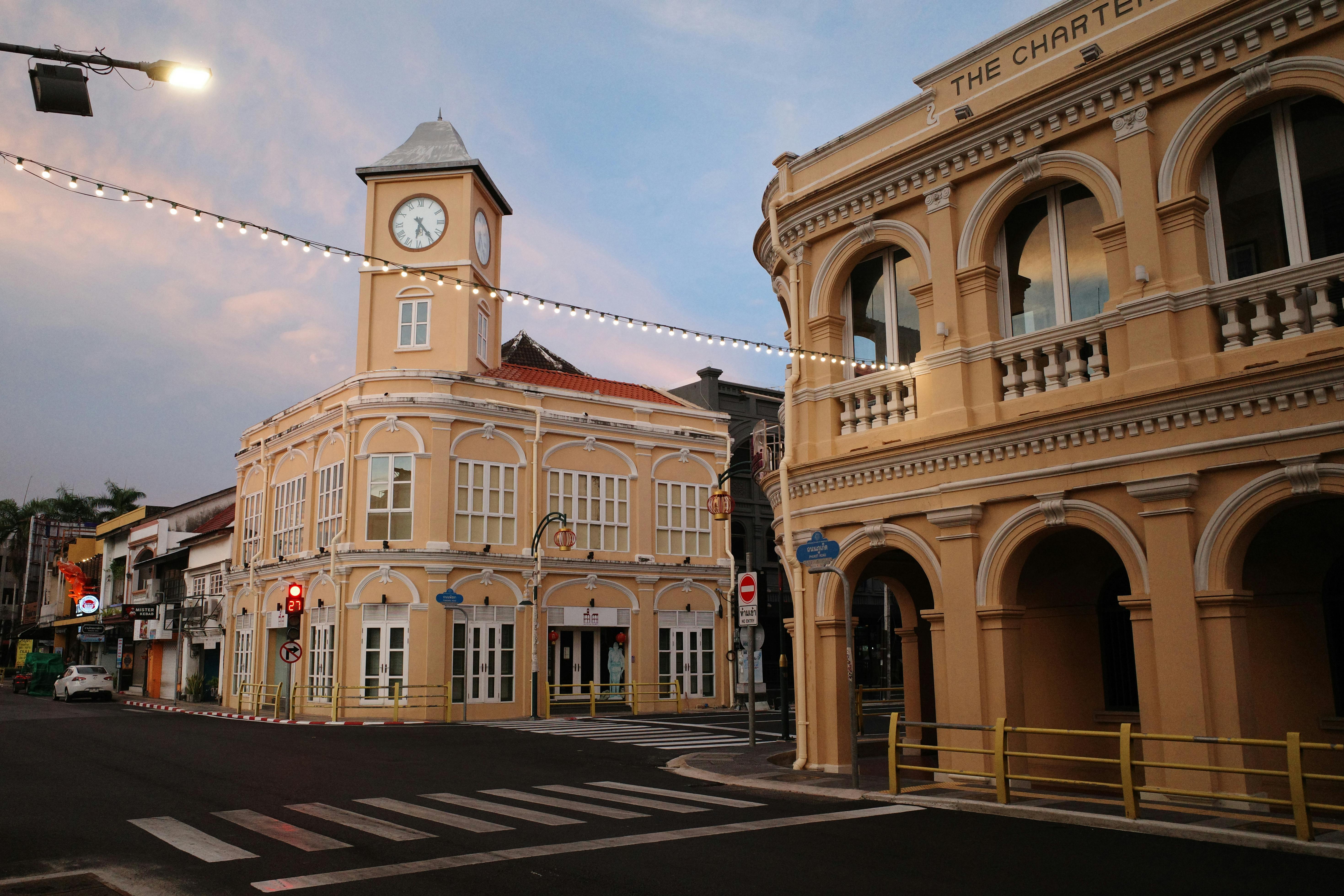
The best way to read these buildings is not as isolated landmarks but as one slow route: start on Phang Nga Road at the old Chartered Bank corner and the yellow clock-tower police building, slip into the Shrine of the Serene Light behind the block, then cut across Thalang Road, Soi Romanee, and Dibuk Road until you find the disguised entrance to Oasis Thalang. This walk takes about 45 minutes without museum stops, a distance short enough to fit between two beach plans and long enough to reset your sense of Phuket: bright street, dim front room, sudden courtyard, incense-thick shrine air, then another facade catching the afternoon light. Set out early. Sunday night is fun, but if you actually want to see the architecture rather than a market draped over it, weekday morning wins by a mile.
Plan your visit
Getting There
Phuket Old Town has no rail link, so the cleanest public route is the 8411 Airport Bus from Phuket International Airport to Phuket Bus Terminal 1: as of 2026, the fare is 100 THB and the ride takes about 1 hour 15 minutes. From Terminal 1, the old quarter begins about 1.1 km away, roughly a 12-minute walk via Phang Nga Road toward the yellow clock tower and Soi Romanee; if you want less heat, the free Dragon Line loop shuttle circles the core daily from 11:00 am to 10:00 pm.
Opening Hours
The historic streets are a public neighborhood, not a gated monument, so you can walk them at any hour; daylight through early evening is when the facades, arcades, and shopfronts make the most sense. As of 2026, the Sunday Walking Street on Thalang Road runs every Sunday from 4:00 pm to 10:00 pm, while key interiors keep their own schedules: Thai Hua Museum is safest planned for Tuesday to Sunday, 9:00 am to 5:00 pm, and Baan Chinpracha is best visited between 9:00 am and 4:00 pm because current listings still conflict.
Time Needed
Give the district 60 to 90 minutes if you only want Thalang Road, Soi Romanee, and a few quick facade stops. A good first visit takes 2 to 4 hours with one museum or shrine, while a half-day of 4 to 6 hours lets you add Thai Hua Museum, Baan Chinpracha, lunch, and a slower walk through Krabi, Dibuk, and Phang Nga roads.
Accessibility
The old town is flatter than many historic quarters in Thailand, but narrow walkways, curb changes, uneven paving, and the covered five-foot ways can still make wheels work harder than the pastel photos suggest. Street-level browsing is possible with assistance, especially on weekday mornings; full step-free access should not be assumed inside historic buildings like Baan Chinpracha, and Sunday after 5:30 pm brings crowds thick enough to turn a short block into a slow shuffle.
Cost & Tickets
Walking the district itself is free, and the Sunday market is also free to enter. As of 2026, Thai Hua Museum charges 200 THB for foreign adults and reports an extra 200 THB photo pass for interior photography, while Baan Chinpracha is generally 150 THB for foreign visitors; no reliable skip-the-line system turned up, though both places can handle reservations or group bookings.
Photo Gallery
A stately Sino-European facade in Phuket shows off white stucco walls, arched entrances, and colonial-era symmetry. Soft daylight and an open forecourt give the historic museum building a calm, formal presence. · AkelukA beautifully lit Sino-European facade in Phuket stands against the night sky, its ornate details and red lanterns reflected across the quiet courtyard. The scene captures the historic character of old Phuket Town. · Deepak-nskA stately white facade in Phuket shows the island's Sino-European architectural legacy. Bright daylight and towering clouds give the historic building a crisp, dramatic presence. · This Photo was taken by Supanut Arunoprayote.
Feel free to use any of my images, but please mention me as the author and may send me a message. (สามารถใช้ภาพได้อิสระ แต่กรุณาใส่เครดิตผู้ถ่ายและอาจส่งข้อความบอกกล่าวด้วย)
Please do not upload an updated image here without consultation with the Author. The author would like to make corrections only at his own source. This ensures that the changes are preserved.Please if you think that any changes should be required, please inform the author.Otherwise you can upload a new image with a new name. Please use one of the templates derivative or extract.A preserved Sino-European building facade in Phuket, Thailand, stands in bright daylight beneath a soft, cloud-filled sky. Its ornate white exterior reflects the island's Chinese-Portuguese architectural heritage. · EasyKLA preserved Sino-European facade stands at the end of a quiet courtyard in Phuket. Soft daylight brings out the cream stucco, shuttered windows, and red tiled roof. · Полина СлавянскаяA white Sino-European heritage building in Phuket stands behind a vintage red bus in the museum courtyard. The bright daylight brings out the ornate facade and old-town character. · AkelukA view of Ancient buildings in Sino-European style, Phuket, Thailand. · This Photo was taken by Supanut Arunoprayote.
Feel free to use any of my images, but please mention me as the author and may send me a message. (สามารถใช้ภาพได้อิสระ แต่กรุณาใส่เครดิตผู้ถ่ายและอาจส่งข้อความบอกกล่าวด้วย)
Please do not upload an updated image here without consultation with the Author. The author would like to make corrections only at his own source. This ensures that the changes are preserved.Please if you think that any changes should be required, please inform the author.Otherwise you can upload a new image with a new name. Please use one of the templates derivative or extract.
History
A Trading Town That Never Quite Stopped Trading
Phuket Old Town survives because its buildings never became empty shells. Records and current street life show the old quarter still works as a mixed urban fabric where commerce, family life, and ritual share the same addresses, much as they did when tin fortunes first paid for these facades in the late 1800s and early 1900s.
That continuity is the real story. Paint colors change, boutique hotels replace hardware stores, and Soi Romanee no longer serves the same trade it once did, but the underlying pattern holds: business in front, private worlds behind, shrines nearby, schools within walking distance, and streets designed for heat, rain, and daily negotiation.
The turning point
Phra Pitak Chinpracha and the Moment Tin Money Turned Into a Household
Documented sources date Chinpracha House on Krabi Road to 1903, built by Phra Pitak Chinpracha, also known as Tan Ma Siang. What mattered to him was not simple display. A merchant could be rich in ledgers and still vanish in a generation; a mansion with imported tiles, carved doors, and a plan built around an inner court turned mining wealth into family authority you could walk through room by room.
That was the turning point. Trade stopped being something counted in sacks and invoices and became architecture, inheritance, marriage strategy, and public standing on a street others had to see. Step inside now and the continuity still reads clearly: front rooms for receiving, deeper spaces for domestic life, light dropping from above, heat venting upward, the house working like a machine for both status and survival.
And the pattern did not end with one mansion. Across Phuket Old Town, smaller shop houses repeat the same social logic in tighter form, which is why the district still feels alive rather than embalmed.
What Changed
Documented research says Phuket Old Town was officially announced as a historic preservation district in 2019, after decades in which many buildings were altered, neglected, repainted, subdivided, or remade for new trades. Soi Romanee changed the most in mood: a lane widely remembered for prostitution, gambling, and opium during the mining boom now sells postcards, cocktails, and carefully staged nostalgia under strings of light.
What Endured
What endured is the street grammar. Families still live above or behind businesses, shrines still anchor blocks, covered walkways still give shade during the wet heat, and Chinese-Peranakan identity still shapes the quarter through food, festivals, and memory. The old town also keeps its habit of mixing the sacred with the commercial; provincial records say Bang Niew Shrine began on Soi Romanee before later fires and relocations, which tells you how tightly worship and daily trade once sat together.
Tips for visitors
Shrine Etiquette
Jui Tui Shrine and the Shrine of the Serene Light still function as places of worship, not stage sets. Dress more modestly than you would for the beach, keep your voice down, and remove shoes when signs or attendants indicate it.
Ask Before Shooting
Street photography is usually fine, but interiors are a patchwork of house rules. Thai Hua Museum may charge 200 THB for an indoor photo pass as of 2026, photography is restricted inside the main shrine area at the Shrine of the Serene Light, and tripods or commercial-looking setups are best cleared first.
Weekday Mornings
Go early on a weekday if you care about architecture more than market atmosphere. The arcades still hold onto the smell of coffee and incense then, and Soi Romanee feels like a street again instead of a queue of phones pointed at the same pastel wall.
Eat The Story
Skip the generic cafe crawl and eat food that belongs to this quarter's Hokkien-Peranakan history. For a budget stop, try A Pong Mae Sunee; for mid-range, One Chun, Tu Kab Khao, and Raya all make sense, while Blue Elephant in the former Governor's Mansion is the polished splurge version of the same family story.
Use Grab Instead
The most common tourist headache here is transport pricing, not street crime. Agree tuk-tuk fares before you get in or just use Grab, Bolt, or InDrive, especially on Sunday evenings when parking tightens and drivers know you have fewer easy options.
Build A Route
The smartest heritage sequence is Thai Hua Museum first, then Krabi Road for Baan Chinpracha, then Phang Nga Road and the old Chartered Bank corner before ending on Soi Romanee and Thalang Road. That order reads the district properly: history first, facades after, market snacks last.
Where to Eat
local_dining
Don't Leave Without Trying
Hokkien meemee Hokkienmoo hongo taoo-aewkhanom jeen with southern currieslocal dim sumroti with currya-pongloba
TOH DAENG at Phuket old town
local favorite
Phuket heritage Thai with local Southern and Peranakan influences€€star4.9(479)
Order: Order the crispy noodle with chicken, and if you want something less expected, add the rambutan curry. Reviews also single out the spicy pineapple ice cream.
This is one of the few places in Old Town where the meal comes with a sense of family history, not just polished plating. Diners keep mentioning the warm host, the story of the historic house next door, and flavors that feel rooted in Phuket rather than copied from a generic Thai menu.
Modern Phuket Thai cooking with premium local-style ingredients€€star4.9(367)
Order: Go for the house take on classic Thai dishes, especially anything featuring wagyu beef or king prawns. Reviews praise the way familiar local flavors are given a sharper, more modern edge.
A Phuket local in the reviews says they appreciated how the kitchen handles local food, and that matters more than any glossy branding. This is a good pick when you want Phuket flavors in a room that still feels relaxed enough for a long dinner.
Rise and Grind Phuket วันใหม่ในเมืองเก่า “Specialty Coffee & Healthy Food”
cafe
Specialty coffee cafe with breakfast, bakery, and light healthy meals€€star4.9(427)
Order: Come for the coffee first, then add something from the bakery cabinet or a light lunch. If you need gluten-free options in Old Town, reviews say the cakes, cheesecake, and desserts are unusually good.
Old Town has plenty of places with pretty facades and weak coffee. This is not one of them. People mention the owners, the barista, and the building's backstory, which makes it feel tied to the street outside instead of sealed off from it.
Order: Order a flat white and one of the fresh croissants or pastries. Regulars specifically call out the coffee and the pastry case.
This is the sort of place you slip into between shophouses when the heat starts pressing down. The draw is simple: strong coffee, proper pastries, and a calm room in the middle of Phuket Town's old streets.
checkOld Town is the best area to eat dishes locals describe as distinctly Phuket, especially in the historic Sino-European shophouse district rather than the beach zones.
checkDo not assume local restaurants open seven days a week. Monday and Tuesday are the most common closure days mentioned in the research.
checkBreakfast in Phuket starts early, and breakfast-focused places often close by 13:00 or earlier.
checkLocal lunch service is busiest roughly between 11:30 and 13:00.
checkCore dinner hours run about 18:00 to 21:00, though night markets usually begin earlier, around 16:00 to 17:00.
checkLard Yai, the Sunday Walking Street Market on Thalang Road in Phuket Old Town, runs Sunday from 16:00 to 22:00 and is the strongest market fit if you want food inside the historic quarter.
checkNaka Market is most consistently confirmed on Saturday and Sunday from 16:00 to 22:00, though some sources list it until 23:00.
checkChillva Market and Phuket Indy Market have conflicting published schedules, so verify locally before making plans.
Food districts:Phuket Old TownThalang Road historic coreThanon RatsadaThanon DibukPhuket RoadYaowarad RoadLimeLight Avenue old quarter areaSamkong area
Restaurant data powered by Google
Frequently asked
Is Phuket Old Town's ancient Sino-European buildings worth visiting?
Yes, especially if Phuket's beach strip leaves you cold after an hour. The old quarter gives you something rarer on this island: tin-boom shophouses, shrine courtyards, school buildings, and family mansions that still feel lived in rather than staged. Go early on a weekday and the arcades, incense, and clatter of breakfast shops make much more sense than the postcard version.
How long do you need at Phuket Old Town's ancient Sino-European buildings?
Two to four hours works well for a first visit. That gives you time for Thalang Road, Soi Romanee, Phang Nga Road, and one interior stop such as Thai Hua Museum or Baan Chinpracha. If you care about architecture more than selfies, give it half a day.
How do I get to Phuket Old Town's ancient Sino-European buildings from Phuket Airport?
The cleanest budget route is the 8411 Airport Bus to Phuket Bus Terminal 1, then a 12-minute walk or the free Dragon Line shuttle into the old quarter. The bus fare is 100 THB and the ride takes about 1 hour 15 minutes, which is slower than a taxi but far less annoying. Grab also works if you're carrying bags or arriving in the afternoon heat.
What is the best time to visit Phuket Old Town's ancient Sino-European buildings?
Weekday mornings are best if you want the buildings rather than the crowd around them. Light falls softly into the five-foot ways, shutters are still opening, and the streets smell more like coffee and incense than hot scooter exhaust. Sunday evening is good only if you want Lard Yai market energy instead of clear architectural views.
Can you visit Phuket Old Town's ancient Sino-European buildings for free?
Yes, the district itself is free because it is a public neighborhood, not a gated monument. You only pay for certain interiors such as Thai Hua Museum or Baan Chinpracha. That makes it one of Phuket's better-value walks, especially if you pair it with a shrine visit and lunch.
What should I not miss at Phuket Old Town's ancient Sino-European buildings?
Do not miss Thalang Road's long arcades, Soi Romanee's prettier-than-it-used-to-be facades, the Chartered Bank intersection, Thai Hua Museum, and Baan Chinpracha on Krabi Road. Also watch for the details most people walk past: the red bat on Thai Hua Museum's gable, the airwell inside old shophouses, and the sudden hush inside the Shrine of the Serene Light. Those details turn the quarter from pretty frontage into a real town.
Is Phuket Old Town a UNESCO World Heritage Site?
No, Phuket Old Town is not on UNESCO's World Heritage List or Thailand's current Tentative List as of April 22, 2026. What Phuket does have is UNESCO Creative City of Gastronomy status, which fits the place better anyway. The quarter matters because it is alive, not because it has a plaque.
Sources & attribution99
Researched and written by the Audiala editorial team from historical records, architectural archives, and local expertise. Last updated April 2026.
UNESCO World Heritage Centre — Confirmed that Phuket Old Town is not on Thailand's World Heritage List or Tentative List as of April 22, 2026.
Tourism Authority of Thailand — Provided overview of Phuket Old Town as a public historic quarter shaped by tin wealth, mixed communities, food culture, and walkable streets.
Tourism Authority of Thailand — Supported route planning, key streets, Sunday market context, and general visitor framing for Phuket Old Town.
MDPI Sustainability — Academic source for conservation history, Penang influence, style terminology, 388 historic buildings, and 2019 preservation district status.
Museum Thailand — Provided interpretation of shophouse layout, Chim-Jae airwell, and Museum Phuket's focus on Peranakan life and architecture.
Museum Thailand — Supplied Thai Hua Museum background, ticketing, visitor notes, and its role in telling Phuket's Chinese and Peranakan history.
Museum Thailand — Supported context on Peranakan identity and local museum framing of Phuket's Baba communities.
The Siam Society — Key historical source on Phuket's links to Penang, Hokkien migration, mining networks, shrines, secret societies, and early town-building.
Thammasat University Journal — Comparative study used for style terminology and how Phuket's architecture is labeled in Thailand versus Penang and Malacca.
Phuket Provincial Government — Confirmed the 1785 Burmese invasion of Thalang in Phuket's official historical material.
Phuket.net — Provided general historical background on Phuket, Thalang, and the island's political shift toward the later tin town.
Museum Thailand — Confirmed 1903 date for Chinpracha House and supplied museum-style description of the mansion and visitor details.
Travelfish — Supported the 1903 construction date and provided independent background on Chinpracha House.
Phuket Provincial Government — Used for Bang Niew Shrine history, its 1904 founding tradition, and its earlier location on Soi Romanee.
Phuket 101 — Provided details on Museum Phuket, the former bank and police-station intersection, and local history claims about banking and administration.
Amazing Thailand — Helped confirm 1911 as a working date associated with Jui Tui Shrine and offered shrine visitor context.
Lonely Planet — Supported Jui Tui Shrine dating and its role in Phuket Town's Chinese religious life.
Phuket Thai Hua School (I) — This Photo was taken by Supanut Arunoprayote.
Feel free to use any of my images, but please mention me as the author and may send me a message. (สามารถใช้ภาพได้อิสระ แต่กรุณาใส่เครดิตผู้ถ่ายและอาจส่งข้อความบอกกล่าวด้วย)
Please do not upload an updated image here without consultation with the Author. The author would like to make corrections only at his own source. This ensures that the changes are preserved.Please if you think that any changes should be required, please inform the author.Otherwise you can upload a new image with a new name. Please use one of the templates derivative or extract. — CC BY 4.0 (https://creativecommons.org/licenses/by/4.0/) — Source: https://commons.wikimedia.org/wiki/File:Phuket_Thai_Hua_School_(I).jpg
Phuket Thai Hua School — EasyKL — CC BY-SA 4.0 (https://creativecommons.org/licenses/by-sa/4.0/) — Source: https://commons.wikimedia.org/wiki/File:Phuket_Thai_Hua_School.jpg
Музей Thai Hua — Полина Славянская — CC BY 3.0 (https://creativecommons.org/licenses/by/3.0/) — Source: https://commons.wikimedia.org/wiki/File:Музей_Thai_Hua.JPG
Strictly necessary cookies keep the site working. Analytics (PostHog, Google Analytics) measures how each visitor uses our pages. Marketing loads YouTube videos and walking-route maps without a tap and lets Google Analytics set advertising cookies. We never sell your data. You can change this any time from the footer.
Privacy
Cookie preferences
Pick what you're okay with. You can change this any time from the footer.
Strictly necessary
Always on
Sign-in, language, navigation. Always on.
Product analytics
PostHog (EU) and Google Analytics record which pages you view and how you use them, under a random identifier stored in your browser. Helps us see which pages work and which need fixing. Google's ad personalisation stays off. No selling.
Marketing
Loads YouTube videos and the walking-route maps (OpenFreeMap) without a tap; without it, they load only when you tap them. If analytics is also on, Google Analytics may set advertising cookies. Ad personalisation stays off.