Phra Nakhon Si Ayutthaya

Thailand Updated Oct 2026

At Wat Mahathat, banyan roots clasp a sandstone Buddha head, making the past feel less like a ruin than a presence that has taken root. This is Phra Nakhon Si Ayutthaya, Thailand: a former royal capital on an island ringed by rivers, where crumbling temples share the streets with markets and noodle shops. Its unusual appeal lies in that overlap—history here is part of the daily scene, not set apart from it.

Phra Nakhon Si Ayutthaya, Thailand Photo: Alberto Capparelli / Pexels
Attractions
8
Trip length
1–2 days
Best season
Cool, dry season (November–February)

Why Phra Nakhon Si Ayutthaya

Built from cited sources · see the method · How we make our guides →

Founded around 1350, Ayutthaya grew into a trading and diplomatic center linking Siam with merchants from East Asia, India, Persia, and Europe. Burmese forces sacked the city in April 1767; the broken brickwork and empty temple courtyards still give that loss a physical scale.

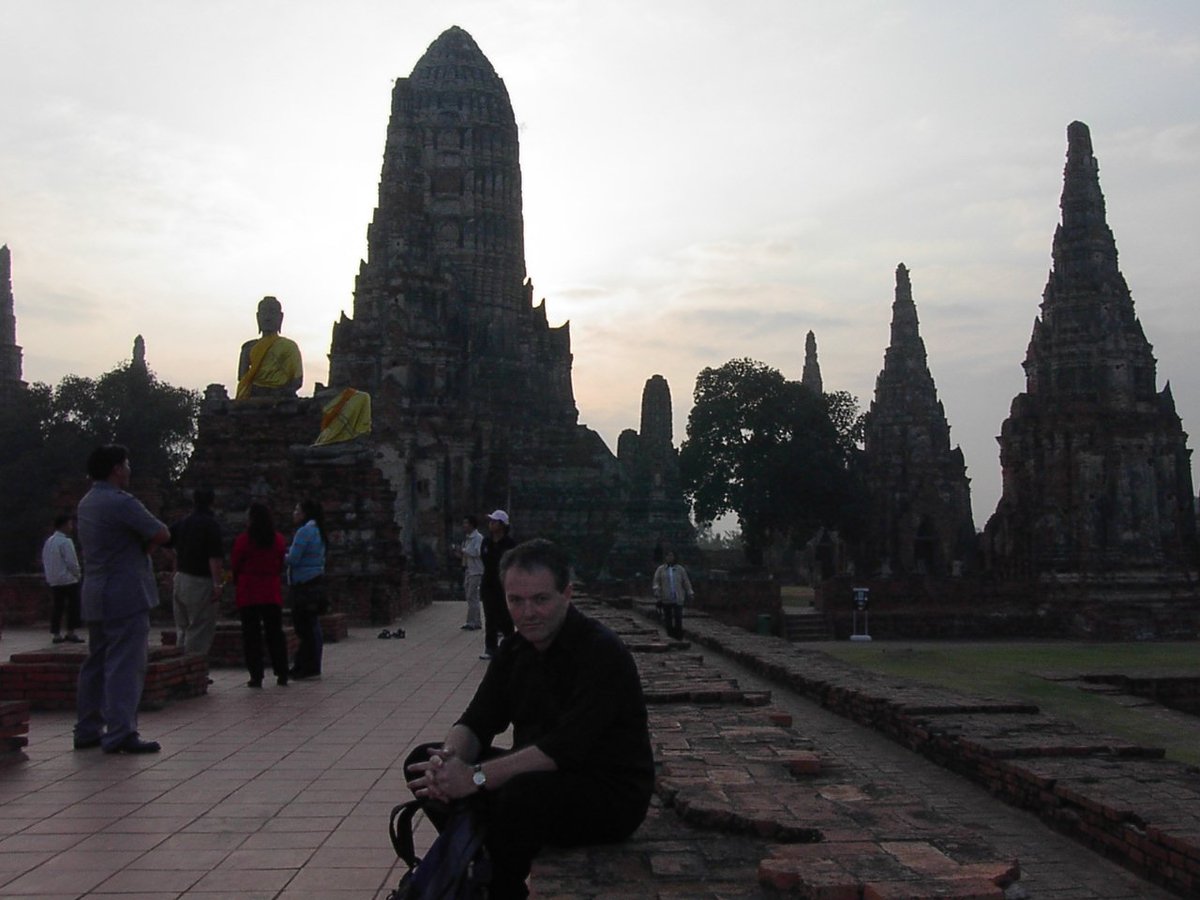
The old capital rewards comparison: Wat Phra Si Sanphet’s three bell-shaped stupas once stood within the royal palace grounds, while Wat Chaiwatthanaram’s Khmer-style towers rise beside the Chao Phraya. Away from the ruins, the city’s trading past lingers in its food—from tiny bowls of boat noodles to roti sai mai and Portuguese-influenced golden sweets.

When Bangkok became the capital in 1782, its planners echoed Ayutthaya’s island form, canals, and royal monuments. Seeing the old city makes Bangkok’s design feel less like a fresh beginning than an attempt to carry a lost capital forward.

  • A capital left in fragments

    Founded around 1350, Ayutthaya was the Siamese capital until its fall in 1767; its 289-hectare UNESCO archaeological zone preserves temple towers, palace foundations and headless Buddha images. At Wat Mahathat, a sandstone Buddha head rests in the roots of a banyan tree—a quiet detail amid the brickwork.
  • Three chedis, one royal model

    Wat Phra Si Sanphet’s three bell-shaped chedis held the ashes of Ayutthayan kings, and their design later influenced Bangkok’s Wat Phra Kaew. Across the river, Wat Chaiwatthanaram arranges its central prang and eight corner chapels in a formal Khmer-style plan.
  • A city shaped by rivers

    The old capital sits where the Chao Phraya, Pa Sak and Lopburi rivers meet, with canals once helping to define its streets and defenses. A boat ride past stilt houses and temple ruins makes clear why Bangkok later borrowed Ayutthaya’s island-and-canal blueprint.
  • Trade routes in the temple town

    Ayutthaya linked Asian and European merchants for centuries, and remnants of Dutch, Japanese and Portuguese settlements still line the river beyond the central ruins. At Chao Sam Phraya National Museum, more than 2,200 gold objects recovered from temple crypts give that trading history a human scale.

Places to Visit

Not every monument, just the ones we'd walk you past ourselves.

All 10 places in Phra Nakhon Si Ayutthaya

Neighborhoods

Where to wander, by quarter — each with its own rhythm.

  • Ayutthaya City Island

    The historic core is encircled by the Chao Phraya, Pa Sak, and Lopburi rivers. Temple ruins sit close to cafés, boat-noodle stalls, and Bang Lan night market, where evening snacks turn the old center into a working town again.
  • U-Thong Road

    This island-perimeter road follows the riverbanks and links temple views with everyday errands. Look for roti sai mai stalls near the provincial hospital, then pause at a riverside table as the light fades across the water.
  • Hua Ro

    At the island’s northeast corner, Hua Ro is best known for its traditional market and old wooden shophouses. Come in the morning for pork satay, coconut ice cream, and the clatter of a market already well into its day.
  • Dutch Settlement (Baan Hollanda)

    Outside the city island, this riverside quarter recalls the Dutch East India Company trading post established in 1608. The reconstructed red-brick museum stands beside original warehouse foundations and traces the long exchange between Dutch traders and Siam.
  • Japanese Village

    South of the island on the Chao Phraya’s east bank, this site commemorates Ayutthaya’s 17th-century Japanese community. A garden and pavilion frame exhibits on figures such as Yamada Nagamasa and the city’s far-reaching trade networks.
  • Portuguese Settlement

    Across the river from the Japanese Village, the remains of San Petro mark Siam’s earliest European trading community. Church ruins and excavated cemetery grounds offer a quieter counterpoint to the island’s grand temple complexes.

Plan your trip

Before you go

Getting There
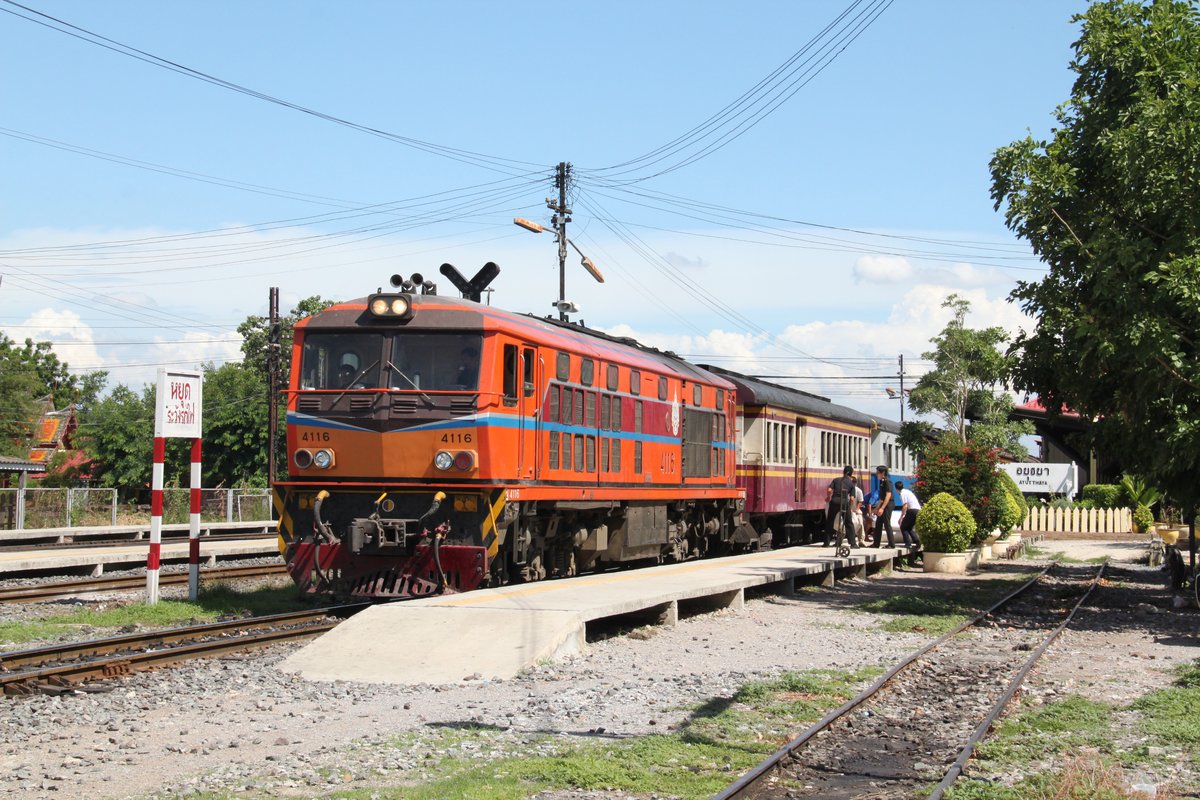
Ayutthaya has no commercial airport: use Don Mueang International Airport (DMK) or Suvarnabhumi Airport (BKK), then continue by State Railway of Thailand train or road. Trains serve Ayutthaya Railway Station from Don Mueang Railway Station and Krung Thep Aphiwat Central Terminal; from Bangkok, allow about 1.5–2 hours, or roughly 45–60 minutes from Don Mueang. By car, Route 32 (Asian Highway 1) and Route 1 connect the city northward, while Motorway 9 links Suvarnabhumi with the Bangkok approach; check 2026 SRT timetables before departure.
Getting Around
In 2026 Ayutthaya has no metro or tram system: zero urban rail lines, with songthaews, local buses, rounded-front tuk-tuks and a passenger ferry across the Pa Sak River doing the local work. The station ferry costs about ฿5, songthaews about ฿10–40, and bicycles ฿40–80 per day; agree a tuk-tuk fare before setting off. A combined ticket for six participating ruins is listed at ฿220 and valid for 30 days, compared with roughly ฿50 at many individual temple gates.
Climate & Best Time
Spring (March–May) is hottest, with highs around 35–38°C or more and lows of 26–28°C; summer (June–August) brings highs near 32–34°C and lows of 25–26°C, with monsoon showers. Autumn (September–November) shifts from the wettest stretch—September can bring about 9 inches of rain—to drier November days; winter (December–February) is comparatively dry, around 31–33°C by day and 21–24°C at night. November–February is peak season and the easiest time for temple visits; May–October is quieter but wetter, so aim for early morning or late afternoon.
Language & Currency
Central Thai is the main language, and English is commonly understood at major hotels and temple ticket offices; a translation app or a saved Thai-script address helps with drivers and market stalls. Thailand uses the baht (THB, ฿), and cash remains useful for street food, bike hire, tuk-tuks and small-site tickets, even though larger hotels and cafés often accept cards.
Safety & Temple Etiquette
The main practical hazards are midday heat on exposed brick courtyards and stray dogs around ruins, especially after dark; carry water, avoid approaching dogs and seek urgent medical care after a bite or scratch. Cover shoulders and knees at sacred sites, and don’t climb stupas or touch Buddha images; agree tuk-tuk fares in advance and call Tourist Police at 1155 if needed.

Ayutthaya: Capital of Rivers, Court, and Ruins

From a riverine settlement to Siam’s lost royal city

  1. c. 6th century

    Before the Island Capital

    Long before Ayutthaya became a royal capital, Mon communities of the Dvaravati culture lived across the lower Chao Phraya basin. Khmer power later reached the region from centers such as Lavo, near modern Lopburi.

  2. c. 13th century

    Ayodhaya by the Rivers

    A settlement called Ayodhaya stood east of the later island city, near the meeting of the Pa Sak and Chao Phraya rivers. Its name hints at the older layers beneath Ayutthaya’s royal story.

  3. 1314

    Uthong, the Founder

    King Uthong, later known as Ramathibodi I, founded Ayutthaya and made it the seat of a new kingdom. He chose an island threaded by waterways, where rivers could serve as roads, barriers, and lifelines.

  4. c. 1324

    A Temple Before the Capital

    Local accounts date Wat Phanan Choeng to 1324, before Ayutthaya’s formal foundation. Its revered seated Buddha, roughly 19 metres high, still gives the riverside temple a presence that feels older than the city around it.

  5. 1351

    A Kingdom Takes Root

    Ramathibodi I established the capital on an island formed by the Chao Phraya, Pa Sak, and Lopburi rivers. The water made Ayutthaya defensible, while its position in the central plain connected it to inland routes and seaborne trade.

  6. c. 1374

    The Great Relic Temple

    King Borommarachathirat I began building Wat Mahathat, which grew into a spiritual center of the capital. Its prang once rose above a crowded precinct of shrines and monasteries; today, brick and tree roots share the silence.

Show the full timeline (29 moments)
  1. 1424

    A Succession Settled by Swords

    Royal chronicles tell how two princes fought a fatal elephant duel near Pa Than Bridge after their father’s death. Their younger brother, Chao Sam Phraya, took the throne as Borommarachathirat II and built Wat Ratchaburana over their cremation site.

  2. 1431

    Angkor Falls to Ayutthaya

    Ayutthayan forces captured and sacked Angkor, the Khmer capital. The victory extended Siamese influence, and accounts connect the campaign with the movement of Khmer artisans and court practices into Ayutthaya.

  3. 1448

    Trailokanat Reorders the Court

    King Borommatrailokanat took the throne and reshaped the administration of the kingdom. His reforms formalized the sakdina system of rank and land assignment, giving Ayutthaya’s court a more centralized grip on its provinces.

  4. 1448

    A Palace Becomes a Temple

    The royal residence moved to a new palace, and the old palace grounds became Wat Phra Si Sanphet. Unlike an ordinary monastery, it served as the royal chapel, its three great chedis later becoming a defining silhouette of Ayutthaya.

  5. 1511

    Portugal Reaches the Royal Court

    Portuguese envoy Duarte Fernandes arrived after Portugal’s capture of Malacca, opening a new line of contact between Ayutthaya and Europe. Trade and diplomacy would soon bring foreign merchants and envoys to the river city.

  6. 1549

    Suriyothai Rides to Battle

    Royal chronicles recount Queen Suriyothai entering battle on an elephant during a Burmese invasion, trying to shield her husband, King Maha Chakkraphat. She was killed in the fighting, and her story became one of Ayutthaya’s most enduring accounts of royal sacrifice.

  7. 1569

    The Capital Falls to Burma

    After a siege, Ayutthaya fell to the Toungoo Burmese under King Bayinnaung. The kingdom became a Burmese vassal, and the loss of autonomy changed the balance of power at the royal court.

  8. 1584

    Naresuan Declares Independence

    Prince Naresuan broke with Burmese authority at Kraeng, declaring Siam independent. His connection to Ayutthaya was forged in its struggle to recover its sovereignty; he later ruled from the capital as king.

  9. 1593

    The Elephant Duel at Nong Sarai

    Siamese chronicles say King Naresuan killed the Burmese crown prince Mingyi Swa in combat atop war elephants at Nong Sarai. The victory secured Ayutthaya’s independence and entered the kingdom’s memory as a defining military triumph.

  10. 1604

    A City of Foreign Quarters

    The Dutch East India Company established a trading post as Ayutthaya drew merchants from across Asia and Europe. Portuguese, Japanese, Persian, Chinese, and other communities lived in quarters beyond the island’s walls, bringing unfamiliar languages and goods to the riverbanks.

  11. c. 1630

    A Monument on the Riverbank

    King Prasat Thong commissioned Wat Chaiwatthanaram on the west bank of the Chao Phraya. Its Khmer-inspired central prang and surrounding towers turned the river’s edge into a royal statement in brick.

  12. 1656

    Narai Opens the Court

    King Narai began his reign during a period of expanding trade and diplomacy. Ayutthaya’s court dealt with merchants and envoys from many shores, while Narai also spent time at Lopburi, another center of royal power.

  13. 1686

    Kosa Pan Reaches Versailles

    Diplomat Kosa Pan led a Siamese embassy from Ayutthaya to the court of Louis XIV at Versailles. His mission carried the capital’s voice across the world—and made the Siamese court a subject of intense European curiosity.

  14. 1688

    The Court Turns Inward

    A political upheaval brought Phra Phetracha to power, ended the Prasat Thong dynasty, and began the Ban Phlu Luang dynasty. Constantine Phaulkon was executed, and French forces were expelled as the court pulled back from foreign influence.

  15. 1734

    Taksin Born in Ayutthaya

    Taksin, the future king of Thonburi, was born in Ayutthaya and later served the kingdom as a military commander. When the capital fell, he would break out of the encirclement and gather forces to fight back.

  16. 1765

    The Final Siege Begins

    Konbaung armies invaded Siam and pressed toward Ayutthaya, beginning the campaign that would end the kingdom. By the time the capital was encircled, its defenders faced a siege lasting roughly 14 months.

  17. 7 April 1767

    Ayutthaya Burns and Falls

    Burmese forces breached the city after tunneling beneath its northern defenses and setting fire to supports. Palaces, temples, libraries, and records were destroyed; inhabitants were killed or taken captive, and the capital was left in ruins.

  18. 1767

    Taksin Founds a New Capital

    After breaking through the Burmese encirclement, Taksin rallied forces and drove remaining Burmese troops from central Siam. He established his new capital at Thonburi, downstream from the ruined city.

  19. 1782

    Bangkok Echoes Ayutthaya

    Rama I founded the Chakri dynasty and made Bangkok the new capital. Its island setting, canals, and royal compounds deliberately recalled Ayutthaya, carrying the old city’s plan into a new age of Siamese rule.

  20. 1935

    The Ruins Receive Protection

    Thailand’s Fine Arts Department placed the central ruins under archaeological protection. The change marked a shift from abandoned royal remains to a site cared for as part of the country’s recorded past.

  21. 1956

    Gold Found Beneath Ratchaburana

    After looters broke into Wat Ratchaburana’s central crypt, excavations recovered gold objects, royal regalia, and votive tablets. The finds revealed the wealth buried beneath the temple’s weathered brick and helped spur the creation of the Chao Sam Phraya National Museum.

  22. 1991

    The Historic City Goes Global

    UNESCO inscribed the Historic City of Ayutthaya as a World Heritage site, protecting 289 hectares of the ancient core. Its temples and palaces became recognized as evidence of a kingdom that once connected distant trading worlds.

  23. 2011

    Floodwaters Reach the Ruins

    Severe floods submerged much of the archaeological park and surrounding communities, with water reaching two to three metres in some places. The inundation exposed how the old river city’s strength—its closeness to water—could also put its surviving monuments at risk.

Who lived here

  • Japanese merchant and official · 1590–1630

    Yamada Nagamasa

    Led Ayutthaya’s Japanese community

    Yamada Nagamasa rose to prominence in the Japanese settlement beside the river, where merchants and political ties linked Ayutthaya to Japan. Today, the Japanese Village’s exhibits offer a glimpse of the international city he knew.

  • Court confectioner · born 1609

    Maria Guyomar de Pinha

    Lived and worked in Ayutthaya

    At the Ayutthaya court, Maria Guyomar de Pinha helped introduce egg-yolk-based sweets shaped by Portuguese cooking traditions. A visit to the old foreign settlements makes the city’s tangled cultural connections feel less abstract—and rather delicious.

  • King of Ayutthaya · 1633–1688

    King Narai

    Ruled from Ayutthaya, 1656–1688

    During Narai’s reign, Ayutthaya’s court cultivated diplomatic and commercial ties with foreign powers. The remains of those communities along the rivers are a reminder that his capital looked outward; he might recognize that openness in the city’s visitors today.

  • King of Ayutthaya · 1555–1605

    King Naresuan the Great

    Lived at Chantharakasem Front Palace as crown prince

    Before becoming king, Naresuan lived at Ayutthaya’s Front Palace, now the site of Chantharakasem National Museum. The museum’s weapons and royal objects give that address a human scale: this was a working court, not just a backdrop of ruins.

Where to Eat

Where locals actually book dinner — not the tourist menus.

Insider tips

Small things that change how the city treats you.

  • Beat the Heat

    Visit temple grounds between 08:00 and 10:30 or after 16:00; bare brick courtyards hold the heat through midday. Carry water, sunscreen and a hat, especially from March to May.
  • Ferry Then Cycle

    A passenger ferry crosses the Pa Sak River from the railway station to the historic island for about 5 THB. Bicycle rentals cost roughly 40–80 THB per day; use extra care at busy road crossings.
  • Carry Small Cash

    Keep baht handy for market food, bike hire, local tuk-tuks and individual temple tickets. Ordinary and commuter trains from Bangkok can cost around 11–50 THB, depending on the service.
  • Dress for Temples

    Cover your shoulders and knees at sacred sites, and remove your shoes before entering active shrine halls. Keep off old walls and stupas, and never climb or sit on Buddha images.
  • Agree on Fares

    Set a tuk-tuk price before you get in; hourly hires commonly run about 200–300 THB. Ignore unsolicited claims that a temple is closed if someone offers to redirect you to a shop.
  • Try Roti Sai Mai

    Look for Ayutthaya’s roti sai mai: fine strands of palm-sugar candy wrapped in a thin, freshly grilled pancake. Chao Phrom Market is a practical place to browse local food stalls.
  • Give Dogs Room

    Stray dogs gather around temple grounds and residential lanes; don’t approach, feed or pet them. Avoid unlit areas with dogs after dark, and seek medical care promptly for any bite or scratch.

Frequently asked

Is Ayutthaya worth visiting?

Yes, especially if you want to see how a former royal capital survives in its ruins. Wat Mahathat, Wat Phra Si Sanphet and Wat Chaiwatthanaram show different sides of the city, while the river setting hints at its history as a trading hub.

How many days do you need in Ayutthaya?

One full day covers the central temple cluster, but two days allow time for museums and sites beyond the island. Stay overnight if you want to visit Wat Chaiwatthanaram near sunset without rushing back to Bangkok.

How do I get to Ayutthaya from Bangkok?

Take a northbound State Railway of Thailand train from Krung Thep Aphiwat or Don Mueang to Ayutthaya. The trip time depends on the service; check the current timetable before setting out, then take the station ferry across the Pa Sak River to the historic island.

How do you get around Ayutthaya?

Rent a bicycle for the flat historic island, use a tuk-tuk for outlying temples, or take local songthaews on their shared routes. Agree on a tuk-tuk fare before departure; the station ferry to the island costs about 5 THB.

Is Ayutthaya safe for tourists?

Ayutthaya is generally peaceful, but heat, stray dogs and occasional shop-diversion scams deserve attention. Avoid approaching dogs, check temple hours at official ticket booths, and call Tourist Police at 1155 if you need assistance.

How much does a trip to Ayutthaya cost?

Local transport can be inexpensive: trains from Bangkok are reported at roughly 11–50 THB, the station ferry costs about 5 THB, and bicycle hire is around 40–80 THB per day. Carry cash for small stalls, tuk-tuks and individual site tickets; admission prices vary by site.

Can I wear shorts in Ayutthaya?

Wear clothing that covers your knees and shoulders when visiting temples. Short shorts and tank tops don’t meet the stated dress guidance, and a light cover-up is useful between sites.

All Places to Visit.

10 places to discover

Chandra Kasem Palace
Place

Chandra Kasem Palace

Chao Sam Phraya National Museum
Place

Chao Sam Phraya National Museum

Wat Chaiwatthanaram
Place

Wat Chaiwatthanaram

Wat Phra Sri Sanphet
Place

Wat Phra Sri Sanphet

Ayutthaya Railway Station
Place

Ayutthaya Railway Station

Wat Phanan Choeng
Place

Wat Phanan Choeng

Wat Suwan Dararam
Place

Wat Suwan Dararam

Place

Wat Ratchaburana

Wat Yai Chai Mongkhon
Place

Wat Yai Chai Mongkhon

Place

Wat Senasanaram Ratworawihan

Photo credits (9)
  1. Alberto Capparelli — Pexels License (https://www.pexels.com/license/) — Source: https://www.pexels.com/photo/8644222/
  2. 500px photo (28321313) — Richard Harrison — CC BY 3.0 (https://creativecommons.org/licenses/by/3.0/) — Source: https://commons.wikimedia.org/wiki/File:500px_photo_(28321313).jpeg
  3. Ayutthaya Technical College sign — Griff88 — CC BY-SA 4.0 (https://creativecommons.org/licenses/by-sa/4.0/) — Source: https://commons.wikimedia.org/wiki/File:Ayutthaya_Technical_College_sign.jpg
  4. Pratuchai, Phra Nakhon Si Ayutthaya District, Phra Nakhon Si Ayutthaya 13000, Thailand - panoramio — martin.ale — CC BY-SA 3.0 (https://creativecommons.org/licenses/by-sa/3.0/) — Source: https://commons.wikimedia.org/wiki/File:Pratuchai,_Phra_Nakhon_Si_Ayutthaya_District,_Phra_Nakhon_Si_Ayutthaya_13000,_Thailand_-_panoramio.jpg
  5. Map ayutthaya district thesaban map — Nord794ub — CC BY-SA 4.0 (https://creativecommons.org/licenses/by-sa/4.0/) — Source: https://commons.wikimedia.org/wiki/File:Map_ayutthaya_district_thesaban_map.jpg
  6. Pratuchai, Phra Nakhon Si Ayutthaya District, Phra Nakhon Si Ayutthaya 13000, Thailand - panoramio (1) — oikk — CC BY 3.0 (https://creativecommons.org/licenses/by/3.0/) — Source: https://commons.wikimedia.org/wiki/File:Pratuchai,_Phra_Nakhon_Si_Ayutthaya_District,_Phra_Nakhon_Si_Ayutthaya_13000,_Thailand_-_panoramio_(1).jpg
  7. Pratuchai, Phra Nakhon Si Ayutthaya District, Phra Nakhon Si Ayutthaya 13000, Thailand - panoramio (2) — trungydang — CC BY 3.0 (https://creativecommons.org/licenses/by/3.0/) — Source: https://commons.wikimedia.org/wiki/File:Pratuchai,_Phra_Nakhon_Si_Ayutthaya_District,_Phra_Nakhon_Si_Ayutthaya_13000,_Thailand_-_panoramio_(2).jpg
  8. Pratuchai, Phra Nakhon Si Ayutthaya District, Phra Nakhon Si Ayutthaya 13000, Thailand - panoramio (3) — joinai — CC BY 3.0 (https://creativecommons.org/licenses/by/3.0/) — Source: https://commons.wikimedia.org/wiki/File:Pratuchai,_Phra_Nakhon_Si_Ayutthaya_District,_Phra_Nakhon_Si_Ayutthaya_13000,_Thailand_-_panoramio_(3).jpg
  9. Pratuchai, Phra Nakhon Si Ayutthaya District, Phra Nakhon Si Ayutthaya 13000, Thailand - panoramio - Mozhar — Mozhar — CC BY-SA 3.0 (https://creativecommons.org/licenses/by-sa/3.0/) — Source: https://commons.wikimedia.org/wiki/File:Pratuchai,_Phra_Nakhon_Si_Ayutthaya_District,_Phra_Nakhon_Si_Ayutthaya_13000,_Thailand_-_panoramio_-_Mozhar.jpg

Photos may have been resized or cropped.