


Place
Pattaya
Thailand Updated Apr 2026
Pattaya gets misread before most travelers arrive. The city they have in mind — all neon and Walking Street bars on Thailand's eastern shore, ninety minutes from Suvarnabhumi by road — exists, but it shares space with Michelin Bib Gourmand pork offal soup stalls, a 105-meter timber temple under construction since 1981 that is designed never to be completed, and an arts festival where Thammasat University students build bamboo carousels in a field. The reputation is earned. It is not the whole city.
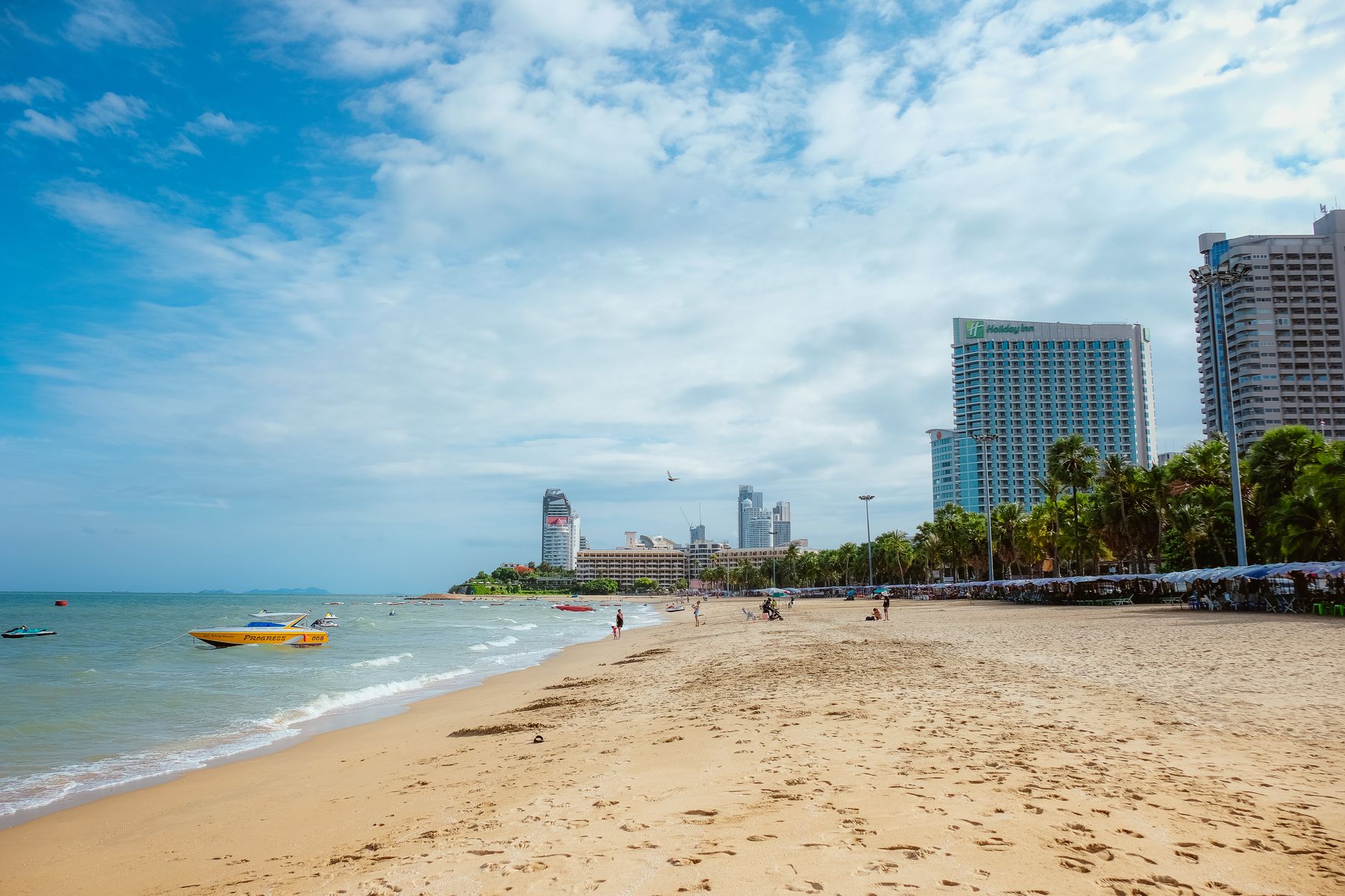
 Photo: Du Tử Mộng / Pexels
- Attractions
- 12
- Trip length
- 3–4 days
- Best season
- Winter (November–March)
Why Pattaya
Built from cited sources · see the method · How we make our guides →
The city is hybrid in a way most tourist destinations only perform. Russian, Korean, and Chinese visitors now outnumber Western arrivals across many seasons. The Eastern Economic Corridor — a government-backed industrial and tech zone running along this coastline — has pulled in professionals who need good espresso in the morning, and specialty roasters have materialized to meet them. The neon strip and the third-wave café exist within the same few kilometers and mostly ignore each other.
The best meal in Pattaya has nothing to do with the seafood restaurants facing Beach Road with laminated photographs on their menus. It is at Mae Pong Sri in Naklua — a stall so consistent that Michelin's 2025 Bib Gourmand list included it, the first time the Chonburi region had appeared on any Michelin list at all. The dish is pork offal soup, sour and funky in equal measure, star gooseberry leaves floating on top. From there, walk north along Naklua Road on a Saturday morning and find the fish market at 6 AM, where boats sell directly from the hold to anyone with a bag.
Pattaya has been reinventing itself almost continuously since American soldiers used it as a rest-and-recreation hub during the Vietnam War. It passed through cheap beach resort, mass international nightlife destination, and post-2014 government crackdown, arriving at something less easily labeled: a city with a 24-hour entertainment strip in one district and, fifteen kilometers away at Siam Country Club every December, an arts festival where Thai designers install bamboo sculptures and unsigned local acts debut alongside international sound artists. These two Pattayas coexist. Which one you find depends entirely on where you look.
A Temple Built to Stay Unfinished
The Sanctuary of Truth has been under construction since 1981 and is designed to stay that way — when one section of the 105-meter all-wooden frame weathers and must be replaced, carvers begin the carvings again. Every surface depicts Hindu and Buddhist cosmology, executed entirely by hand.The Island 8 Kilometers Out
Koh Larn is what Pattaya's main beach was before the hotels arrived. The public ferry from Bali Hai Pier costs 40 THB and takes 30 minutes — long enough for the water to shift from murky to genuinely clear.Cabaret Since 1974
Tiffany's Show has staged performances for over 50 years; Alcazar opened later with a 1,200-seat theater and sharper production values. Both run multiple shows nightly and have long since stopped being a curiosity — they're a legitimate performing art.Four Languages on the Menu Board
Restaurant signs in Pattaya run English, Russian, Chinese, and Korean — and the menus follow. The city draws enough distinct national communities that eating across four culinary traditions in an afternoon requires no planning and no pretense.
Places to Visit
Not every monument, just the ones we'd walk you past ourselves.
Neighborhoods
Where to wander, by quarter — each with its own rhythm.
Naklua
The old fishing quarter north of the tourist strip is where Thai residents actually eat. Mum Aroi, a sprawling open-air restaurant right on the water, serves traditional seafood to Thai families who drive across the province on weekends. Mae Pong Sri, the Michelin Bib Gourmand pork offal soup stall on Naklua Road, always has a queue by 8 AM. The Saturday fish market starts at 6 AM when boats dock and sell directly from the hold. Quieter than everything south of it and best explored by bicycle or motorbike.Pratumnak Hill
The hill between Pattaya Bay and Jomtien Beach holds the city's clearest viewpoint — a full panorama of both coastlines from Wat Phra Yai, where an 18-meter golden Buddha faces the sea. The surrounding streets are upscale residential, favored by EEC professionals and longer-stay expats, and a cluster of quality restaurants and rooftop bars has followed them. Far enough from Walking Street that you can have a conversation at a normal volume.Walking Street and South Pattaya
The half-kilometer strip running from Beach Road to Bali Hai Pier is pedestrianized after 6 PM and constitutes what most people picture when they picture Pattaya. Nightclubs, cabaret theaters, go-go bars, live music venues, and street performers stack up on both sides. Worth one daytime walk — when it is quiet and the full scale becomes legible — before experiencing it after dark. At 4:30 AM, when the clubs close, street food vendors set up along the full length: tom kha, grilled meats, noodle soups. The post-club food market is its own thing entirely.Soi Buakhao and LK Metro
Central Pattaya but consistently overlooked by first-time visitors, this zone has the densest concentration of live music pubs in the city. Cover bands play Thai pop and international rock from 9 PM to 2 AM, beer runs 80–100 THB, and the atmosphere is far less aggressive than the strip to the south. Long-stay expats and Thai regulars form most of the clientele. The locals' answer to where to actually drink.Jomtien Beach
South of the main city, Jomtien stretches quieter and longer, with more residential character than resort. The beach is cleaner than central Pattaya's, the pace is slower, and a LGBTQ-friendly bar zone on the southern end has operated openly for decades. Families with small children prefer the shallower water and lower foot traffic. The opposite of Walking Street in almost every respect.North Pattaya and the Sanctuary Area
The Sanctuary of Truth anchors this quieter northern district — a 105-meter all-wooden temple hand-carved since 1981, intentionally designed to be perpetually unfinished, the ongoing work of artisans trained in Khmer temple traditions. Wong Amat Beach, a short walk away, has softer sand and fewer vendors than the main beach, with traditional fishing boats still moored in the early morning. The area feels like a different city from the entertainment strips two kilometers south.Central Pattaya and Beach Road
The main tourist corridor runs along Beach Road between North and South Pattaya: hotels, malls, international restaurants, and shops filling both sides at all hours. Royal Garden Plaza houses Ripley's Believe It or Not and a cluster of air-conditioned entertainment venues useful for escaping midday heat. Functional and always busy, it is the city's commercial spine. Most visitors pass through it constantly; few linger deliberately.
Plan your trip
Before you go
- Getting There
- Two airports serve Pattaya. Suvarnabhumi (BKK), 147 km northwest, connects via public bus (130–150 THB from Level 1, Gate 8, roughly every 1–2 hours) or private transfer from around 1,200 THB; journey time is 90–120 minutes depending on traffic. U-Tapao Airport (UTP), just 35 km south near Rayong, handles AirAsia, Thai Lion Air, and direct routes from China and Korea — a shared minibus costs 250–350 THB and takes under an hour.
- Getting Around
- Pattaya has no metro, tram, or BRT. The city runs on songthaews — shared pickup trucks with bench seating — and as of April 2026 the base fare is 15 THB (raised from 10 THB); Jomtien and Naklua routes cost 20 THB. Flag one down, press the interior buzzer when you want to stop, pay on exit in cash; Grab works reliably for late nights or when you have luggage.
- Climate & Best Time
- Pattaya runs tropical year-round, with temperatures between 31–35°C and a hard monsoon from May through October — September alone averages 229 mm of rain across 20 days. November through March is the dry window; January and February combine the lowest rainfall of the year with cooler nights around 22°C, and the sea at Koh Larn stays clear enough to see the bottom.
- Language & Currency
- Thai Baht (THB) is the only currency that works at street level; carry 20 and 50 THB notes for songthaews and markets. Every Thai ATM charges a flat 220 THB foreign transaction fee per withdrawal in 2026 — a Wise or Revolut card avoids most of this, and always select 'THB' when the machine offers Dynamic Currency Conversion. English is functional across tourist-facing businesses; Russian and Mandarin are common enough that menus frequently appear in all three.
- Safety
- The jet-ski rental scam — operators claiming damage after you return the vehicle — is Pattaya's most consistent tourist problem; photograph every surface of any rented vehicle before riding away. Motorbike accidents kill more tourists in Pattaya than crime does, so wear a helmet and avoid unfamiliar roads after dark. The English-speaking tourist police line is 1155, staffed 24 hours.
Named by an Army, Built by Strangers
260 years of soldiers, tourists, crises, and reinvention
- 1767
An Army Names a Village
A column of roughly 500 men marched east from the ruins of Ayutthaya in early 1767, led by the military governor Phraya Tak. Near this crescent bay, they met a local commander named Nai Klom, whose orders were to stop them. Nai Klom judged the situation, surrendered, and joined the march instead. The site of that non-battle took the name Thap Phraya — 'the army of the Phraya' — which bent through centuries into Pattaya.
- 1767
Phraya Tak: The King Who Passed Through
Phraya Tak rested briefly at this bay en route to rewriting Siamese history. By December 28, 1767 — less than nine months after passing through — he had expelled the Burmese from Thonburi and been crowned King Taksin of a reconstituted Siam. He ruled fifteen years before a coup ended him, his general becoming Rama I and founding the Chakri dynasty still on the throne today. The beach kept his title in its name long after the rest of history moved on.
- June 29, 1959
The Soldiers from Korat Arrive
On June 29, 1959, a group of American servicemen drove from their base in Nakhon Ratchasima to a beach they had heard about, rented houses from a local named Phraya Sunthorn, and swam in the Gulf of Thailand. Word traveled back to base, then to other bases, then to Saigon. Within a decade, the US military ran organized charter flights from Vietnam to Bangkok with buses south to Pattaya for five-day R&R rotations — roughly 6,000 men monthly at the peak. A fishing village in the path of a war machine.
- 1965
Nipa Lodge: The First Hotel Opens
The Nipa Lodge opened in 1965 on the south end of the bay — Pattaya's first purpose-built hotel, designed for men with five days, military wages, and no particular plans. The building is long gone, absorbed and renamed, but the site marks the point where Pattaya stopped being a beach and became a destination. By 1978, the city had 7,000 hotel rooms.
- 1976
The Americans Leave, the City Stumbles
When the US military formally withdrew from Thailand in 1976, Pattaya lost roughly half its visitors in under two years. Guesthouses shuttered; the strip emptied. A town built on five-day R&R rotations found it had no fallback economy. European backpackers eventually arrived, then German and Scandinavian package tourists — a different kind of visitor, looking for something the soldiers hadn't particularly sought.
- November 29, 1978
Pattaya Becomes a City
On November 29, 1978, Thailand enacted the Pattaya City Act, creating a municipality with a governance structure found nowhere else in the country — incorporating the main beach district and the Naklua sub-district under a single specially administered city. The date is now Pattaya's official birthday, though the city had been running on its own logic since 1959. By year-end, the room count stood at 7,000.
Show the full timeline (22 moments)
- 1978
Cindy Sirinya Bishop: Raised on the Strip
Born in Bangkok on December 30, 1978, Cindy Burbridge grew up in Pattaya during the resort's early boom years. She won Miss Thailand World at 17, built a career in Thai television and international modeling, and later became host and judge on Asia's Next Top Model. Her face — American father, mother of half-English, half-Indian, and Thai heritage — was an unlikely product of a beach town more famous for its bars than its schools.
- August 13, 1981
Lek Viriyaphan Begins the Unfinishable
In August 1981, the Thai billionaire Lek Viriyaphan broke ground on 13 hectares in northern Pattaya and began building a 105-metre wooden temple explicitly designed never to be completed. The Sanctuary of Truth employs master artisans who carve Hindu and Buddhist mythological figures across every surface — each panel replaced when it weathers, the structure perpetually in progress. Lek died around 2000. The building continued, and in 2026, after 45 years of construction, it continues still.
- 1991
The AIDS Crisis Hits the Strip
By 1991, an estimated 15% of female sex workers in Pattaya tested HIV-positive — a figure that drew sustained international media coverage and drove European family tourists away for years. The government's response was the 100% Condom Programme, mandatory condom use in commercial sex venues driven by activist-turned-minister Mechai Viravaidya, which measurably reduced new infections by the mid-1990s. The reputation had crystallised before the recovery, and Pattaya spent the next decade managing two realities at once.
- March 18, 1993
Urassaya Sperbund Born in Pattaya
Born in Pattaya on March 18, 1993, to a Norwegian father and Thai mother, Urassaya Sperbund grew up attending Regent's International School in Chonburi Province, becoming fluent in five languages before graduating. She won the Suphannahong National Film Award for Best Actress twice and became Thailand's most internationally recognized actress. Her success — built from a resort city better known for its beaches than its performing arts — was a quiet argument for a different version of what Pattaya could produce.
- July 11, 1997
Royal Jomtien Hotel Fire Kills 91
At 10:20 AM on July 11, 1997, a worker at the ground-floor buffet of the 17-storey Royal Jomtien Resort Hotel accidentally triggered a gas explosion by adjusting a faulty LPG valve. The fire burned for up to twelve hours; at least 91 people died and 63 were injured. The building had been constructed before Thailand's 1992 fire safety laws and had no sprinklers, no smoke alarms, and combustible finishes throughout. The fire department arrived more than thirty minutes later and lacked the equipment to reach the upper floors.
- 1997
The Baht Collapses — and Tourism Surges
Thailand floated the baht on July 2, 1997, triggering the Asian financial crisis and pushing an estimated 10 million Thais into poverty. For Pattaya specifically, the effect was paradoxical: the baht lost roughly 40% of its value against Western currencies, making Thailand suddenly affordable for budget travelers who had never considered it. Real estate projects collapsed; hotels that survived filled with a new demographic. A national catastrophe accidentally extended the resort boom by five years.
- 2002
The Music Festival Launches Free
Pattaya's first International Music Festival launched in 2002 as a free beach concert mixing Thai and international acts. Free entry was the key decision — it pulled demographics the resort's reputation had actively repelled. The event grew into one of Asia's largest beach music festivals, drawing hundreds of thousands each year. A city defined by its nightlife discovered it could fill a beach in daylight.
- 2004
First Democratic Mayoral Election
Nirun Wattanasartsaton won Pattaya's first democratic mayoral election in 2004, ending decades under which the city's unique governance structure had kept its executive appointed rather than chosen. The election didn't resolve Pattaya's political complications — subsequent mayors faced corruption investigations, and a coup in 2014 would suspend elections entirely — but it was the first time residents held formal authority over who ran the city they lived in.
- April 11, 2009
The ASEAN Summit That Wasn't
On April 11, 2009, thousands of red-shirt protesters stormed the Royal Cliff Beach Resort while nine foreign heads of state were inside for the 14th ASEAN Summit, smashing through glass doors and overwhelming security. Nine leaders were evacuated by military helicopter from the hotel roof. Prime Minister Abhisit Vejjajiva declared a state of emergency in Chonburi Province and cancelled the summit — the only ASEAN meeting in the organization's history abandoned mid-session by protesters. Thirteen protest leaders were later sentenced to four years in prison.
- May 22, 2014
The Coup and the Economic Pivot
On May 22, 2014, General Prayuth Chan-o-cha staged Thailand's 13th modern coup, suspending civilian governance and installing the National Council for Peace and Order. For Pattaya, this meant appointed rather than elected administrators for several years, ending the democratic experiment begun in 2004. The NCPO also drafted the Thailand 4.0 economic vision that would become the Eastern Economic Corridor — the investment zone that now shapes Pattaya's economic identity more than its beaches do.
- 2015
Stamp Fairtex Moves to Pattaya
Nadthawan Panthong left Rayong Province at 18 in 2015 and moved to Pattaya to train full-time at Fairtex Gym, taking the gym's name as her professional identity. She built a career that made her the first athlete in ONE Championship history to hold world titles simultaneously in Muay Thai, kickboxing, and MMA — all at Women's Atomweight. The city that had spent decades managing its reputation as a nightlife destination had quietly produced one of the most decorated female combat athletes in Asia.
- January 17, 2017
The Eastern Economic Corridor Is Born
An NCPO order on January 17, 2017 formally established the Eastern Economic Corridor across Chonburi, Rayong, and Chachoengsao provinces — a special investment zone backed by 1.5 trillion baht in planned infrastructure spending. High-speed rail, deep-sea port upgrades, a targeted biotech cluster. By the time the formal EEC Act passed in February 2018, US$9.3 billion in foreign direct investment had already been pledged. The economic identity Pattaya is building now runs through boardrooms in Bangkok and Seoul, not the beachfront bars that preceded them.
- 2018
The Beach Gets Its Sand Back
In 2018, Pattaya completed a 429-million-baht beach restoration project addressing a problem decades in the making: in some sections, the crescent bay had eroded from its original 35-metre width to barely 2–3 metres. Sand was graded back and the seawall reconfigured. Whether this was an environmental repair or an admission that the resort had spent sixty years consuming its own foundation is a matter of perspective. The beach is wider now.
- March 25, 2020
COVID: Walking Street Goes Dark
Thailand's national lockdown on March 25, 2020 and subsequent fifteen-month border closure did what six decades of war, financial crisis, and coups had not: it stopped Pattaya entirely. By 2021, an estimated 80% of the city's tourism and hospitality businesses were closed, bankrupt, or suspended. The recovery, when it arrived in 2022–2023, brought a different demographic mix — more Indian and Middle Eastern visitors, fewer long-stay Western residents — and a city forced to ask which of its identities it actually wanted to keep.
- 2023
Corruption, a Documentary, a Reckoning
In 2023, former mayor Itthiphol Khunpluem was arrested on corruption charges related to a condominium development he had approved near Bali Hai Pier during his tenure. That autumn, a Deutsche Welle documentary on child exploitation in Pattaya aired internationally and was immediately banned in Thailand; Prime Minister Srettha Thavisin ordered a formal investigation. That November, sitting mayor Poramet Ngampichet received Thailand's National Anti-Corruption Commission award at Government House, Bangkok. The city was being investigated for its worst tendencies and commended for its better ones in the same month.
- December 11–13, 2026
Tomorrowland Arrives in Asia
Confirmed for December 11–13, 2026, the first Tomorrowland in Asia will be held in Pattaya — the Belgian festival that draws 400,000 people across two weekends to its home in Boom, Belgium. For a city that spent decades arguing about what it was and wasn't, hosting one of the world's most-watched music events is a specific kind of statement. Not confirmation that the reinvention is complete. A signal that it's still in progress.
Who lived here
-
Actress and model · born 1993
Urassaya Sperbund
Born in Pattaya
Born in Pattaya to a Norwegian father and a Thai mother, Urassaya Sperbund — known simply as Yaya — became one of Thailand's most decorated film actresses, winning the Suphannahong National Film Award for Best Actress twice. She grew up speaking five languages and carried the city's hybrid, multinational identity into mainstream Thai culture. Pattaya rarely produces famous children, and she is the clearest exception the city has.
-
Model, actress and activist · born 1978
Cindy Sirinya Bishop
Raised in Pattaya
Raised in Pattaya by an American father and a half-English, half-Thai mother, Cindy Burbridge became Miss Thailand World 1996 and later one of Southeast Asia's most recognized faces as host and judge on Asia's Next Top Model. She went on to campaign publicly against sexual violence in Thailand — a different world from the Pattaya of her childhood, which in the 1980s was still a resort town learning what it wanted to be.
-
Muay Thai fighter · born 1985
Yodsanklai Fairtex
Career built at Fairtex Gym, Pattaya
Known as 'The Boxing Computer' for a technical precision that made commentators reach for statistics, Yodsanklai built his career at Fairtex Gym in Pattaya — the facility that also gave him his fighting name. He is widely regarded as one of the greatest Muay Thai practitioners ever to compete, a multiple-time WBC world champion who turned Pattaya into a pilgrimage destination for fighters from across Asia and Europe. The gym still operates on the same site.
-
Combat sports athlete · born 1997
Stamp Fairtex
Moved to Pattaya at age 18 to train at Fairtex Gym
Stamp Fairtex moved to Pattaya at 18 from Rayong Province and trained at Fairtex Gym until she became the first athlete in ONE Championship history to hold world titles simultaneously in three disciplines — Muay Thai, Kickboxing, and MMA, all at Women's Atomweight. The Fairtex name embedded in her fighting identity is a direct reference to the Pattaya gym where she built everything. She is, by most measures, the city's most accomplished living athlete.
Where to Eat
Where locals actually book dinner — not the tourist menus.
-
Grilled Seafood at Naklua Market
The New Naklua Market runs Friday through Sunday evenings, 5–10 PM, and sells fresh grilled prawns, squid, and whole fish alongside nam jim seafood — a sharp dipping sauce of lime, fish sauce, garlic, and bird's eye chili. Order by pointing at the raw ingredients, pick your size, and pay when it arrives at the table.
-
Boat Noodles (Kuai Tiao Ruea)
Named for the canal boats that once sold them, these pack pork or beef into a blood-thickened broth with dried chili, morning glory greens, and meat — all in a bowl small enough to finish in six spoonfuls. The correct order is three or four bowls per person, eaten standing.
-
Som Tam (Green Papaya Salad)
Made to order in a clay mortar: shredded green papaya, dried shrimp, cherry tomatoes, palm sugar, fish sauce, lime, and a negotiable number of bird's eye chilies. Say 'mai phed' if you don't want real heat — the default assumes a Thai palate, not a tourist one.
-
Pad Thai
Pattaya's tourist-zone Pad Thai ranges from forgettable to decent; the better versions use wide rice noodles, a tamarind-palm sugar balance, and dried shrimp rather than chicken. Walk two streets back from Beach Road and quality improves sharply.
-
Tom Yum Goong
The hot-and-sour shrimp soup — lemongrass, galangal, kaffir lime leaves, mushrooms, river prawns — in a broth that smells of a kitchen working at full tilt. Order it alongside jasmine rice and morning glory stir-fried in oyster sauce and it becomes a complete meal.
-
Mango Sticky Rice
Glutinous rice steamed in coconut cream, topped with ripe mango and finished with a drizzle of slightly salted coconut sauce — the salt is what makes it. Naklua Market vendors sell it for 60–80 THB, and the mango is reliably ripe from April through June.
-
Khao Man Gai (Poached Chicken Rice)
One of Thailand's most reliable cheap meals: poached chicken over rice cooked in the same broth, served with a clear soup and a sharp ginger-fermented soybean dipping sauce on the side. Available from dawn at street stalls across the city, typically for 50–60 THB.
-
Korean BBQ (North Pattaya)
A sizable Korean community along Naklua Road has produced a strip of tabletop-grill restaurants serving marinated galbi, proper banchan spreads, and real doenjang jjigae. Not a Korean-Thai fusion compromise — the actual thing.
Insider tips
Small things that change how the city treats you.
Board, Don't Charter
When flagging a songthaew (baht bus), just hop on and ride the route — the moment you tell the driver a specific address, the 15 THB shared fare becomes a 150–300 THB private hire. Press the buzzer when you're close to your stop.Photograph Before Renting
Before accepting any jet-ski or scooter, photograph every scratch, dent, and scuff from all angles. The damage scam — where staff claim you caused pre-existing damage — is Pattaya's most common tourist trap, and your timestamped photos are the only real defense.Refuse ATM Conversion
Thai ATMs charge a flat 220 THB foreign transaction fee per withdrawal. Always select 'Thai Baht' when prompted — choosing your home currency triggers Dynamic Currency Conversion at an additional 3–5% markup on top of the fee.Sanctuary at Opening
The Sanctuary of Truth (500 THB entry) gets swamped by tour groups from 11 AM onward. Arrive at the 8 AM opening for an hour of the structure largely to yourself, with the best light for photography.Take the First Ferry
The public ferry to Koh Larn costs 40 THB each way from Bali Hai Pier. Take the earliest crossing — water clarity drops as tour boats churn the shallows through the day, and weekday visits mean the beaches are actually walkable.Eat in Naklua
Naklua, the fishing quarter north of central Pattaya, is where the city's best seafood actually lives. Mum Aroi and Mae Pong Sri (Michelin Bib Gourmand 2025) are both here — not on Beach Road.Tourist Police: 1155
The tourist police hotline (1155) is English-speaking and handles scam disputes, theft reports, and medical emergencies. Save it before you land — the general emergency number (191) is Thai-language only.November–March Only
September averages 235 mm of rain across 20 wet days. December averages 16 mm. The dry window from November through March is not a marginal improvement — it's a different city.
Gallery
The city, as it actually looks.


Watch
-
Strictly Dumpling INSIDE the World’s CHEAPEST Food Court & FRESHEST Seafood Buffet in Pattaya Thailand
-
Tim Travel Taste Pattaya Guide for First Timers (save MONEY & TIME!)
-
Mac TV Travel Learn Inspire First Hour In PATTAYA - 15 Worst Mistakes To Avoid
-
William Taudien A FULL Tour Of Pattaya & Jomtien in Thailand 2026
Frequently asked
Is Pattaya worth visiting?
Yes, but not for the reasons most people expect. The nightlife reputation is real, but Pattaya also has the Sanctuary of Truth — a 105-meter all-wooden structure unlike anything else in Asia — and Koh Larn, a coral island 8 km offshore. The city sits 90 minutes from Bangkok Suvarnabhumi, which makes it an accessible side trip or a standalone destination depending on your time.
How many days do you need in Pattaya?
Three to four days covers the main attractions without feeling rushed. Day one: Sanctuary of Truth and Naklua seafood. Day two: Koh Larn day trip. Day three: Nong Nooch Tropical Gardens and an evening night market. A fifth day makes sense if you want to explore Jomtien properly — otherwise the city starts to repeat itself.
How do I get from Bangkok to Pattaya?
The public bus from Suvarnabhumi Airport Level 1, Gate 8 costs 130–150 THB and takes about two hours — the cheapest option if you're flying in. A metered taxi runs 1,000–1,500 THB plus tolls. From U-Tapao Airport — which serves AirAsia and Thai Lion Air — it's only 35 km and a 200 THB bus ride, so check your airline before assuming Suvarnabhumi is closer.
Is Pattaya safe for tourists?
Violent crime against tourists is rare. The real risks are scams (jet-ski damage claims, baht bus overcharging, gem shop cons) and road accidents — motorbike crashes are the leading cause of tourist hospitalizations. Walking Street at night warrants the usual caution: watch your drink, don't flash valuables, and use the 1155 tourist police line if something goes wrong.
What is the best time to visit Pattaya?
November through March, with January and February as the strongest dry months. December has the lowest rainfall of the year at just 16 mm average and cooler evenings around 22°C. Avoid September and October — the monsoon tail delivers over 235 mm per month, with flooding a real risk in low-lying areas of the city.
How much does a day in Pattaya cost?
Budget travelers spending on street food, baht buses, and guesthouses can get by on 800–1,200 THB per day (roughly €20–30). A mid-range day — sit-down meals, one paid attraction, Grab rides — runs 2,000–3,500 THB. The main paid attractions are the Sanctuary of Truth (500 THB), Koh Larn ferry (80 THB return), and Nong Nooch Gardens.
Is Pattaya family friendly?
Surprisingly, yes — as long as you stay out of South Pattaya after dark. The family-oriented areas (Jomtien Beach, Nong Nooch Tropical Gardens, Koh Larn, the Sanctuary of Truth) are genuinely good for children. The city runs two parallel lives in different zones, and the family version is accessible without effort.
Does Pattaya have good food?
The Michelin Guide awarded Bib Gourmand recognition to five Pattaya-area restaurants in 2025 — the first time the city appeared in the guide at all. The best eating is concentrated in Naklua and at the weekend night markets, not along Beach Road or Walking Street. Grilled seafood, pork offal soup, and bamboo sticky rice are what the city actually does well.
All Places to Visit.
1 place to discover
Pick up where you left off
Saved and recently read places — kept on this device only.
Photo credits (12)
- Du Tử Mộng — Pexels License (https://www.pexels.com/license/) — Source: https://www.pexels.com/photo/2331044/
- Kirandeep Singh Walia — Pexels License (https://www.pexels.com/license/) — Source: https://www.pexels.com/photo/16206354/
- Markus Winkler — Pexels License (https://www.pexels.com/license/) — Source: https://www.pexels.com/photo/13677858/
- Piya Nimityongskul — Pexels License (https://www.pexels.com/license/) — Source: https://www.pexels.com/photo/11122211/
- Bruno Charlier — Pexels License (https://www.pexels.com/license/) — Source: https://www.pexels.com/photo/21414632/
- Kirandeep Singh Walia — Pexels License (https://www.pexels.com/license/) — Source: https://www.pexels.com/photo/16252642/
- Andreas Maier — Pexels License (https://www.pexels.com/license/) — Source: https://www.pexels.com/photo/2983756/
- Pareekshith Indeever — Pexels License (https://www.pexels.com/license/) — Source: https://www.pexels.com/photo/26752791/
- TB Jeremy — Pexels License (https://www.pexels.com/license/) — Source: https://www.pexels.com/photo/5988448/
- Andreas Maier — Pexels License (https://www.pexels.com/license/) — Source: https://www.pexels.com/photo/32570564/
- Da Na — Pexels License (https://www.pexels.com/license/) — Source: https://www.pexels.com/photo/32419675/
- Andreas Maier — Pexels License (https://www.pexels.com/license/) — Source: https://www.pexels.com/photo/4533328/
Photos may have been resized or cropped.