Introduction
A Tajikistan travel guide starts with one fact that changes everything: more than 90 percent of the country is mountain, and the roads are half the story.
Tajikistan suits travelers who want altitude, history, and places that still feel earned. In Dushanbe, Soviet planning meets Persian memory, with broad avenues named for poets and a statue of Ismoil Somoni planted at the center of the national story. Drive a few hours and the country changes fast: Hissor keeps a fortress gate and courtly echoes west of the capital, while Iskanderkul sits in the Fann Mountains like a sheet of blue metal dropped between cliffs. Distances look modest on a map. The road teaches humility.
The deeper pull lies east and north, where old trade routes and hard geology still shape the trip. Penjikent gives you the wreckage of Sogdian city life, wall paintings, and the afterimage of a merchant civilization that once linked China, Persia, and the Mediterranean. Khujand, on the Syr Darya, feels older than many travelers expect, with market energy and Silk Road continuity rather than staged nostalgia. Then the high country begins: Khorog, Murghab, Karakul, and the Wakhan Corridor turn a country break into a mountain crossing, with passes above 4,000 meters, Afghan villages visible across the Panj, and nights so clear they make capital cities feel invented.
This is not a polished, low-effort destination, which is exactly why people remember it so sharply. Tajikistan rewards travelers who plan around weather, carry cash, and leave room for delay, tea, and conversation. The best first trip usually balances one city with one mountain arc: Dushanbe and Hissor for context, Penjikent and Iskanderkul for history and walking, or Khorog and the Wakhan Corridor for the Pamir scale people come here to find. Yagnob Valley and Vrang are for those who want the quieter version of that same story.
A History Told Through Its Eras
Roxane, merchant princes, and the painted cities before Islam
Sogdian and Hellenistic Frontiers, 329 BCE-722 CE
Night mattered in these mountains. In 327 BCE, while snow gripped the cliffs of the Sogdian Rock, Alexander's men hammered iron pegs into the ice and climbed where the defenders thought no one could climb. By morning, Oxyartes had lost his fortress, and his daughter Roxane had entered history not as a footnote, but as the woman the conqueror of Asia chose to marry.
Ce que l'on ignore often is that Tajikistan's earliest glamour was urban, not nomadic. In the valleys around Penjikent and along the Zeravshan, Sogdian merchants built a world on ink, silver, and nerve. They carried silk, musk, glass, and gossip from China to Iran, and when their letters turn up in desert ruins, they sound startlingly alive: one abandoned wife in Dunhuang writes, with no patience left, that had she known her husband would desert her, she would never have come.
Ancient Penjikent, near today's Penjikent, was one of their great stages. Its houses were painted with feasts, musicians, hunters, and gods; its nobles lived among color while caravans came and went below the citadel. Then came the Arab advance. In 722 CE, the Sogdian ruler Dewashtich fled with documents and hopes of negotiation into the mountains, only to be captured and executed, and a civilization that had traded across Eurasia was broken with shocking speed.
Yet the silence never became complete. Archaeologists found bowls, household goods, and archives abandoned so quickly that the city seems to have exhaled and vanished at once. That is Tajikistan's first great secret: before the dynasties, before the emirs, before the Soviet planners drew avenues in Dushanbe, this land already knew how to make money, paint walls, and lose everything in a weekend.
Roxane was not merely Alexander's beautiful bride; she was a Sogdian aristocrat whose marriage turned a mountain defeat into a dynastic alliance.
A Sogdian woman's private complaint about her runaway husband, written around 313 CE, survives in the desert and still reads like a fresh quarrel.
When Persian found its voice again
Samanid Renaissance, 819-999
A court can change a language. In the 9th and 10th centuries, under the Samanids, Persian returned to public life not as memory, but as power. The rulers of Transoxiana and Khurasan governed from Bukhara, yet their emotional geography reaches straight into today's Tajikistan, because this is where the poets, scholars, and legends claimed as Tajik ancestors were formed.
The most touching figure is Rudaki, born near modern Penjikent, the poet later called the father of New Persian verse. Imagine the old man at court, admired for decades, then abruptly discarded. One tradition says he was blinded; another says he had long been blind. Records are thin, but the pathos is not: after glory and patronage, he returned home in poverty, and the surviving lines attributed to his last years have the thin, cold sound of silk turned to rags.
Then comes Ismoil Somoni, who still stands on a colossal pedestal in Dushanbe, bronze and horse and state mythology. But behind the monument was a political intelligence of the first order. By backing Persian letters in a world where Arabic held prestige, he gave a conquered culture its grammar back; this was not nostalgia, it was policy.
What grew from that choice was larger than one dynasty. A language regained courtly dignity, a literary canon began to gather, and the Persianate world found new confidence east of Iran. The consequence runs all the way forward to modern Tajik identity: when Tajikistan presents itself as heir to a refined Persian civilization, it is speaking in a register the Samanids helped compose.
Ismoil Somoni, celebrated today as the national patriarch, was in life a hard political operator who understood that culture could govern as surely as soldiers.
Only a fraction of Rudaki's immense output survives, though medieval writers claimed he composed more than a million verses.
Between emirs, saints, and the roads no army quite controlled
Conquest, courts, and mountain refuges, 1000-1868
Empires passed through Tajikistan as if through a richly furnished corridor. Turkic dynasties, Mongol armies, Timurid princes, Uzbek khanates, and finally the Emirate of Bukhara all claimed parts of this land, taxed it, fortified it, and recruited from it. But the mountains had their own manners. Authority could be announced in a capital and ignored in a valley three days away.
Khujand endured precisely because it sat where roads, river, and ambition met. Alexander had already marked the site in legend with Alexandria Eschate, the 'Farthest Alexandria,' and later rulers understood the same truth: whoever held this northern gate watched the Ferghana approaches. Markets prospered, fortresses were rebuilt, and dynasties changed names more quickly than ordinary people changed trades.
In the high Pamirs and along what travelers now know as the Wakhan Corridor, another story unfolded. Ismaili communities held to a different religious allegiance from the Sunni lowlands, and remoteness became a form of protection. Ce que l'on ignore often is that survival here was never romantic. It meant narrow terraces, brutal winters, fragile loyalties, and memory carried village to village because no imperial center cared enough to preserve it.
The monuments of places such as Hissor and Istaravshan look solid today, with gates, madrasas, and market traces that suggest continuity. The reality was rougher. Central Asia's courts glittered when revenues were good, then squeezed the countryside when they were not, and by the 19th century this old Persian-speaking society found itself politically weak, divided, and exposed just as two empires began studying the map with predatory calm.
The nameless local begs, tax collectors, shrine keepers, and mountain headmen matter here as much as dynasts, because they carried daily life through centuries of conquest.
The title 'Farthest Alexandria' attached to Khujand preserves the vanity of empire and the stubborn importance of a city that kept mattering long after the empire vanished.
From Bukhara's shadow to a capital called Dushanbe
Russian Rule, Soviet Engineering, and Independence, 1868-1997
The Russian advance into Central Asia in the 19th century did not arrive as a neat civilizing pageant. It arrived with military columns, treaties signed under pressure, and a strategic hunger sharpened by rivalry with Britain. After 1868, much of what is now northern Tajikistan fell under Russian control, while other territories remained tied to the Emirate of Bukhara. A Persian-speaking population that had long been culturally central discovered it could be politically secondary in its own region.
Then came the Soviet century, which redrew everything. In 1924 and 1929, Moscow carved borders, named republics, sorted peoples into administrative boxes, and turned a market settlement called Dushanbe, known for its Monday bazaar, into the capital of the Tajik Soviet Socialist Republic. Picture the scene: mud-brick lanes, pack animals, traders, then surveyors, party officials, theaters, ministries, parade ground scale. A capital was not born here. It was imposed, drafted, and then inhabited.
This was also the age of promotion and mutilation. Tajik elites gained schools, publishing houses, and institutions in the Tajik language, yet many of the same intellectuals were later shot, purged, or silenced in Stalin's terror. Ce que l'on ignore often is how intimate that violence was: teachers, poets, administrators, men who had just helped define modern Tajik culture suddenly recast as enemies of the people.
Independence came on 9 September 1991, but freedom did not arrive dressed for a celebration. Civil war followed in 1992, splitting region against region, faction against faction, and driving tens of thousands from their homes. When the peace accord was signed in 1997, Tajikistan had survived, though scarred. The modern traveler sees boulevards in Dushanbe, fortresses in Hissor, and roads pushing toward Khorog and Murghab; beneath them lies a century of wrenching reinvention, the kind that gives a young state an old, watchful face.
Bobojon Ghafurov, scholar and statesman, helped give Soviet Tajikistan a usable past by writing its history in terms grand enough for a nation to inherit.
Dushanbe takes its name from the Tajik word for Monday, because the settlement grew around a weekly market held on that day.
The Cultural Soul
Persian in a Soviet Coat
Tajik does something exquisite to the eye. It takes Persian, one of the great silk languages of the world, and dresses it in Cyrillic. In Dushanbe, a shop sign can look Soviet from ten steps away and then, at the distance where desire begins, reveal itself as kin to Hafez and Rudaki. An alphabet can be a disguise. This one is also a love story.
Listen for the gradations of respect. Shumo arrives before intimacy does. Assalomu alaykum is not a greeting tossed into the air; it is placed between people like bread, with care, and one notices quickly that age changes the temperature of speech, that Russian still moves through offices and markets, that Uzbek enters at the edges, and that in Khorog the Pamiri languages remain alive like mountain springs under stone.
Language here is never only information. It is rank, tenderness, memory, and the quiet persistence of a Persian world that survived empire by changing its script rather than its soul. The effect is almost comic, and then suddenly moving: a lyric civilization wearing bureaucratic boots.
Go to Penjikent and the name of Rudaki stops being a schoolbook noun. It becomes local weather. A poet born near here still governs how people imagine eloquence, which is one of the noblest forms of haunting.
Bread Decides the Moral Order
A Tajik table does not begin with appetite. It begins with non. Bread appears before the meal explains itself, before you know who is important, before anyone has asked the question that matters, which is not where you are from but whether you understand that a loaf may be food, blessing, etiquette, and architecture at once. Turn it upside down and you have announced a defect of character.
Then comes tea, and Tajikistan reveals its method. Hospitality is not theatrical here. It is labor. Someone has sliced tomatoes, arranged herbs, warmed fatir, chosen the better apricots, and made room for you in the geometry of the cloth. A guest is never decorative. A guest rearranges the room.
The dishes explain the country better than any flag can. Qurutob collapses torn bread into sour dairy and onions until humility itself becomes delicious. Oshi palav takes rice, carrot, meat, oil, and patience, then turns them into a public event with prestige attached, especially to the man hovering over the kazan as if he were conducting an orchestra of steam. Cuisine here is not performance. It is social grammar with a spoon.
In Dushanbe and Khujand you can eat well without ceremony, but the real seduction often happens in smaller rooms, where someone tears bread with the gravity of a priest and passes you more than you wanted, which is how affection behaves in much of Central Asia.
Poets Kept in the House Like Fire
Tajikistan belongs to the Persian literary universe with a seriousness that can surprise visitors who arrive expecting only mountains. The surprise is their mistake. A country may be built of rock and still measure itself by verse. Rudaki, born near Penjikent in the 9th century, remains the founding presence: court poet, master of New Persian, a man whose surviving lines feel all the sharper because most of his work vanished into history's appetite.
This matters because poetry here is not shelved away from ordinary life. It leaks. A proverb, a recitation, a formal turn of phrase, the instinct to treat language as something with rank: all of this belongs to the same inheritance. The Samanid past is not dead material in a museum case. It still supplies the country with dignity, and with that very Persian conviction that eloquence is a mode of civilization.
One feels the older layers even more strongly in Penjikent, where the Sogdian world left painted walls and broken cities, the kind of remains that make archaeology look indecently intimate. Merchant houses, letters, bowls, archives abandoned in haste: civilization reduced to objects that still seem to have body heat. Then the Arab conquest, then the Persian renaissance, then Soviet reordering. Tajik literature learned endurance early.
A small epiphany follows. In some countries literature is a department. In Tajikistan it is evidence of survival. Words outlived dynasties. They usually do.
Tea Before Questions
Tajik etiquette has the elegance of a ritual that refuses to announce itself as ritual. You enter. Tea appears. Bread arrives. The older person is greeted first. Questions wait their turn. Nothing in this sequence is accidental, and that is precisely why it feels generous rather than stiff. Good manners are most beautiful when they hide their machinery.
The distinction between warmth and familiarity is carefully maintained. People may feed you within minutes and still preserve a formal register for far longer than many Western travelers expect. This is not distance. It is precision. Respect does not prevent affection here; it gives affection its shape.
Meals make the code visible. You do not paw at the bread. You do not rush to the best piece. You accept tea, even if only a little, because refusal can land with more force than you intended. In mountain homes near Iskanderkul or in family rooms in Dushanbe, you notice the same principle repeated with local variations: the guest is honored, but the honor comes with choreography.
A country is a table set for strangers. Tajikistan understands this with unusual refinement. Even insistence has manners. Especially insistence.
Faith at High Altitude
Religion in Tajikistan does not produce one atmosphere. It produces several, and the mountains keep them apart long enough for each to remain itself. Most of the country is Sunni Muslim. In Gorno-Badakhshan, around Khorog and along the routes that lead toward the Wakhan Corridor and Vrang, many communities are Ismaili, linked spiritually to the Aga Khan and marked by a different religious texture: quieter in some ways, more inward, often less demonstrative to the outsider's eye.
This is not a place where faith needs to advertise itself to be felt. You notice it in the order of the day, in greetings, in the way food is treated, in the social seriousness attached to hospitality and restraint. Religion enters less as spectacle than as conduct. That may be why it lingers more deeply.
And then Tajikistan does its old trick of revealing another layer beneath the visible one. Before Islam, this region held Zoroastrian traditions, Buddhist sites such as Ajina Tepe, Hellenistic inheritances, Sogdian merchant cults. The result is not confusion but sediment, a civilization with many previous lives. Penjikent remembers one kind of world. The Pamirs remember another.
Mountain religion has a particular force. Above 3,500 meters, near Murghab or Karakul, metaphysics stops being an academic hobby. The air itself edits human pride. A prayer at altitude makes immediate sense.
Mud Walls, Citadels, and the Geometry of Survival
Tajik architecture rarely flatters itself. It solves. Earth, timber, shade, thickness, inwardness: these are not stylistic whims but answers to winter, dust, heat, and the social value of the courtyard. In villages and old quarters, walls are often the color of the land that made them, which gives entire settlements the look of having been thought by the mountain rather than built against it.
Then a fortress appears and the country changes register. Hissor keeps the grammar of power in brick and gate form, while older sites around Penjikent preserve the shattered intelligence of urban life that once prospered on Silk Road exchange. These are not ruins that beg for romance. They are arguments in masonry. They say that people settled, traded, wrote, worshipped, and defended themselves here for longer than modern borders can conveniently explain.
Dushanbe adds another chapter: Soviet avenues, monumental axes, institutions built to stage modernity, and then the post-Soviet appetite for national symbols, especially anything linked to Ismoil Somoni and the Persian past. Capitals often overact. Dushanbe sometimes does. The result can be oddly charming because the theatricality is sincere.
In the Pamirs, architecture becomes almost ascetic. Houses and settlements near Khorog or on the road toward Murghab look less like monuments than negotiations with altitude. That is their beauty. A building that survives winter has already written its poem.
What Makes Tajikistan Unmissable
The Pamir Highway
The M41 is one of the world's highest great roads, crossing eastern Tajikistan through Murghab and past Karakul at nearly 3,900 meters. You come for the switchbacks and empty plateau, then remember the homestays, checkpoints, and tea stops.
Silk Road Cities
Penjikent and Khujand hold the country's urban memory: Sogdian ruins, river trade, bazaars, and the Persian-speaking thread that sets Tajikistan apart from its Turkic neighbors. This is Central Asia before the brochure voice got to it.
Fann Mountain Lakes
Iskanderkul and the wider Fann range offer the most accessible high scenery in the country, with sharp ridges, glacial water, and summer trekking without Pamir-level remoteness. The color of the lakes does most of the talking.
Wakhan Edge
The Wakhan Corridor runs beside the Panj River, where Tajik villages face Afghanistan across a narrow strip of water and history feels close enough to point at. Khorog makes the practical base; Vrang adds fortress ruins and mountain silence.
Tea, Bread, Qurutob
Tajik hospitality starts with bread placed properly and tea poured before business. In Dushanbe and beyond, qurutob, plov, shurbo, and hot non tell you more about the country than any museum label could.
Low-Volume Travel
Even in July and August, Tajikistan remains a sparse-tourism country where mountain transport still depends on shared taxis, weather, and patience. For travelers tired of choreographed destinations, that scarcity is part of the appeal.
Cities
Cities in Tajikistan
Dushanbe
"A Soviet-era capital that wears its contradictions openly โ Stalinist boulevards planted with mulberry trees, a national museum housing the world's second-largest Lenin statue repurposed as a Tajik antiquities hall, and "
Khujand
"Tajikistan's second city sits where Alexander the Great founded Alexandria Eschate in 329 BCE, and the bazaar at Panjshanbe โ one of Central Asia's largest covered markets โ still operates on the logic of a Silk Road ent"
Penjikent
"The Sogdian city that Arab armies took in 722 CE was abandoned so fast that food was left in bowls; Soviet archaeologists eventually uncovered painted merchant houses whose frescoes now anchor the Hermitage's Central Asi"
Istaravshan
"One of Central Asia's oldest continuously inhabited towns, its tangle of mud-brick lanes and the Mug Teppe citadel mound have changed shape so slowly that the 16th-century Kok Gumbaz mosque still functions as the neighbo"
Khorog
"Capital of the Gorno-Badakhshan Autonomous Oblast at 2,200 metres, it is the last proper town before the Pamir Highway climbs into genuine remoteness, and its botanical garden โ the world's highest, founded in 1940 โ gro"
Murghab
"At 3,618 metres, this wind-scoured Kyrgyz settlement on the eastern Pamirs is less a town than a logistical fact: the highest market in Tajikistan, a container-shop bazaar where yak meat, Chinese goods, and Russian fuel "
Iskanderkul
"The turquoise glacial lake in the Fann Mountains takes its name from Alexander โ Iskander โ because local tradition insists his horse Bucephalus drowned here, a story almost certainly false and completely irrelevant to h"
Wakhan Corridor
"The narrow Afghan panhandle that Tajikistan faces across the Panj River was drawn by Victorian imperial negotiators in 1895 as a buffer between Russia and British India; the Tajik side of the valley holds Silk Road carav"
Vrang
"A hamlet in the Wakhan with a Buddhist stupa dating to the 5thโ7th century CE, a zoroastrian-era tower grave field, and petroglyphs on the cliffs above โ three religions layered in a single hillside walk that most travel"
Yagnob Valley
"The Yaghnobis who live in this remote northern valley are the direct linguistic descendants of the ancient Sogdians, speaking a language closer to the tongue of Penjikent's painted merchants than anything else alive; the"
Hissor
"Sixteen kilometres west of Dushanbe, the 18th-century Hissor Fortress gate โ massive, crumbling, photogenic โ stands in front of a caravanserai and a madrassa whose foundations are considerably older than the Bukhara kha"
Karakul
"A crater lake at 3,900 metres in the eastern Pamirs, formed by a meteorite impact roughly 25 million years ago, so saline and oxygen-thin that almost nothing lives in it โ the surrounding landscape looks less like Centra"
Regions
Dushanbe
Dushanbe and the Western Gate
Dushanbe is the part of Tajikistan that explains itself fastest: broad avenues, Soviet bones, state museums, and enough cafes to recover from a red-eye arrival. The real point is range. Within day-trip distance you can move from the capital to Hissor's fortress walls or the Fann foothills around Iskanderkul without spending the whole day in a car.
Khujand
Sughd and the Northern Silk Road
Northern Tajikistan feels older, denser, and more mercantile than the capital. Khujand still carries the logic of a river city, while Istaravshan and Penjikent hold the kind of layered history that survives because traders, craftsmen, and rulers all wanted the same valley roads.
Penjikent
Zeravshan Highlands
Penjikent is the best base for travelers who want ruins, mountain villages, and the afterlife of Sogdiana in the same trip. West of town the archaeology is exacting; east and south the landscape pulls upward toward lakes, passes, and smaller settlements where the road still decides the day's tempo.
Khorog
The Pamir Capital and GBAO Valleys
Khorog is where Tajikistan changes register. Persian-speaking lowland culture gives way to Pamiri languages, Ismaili traditions, tighter valleys, and a sense that every settlement is negotiating with the mountain beside it; from here, the Wakhan Corridor and Vrang stop being map names and turn into actual roads, shrines, and homestays.
Murghab
Eastern Pamirs
Murghab belongs to the high plateau rather than to any easy idea of a town. This is the stripped-down Pamirs: yaks, wind, truck stops, salt lakes, and distances that look small on a map until the altitude reminds you otherwise; Karakul is the obvious anchor, but the real attraction is the feeling of exposure between places.
Suggested Itineraries
3 days
3 Days: Dushanbe and the Hissor Plain
This is the short version that still explains the country. You base yourself in Dushanbe, make the easy run to Hissor for fortress history, then climb to Iskanderkul for a clean hit of mountain air before returning to the capital.
Best for: first-timers with limited time
7 days
7 Days: Silk Road North
Northern Tajikistan rewards travelers who care more about old trade routes than big hotels. Start in Khujand, continue to Istaravshan for metalwork and old streets, then finish in Penjikent, where Sogdian history stops being abstract and turns into walls, documents, and dust.
Best for: history lovers and overland travelers
10 days
10 Days: Pamir Highway to the High Plateau
This route begins in Dushanbe, then rises in stages until the landscape feels stripped to bone. Khorog introduces the Pamirs gently; Murghab and Karakul deliver the altitude, the cold light, and the road trip people imagine when they talk about the M41.
Best for: road-trippers and high-altitude scenery seekers
14 days
14 Days: Wakhan and the Lost Valleys
Take this one if you want the country at its most remote and least edited. From Khorog, you trace the Wakhan Corridor through Vrang, push east toward Murghab, then swing west again into the Yagnob Valley, a route that joins Ismaili villages, ruined fortresses, and one of Central Asia's most isolated inhabited valleys.
Best for: experienced travelers with time and a driver
Notable Figures
Roxane
c. 340 BCE-c. 310 BCE ยท Sogdian noblewoman and queenShe entered history in a mountain crisis, when Alexander captured the Sogdian Rock and married the local aristocrat everyone else would have treated as spoils. That marriage made her the mother of his only legitimate heir, and turned a woman from this frontier world into a queen at the center of Hellenistic dynastic tragedy.
Dewashtich
d. 722 ยท Last Sogdian ruler of PenjikentHe is one of those doomed men history remembers because he carried papers when swords would have been more useful. When Penjikent fell, he escaped with letters and legal documents into a mountain fortress, only to be captured and executed; the archive he left behind became one of the great gifts to historians of early Central Asia.
Rudaki
c. 858-941 ยท PoetRudaki matters to Tajikistan because he gave New Persian literature one of its first unmistakable human voices: courtly, musical, and then suddenly wounded by age and disgrace. The old poet sent home from splendor to poverty remains one of the country's most moving ancestral figures, less marble bust than broken favorite.
Ismoil Somoni
849-907 ยท Samanid rulerModern Tajikistan treats him as founding patriarch, and not without reason. He ruled from Bukhara, not from Dushanbe, yet by backing Persian culture in a courtly world that favored Arabic, he helped create the civilizational script the country still uses to describe itself.
Abu Ali ibn Sina (Avicenna)
980-1037 ยท Physician and philosopherHe was born near Bukhara, outside modern Tajik borders, but Tajikistan embraces him because the country thinks of itself through the Persian renaissance he embodies. In Dushanbe, his name feels less imported than inherited: the physician-prince of reason belongs to the same literary and scholarly cosmos as Rudaki and the Samanids.
Ahmad Donish
1827-1897 ยท Writer, reformer, court intellectualHe served the emir, watched the rot from inside, and wrote with the cold eye of a man no longer fooled by ceremony. Tajik readers value him because he bridges the old courtly Persian world and the modern demand for reform, that awkward, dangerous moment when wit becomes criticism.
Bobojon Ghafurov
1908-1977 ยท Historian and statesmanNations often need a scholar before they need a slogan. Ghafurov wrote Tajik history on a scale large enough to argue that Persian-speaking Central Asia was not a provincial leftover but a civilizational force, and that argument still underpins how the state narrates itself today.
Mirsaid Mirshakar
1912-1993 ยท Poet and writerHe belongs to the generation that had to write under Soviet rules without letting the language go dead in their hands. His work helped make Tajik literature public, performable, and modern, even while politics pressed every writer to sound more obedient than human.
Emomali Rahmon
born 1952 ยท President of TajikistanHe is the unavoidable figure of modern Tajikistan: the man who consolidated power after the civil war and wrapped the state in symbols of stability, antiquity, and national continuity. To walk through central Dushanbe today is to see not only his political order, but also the careful staging of a historical narrative in which the state presents itself as ancient, resilient, and indivisible.
Photo Gallery
Explore Tajikistan in Pictures
Scenic view of misty mountains and valleys at dawn in Dushanbe, Tajikistan.
Photo by ZUMRAD NORMATOVA on Pexels · Pexels License
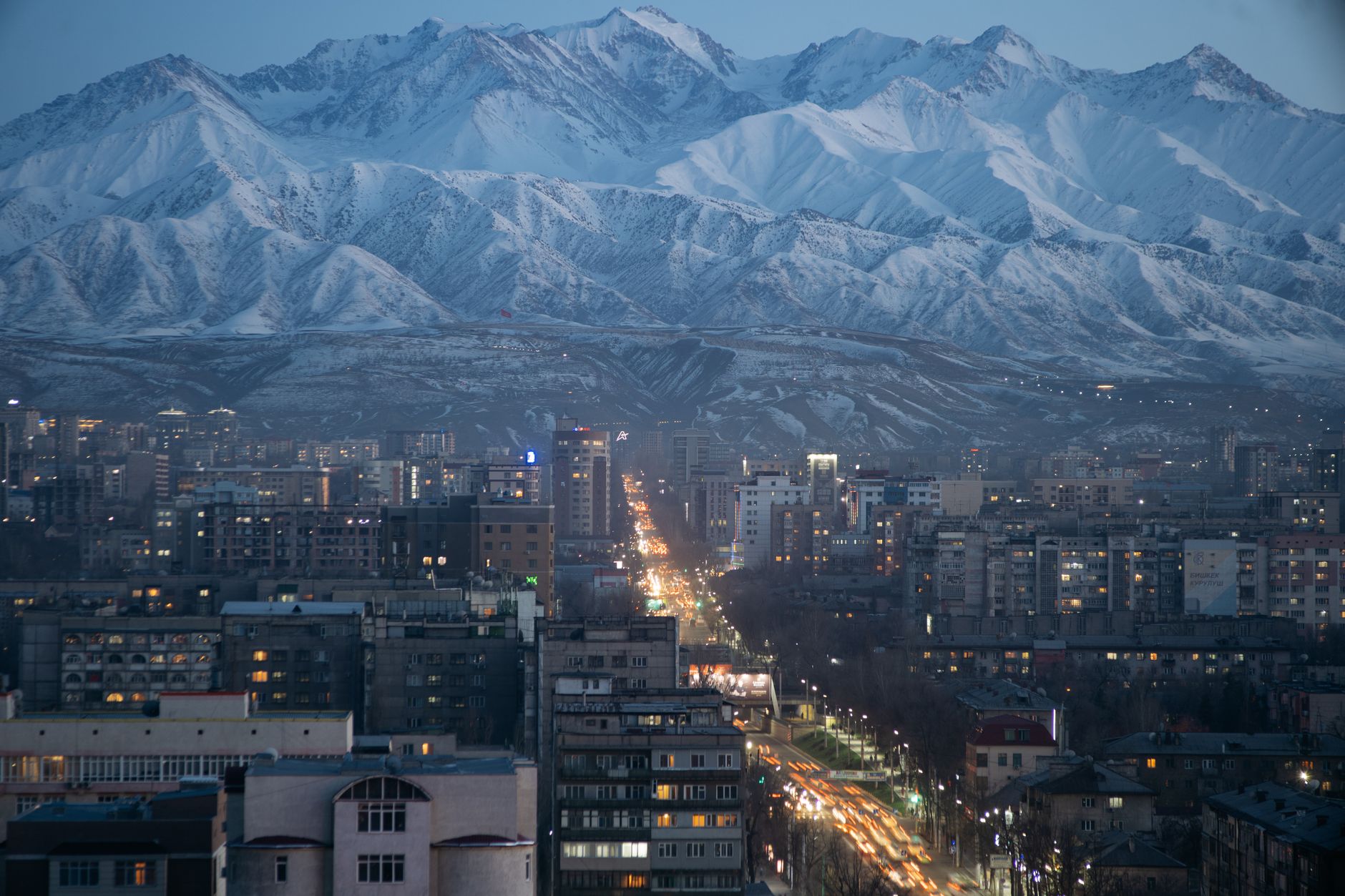
A breathtaking view of Bishkek with snow-capped mountains at twilight, showcasing its urban skyline and natural beauty.
Photo by Arseniy Kotov on Pexels · Pexels License
Baku's skyline with modern architecture reflected on the Caspian Sea under a tranquil sky.
Photo by Zulfugar Karimov on Pexels · Pexels License
Practical Information
Visa
Tajikistan now gives many passport holders 30 days visa-free, including U.S., Canadian, Australian, and most EU nationals. British citizens still need a visa, and anyone going longer than 30 days should use the eVisa system; for the Pamirs around Khorog, Murghab, Karakul, Vrang, and the Wakhan Corridor, add the GBAO permit.
Currency
The local currency is the Tajikistani somoni, written TJS or SM, and cash still runs most daily transactions outside central Dushanbe and Khujand. Use a planning rate of about TJS 9.6 to USD 1, carry clean backup dollars or euros, and do not expect mountain guesthouses to take cards.
Getting There
Most travelers arrive through Dushanbe International Airport, with smaller international links at Khujand, Kulob, and Bokhtar. The easiest flight connections usually run through Istanbul, Dubai, Tashkent, Almaty, Astana, Delhi, or Tehran, depending on your passport and tolerance for awkward routings.
Getting Around
Tajikistan works on roads, not rail. Shared taxis, marshrutkas, and hired drivers connect Dushanbe, Khujand, Penjikent, Istaravshan, Hissor, and Iskanderkul; for Khorog, Murghab, Karakul, and the Wakhan Corridor, travel is slower, weather-sensitive, and often shaped by road conditions more than by distance.
Climate
Altitude decides everything here. Dushanbe can push past 35C in summer while the Pamirs around Murghab and Karakul can freeze at night even in July; late June to early September is the safest window for high routes, while April to June and September to October suit lower valleys and city travel.
Connectivity
Mobile coverage is decent in Dushanbe, Khujand, and larger valley towns, then thins sharply in the Pamirs and can disappear altogether on long stretches between Khorog, Murghab, and Karakul. Buy a local SIM in a city, download maps before leaving, and assume guesthouse Wi-Fi is for messages rather than work calls.
Safety
Tajikistan is generally manageable for independent travelers, but the real risks are road accidents, landslides, altitude, and sudden changes in border-zone rules. Keep your passport and permit copies handy, check local advice before any trip toward Afghanistan or the eastern Pamirs, and do not plan mountain transfers without time buffer.
Taste the Country
restaurantQurutob
Hands tear fatir. Sour qurut melts. Onions, herbs, tomato follow. Shared platter. Midday. Family or guests.
restaurantOshi palav
Rice steams in a kazan. Carrots, lamb, chickpeas, quince join. Spoon work. Weddings, Fridays, large tables, male pride.
restaurantFatir-maska
Layered bread arrives hot. Butter softens. Tea follows. Breakfast, guest welcome, slow morning talk.
restaurantShurbo
Broth first. Meat and potatoes next. Bread dips. Evening meal. Home, chaikhana, cold weather.
restaurantMantu
Steam burns careless mouths. Dumplings open with sour cream or yogurt. One by one. Family table, market lunch, winter.
restaurantSumanak
Women stir sprouted wheat through the night. Songs continue. Small bowls at Navruz. Ritual before dessert.
restaurantKabob
Skewers hit coals. Onion rings, vinegar, non wait nearby. Fingers or fork. Roadside stop, city grill, late lunch.
Tips for Visitors
Carry small cash
ATMs are reliable enough in Dushanbe and decent in Khujand, then sharply less so once you leave the main urban corridor. Break large notes early and keep enough cash for at least two days of transport and meals.
Skip trains
Rail exists, but it is rarely the smartest use of limited travel time in Tajikistan. Shared taxis and private drivers are what most travelers actually use between Dushanbe, Khujand, Penjikent, and mountain departures.
Book Pamirs early
In Khorog, Murghab, and the Wakhan Corridor, the issue is not luxury but bed count. Reserve homestays and drivers ahead for July to September, especially if you need a GBAO route that does not leave room for improvisation.
Respect altitude
Murghab and Karakul sit high enough to punish rushed itineraries. Sleep lower when you can, hydrate hard, and do not treat a headache at 3,600 to 4,000 meters as a minor inconvenience.
Bread etiquette
Bread matters here. Do not place non upside down, do not waste it casually, and expect tea to arrive before anyone asks what you want; that is hospitality, not upselling.
Start early
Mountain drives are slower than the map suggests because of roadworks, washouts, animals on the road, and long photo stops you did not plan. Leaving at dawn often saves both time and stress.
Download offline maps
Phone signal fades fast outside major towns, and guesthouse Wi-Fi in remote areas is rarely strong enough for navigation backups. Download maps, translation files, and permit scans before leaving Dushanbe or Khujand.
Explore Tajikistan with a personal guide in your pocket
Your Personal Curator, in Your Pocket.
Audio guides for 1,100+ cities across 96 countries. History, stories, and local insight โ offline ready.
Audiala App
Available on iOS & Android
Join 50k+ Curators
Frequently Asked
Do I need a visa for Tajikistan in 2026? add
Maybe, depending on your passport. U.S., Canadian, Australian, and most EU travelers can enter visa-free for up to 30 days, while British citizens still need a visa; for longer stays, use the eVisa system, and for Khorog, Murghab, Karakul, Vrang, or the Wakhan Corridor, add the GBAO permit.
Is Tajikistan expensive for travelers? add
No, not by regional or global standards. A careful traveler can manage on roughly 220 to 350 TJS a day in cities and lower valleys, but private transport in the Pamirs pushes budgets up fast because distances are long and vehicles are scarce.
What is the best month to visit Tajikistan? add
September is the safest all-round answer. Roads are usually open, the Pamirs are still reachable, harvest season improves markets and village meals, and you avoid the heaviest July-August traffic on the Pamir Highway.
Can you travel the Pamir Highway without a tour? add
Yes, but most independent travelers still hire a driver or share a vehicle. The route from Dushanbe to Khorog, Murghab, and Karakul is less about navigation than about permits, fuel planning, weather, road damage, and knowing when a pass is a bad idea.
How many days do you need in Tajikistan? add
Seven days is enough for one region, not the whole country. If you want Dushanbe plus the north around Khujand and Penjikent, a week works; if you want the Pamirs, give yourself at least ten days and preferably two weeks.
Is Tajikistan safe for solo travelers? add
Usually yes, if you treat it as a logistics-heavy mountain country rather than an easy city break. The main hazards are transport, altitude, landslides, and abrupt route changes near border zones, not petty crime.
Can I use credit cards in Tajikistan? add
Only sometimes. Better hotels, a few supermarkets, and newer cafes in Dushanbe or Khujand may take cards, but smaller towns and almost all mountain routes still work on cash.
What is the easiest route for a first trip to Tajikistan? add
Base yourself in Dushanbe and add Hissor and Iskanderkul. That gives you the capital, one of the country's most accessible historical sites, and a mountain landscape you can reach without committing to a full Pamir expedition.
Sources
- verified Ministry of Foreign Affairs of the Republic of Tajikistan โ Official visa policy, entry rules, and consular guidance, including recent visa-free changes and permit context.
- verified U.S. Department of State: Tajikistan International Travel Information โ Entry requirements, eVisa and registration details, security guidance, and permit notes for GBAO.
- verified GOV.UK Foreign Travel Advice: Tajikistan โ Current British entry rules, passport validity requirements, and practical safety advice.
- verified Somon Air โ Useful for checking current domestic and regional flight patterns, especially Dushanbe to Khujand and international access.
- verified UNESCO World Heritage Centre: Tajik National Park โ Authoritative background on the Pamir highlands, geography, and why the eastern plateau matters beyond road-trip mythology.
Last reviewed: