Temple of the Five Concubines
West Central DistrictTaiwan 22° N · 120° E Updated Aug 2026
Five concubines chose death rather than outlive the Ming dynasty; their quiet tomb-temple on Tainan’s Guikui Hill is now a leafy urban refuge in central Tainan.
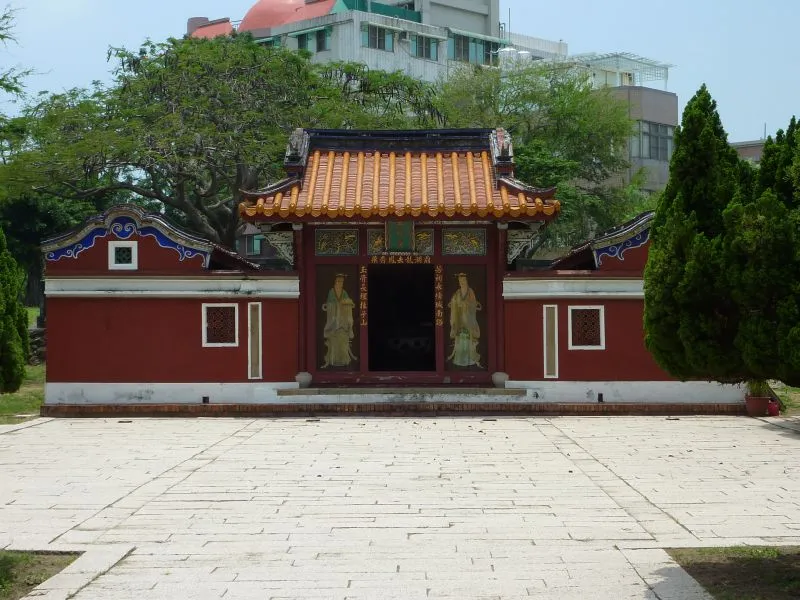 Photo: User: (WT-shared) Naplee12 at wts wikivoyage · CC BY-SA 3.0
- Entry
- Free
A royal tomb that doubles as a temple sits across from a baseball stadium in Tainan. The Temple of the Five Concubines in West Central District, Tainan, Taiwan, rewards visitors with a rare tomb-shrine design, painted court attendants instead of warrior guardians, and a story of loyalty that ends with five women choosing death. Look behind the altar and the past stops behaving like a museum display: the tomb is the temple.
Come early, when incense smoke hangs lightly beneath the eaves and footsteps sound louder than expected. The entrance doors show eunuchs with boxes and whisks, while court maidens carry lotus blossoms and tea sets—an unusually restrained welcome for a Taiwanese temple.
Scholars describe the complex as a tomb-shrine integration, or mu-miao he-yi. Behind the altar statues, the burial mound presses against the rear wall, joining the dead women’s graves to the place where visitors pray.
Records show that this quiet hill marks the final chapter of the Kingdom of Tungning, the Southern Ming regime founded by Koxinga. The temple asks a sharp question without spelling it out: when a dynasty disappears, what survives—its throne, its rituals, or the people who refuse to abandon it?
What to see
-
The Front Pavilion and Its Courtly Door Gods
The first surprise is how modest the entrance feels: a low crimson facade, saddle-shaped roof, and four painted doors beneath banyan shade, more intimate than imperial. Look closely at the door guardians—beardless palace eunuchs and handmaids carry lanterns, fruit bowls, scrolls, and ritual objects instead of weapons, a quiet clue that this shrine commemorates a household caught in political collapse. Inside, incense softens the light and footsteps lose their sharpness. -
The Tomb Behind the Altar
Walk through the central hall and the temple’s real revelation appears: the 1746 stele naming the tomb of Prince Zhu’s five concubines stands directly before their grass-covered burial mound, the shrine and grave joined as one structure. In 1683, Ladies Yuan and Wang, Xiugu, Meijie, and Hejie chose death after the Tungning Kingdom fell at Penghu; the raised earth behind the altar makes that decision feel startlingly close, not safely historical. To the right, seek the smaller Yi Ling Jun shrine for Yi Ting and Shen Jing, the two attendants who buried them before taking their own lives. -
A Quiet Circuit Beneath the Banyans
Give the compound ten unhurried minutes: enter from Wufei Street, circle the red walls beneath cassia and banyan trees, pause at the auxiliary shrine, then return to the main hall as cicadas and distant baseball cheers replace the city’s harder edges. The scent shifts between sandalwood, damp stone, and crushed grass, while afternoon light turns the ochre brick warm against the deep green lawn. Cross the road afterward for Tainan-style douhua; the sweet, silky bean curd is a useful reminder that grief and ordinary life have always shared the same street.
Plan your visit
- Getting There
- The temple is at No. 201, Wufei Street. From Tainan TRA Station, take Bus 0's Left or Right Loop to Wufei Temple (Tainan Municipal Baseball Stadium); from the Confucius Temple, walk south along Nanmen Road for about 1 km, or 12–15 minutes, then turn left onto Wufei Street. Cars can use metered street parking on Wufei, Qingzhong, or Jiankang roads, with paid lots near the baseball stadium; NUTN is a 3–5 minute walk away.
- Opening Hours
- As of 2026, the temple is generally open daily from 08:00 to 17:00, year-round, including national holidays; some municipal listings give gate access as 08:30–17:30. The surrounding park remains accessible in daytime, though conservation work can cause occasional partial closures.
- Time Needed
- Allow 15–20 minutes for the gate, memorial steles, front shrine, burial mound viewed from outside, and the small auxiliary shrine. Give it 30–45 minutes to study the painted door gods, the tomb steles set into the rear wall, and the Yi Ling Jun Tomb beneath the banyan shade.
- Accessibility
- Paved paths through the park and outer courtyard are flat and generally wheelchair- and stroller-friendly, despite the temple's position on a gently raised historic knoll. The single-storey shrine has no elevator, and its 10–20 cm stone thresholds and small steps may require assistance.
- Cost and Tickets
- As of 2026, admission is free for all visitors, with no reservation, ticket, or skip-the-line system. Keep anyone offering an admission charge at arm's length: the gates are open-access, not a toll bridge.
Photo Gallery


History
The Last Household of the Southern Ming
Records show that Prince Zhu Shugui arrived in Taiwan in 1664, carrying the Ming imperial bloodline into the Kingdom of Tungning. His residence stood inside Tainan, while Guanhuai Hill—then a bleak knoll beyond the southern city wall—served as the burial ground for the household’s final act.
By 1683, Qing forces under Admiral Shi Lang had defeated Tungning’s fleet at Penghu. According to the historical accounts, the defeat left Zhu, his five concubines, and two attendants facing a choice between submission and death; the temple now preserves the physical trace of that decision.
The turning point
When Zhu Shugui Chose the Rope
Zhu Shugui, the Prince of Ningjing, lived from 1617 to 1683 and descended from the Ming founder Zhu Yuanzhang. For him, capture meant more than personal danger: it threatened dynastic legitimacy, royal honor, and the last visible claim of Ming continuity in Taiwan. According to surviving accounts, he advised his household to save themselves rather than follow him.
The five women refused. Records name them as Lady Yuan, Lady Wang, Xiugu, Meijie, and Hejie. They hanged themselves inside the prince’s palace residence, several kilometers from this hill, after the fall of Tungning became unavoidable; that residence later became Tainan’s Grand Matsu Temple. Their decision marked the turning point from a threatened royal household to a household already choosing its memorial.
Records show that Zhu buried the women with full honors at Guanhuai Hill, then returned to his residence and hanged himself in ceremonial Ming robes. Accounts also describe a death poem written on the wall and land titles handed to local tenants before his death. Two attendants, Yi Ting and Shen Jing, later completed the burial work and died nearby, a loyalty commemorated by the small Righteous Spirit Shrine.
From Burial Mound to Official Shrine
A Temple That Keeps Its Household Details
Tips for visitors
Respect The Memorial
Casual clothing is fine, but cover the torso and avoid swimwear; speak softly inside the shrine. Step over, never onto, the raised doorway sill, enter through the right-hand Dragon-side door when both are open, and do not climb the burial mound.Photograph Quietly
Photography is allowed in the grounds, courtyard, and shrine, while flash is discouraged around the painted woodwork and door-god murals. Tripods are acceptable on garden paths, but do not block the narrow entrance or worshippers; urban drone flights require the relevant Taiwan CAA permissions.Eat Across The Street
As of 2026, Huaijiu Xiaozhan at No. 206, Wufei Street serves almond-tofu shaved ice for about NT$50–90, practically opposite the gate. For a savory budget meal, try Qingzhong Street pig-blood soup at roughly NT$50–120; Kadoya Japanese Pastry Cafe is the retro mid-range choice, about NT$180–350, an 8–10 minute walk away.Go Before Noon
Early morning brings cooler air, softer light on the red timber, and quieter banyan-shaded paths before student traffic gathers. Summer afternoons can bring mosquitoes around the grass and shade, so insect repellent earns its place in your bag.Build A History Walk
Pair the temple with Great South Gate and Nanmen Park, about 5–8 minutes northwest, then continue to the Confucius Temple and Fuzhong Street in 10–12 minutes. Tainan Art Museum Buildings 1 and 2 are another 12–15 minutes north, turning the visit into a walk through the city's Ming-Qing story.Plan For Luggage
The temple has no baggage lockers; use the coin lockers at Tainan TRA Station, roughly 1.8 km away, before coming south. The neighborhood is well lit and low-crime, but keep bags close on the student food streets, where crowds—not ghosts—are the more practical nuisance.
Frequently asked
Is the Temple of the Five Concubines worth visiting?
Yes—the Temple of the Five Concubines is worth visiting for its rare fusion of shrine and burial mound, and for the human drama of five women who died with Prince Zhu Shugui in 1683. The complex is small rather than grand, but beneath the banyans you get incense, cicadas, red brick, and a remarkably intimate final chapter of Taiwan's Tungning kingdom.
How long do you need at the Temple of the Five Concubines?
Allow 30–45 minutes for a proper visit, roughly the length of a coffee and a slow circuit of the grounds. A quick look takes 15–20 minutes, while extra time lets you study the eunuch and court-maiden door paintings, the tomb stele behind the altar, and the small Yi Ling Jun Shrine for the two loyal attendants.
How do I get to the Temple of the Five Concubines from Tainan?
From Tainan Railway Station, take city bus 0 to the Wufei Temple stop, also signed as Tainan Municipal Baseball Stadium. You can also walk south from the Confucius Temple along Nanmen Road for about 1 kilometre, then turn onto Wufei Street; the temple stands at No. 201, opposite the baseball stadium.
What is the best time to visit the Temple of the Five Concubines?
Visit between October and February for milder, drier weather and warm afternoon light on the red walls. Early morning is quieter year-round, while summer brings heavy humidity, cicadas, and welcome shade beneath the banyan trees; opening hours generally begin around 08:00–08:30 and end around 17:00–17:30.
Can you visit the Temple of the Five Concubines for free?
Yes, admission to the Temple of the Five Concubines is free, and no reservation is required. The temple generally opens daily during daylight hours, with paved park paths, shaded benches, and public restrooms nearby; step over the raised threshold and keep off the grass-covered burial mound.
What should I not miss at the Temple of the Five Concubines?
Don't miss the four door panels painted with palace eunuchs and handmaidens instead of the usual armed warrior guardians. Look behind the altar for the 1746 tomb inscription and the mound it names, then find the modest Yi Ling Jun Shrine to the side—the quiet memorial to Yi Ting and Shen Jing, the prince's two faithful attendants.
Sources & attribution 30
- Tainan Travel — Religion — Official Tainan tourism information used for the temple's history, restoration dates, and religious context.
- GoTeamJosh — Tainan Historical Temples — Historical account of Prince Zhu Shugui, the 1683 collapse of Tungning, the five concubines, and the former palace that became Grand Matsu Temple.
- Stanford University — Tainan, Taiwan — Background source used for the prince's arrival in Taiwan and Tainan historical sites.
- Wikipedia — Temple of the Five Concubines — Reference source used for the temple's history, the five women, and the 1683 events.
- Tainan City Cultural Affairs Bureau — Historic Sites Portal — Municipal heritage information used for the site's history, Qing-era recognition, and restoration record.
- Tripadvisor — Wufei Temple — Visitor information and observations used for atmosphere, access, and current visitor experience.
- Taiwan Religious Culture Map — Ministry of the Interior — Religious heritage reference used for the 1746 shrine establishment and later renovation history.
- Chinese Wikipedia — 五妃廟 — Chinese-language reference used for additional historical and architectural details.
- GoTeamJosh — Prefectural City God Temple Tag — Background source used for Tainan's Tungning-era historical setting.
- Tainan West Central District Office — District government information used for the temple's historical chronology and local setting.
- Tainan City Guide — Wufei Temple — Detailed visitor guide used for architecture, tomb-shrine layout, atmosphere, nearby food, and restoration notes.
- Tainan Travel — Temple of the Five Concubines — Official attraction listing used for location, historical summary, opening information, and free admission.
- GoTeamJosh — Tainan City God Temple Tag — Historical background source used for Prince Zhu Shugui's residence and Tainan's late Tungning history.
- Trip.com — Wufei Temple Guide — Community travel guide used for visitor-oriented information and a reported heritage designation.
- Tainan Film Studio — Wufei Temple — Municipal cultural source used for the temple's roof forms, worship pavilion, tomb stele, and restoration history.
- Tainan City Cultural Affairs Bureau — Wufei Temple — English municipal heritage entry used for the Five Concubines, the Yi Ling Jun Shrine, and visitor information.
- Taiwan Panorama — The High Point of Chinese Architecture — Architecture reference used for Southern Min roof forms and traditional Taiwanese building design.
- Taiwanese Gods Heritage — Temple Architecture — Cultural architecture source used for the temple's distinctive court-attendant door paintings.
- Academia.edu — How Should We Understand Creativity in History — Historical and cultural reference used for the temple's memorial naming and the wider Southern Ming story.
- WacowTainan — Local Store Information — Local guide source used for Wufei Street references and the tofu dessert shop opposite the temple.
- Tainan Travel — 五妃廟 — Official Chinese-language tourism entry used for the temple's historical location and tomb-shrine form.
- Vocus — Wufei Temple Local Discussion — Local cultural commentary used for the debate over the temple's classification as a yin shrine and its status as a righteous memorial.
- FTV News — Wufei Temple Report — News discussion used for local debate around the temple's tomb-shrine identity.
- Threads — Wufei Temple Discussion — Social discussion used as local commentary on ritual status and the temple's identity.
- YouTube — Tainan Local Area Video — Local video source used for neighborhood atmosphere and nearby food references.
- Nick Kembel — Things to Do in Tainan — Tainan travel guide used for nearby attractions and walking connections.
- HuannnTravel — Tofu Ice — Food guide used for the almond tofu shaved ice shop opposite the temple.
- Curly.com.tw — Almond Tofu Ice — Local food reference used for the dessert specialty associated with Wufei Street.
- IFEEC — Travel in Tainan PDF — Tainan heritage travel document used for the Southern Ming context and temple history.
- TonyHuang39 — Wufei Temple — Local historical guide used for the temple grounds, Qing-era development, and memorial context.
Built from cited sources · see the method · How we make our guides →
Pick up where you left off
Saved and recently read places — kept on this device only.
Photo credits (12)
- Wufei — User: (WT-shared) Naplee12 at wts wikivoyage — CC BY-SA 3.0 (https://creativecommons.org/licenses/by-sa/3.0/) — Source: https://commons.wikimedia.org/wiki/File:Wufei.jpg
- 2008-02-18 Temple of the Five Concubines — Pascal Terjan — CC BY-SA 2.0 (https://creativecommons.org/licenses/by-sa/2.0/) — Source: https://commons.wikimedia.org/wiki/File:2008-02-18_Temple_of_the_Five_Concubines.jpg
- DSC05022-五妃廟-台南 — 黃庭富 — CC BY-SA 4.0 (https://creativecommons.org/licenses/by-sa/4.0/) — Source: https://commons.wikimedia.org/wiki/File:DSC05022-五妃廟-台南.jpg
- Drawing of an eunuch at Temple of the Five Concubines 20100219 01 — eazytraveler — CC BY 2.0 (https://creativecommons.org/licenses/by/2.0/) — Source: https://commons.wikimedia.org/wiki/File:Drawing_of_an_eunuch_at_Temple_of_the_Five_Concubines_20100219_01.jpg
- 2008-02-18 Temple of the Five Concubines, Tainan — Pascal Terjan — CC BY-SA 2.0 (https://creativecommons.org/licenses/by-sa/2.0/) — Source: https://commons.wikimedia.org/wiki/File:2008-02-18_Temple_of_the_Five_Concubines,_Tainan.jpg
- 2010-02-19 Wufei Temple (Temple of Five Concubines) — eazytraveler — CC BY 2.0 (https://creativecommons.org/licenses/by/2.0/) — Source: https://commons.wikimedia.org/wiki/File:2010-02-19_Wufei_Temple_(Temple_of_Five_Concubines).jpg
- Drawing of a court lady at Temple of the Five Concubines 20100219 — eazytraveler — CC BY 2.0 (https://creativecommons.org/licenses/by/2.0/) — Source: https://commons.wikimedia.org/wiki/File:Drawing_of_a_court_lady_at_Temple_of_the_Five_Concubines_20100219.jpg
- Fire hydrant in Temple of the Five Concubines 2012-12-02 — Honmingjun — CC BY-SA 3.0 (https://creativecommons.org/licenses/by-sa/3.0/) — Source: https://commons.wikimedia.org/wiki/File:Fire_hydrant_in_Temple_of_the_Five_Concubines_2012-12-02.jpg
- Drawing of an eunuch at Temple of the Five Concubines 20100219 02 — eazytraveler — CC BY 2.0 (https://creativecommons.org/licenses/by/2.0/) — Source: https://commons.wikimedia.org/wiki/File:Drawing_of_an_eunuch_at_Temple_of_the_Five_Concubines_20100219_02.jpg
- Tainan Wu-fei (Five Princess) Temple (id DA09602001446) by BillyF — Billy W.F. — CC BY-SA 3.0 (https://creativecommons.org/licenses/by-sa/3.0/) — Source: https://commons.wikimedia.org/wiki/File:Tainan_Wu-fei_(Five_Princess)_Temple_(id_DA09602001446)_by_BillyF.jpg
- Statue of a concubine at Temple of the Five Concubines 20100219 — eazytraveler — CC BY 2.0 (https://creativecommons.org/licenses/by/2.0/) — Source: https://commons.wikimedia.org/wiki/File:Statue_of_a_concubine_at_Temple_of_the_Five_Concubines_20100219.jpg
- Tainan Wu-fei (Five Princess) Temple tomb (id DA09602001446) by BillyF — Billy W.F. — CC BY-SA 3.0 (https://creativecommons.org/licenses/by-sa/3.0/) — Source: https://commons.wikimedia.org/wiki/File:Tainan_Wu-fei_(Five_Princess)_Temple_tomb_(id_DA09602001446)_by_BillyF.jpg
Photos may have been resized or cropped.