Plan and listen to Remains Of Taipei Prison Wall with Audiala.
Audio guide in your pocket, itinerary in your browser. Built for the way you actually visit.
Introduction
The Remains of Taipei Prison Wall stand as a powerful testament to Taiwan’s layered history—spanning Japanese colonial rule, the White Terror, and the island’s path to democracy. Situated in Taipei’s Zhongzheng District, this preserved monument offers a rare window into the evolution of Taiwan’s penal system, the legacy of political repression, and the city’s architectural transformation. This guide provides detailed information on the prison wall’s historical background, architectural features, visiting hours and tickets, accessibility, travel tips, and nearby attractions to help you plan an enriching visit.

Historical Background
Origins and Construction
Originally built in 1896 and expanded in 1904, Taihoku (Taipei) Prison was one of the first major penitentiaries constructed by the Japanese colonial government after Taiwan’s cession from the Qing Dynasty (Taipei Times; Wikipedia). The prison’s location in the administrative heart of Taipei and its modern design reflected the Japanese commitment to control and modernization. Stones from the old Qing-era Taipei City Wall, quarried locally, were repurposed for the construction, symbolizing the island’s transfer of power (Wikipedia).
Japanese Colonial Period (1895–1945)
Under Japanese rule, the prison became synonymous with repression, used to detain both common criminals and political dissidents. Its imposing red brick walls—built using contemporary Japanese and Western techniques—were designed both for security and to project authority (Trip.com; Wanderlog). Notable figures, from anti-colonial activists to legendary folk heroes like Liao Tien-ting, were held and executed here, highlighting the prison’s grim reputation (Taipei Times).
World War II and Allied Prisoners
During World War II, the prison held Allied POWs. On June 19, 1945, 14 American airmen were executed following a mock trial—an event now commemorated by a plaque at the site (Wikipedia; Taipei Times).
Postwar & White Terror Era
After 1945, Taiwan was governed by the Republic of China, which continued to use the prison for detaining and executing political prisoners, especially during the White Terror (1947–1987). The prison thus became a symbol of both colonial and authoritarian oppression (Spectral Codex).
Demolition and Preservation
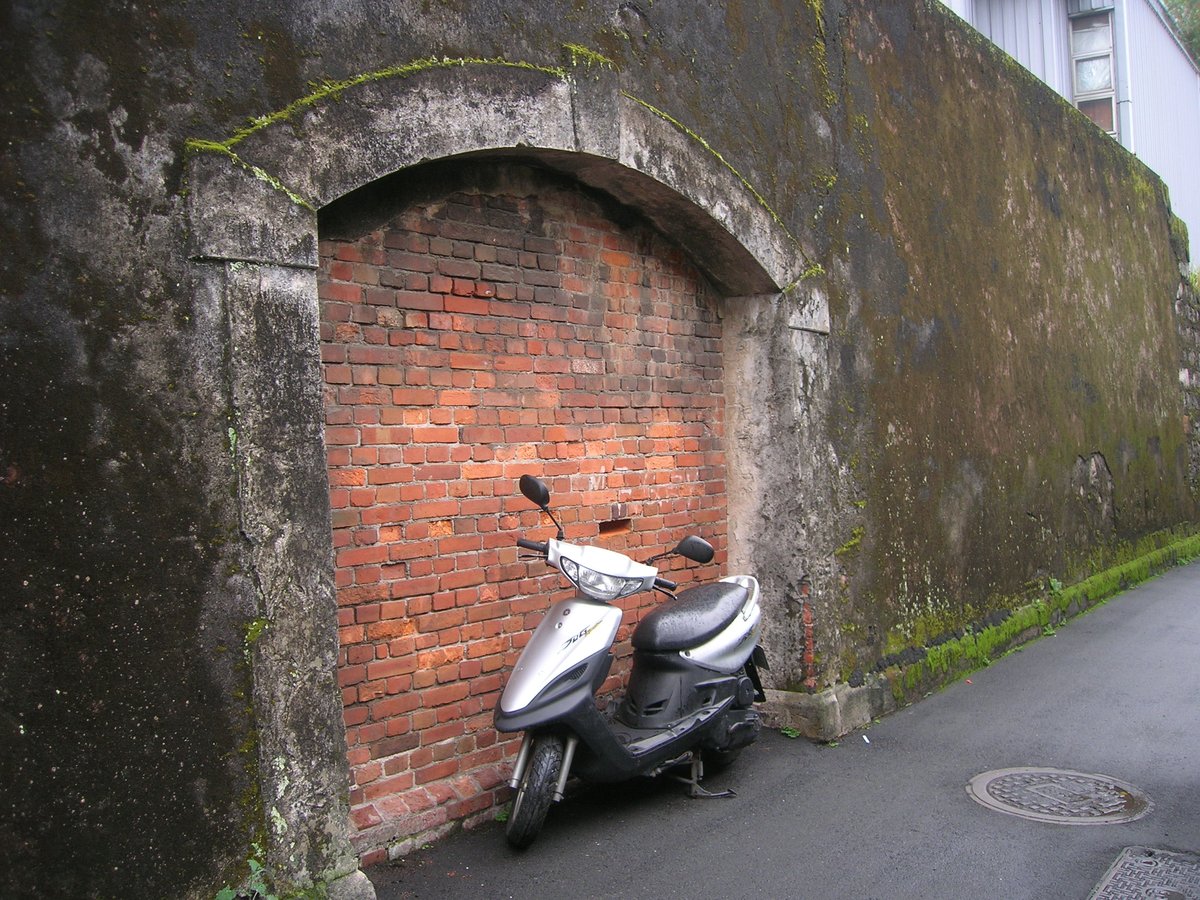
Most of the prison was demolished in the 1960s as Taipei modernized. However, thanks to local historians and civic groups, a section of the original wall—about 100 meters long and 5 meters high—was preserved and later designated a historic site in 1998 (Taipei City Government; Taiwan Cultural Memory Bank). The “corpse door” (Yùnshī Gate), through which executed prisoners’ bodies were removed, remains a poignant feature (Spectral Codex).
Architectural Features & Symbolism
The Remains of Taipei Prison Wall are constructed primarily of red brick in a Flemish bond pattern, with a sturdy stone foundation to withstand seismic activity (Taiwan Cultural Memory Bank). Decorative touches include recessed brick panels, stone plaques with Japanese inscriptions, and remnants of iron spikes and barbed wire, all underscoring the wall’s dual function as both fortress and symbol of authority (Taipei City Archives). The reuse of Qing-era stones further signifies historical continuity and change.
Nighttime illumination and interpretive panels enhance the visitor experience, while the wall’s weathered surface, marked by scars of conflict, conveys the site’s somber history.
Visiting Information
Location
- Address: Intersection of Aiguo East Road and Jinshan South Road, Zhongzheng District, Taipei
- Nearby MRT: Chiang Kai-shek Memorial Hall Station, Ximen Station, Dongmen Station (Taipei Metro Map)
Visiting Hours & Ticketing
- Hours: Open daily from 9:00 AM to 5:00 PM
- Admission: Free; no tickets required (Taipei Travel Net)
Accessibility
- Barrier-free paths suitable for wheelchairs and strollers
- Flat sidewalks, though some narrow spots near the wall
Guided Tours & Special Events
- Occasional guided tours are offered by local heritage groups—check the Taipei City Government or Taipei Travel Net for updates.
- Special events commemorating the White Terror or World War II are sometimes held at the site.
Photography Tips
- Best lighting is during early morning or late afternoon.
- Respect the solemnity of the site; do not climb or deface the wall.
Nearby Attractions
- Chiang Kai-shek Memorial Hall: Major cultural landmark within walking distance
- 228 Peace Memorial Park: Dedicated to victims of the February 28 Incident
- National Taiwan Museum: Offers broader context on Taiwan’s history
- Yongkang Street: Renowned for local cuisine and cafes
Frequently Asked Questions (FAQ)
Q: What are the visiting hours for the Remains of Taipei Prison Wall?
A: Open daily from 9:00 AM to 5:00 PM.
Q: Is there an admission fee or need for tickets?
A: No, admission is free and tickets are not required.
Q: Is the site wheelchair accessible?
A: Yes, there are barrier-free paths, though some sections may be narrow.
Q: How do I get there by public transport?
A: Take the MRT to Chiang Kai-shek Memorial Hall, Ximen, or Dongmen stations. The site is a short walk from any of these (Taipei Metro Map).
Q: Are guided tours available?
A: Occasionally, through local heritage or human rights groups. Check official sites for schedules.
Q: Can I take photos at the site?
A: Yes, photography is encouraged, but please respect the site’s historical significance.
Summary & Recommendations
The Remains of Taipei Prison Wall encapsulate Taiwan’s tumultuous journey through colonial rule, authoritarianism, and democratization. This well-preserved site is both a powerful memorial and an educational resource—particularly for those interested in architecture, political history, and human rights (Taipei City Government; Taipei Times; Spectral Codex).
Visitor Recommendations:
- Allocate at least 30–45 minutes to explore the wall and read the interpretive signage.
- Pair your visit with nearby historical sites for a comprehensive understanding of Taipei’s past.
- For deeper engagement, use the Audiala app for audio tours and updates about events and commemorations.
Listen to the full story in the app
The whole Remains Of Taipei Prison Wall,
told well.
Audio guides for 1,100+ cities across 96 countries. History, stories, and local insight — offline ready.
Verified, and shown.
Researched and written by the Audiala editorial team from historical records, architectural archives, and local expertise.
Researched from Wikidata, Wikipedia & official sources · fact-checked · How we make our guides →